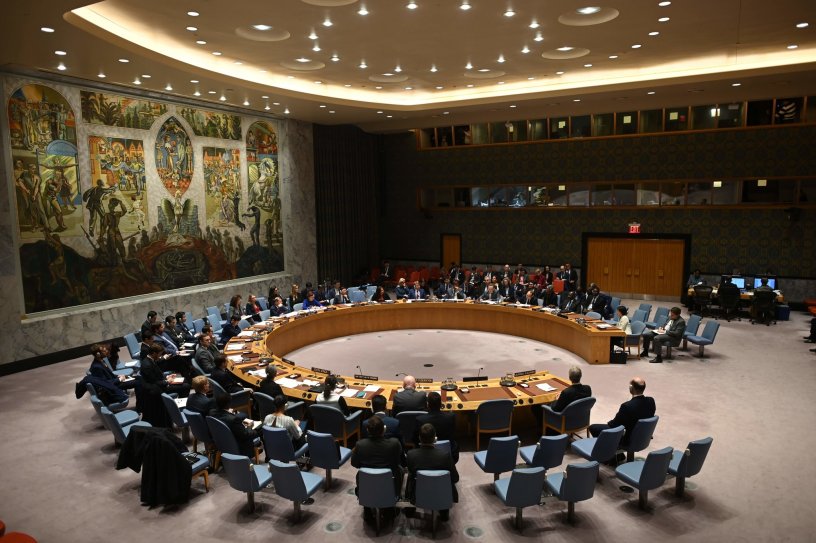
This morning (5 January), the Security Council will hold an open briefing under the “Threats to international peace and security” agenda item.
Source: What’s In The Blue
Venezuela: Emergency Meeting
This morning (5 January), the Security Council will hold an open briefing under the “Threats to international peace and security” agenda item. Council member Colombia requested the emergency meeting following the US’ 3 January military operation in Venezuela, during which it removed Venezuelan President Nicolás Maduro Moros and his wife, Cilia Flores, from the country. Venezuela also sent a letter on 3 January requesting an emergency Council meeting (S/2026/5), and China and Russia supported the meeting request. Under-Secretary-General for Political and Peacebuilding Affairs Rosemary DiCarlo is expected to brief. Two civil society representatives—one requested by the US and another by China and Russia—are also expected to brief the Council. Venezuela and several countries from the region—including Argentina, Brazil, Cuba, and Mexico—are expected to participate in the meeting under rule 37 of the Council’s provisional rules of procedure.
The US launched the military operation in which Maduro and Flores were captured early on 3 January by carrying out large-scale strikes in Caracas, the capital of Venezuela. The deposed leader and his wife were transported to New York City, where the US charged them with several counts, including narco-terrorism, conspiracy to import cocaine, and possession of machine guns. Maduro’s vice president, Delcy Rodríguez, was reportedly subsequently sworn in as Venezuela’s interim president.
US officials said that the operation involved more than 150 US aircraft that were dispatched to disable Venezuelan air defences, allowing the entry of US Special Operations forces, who carried out the raid on Maduro’s compound. They added that no American troops were killed in the operation. According to Venezuelan officials, preliminary assessments indicate that at least 80 people were killed in the US attack, including civilians and members of security forces.
The 3 January military operation followed several months during which the US increased its military presence near Venezuela in the southern Caribbean, citing the need to curtail the flow of drugs into its territory. Since September 2025, the US has been carrying out attacks against boats in the Caribbean Sea and eastern Pacific Ocean that Washington alleged were smuggling drugs, which reportedly resulted in the deaths of at least 104 people. In mid-December 2025, US President Donald Trump ordered a “total and complete blockade” of all oil tankers sanctioned by the US going into and out of Venezuela. Since then, the US Coast Guard has been intercepting vessels allegedly carrying sanctioned Venezuelan oil. At Venezuela’s request, the Security Council held two meetings to discuss the escalation around the country, on 10 October and 23 December 2025. (For more information, see our 23 December 2025 What’s in Blue story.)
In a press conference held shortly after the 3 January operation, Trump said that the US will “run” Venezuela until such time that a “safe, proper, and judicious transition” could take place, without providing an estimate on the length of time that this process would take. He emphasised that the US does not recognise Maduro as the winner of the 28 July 2024 presidential election held in the country and reiterated allegations that the deposed leader headed a cartel that brought drugs into the US.
Trump also repeated accusations that Venezuela “unilaterally seized and sold American oil, assets, and platforms”—an apparent reference to the process that began in 1976, in which the Venezuelan government nationalised hundreds of private businesses and foreign-owned assets related to the petroleum industry. He said that American companies will go into Venezuela, fix the oil infrastructure in the country, and use the profits to benefit the Venezuelan people and to reimburse the US for its losses. Although US forces are not currently deployed in Venezuela, Trump asserted that he is not afraid of “putting boots on the ground”, while warning that political and military figures in the country could suffer the same fate as Maduro “if they are not just and fair to their people”.
In its 3 January letter requesting today’s meeting, Venezuela accused the US of carrying out a series of “brutal, unjustified, and unilateral armed attacks” against civilian and military sites in the country. It added that the US’ actions violate Article 2(4) of the UN Charter, which prohibits the threat or use of force against the territorial integrity or political independence of any state, and said that it reserves the right for self-defence under Article 51 of the UN Charter in order to “protect its population, its sovereignty, and its territorial integrity”. Venezuela further called on the Council to condemn the US’ aggression against the country and to hold it accountable for such acts.
The US operation has plunged Venezuela into uncertainty, leaving open questions about who will rule the country and raising concerns about the potential for increased insecurity and the worsening of the already dire humanitarian situation in the country.
A number of analysts and media outlets have denounced the US’ actions in Venezuela as illegal under international law and US domestic law. They have also rejected the US’ arguments that it is acting in self-defence in its efforts to curtail the drug trade, including by challenging whether the trafficking of illegal substances can be characterised as an imminent armed attack. Some analysts have further noted in this regard that Venezuela is not a drug producer and that most cocaine transiting the country is bound for Europe.
In a 3 January statement, Secretary-General António Guterres expressed alarm over the escalation in Venezuela, noting that the US’ military action “has potential worrying implications for the region”. He added that these developments “constitute a dangerous precedent”, expressing concern that “the rules of international law have not been respected”. DiCarlo—who will deliver a statement at today’s meeting on Guterres’ behalf—is likely to reiterate these messages at the briefing.
Analysts have similarly warned about the dangerous precedent set by the US’ actions, noting that international law (including the UN Charter) and the legal limits of the use of force more broadly will be invalidated if countries unilaterally take military action to remove leaders of other countries that they deem illegitimate. Analysts have also warned that this could inspire similar action from other states.
Some have expressed concern that the US’ actions in Venezuela signal its intention to implement the “Trump Corollary” to the 1823 Monroe Doctrine, which was outlined in Trump’s national security strategy issued in November 2025. Trump mentioned the “Trump Corollary” in his 3 January press conference, saying that “US dominance in the Western Hemisphere will never be questioned again” and issuing warnings to any other countries in the region who seek to “threaten US sovereignty”. References were made in this regard to Cuba and to Colombia; Trump has long accused Colombian President Gustavo Petro Urrego of mismanaging his country’s drug control policy. More broadly, there is concern about the revival of the era of “gunboat diplomacy”, during which the US used its military strength to seize territory and resources. Trump has referenced such aspirations in the past, promising to annex Greenland and take back the Panama Canal, issues that directly concern Council members Denmark and Panama.
Nonetheless, allies of the US have refrained from criticising it directly in the aftermath of the 3 January attack, similarly to their responses in the run-up to the operation. Instead, they have expressed concern about the developments in Venezuela, called on relevant actors to pursue de-escalation and dialogue, and emphasised the need to uphold international law, including the UN Charter, under all circumstances. Such messages were conveyed in a 3 January communiqué of the African Union (AU) and a 4 January statement issued by members of the European Union (EU) and are likely to be reiterated by many speakers at today’s meeting. European countries, such as France and the UK, have also cited their lack of recognition of the legitimacy of Maduro’s rule and criticised his mistreatment of the Venezuelan people, including his role in human rights violations in the country.
Other states with ties to the region have responded more strongly. In a 4 January joint statement, Brazil, Chile, Colombia, Mexico, Uruguay, and Spain firmly rejected the “military actions undertaken unilaterally in Venezuelan territory”, calling them a contravention of fundamental principles of international law and a “dangerous precedent for peace and regional security”. They also expressed concern about any attempt at “governmental control” or “external appropriation of natural or strategic resources”, arguing that this would threaten the political and economic stability of the region. Colombia and some other speakers may echo these points at today’s meeting. China and Russia have expressed support for the views of some regional states and have taken an even more critical tone, directly condemning the US’ actions as an act of aggression.
At the time of writing, it was unclear whether any Council member would propose a Council product in response to the US’ 3 January operation. The recent development bears some parallels to the US’ 1989 incursion into Panama, in which it removed General Manuel Noriega, the de facto ruler of the country at the time. Following that operation, seven Council members put forward a draft resolution condemning the American invasion of Panama, which was vetoed by France, the UK, and the US. This was the last instance in which France and the UK used their veto. The UN General Assembly subsequently adopted a text similar to that proposed at the Security Council by a vote of 75 in favour and 20 against, with 40 abstentions.
Today’s meeting will be the first formal one of 2026, and include the participation of new members Bahrain, Colombia, the Democratic Republic of the Congo (DRC), Latvia, and Liberia. This will be the first time they present their views on the situation in Venezuela as Council members.
 Martin Plaut