When you look at what took place as US troops swooped down on Caracas to seize President Maduro and his wife, something just does not add up. Much as I loathe conspiracy theories, here are some elements of the puzzle.
- Why did the Russian air defences not work? In November it was reported that Russia had sent of “new air-defense systems to Venezuela—including Pantsir-S1 and Buk-M2E batteries to reinforce the existing S-300VM (Antey-2500)—has altered the regional security calculus. The systems strengthen Caracas’ deterrence posture yet simultaneously raise miscalculation risks with the United States, which is intensifying maritime interdictions and military presence in the Caribbean.”
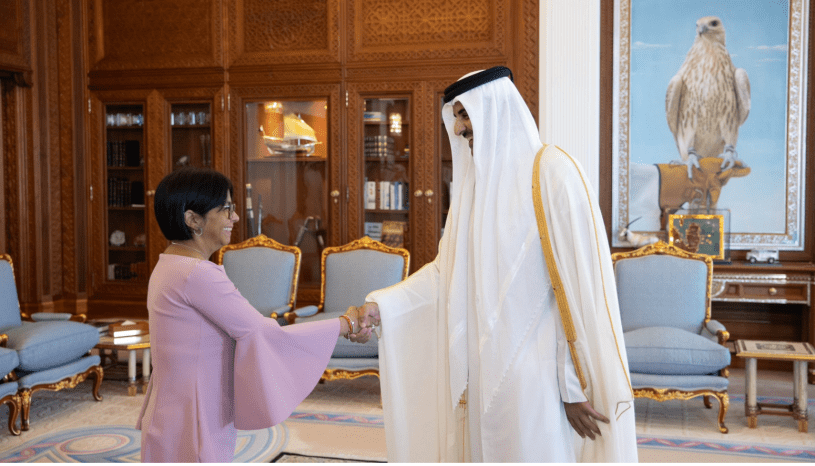
- Venezuela’s Vice President Delcy Gomez is now running the country. But she has a very odd record. On a number of occasions she went to Doha and negotiated with the Royal Family. What was discussed? The Miami Herald – no friend of the Latin American left – reported on October 16, 2025 that Vice President Gomez was putting herself forward as “a ‘more acceptable’ alternative to Nicolás Maduro’s regime”.
- This is what the Miami Herald reported: “A group of senior Venezuelan government officials, led by Vice President Delcy Rodríguez and her brother Jorge, who is president of the National Assembly, have quietly promoted a series of initiatives in recent months aimed at presenting themselves to Washington as a “more acceptable” alternative to Nicolás Maduro’s regime, according to people with direct knowledge of the talks. The proposals, funneled through intermediaries in Qatar, sought to persuade sectors of the U.S. government that a ‘Madurismo without Maduro’ could enable a peaceful transition in Venezuela—preserving political stability without dismantling the ruling apparatus.”
- Even now deposed President Maduro was offering the Trump administration access to Venezuela’s oil and other resources as late as October 2025. The New York Times reported that: “Venezuelan officials, hoping to end their country’s clash with the United States, offered the Trump administration a dominant stake in Venezuela’s oil and other mineral wealth in discussions that lasted for months, according to multiple people close to the talks. The far-reaching offer remained on the table as the Trump administration called the government of President Nicolás Maduro of Venezuela a “narco-terror cartel,” amassed warships in the Caribbean and began blowing up boats that American officials say were carrying drugs from Venezuela. Under a deal discussed between a senior U.S. official and Mr. Maduro’s top aides, the Venezuelan strongman offered to open up all existing and future oil and gold projects to American companies, give preferential contracts to American businesses, reverse the flow of Venezuelan oil exports from China to the United States, and slash his country’s energy and mining contracts with Chinese, Iranian and Russian firms.”
So what is going on?
The Daily Mail is not a source I would normally quote, but the paper has put a plausible argument forward, which is worth considering. I have removed the extraneous photographs.
Was Maduro capture an inside job? Secret talks in the Middle East, a CIA team on the ground and conspiracy theorists question why US didn’t meet heavier opposition
By IMOGEN GARFINKEL – SENIOR FOREIGN NEWS REPORTER
Published: 09:21, 5 January 2026 | Updated: 16:49, 5 January 2026
Venezuela’s vice-president held secret meetings with Washington in Doha in the months leading up to the US military assault on Caracas that saw Nicolás Maduro’s capture, it has been claimed.
During the covert talks, mediated by a senior member of the Qatari royal family, Delcy Rodríguez presented herself to American officials as a ‘more acceptable’ alternative to the 63-year-old dictator.
According to an October report in the Miami Herald, Rodríguez offered the US a vision of ‘Madurismo without Maduro,’ a kind of ‘regime lite’.
Details of the meetings have fueled speculation that the US capture of the Venezuelan president and his wife, Cilia Flores, was an ‘inside job’, planned meticulously over months.
As the US executed its extraordinary military intervention on Saturday, sneaking into the country at just 100ft above the water, conspiracy theorists have questioned why American helicopters were not targeted with heavy small arms fire – despite Venezuelan missiles being knocked out.
It comes as Colombia’s former vice–president Francisco Santos Calderón says he is ‘absolutely certain’ that Maduro’s second-in-command betrayed him by having ‘handed him over’ to the US without a fight.
‘They didn’t remove him, they handed him over,’ he told Colombian cable television news channel NTN24.
According to a source familiar with the matter, the CIA assembled a small team on the ground in Venezuela starting in August, who were able to provide information about the dictator’s pattern of life that made grabbing him seamless.
For months the team – including one source within the Venezuelan government – had been spying on Maduro, recording where he slept, what he ate, what he wore and even, according to top military officials, ‘his pets’.
Low-flying aircraft targeted and destroyed military infrastructure, including air defence systems, to make way for helicopters that landed at Maduro’s compound.

Delcy Rodriguez (pictured) held secret meetings with Washington in Doha in the lead-up to the US military assault on Caracas that saw Nicolás Maduro’s capture.
Following the US raid on Maduro’s compound in Caracas on Saturday, Rodriguez maintained the critical tone adopted by all members of the dictator’s cabinet.
In a televised address, she condemned the White House’s ‘unprecedented military aggression’, demanded the ‘immediate release’ of Maduro and his wife, and said the country ‘will never again be anyone’s colony’.
However, in a dramatic shift of tone on Sunday, Rodríguez – Venezuela’s acting president – offered ‘to collaborate’ with the Trump administration and she said she hoped to build ‘respectful relations’ with the US president.
‘We invite the US government to collaborate with us on an agenda of cooperation oriented towards shared development within the framework of international law to strengthen lasting community coexistence,’ she said on social media.
Santos, vice–president of Venezuela’s neighbour Colombia for eight years between 2002 and 2010 and later Colombian ambassador to the US, named Rodriguez as the person who sold out Maduro.
‘I’m absolutely certain Delcy Rodriguez handed him over,’ he said.
‘All the information we have, you start to put it together and say: “Oh, this was an operation in which they handed him over.”
‘Obviously, they have to set the stage. President Trump says that Delcy is going to be the one to lead the transition, so Delcy is going to be the one to lead the transition.
‘She’s very clear about the role she’s going to play and she’s going to try to earn a little bit of independence.’
Describing the US president’s actions as ‘very pragmatic’, he added: ‘Trump took three decisions which were: “I’ll take Maduro, I’ll establish a transition with someone from the regime and I’ll seek financing and profits from oil companies.”‘
Rodríguez, who is next in the presidential line of succession, served as Maduro’s vice president since 2018, overseeing much of Venezuela’s oil-dependent economy as well as its feared intelligence service.
On Saturday, Venezuela’s high court ordered her to assume the role of interim president.
‘She’s essentially willing to do what we think is necessary to make Venezuela great again,’ Trump told reporters of Rodríguez, who faced US sanctions during Trump’s first administration for her role in undermining Venezuelan democracy.
The New York Times, citing a Venezuelan official, reported on Sunday that the death toll from the US raid on Maduro’s compound in Caracas stood at 80 and was expected to rise
At 4:21am (9.21am GMT) on Saturday morning, President Donald Trump sent a message on his Truth Social platform: the US had carried out a daring mission to capture Venezuelan President Nicolas Maduro and his wife.
The mission – dubbed ‘Operation Absolute Resolve’ – came as a surprise, but according to sources close with the matter, planning for one of the most complex US operations in recent memory had been in the works for months and included detailed rehearsals.
The Pentagon has overseen a massive military buildup of forces in the Caribbean, sending an aircraft carrier, 11 warships and more than a dozen F-35 aircraft.
Does the lack of resistance during the raid seem suspicious?
In total, more than 15,000 troops have poured into the region for what US officials have long described as anti-drug operations.
According to one of the sources, Trump senior aide Stephen Miller, Secretary of State Marco Rubio, Defense Secretary Pete Hegseth and CIA Director John Ratcliffe formed a core team working on the issue for months with regular – sometimes daily – meetings and phone calls.
They often also met with the president.
Elite US troops, including the Army’s Delta Force, created an exact replica of Maduro’s safe house and practiced how they would enter the strongly fortified residence.
The CIA also had an asset close to Maduro who would monitor his movements and was poised to pinpoint his exact location as the operation unfolded.
Late on Friday night and into early Saturday, Trump and his advisers huddled as a number of US aircraft took off and carried out strikes against targets inside and close to Caracas, including air defense systems.
The operation involved more than 150 aircraft launched from 20 bases around the Western Hemisphere, including F-35 and F-22 jets, and B-1 bombers.
‘We had a fighter jet for every possible situation,’ Trump told Fox News Channel’s ‘Fox & Friends’.
With the strikes taking place, US Special Forces made their way into Caracas heavily armed, including with a blowtorch in case they had to cut through steel doors at Maduro’s location.
Around 1am EST Saturday, troops arrived at Maduro’s compound in downtown Caracas while being fired upon.
One of the helicopters was hit, but still able to fly.
Social media videos posted by residents showed a convoy of helicopters flying over the city at low altitude.
Once they reached Maduro’s safe house the troops, along with FBI agents, made their way into the residence, which Trump described as a ‘very highly guarded … fortress’.
‘They just broke in, and they broke into places that were not really able to be broke into, you know, steel doors that were put there for just this reason,’ Trump said. ‘They got taken out in a matter of seconds.’
Once the troops were inside the safe house, Maduro and his wife surrendered. Trump said the Venezuelan leader had tried to reach a safe room but was unable to close the door.
‘He got bum rushed so fast that he didn’t get into that,’ Trump said.
Some US forces were hit, Trump said, but none were killed.
‘Over the weeks through Christmas and New Year, the men and women of the United States military sat ready, patiently waiting for the right triggers to be met and the president to order us into action,’ General Dan Caine, the nation’s highest-ranking military officer, told a news conference on Saturday morning.
While Venezuela has not confirmed how many people were killed during the US raid on Maduro’s compound in Caracas, the New York Times, citing a Venezuelan official, reported on Sunday that the death toll stood at 80 and was expected to rise.
According to the Miami Herald, Rodríguez taking power was one of two options presented to the White House by Qatari mediators.
The other option was Miguel Rodríguez Torres, a retired general who is currently in exile.
The proposals for ‘Madurismo without Maduro’ were delivered to the White House by Richard Grenell, one of Trump’s special envoys, who met the ousted Maduro in January last year.
An initial plan presented in April called on Maduro to step down, remain in his country, and give American companies access to Venezuelan oil.
In exchange, the White House would drop criminal charges against the Venezuelan leader and Rodríguez would take his place.
But that proposal was rejected, with Rubio arguing that the US wouldn’t accept anything other than regime change.
In September, another proposal was suggested, which involved Rodríguez heading a transitional government while the president sought exile in Qatar or Turkey.
But the White House rejected this proposal too, believing the regime’s criminal structures would be repackaged under new leadership.
‘The “cartel lite” was not a viable option,’ one source said.
Over recent weeks intermediaries have been persuading the Trump administration that Rodríguez would protect and champion future American energy investments in Venezuela.
‘I’ve been watching her career for a long time, so I have some sense of who she is and what she’s about,’ one senior US official, referring to Rodríguez, told the New York Times.
‘I’m not claiming that she’s the permanent solution to the country’s problems, but she’s certainly someone we think we can work at a much more professional level than we were able to do with him,’ the official added, referring to Maduro.
A lawyer educated in Britain and France, 56-year-old Rodríguez has a long history of representing the revolution started by the late Hugo Chávez on the world stage.
She and her brother, Jorge Rodríguez, head of the Maduro-controlled National Assembly, have sterling leftist credentials born from tragedy.
Their father was a socialist leader who died in police custody in the 1970s, a crime that shook many activists of the era, including a young Maduro.
Unlike many in Maduro’s inner circle, the Rodríguez siblings have avoided criminal indictment in the US.
Rodríguez developed strong ties with Republicans in the oil industry and on Wall Street who balked at the notion of US-led regime change.
Among her past interlocutors were Blackwater founder Erik Prince and, more recently, Richard Grenell, a Trump special envoy who tried to negotiate a deal with Maduro for greater US influence in Venezuela.
She is the most vocal of the country’s opposition leaders and was this year the recipient of the Nobel Peace Prize.
Declaring that the US will ‘run’ Venezuela until a ‘safe, proper and judicious transition’ can be ensured, Trump sidelined Machado, saying she ‘doesn’t have the support within or the respect within the country’ needed to run the country.
Maduro is set to appear in Manhattan federal court on Monday to face narco-terrorism charges.
The ousted president and his wife are set to appear at the hearing scheduled for 12:00pm EST (5pm GMT) before US District Judge Alvin K. Hellerstein.
It is unclear if either had obtained lawyers, or if they would enter pleas.
The US has deemed Maduro an illegitimate dictator since he declared victory in a 2018 election marred by allegations of massive irregularities.
His capture marks Washington’s most controversial intervention in Latin America since the invasion of Panama 37 years ago.
Prosecutors say Maduro is the kingpin of a cartel of Venezuelan political and military officials who have conspired for decades with drug trafficking groups and US-designated terrorist organisations to flood the US with thousands of tons of cocaine.
Maduro was first indicted in 2020 as part of a long-running narcotics trafficking case against current and former Venezuelan officials and Colombian guerrillas.
In a new indictment unsealed Saturday, prosecutors allege that Maduro personally oversaw a state-sponsored cocaine trafficking network that partnered with some of the world’s most violent and prolific drug trafficking groups, including Mexico’s Sinaloa and Zetas cartels, the Colombian paramilitary group FARC and the Venezuelan gang Tren de Aragua.
‘As Venezuela’s President and now de-facto ruler, Maduro allows cocaine-fueled corruption to flourish for his own benefit, for the benefit of members of his ruling regime, and for the benefit of his family members,’ according to the indictment filed by prosecutors from the US Attorney’s Office in the Southern District of New York.
Trump warned Colombia could be the next country to face a military operation, calling the its leftist President Gustavo Petro a ‘sick man’ who ‘likes making cocaine’ after threatening Petro to ‘watch his a**.’
‘Colombia is very sick, too, run by a sick man, who likes making cocaine and selling it to the United States, and he’s not going to be doing it very long,’ Trump said on Sunday while travelling on Air Force One.
When asked whether the US would pursue a military operation against the country, Trump bluntly replied: ‘It sounds good to me.’
Petro hit back at Trump in a fiery social media post, after the US president accused him of being a drug trafficker.
‘Stop slandering me, Mr Trump,’ Petro said in a lengthy post on X.
‘That’s not how you threaten a Latin American president who emerged from the armed struggle and then from the people of Colombia’s fight for Peace.’
In a later social media post Sunday, Petro added: ‘Friends do not bomb.’
 Martin Plaut
Delcy Rodríguez. No Delcy Gómez. Your article looks interesting, but I am not sure if trusting you after seeing such a mistake