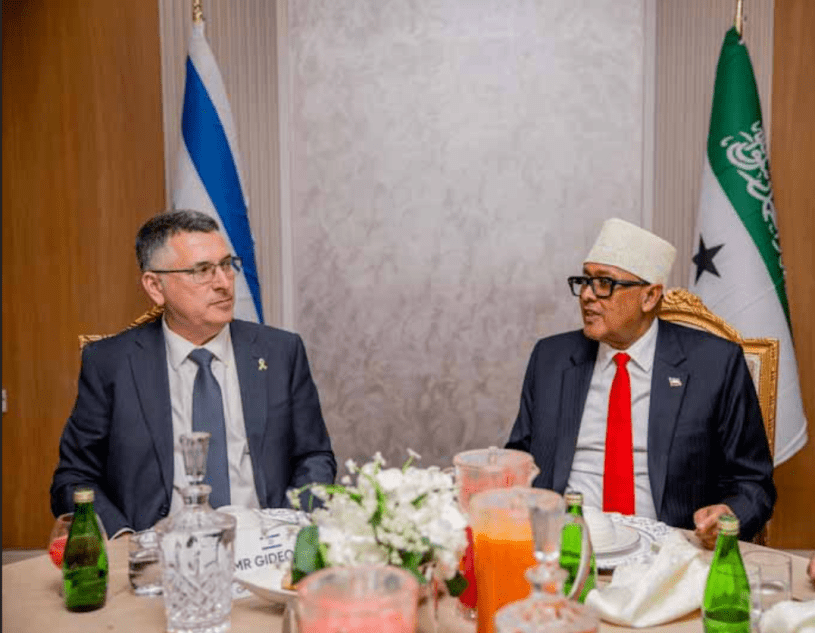
It appears that Israel is pivoting towards the Emirati-led “Axis of secessionists,” which aligns with the UAE’s established foreign policy strategy across the Southern Arabian periphery, the Horn of Africa, and the Gulf of Aden. This shift involves supporting various non-state, often separatist, actors to generate influence and strategic depth for the UAE. This approach frequently puts the UAE in opposition to established central governments or rival regional powers such as Saudi Arabia and Iran.
Today’s editorial in The Somali Wire is written by Dr Ngala Chome.
We would like to extend an invitation to others who may wish to contribute to The Somali Wire in the future. We appreciate insightful perspectives on topics concerning Somalia crafted as editorials.
Please contact us for more information if interested.
On 26 December 2025, Israel officially became the first country to recognise Somaliland as an independent sovereign state. This decision appears to be connected to the broader geopolitical shifts following the Hamas attack on Israel on 7 October 2023. The ensuing conflict saw the Houthis, who control parts of Yemen, launch missiles targeting Israel and disrupt international shipping in the Red Sea and the Gulf of Aden in solidarity with Hamas. This escalation of disturbances in the Red Sea not only poses a significant risk to international oil and merchant shipping but also highlights the increasing integration of the Horn of Africa into the security systems of the Indo-Pacific, the Mediterranean, and the wider Gulf region and Middle East. This integration is driven by intensifying competition for influence over the Red Sea’s trade and transit routes. But it is also about competing political visions for the future direction of the Muslim world, between different versions of Islamism and their detractors.
The geopolitical shift following the 2011 Arab Spring has seen traditional Middle Eastern powers like Syria, Libya, Egypt, and Iraq eclipsed by the rise of Gulf states as the region’s primary competing influences. In the mediation of the conflict in Gaza, Qatar, Saudi Arabia, and the United Arab Emirates (UAE) have assumed central roles, though their differing agendas have contributed to an unstable ceasefire. Significant diplomatic divisions persist among these states. For instance, the UAE remains the only one of the three to have signed the 2020 Abraham Accords to normalise relations with Israel. Furthermore, varying levels of commitment to countering Islamist causes and differing diplomatic stances toward Iran—the leader of the “Axis of Resistance” involving Hezbollah, the Houthi Movement, and Hamas—continue to shape regional relations. These internal suspicions among the Gulf powers have hindered the mediation process between Israel and Hamas, as exemplified by the Israeli attack on Hamas negotiators in Doha on 9 September 2025, highlighting the fragility of the current diplomatic framework around the crisis in Gaza.
It appears that Israel is pivoting towards the Emirati-led “Axis of secessionists,” which aligns with the UAE’s established foreign policy strategy across the Southern Arabian periphery, the Horn of Africa, and the Gulf of Aden. This shift involves supporting various non-state, often separatist, actors to generate influence and strategic depth for the UAE. This approach frequently puts the UAE in opposition to established central governments or rival regional powers such as Saudi Arabia and Iran. Notably, before moving to recognise Somaliland (a UAE ally and breakaway region of Somalia), Israel also pivoted toward the UAE-backed Southern Transitional Council (STC) in Yemen. The STC is an autonomous region seeking independence and international recognition.
This new relationship seems to have encouraged the STC’s leadership to embark on an expansionist program, recently taking the oil-rich areas of Hadhramaut and al-Mahran in Western Yemen, close to the Saudi border, which has clearly generated concern in Riyadh. And while Riyadh has moved to retake areas recently claimed by the STC, and UAE security personnel in the area withdrawn, the resulting UAE-Saudi rift parallels a similar situation in Sudan. This rupture bears major implications for the entire Horn of Africa. The Horn is now firmly part of a wider geopolitical confluence involving the Gulf and the Middle East, where rivalries among Gulf monarchies—the UAE, Saudi Arabia, and Qatar—are spilling over. These rivalries carry significant consequences for the region’s peace and security landscape.
In particular, Israel’s recent recognition of Somaliland on the Horn of Africa risks escalating regional tensions, reminiscent of the situation following the 2024 Memorandum of Understanding (MoU) between Somaliland and Ethiopia. That MoU, which involved a stretch of Somaliland coastline in exchange for international recognition for Hargeisa, previously generated fears of imminent conflict between Somalia and Ethiopia.
With Ethiopia now closely aligned with the UAE—similar to Somaliland, the autonomous Somali federal member state of Puntland, and Somalia’s federal member state of Jubaland—Israel’s involvement introduces further complexity. This could heighten the risk of open conflict, not only between Somaliland and the Federal Government of Somalia (FGS) in Mogadishu, but potentially also involving Ethiopia. Moreover, these events jeopardise the Turkish-brokered rapprochement between Addis Ababa and Mogadishu concerning the 2024 MoU. They also lend renewed impetus to the 2024 “Tripartite Alliance” between Egypt, Eritrea, and Somalia, which was designed to counter Ethiopia’s ambitions for sea access via the Red Sea or the Gulf of Aden. This regional dynamic is further complicated by the ongoing disagreement between Ethiopia and Egypt over the Grand Ethiopian Renaissance Dam (GERD).
It is notable that the “Tripartite Alliance” originally included countries that have since aligned with states traditionally opposed to Israel. Specifically, Iran (rumoured to be pivoting towards Asmara), Turkiye and Qatar (both strong allies of the Federal Government of Somalia), and Saudi Arabia (allied with Sudan’s Armed Forces, also regarded as an ally of the FGS and Eritrea) now appear to be aligned on one side. Conversely, the UAE and Israel appear to be aligning on the other side, supporting secessionist causes such as Somaliland, Puntland, the Southern Transitional Council (STC), and Sudan’s Rapid Support Forces (RSF).
This story primarily focuses on the geopolitical competition for influence and resources in the Horn of Africa, encompassing hydrocarbons, minerals, agricultural land, and strategic access to vital waterways and ports. However, beyond these material factors, the conflict also reflects a deeper ideological contest regarding competing visions for the future of the Muslim world. This contest is currently demonstrated by Islamist causes—represented in groups like the SAF—and their opposition, which is most notably symbolised by the emerging alliance between Tel Aviv and Abu Dhabi, an alliance that is now extending its influence through strategic locations such as Hargeisa.
| Dr Ngala Chome is an expert on security, geopolitics and political economy, with eleven years of experience working mainly in Eastern Africa and the Horn of Africa region. He has recently served in senior roles at Sahan Research, a think-tank on peace and security issues working on the Horn of Africa, alongside developing his own work as an academic researcher on multiple research projects covering violent Islamist groups, Muslim politics, elections, governance, political stability and the political economy of development. Ngala obtained his doctorate from Durham University (UK) in 2021. |
 Martin Plaut