News: Report tracks UAE-linked cargo flights to Ethiopian military base amid regional power struggle
January 21, 2026
Source: Addis Standard
Addis Abeba — A cargo aircraft previously linked to the supply of weapons to armed groups in Sudan has conducted multiple flights to Ethiopia in recent weeks, according to an exclusive investigation by the UK-based outlet Middle East Eye (MEE), raising questions about Ethiopia’s role in intensifying regional rivalries tied to the war in Sudan.
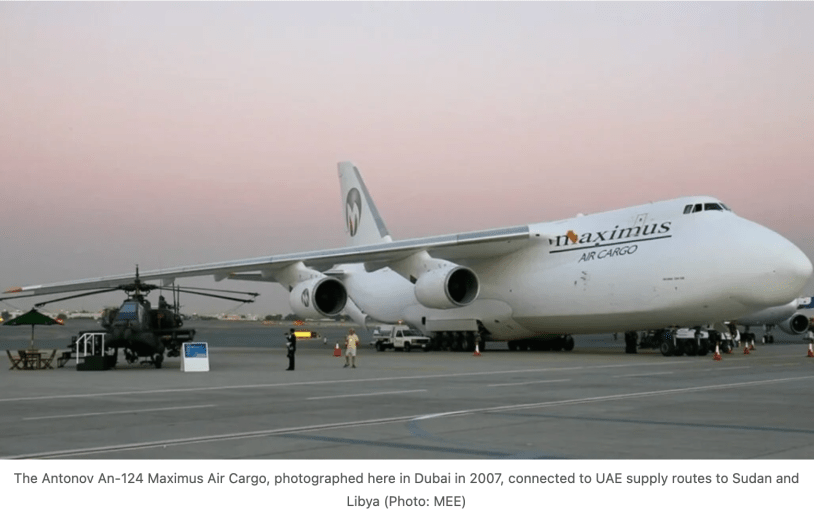
MEE reported that an Antonov An-124 cargo plane operated by UAE-based Maximus Air, and allegedly linked to Emirati military logistics, made repeated flights between Abu Dhabi and Harar Meda airbase, the main base of the Ethiopian Air Force. Flight-tracking data reviewed by the outlet shows at least four trips to Harar Meda between 3 and 17 January, including one flight that later continued to Addis Ababa’s Bole International Airport before departing for Europe and Asia.
While the purpose of the flights remains unclear, Middle East Eye said they took place against the backdrop of escalating competition between the United Arab Emirates and Saudi Arabia across the Horn of Africa and the Middle East, as well as growing international concern over external involvement in Sudan’s nearly three-year war between the Sudanese Armed Forces (SAF) and the paramilitary Rapid Support Forces (RSF).
According to the report, uncertainty surrounding Emirati military positions in Somalia — following the Somali government’s cancellation of defence agreements with the UAE — has reportedly led to the redeployment of Emirati personnel and logistical focus toward Ethiopia. MEE cited multiple sources, including a former Ethiopian government adviser, who described Ethiopia as “crucial” to the UAE’s regional strategy.
The former adviser, quoted by Middle East Eye, said Prime Minister Abiy Ahmed “certainly seems to see the future as Ethiopia aligning itself firmly with the UAE alliance,” adding that some officials believe Abu Dhabi has exerted significant influence over Ethiopia’s positions on Sudan and broader Red Sea security dynamics in recent years.
Analyst Jalel Harchaoui told MEE that while Saudi Arabia has recently increased its military and diplomatic engagement to counter Emirati influence in Sudan, Ethiopia is unlikely to shift away from its alignment with the UAE. “Addis Ababa will stick with the UAE,” he was quoted as saying, arguing that this has made Ethiopian territory a focal point for Emirati military logistics following disruptions elsewhere in the region.
The An-124 aircraft tracked by MEE, identified by tail number UR-ZYD, is described as one of the world’s largest military transport planes, capable of carrying heavy military equipment. Middle East Eye reported that the same aircraft had, days earlier, flown multiple times between military bases in Bahrain and Israel, before beginning its series of flights to Ethiopia.
Nathaniel Raymond, executive director of Yale University’s Humanitarian Research Lab, told MEE that repeated sorties by such a high-capacity aircraft to an Ethiopian military airfield “should be of global concern,” particularly given reports of increased RSF activity in the region. He added that if the flights were proven to be linked to arms transfers, Ethiopia would face pressure to restrict access to its airspace.
The report further alleges that dismantled fighter jets and other military equipment destined for the RSF may have transited through Ethiopia in the past, alongside routes through eastern Libya. The UAE has repeatedly denied supporting the RSF, which has been widely accused of committing atrocities in Sudan’s Darfur region.
Middle East Eye said it contacted the UAE’s foreign ministry, Ethiopia’s Ministry of Foreign Affairs, Maximus Air, and the RSF for comment. As of publication, no responses had been reported.
The revelations come as Ethiopia navigates heightened geopolitical pressure in the Horn of Africa, amid the spillover effects of the Sudan war, competition among Gulf states, and ongoing concerns over Red Sea security and regional military realignments.
 Martin Plaut