
Who are the actors, why are they fighting? Is the conflict caused by money, gold, oil, power, religion or ethnicity? Which foreign powers are involved?
By Clément Molin
Here, you will find a general guide of the Sudan war:
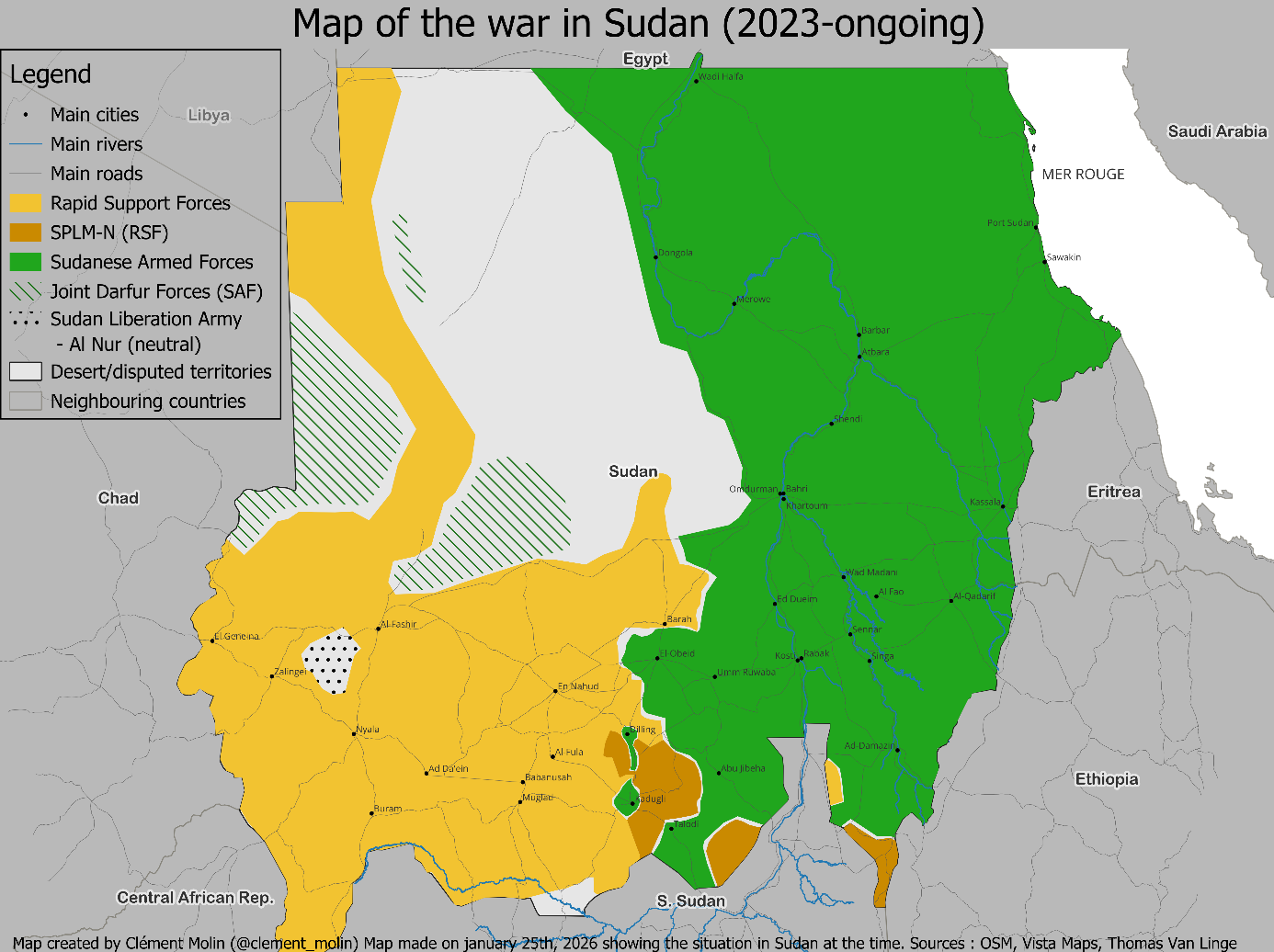
Map of the war in Sudan – @clement_molin –
When and where did the war start?
On April 15th 2023. Where? In Khartoum, the capital city, unlike previous conflicts, which all started on the periphery of the Sudanese state. Sudan was already partly at war before, discontinuously since 1983 (1983-2005, 2nd South Sudan Independence war, 2003-2020, Darfur war, 2011-2020, South Kordofan and Blue Nile war). Since its independence, Sudan have been nearly constantly at wat with the periphery of the state, in South Sudan, in Darfur, in Kordofan, in Blue Nile or in the north-eastern mountain, but never directly in the capital city and in the heart of the state power, along the Nile river and on the fertile Gezira and Sennar regions. This is why this war is more dramatic than ever for Khartoum.
Who is fighting the war ?
A large number of military actors are fighting in Sudan. There are two main sides, as well as multiple former rebel groups, paramilitary forces, civilian, political and foreign actors.
- The Sudanese Armed Forces : The SAF are based in Khartoum and Port Sudan; they defend the state’s borders and internal stability. Their leader is Abdel Fattah Al-Burhan, and the military commanders are partly heirs to the military-Islamist regime of Omar al-Bashir (1989-2019). The SAF are well organized around infantry divisions and brigades, as well as one armoured division and one air assault division. The army is often described as an heavy force (strong airforce, heavy mechanized and tank forces) based in the main cities and town across the country, which was helped by paramilitary, highly mobile, pro-government forces such as the RSF to fight rebel insurgencies.
- The Rapid Support Forces : The Rapid Support Forces (RSF) is a paramilitary militia (formerly named as Janjaweed) created by the former regime to fight the Darfur rebels and who perpetrated the Darfur genocide against non-Arab populations. They originate from Darfur and seek to overthrow the government in Khartoum. The RSF have a strong ethnic background, coming back to the central African Arab confederation called “Baggara”. The RSF are led by the Hemedti family and have strong ties with Arab suprematism in Darfur. They aimed at taking power in Khartoum and expel part of the non-arab populations in Darfur.
6 causes that started the war :
- 1- 2019-2021 military coups :
In 2019, the SAF and the RSF jointly overthrew al-Bashir’s government following the Sudanese revolution, then seized the power they had granted to civilians in 2021. The Sudanese Revolution was a massive protest movement in Sudan’s biggest cities, first against the difficult economical conditions and then against the Islamist dictature. It was ultimately helped by the army’s intervention to overthrow Omar El Bechir’s regime. The transitional government, mixed with military and civilian control (led by prime minister Abdallah Hamdock) lasted 2 years before the SAF and RSF jointly overthrowew it in 2021. The RSF, was in charge of the repression of civilian protests, killing more than 130 people during the Khartoum massacre. -> Al-Burhan becomes number 1 -> Hemedti becomes number 2
- 2- Thucydides’ Trap
Over the years, the RSF and their leader, Hemedti, had become more powerful than the army. The army wanted to prevent this rise to power by integrating them under military command. In 2023, the military junta was meant to give back power to civilians. To start the process, Al Burhan asked for the RSF to be under his own military leadership. The RSF refused and attempted a military coup on April 15, 2023 by seizing the most important places of power, which failed and transformed into a full fledge war.
- 3- Natural Resources, Gold, Oil and Agriculture
The RSF and the Hemedti family, controlling a vast gold trafficking network, wanted to secure and expand it. The gold the RSF were using was going to Nairobi, Dubaï and even into the hands of the Wagner group. The RSF also wanted to acquire control over oil and agricultural areas whose wealth reached only the people of the Nile.
- 4- Ethnic division:
70% of Sudan’s population is Arab, with 50% living in the east, north or along the Nile (the wealthier regions) and 15% holding power for the past 150 years (the 3 arabs tribes north of Khartoum, which are the Ja’alin, Shaigya and Danagla).
-> The Bagarra Arabs of Darfur (the base of the RSF, the remaining 20%) felt neglected : no universities during long time in the west
-> Darfur power controled by African tribes (Fur, Zaghawas, Massalit…)
-> Minimal representation in Khartoum for Bagarra Arabs, no power in the economy or the military
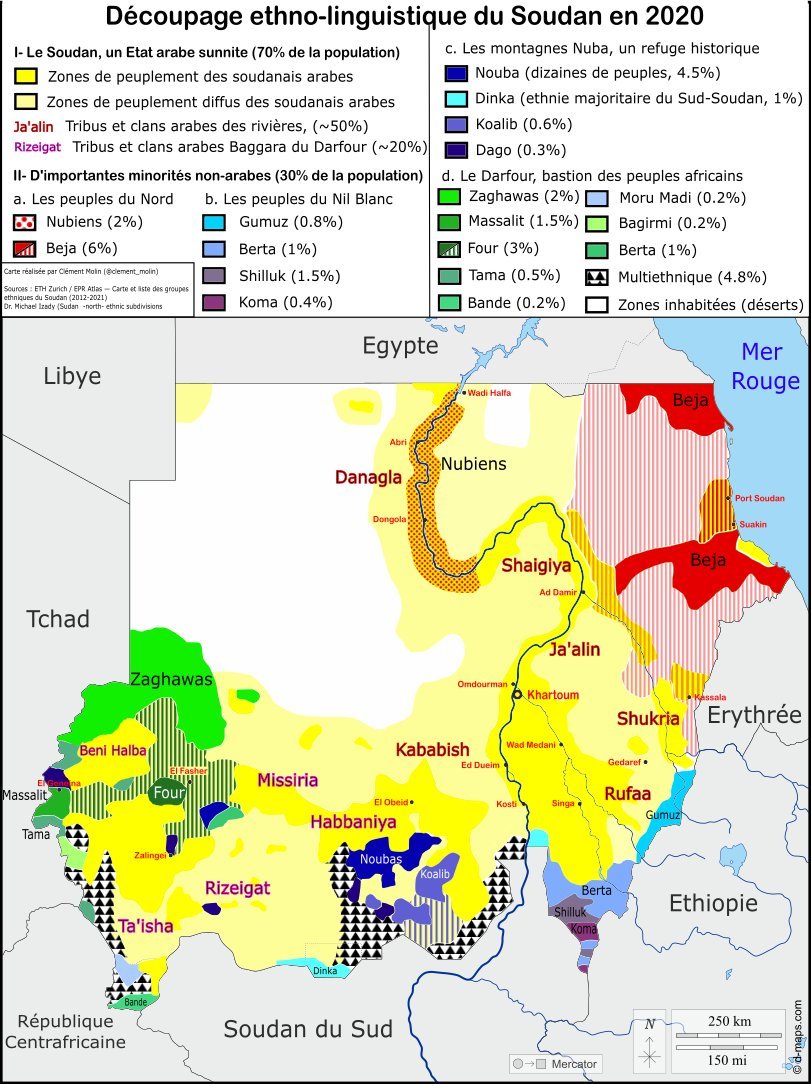
Map of Sudan ethnicities – @clement_molin –
- 5- The Darfur War
From 2003 to 2020, Khartoum armed the Janjaweed militia and later the RSF to fight the rebellions launched by the Sudanese Revolutionary Front (SRF) coalition, which aimed to overthrow the government from Darfur, Kordofan, and Blue Nile. -The SRF represents approximately the 30% remaining non-Arab population.
-The SRF was composed of nearly all the Sudanese rebel groups, including the Sudan Liberation Army, the Justice and Equality Movement, the Sudan People Liberation Army – North…
-The Janjaweed and later RSF were sent by the army to do the ethnic cleasing of the areas the Sudanese Air Force was bombing during the war. The RSF were Khartoum’s militia to fight rebels.
6- Foreign Investments The United Arab Emirates invested heavily in supporting the RSF as an alternative to the old “Islamist” army. They actively participated in preparing for war by financing and arming the RSF. Russia and Turkiye have also been active toward both sides because of their wish to acquire a naval base on the red sea, as well as Egypt in its confrontation against Ethiopia.
How many soldiers in the army ?
~100 000 soldiers at least, with ~100 000 more allied militiamen from Joint Darfur Forces (former rebels includes SLA-MM, JEM and others) ; Popular Resistance Forces (civilians who joined the army) ; Al-Bara’ ibn Malik Battalion (islamists) ; Sudan Shield Forces and other smaller groups. The army heavily relies on highly mobile militias to fight the war, even if, after 3 years of war, it started implementing a new pick-up strategy.
How many soldiers in the RSF ?
~120 000 plus additionnal 20-25 000 SPLM-N (Sudan Popular Liberation Movement-North, led by Abdelaziz Al Hilu) which joined the alliance in 2025. The RSF is strongly ethnic based. Most of its soldiers come from different arab tribes from the Bagarra arab confederation, as well as some Fur rebels and the old Blue Nile/Nuba mountains commanders Abelaziz Al Hilu and Turka forces.
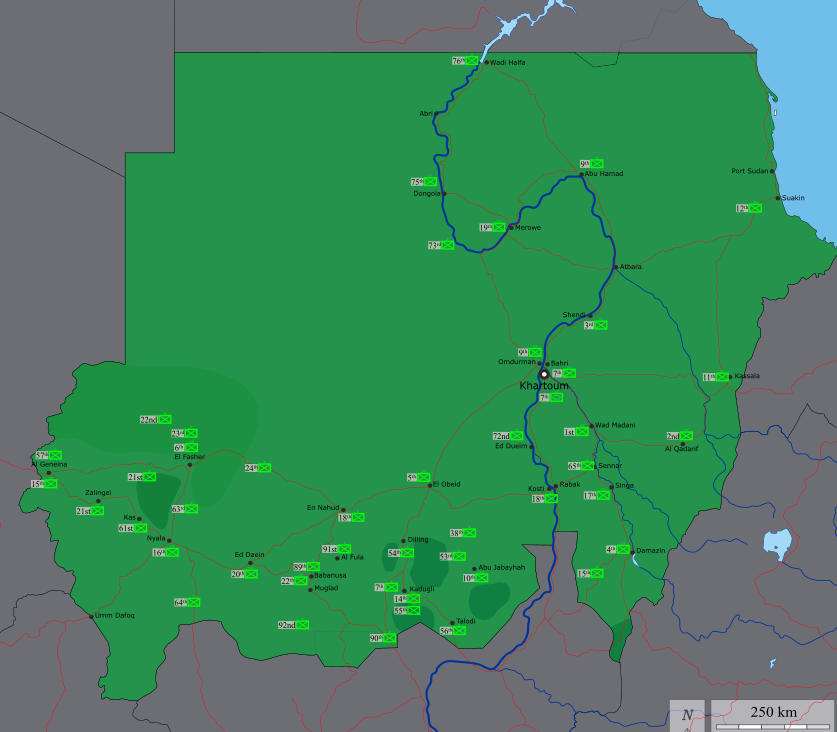
Map of SAF units bases – @clement_molin –
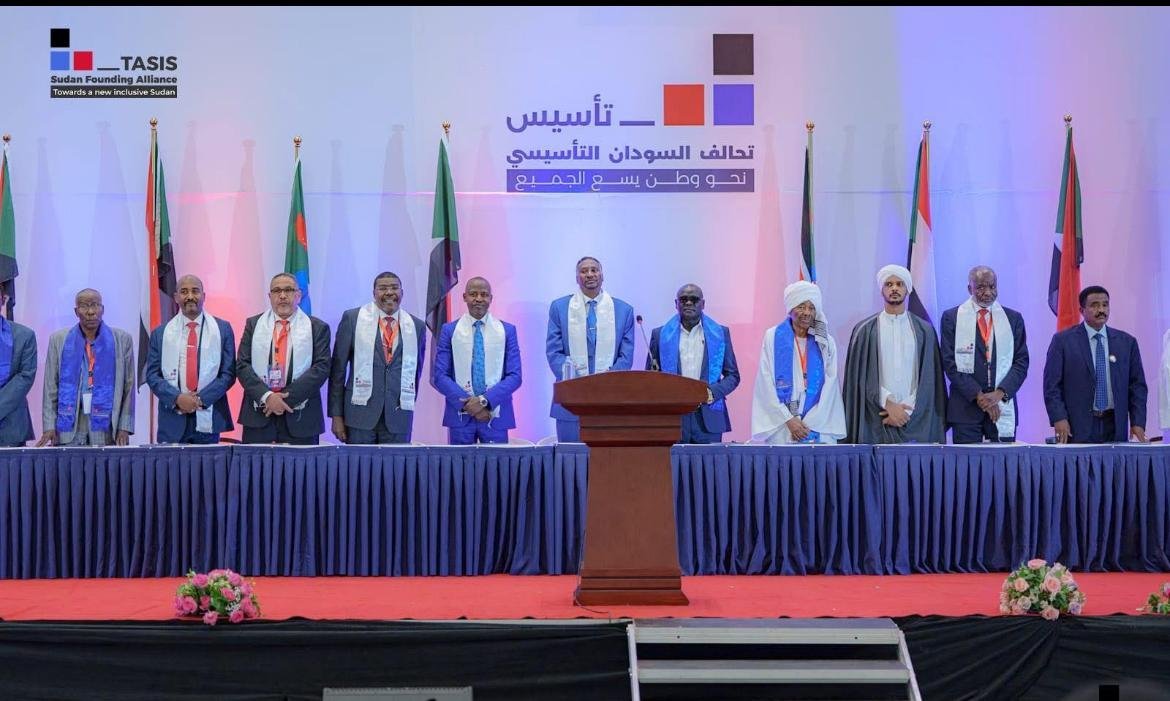
A civilian–political front backed by Sudan’s Rapide Support Forces, formed in Nairobi, Kenya to give the militia political legitimacy. It includes RSF leaders, breakaway civilian figures , and some armed movements opposed to SAF & Islamists. -> aim to organize their own administration
- Rapid Support Forces (RSF): Fully represented.
- SPLM-N (Abdelaziz al-Hilu faction): Fully represented.
- SLM-TC (Transitional Council): Fully represented.
- National Umma Party (NUP): Marginally represented (specifically the Fadlallah Burma Nasir faction).
- Democratic Unionist Party (DUP): Marginally represented (specifically the Ibrahim al-Mirghani faction).
- Sudanese Revolutionary Front (SRF): Fully represented.
- Resistance Committees: Marginally represented (specific local branches only).
- Sudanese Professionals Association (SPA): Marginally represented (specific dissident wings).
What are the civilian political figures doing ?
-> Taqaddum, a “Coordination of Civil Democratic Forces”, in exil -> They do not support any side -> They blame both sides for the war -> They support a democratic end to the war, a democratic and non islamic future for Sudan -> Sudaneses civilians mainly support the army (apart from Bagarras).
Is it a religion war ?
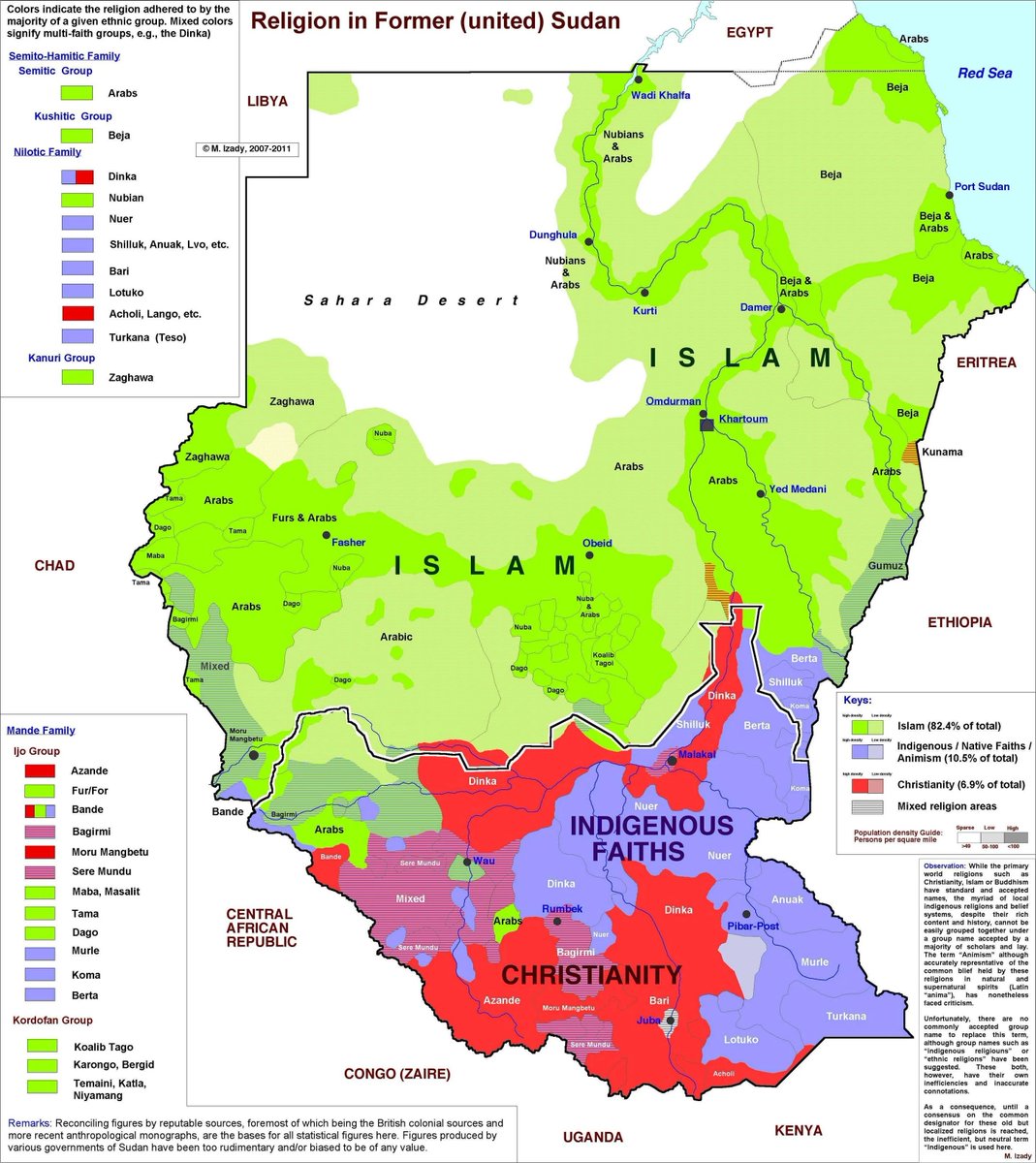
No. First, 97% of Sudanese are Sunni muslim, there is only 1.5% christians and 1.5% animists. -> Both sides are muslim, even if the SAF history and backing is more islamist and the RSF more secular. The war is more about ethnicities, tribalism and power than about religion. Only marginal pro-SAF factions are islamists, which does not make the SAF a pro Muslim brotherhood army.
What are the main battles of the war ?
-> Khartoum battle 2023-2025, SAF victory -> Gezira-Sennar battle 2024, SAF victory -> Darfur battle 2023-2025, RSF victory -> Kordofan battle (ongoing) -> Sahara desert battle (ongoing) RSF superiority
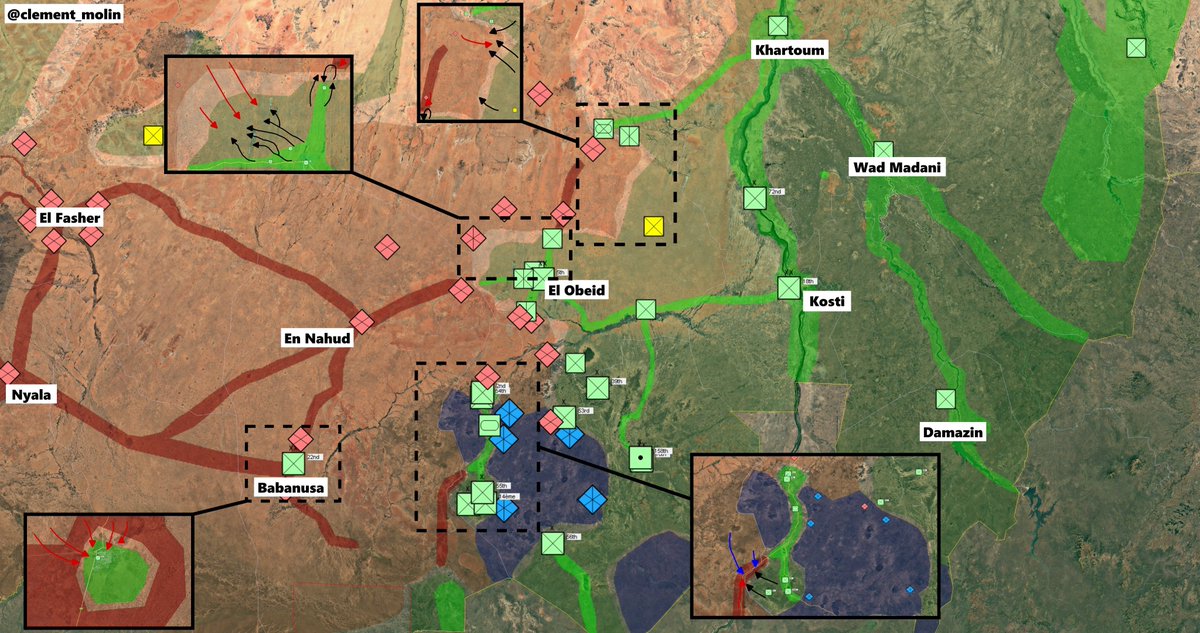
Map of war in Kordofan – @clement_molin –
How many people died ?
150 000 to 400 000 as per official reports. -> 60 000 in Khartoum state -> 63 000 in Al Fashir massacre -> 20 000 in El Geneina massacre -> hundred of thousands others in other regions, multiple others indirectly, from disease and hunger.
How many people migrated ?
-> 7.55 million people were newly displaced due to the conflict -> 4 million left the country (to Chad, Egypt, South Sudan mainly) -> 3.3 million returned to their houses after Khartoum and south liberation including 455 000 from abroad.
Who is winning the war ?
Currently, no one, both forces are fighting hardly in Kordofan region, especially around El Obeid. On january 26th 2026, the army lifted the siege of Dilling, while the RSF launched the first attacks from the southern part of Blue Nile state. The war may still continue for a long time since both sides still think they can win the war before negotiations.
Which foreign powers are helping the SAF ?
-> Turkiye 🇹🇷 (military) -> Egypt 🇪🇬 (military and financial) -> Saudi Arabia 🇸🇦 (financial) -> Qatar 🇶🇦 (financial) -> Iran 🇮🇷 (military, former) -> Russia 🇷🇺 (military) -> Eritrea 🇪🇷 (military) -> Ukraine 🇺🇦 (military, former ?)
Which foreign powers are helping the RSF ?
-> United Arab Emirates 🇦🇪 (financial, military, logistics, intelligence, mercenaries) -> Chad 🇹🇩 (logistics + indirectly mercenaries) -> Ethiopia 🇪🇹 (logistics) -> South Sudan 🇸🇸 (logistics + indirectly mercenaries) -> CAR 🇨🇫 (logistics + indirectly mercenaries) -> LNA 🇱🇾 (logistics + indirect support) -> Wagner 🇷🇺 -> Kenya 🇰🇪 (logistics and diplomatic) -> Uganda 🇺🇬 (logistics)
What is the position of other countries ?
-> China 🇨🇳 supports SAF territorial integrity -> USA /Europe (western) 🇺🇸🇬🇧🇪🇺 talk to both sides, support the civilian organisation, opposed to both sides governance -> Israel 🇮🇱 neutral for now -> Others 🇮🇳🇵🇰🇮🇩 remained +/- neutral
Why following this war matters ?
-> Sudan is a strategic country at a crossroad -> If the war last too long, many civilians will try to flee to Europe -> There are critical ressources in Sudan (gold, oil…) -> The Nile river -> At the heart of multiple rivalry (Ethiopia-Egypt, Saudi Arabia-UAE, Turkiye-UAE…)
Clément Molin
 Martin Plaut