My experience of brutal violence and cultural erasure in Tigray – Viewpoint by Negasi Awetehey.
| FEB 1 |
The war in Tigray was the ultimate betrayal, a genocidal campaign orchestrated by Ethiopian government forces and their allies that descended upon us. For those of us who experienced it firsthand, it felt like the sky had fallen.
In the days leading up to Axum’s fall, the streets of Tigray were a microcosm of the region’s suffering. Fear and confusion were palpable as daily life crumbled. Conversations revolved around the escalating crisis, the government’s deceitful denials, and the world’s inaction.
Despite the turmoil, our resilience shone through in small acts of defiance, like waiting in line for bread or sharing knowing glances.
The nightmare became more real as our society struggled visibly.
The long queues at the Commercial Bank of Ethiopia reflected the strain on our collapsing banking system. The desperate search for cash was a fight for survival.
On 5 November 2020, amidst chaotic crowds and failing systems, the local government organized a last-ditch cash distribution, a lifeline in the face of looming air raids from Eritrea.
As the infrastructure crumbled around us, electricity failed for days, and water scarcity forced us to rely on ancient wells, our modern lives fading into a primal struggle.
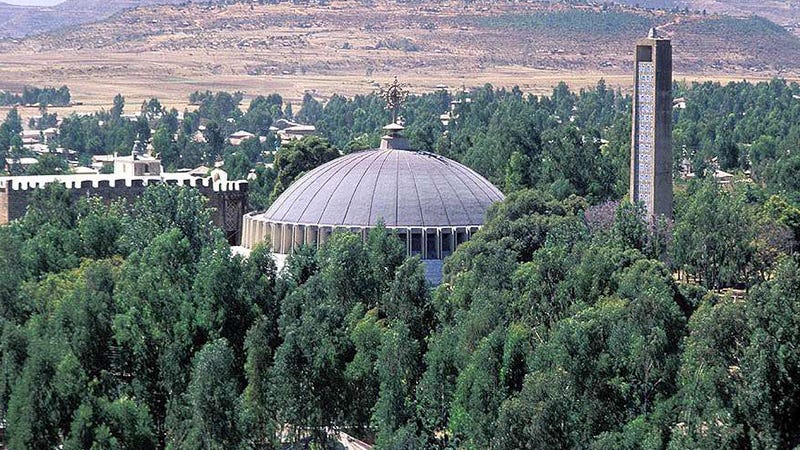
In this physical and metaphorical darkness, faith became our stronghold. Churches, particularly the revered Church of Tsion, overflowed with people seeking a miracle, their hymns providing a gentle backdrop to the distant rumble.
Alongside prayers, young men and women trained in fields, preparing for conscription with determined faces ready to defend our land.
On 17 November, I traveled to Wukro Maray to check on my sister, who had been displaced from Sheraro. The road to Shire was veiled in a menacing cloud of smoke from bombed fuel depots, casting a dark shadow on the horizon.
In Wukro Maray, a mother near Endaba Abruk church released her cattle to the distant hills, crying out in sorrow: “They are coming for our land.”
A mechanized division of Tigray’s forces advanced cautiously, avoiding surveillance drones that highlighted the harsh reality of our unequal conflict.
Axum’s Fall
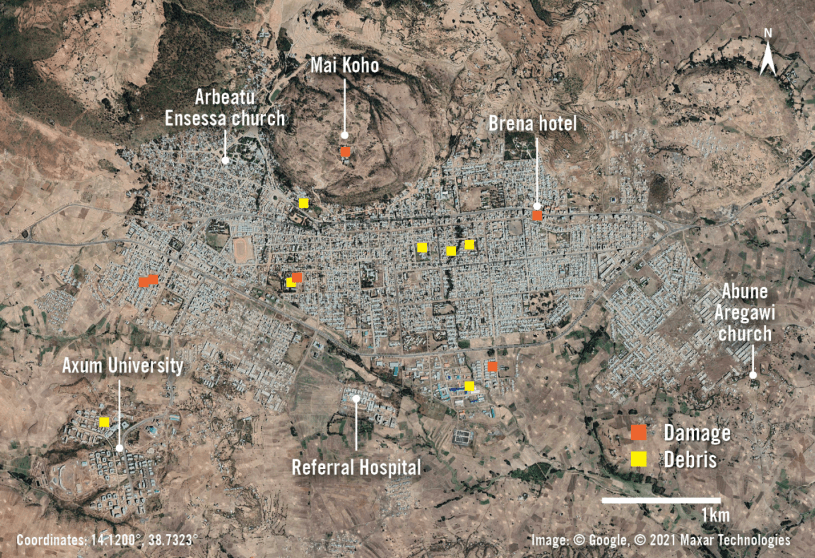
On 19 November, Axum was hit by heavy shelling, causing chaos and destruction. The city was transformed into a terrifying maze of fire and noise, with bombs striking key locations like the market, university, hospital, stadium and school.
Despite the chaos, the community came together, with local youth organizing patrols to maintain order. The night was filled with the relentless sound of artillery and rifle fire, leaving us questioning our future.
At dawn, a massive convoy of Ethiopian and Eritrean military vehicles was spotted on the Axum-Shire road, causing despair. Tanks, trucks, and artillery pieces stretched as far as the eye could see.
Victory songs blared from their vehicles, taunting us with chants meant to crush our hope. In that moment, the core Tigrayan belief that “The people cannot be defeated” fractured under the weight of this overwhelming force.
Cultural Annihilation
The invasion’s brutality quickly turned into cultural destruction. After the chaos settled, we ventured to see the damage done to our heritage.
Melekia, a site mentioned in the medieval Book of Axum and located near the Church of Maryam Tsion, was gouged by heavy artillery fire and shrapnel. Priceless Axumite artifacts from the Archaeological Museum were stolen and the iconic obelisks damaged by tank tracks. The loss echoes in the silence of the historic site.
However, the most devastating blow was at Axum University. As a center for archaeology and heritage preservation, its facilities, including the mini-laboratory, and collection rooms, were methodically looted by Eritrean and Ethiopian forces. Priceless books, ancient manuscripts, valuable research, and teaching materials were either stolen or destroyed.
This was a deliberate attempt to erase our identity, a targeted attack on the very memory of our people.
The news of Mekelle’s fall on 28 November was a devastating and humiliating final blow.
Axum remained under the brutal grip of Eritrean occupation, with their command post ominously situated on the strategic hill of Mai Koho, overseeing us like a vulture.
Mass Killing
On that fateful day, gunfire near Mount Gobo Dura escalated into an eerie silence. Seeking shelter with my friend, we heard whispers that Eritrean forces were conducting house-to-house killings, moving from the Church of Tsion through downtown and neighboring kebeles.
The next morning, I went to church wearing a traditional netela. The prayers were heartfelt, focusing on the deceased and the living.
Afterward, I strolled through Daero Piassa, witnessing a haunting scene: men pulling carts carrying covered bodies, women preparing linens and asking for help to cover the deceased. The air was heavy with the smell of dust and death, leaving a lasting impression.
Our home was in a state of panic as Eritrean soldiers raided our neighborhood and abducted three men. The men and boys in my household fled to a village south of Axum.
Upon our return, we saw soldiers mistreating villagers, making them kneel in the dirt, and subjecting them to beatings and shootings. The cries of young men witnessing the violence made us retreat in fear. I then embarked on a risky journey to my family’s village in Adwa, living in exile for a month, filled with anxiety and uncertainty.
Bitter Aftermath
When I returned to Axum, I was shocked to find the city empty and desolate.
The tragic reality became clear as I learned that my colleague Alemshewit Gebrewahid from the Institute of Archaeology and Tourism had been killed near the Tsion Church’s main gate. His life and knowledge were lost on sacred ground.
After the violence in Axum, a deceitful online campaign emerged to distort the truth with hashtags like #FakeAxumMassacre flooding Twitter. This malicious effort contrasts starkly with the physical graves in Axum.
Despite efforts to erase our truth, we stand firm in our resolve and refuse to forget.
Support Ethiopia Insight on Patreon

About the author.
Negasi Awetehey is a member of the Department of Archaeology and Heritage Management at Aksum University. He is currently pursuing his Ph.D. at the University of Geneva. He can be reached at: negasiawetehey@gmail.com.
 Martin Plaut