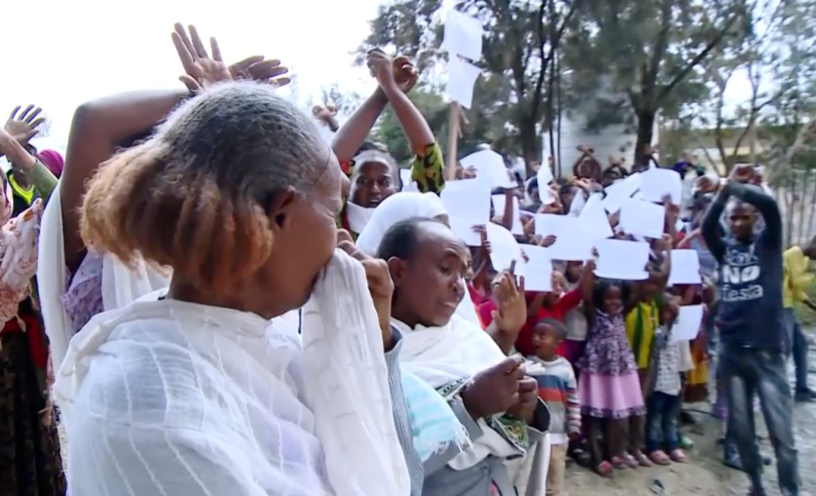
Source: Addis Standard
Prime Minister Abiy Ahmed (PhD) told the House of Peoples’ Representatives (HoPR) that the deterioration in relations between Ethiopia and Eritrea began during the early phases of the two-year devastating war in the Tigray region, citing atrocities committed by Eritrean forces, and not Ethiopia’s more recent push for access to the Red Sea.
Addressing lawmakers today, the Prime Minister rejected analyses that link the current rift to Ethiopia’s maritime ambitions. “Some people argue, think, and analyze that the problem between the Ethiopian and Eritrean governments arose because the Ethiopian government raised the Red Sea question. This is not the case,” Abiy said. He added that tensions long predated the sea access debate and “began during the start of the Tigray war.”
According to Abiy, the first major rupture occurred after “federal forces captured Shire” in the early phase of the war. “After we cleared Shire in the first round of the war, the Eritrean army followed behind us, entered the town, and began destroying private homes and buildings. That is when the friction started, though we did not speak of it at the time,” he said.
The Prime Minister claimed the situation worsened as the war moved through historic towns in central Tigray. “When we moved through Axum, the tension intensified as [Eritrean forces] entered and conducted mass executions of youth,” he told parliament, adding that in Adwa, Eritrean troops “began dismantling and looting factories,” and in Adigrat, “uprooted what could be moved from the pharmaceutical factory and destroyed the rest,” pushing relations to a breaking point.
Abiy further claimed the federal government refrained from confronting Eritrea at the time due to military overstretch. “The Ethiopian government did not have the capacity to fight on multiple fronts,” he said, noting that forces were focused on pursuing the Tigray People’s Liberation Front (TPLF) while consolidating territory already taken.
Framing his remarks as a historical record rather than a policy shift, the Prime Minister said he repeatedly sought to stop abuses through peaceful channels. “When the youth were killed in Axum, and when Adwa and Adigrat were being looted, I sent numerous envoys to Eritrea,” he said.
Former foreign minister Gedu Andargachew was dispatched “more than once,” Abiy added, with a clear message: “Do not terrorize the people of Tigray, do not loot their wealth; the fight is with the TPLF, not the people of Tigray.”
When those efforts failed, Abiy said he sent then–Deputy Prime Minister Demeke Mekonnen. Both officials have since left government, but Abiy insisted that “they are still alive; they can be accessed and they can speak to the truth of why they were sent.”
It is recalled that in his remarks to parliament in October 2025, Prime Minister Abiy said that Ethiopia was stripped of sea access without any legal, consultative, or institutional decision. He told MPs that neither the public, parliament, nor the cabinet had sanctioned such a move and that “we cannot find a single document explaining how this happened.” Framing the matter as one of “national existence, a matter of survival,” Abiy stressed that the Red Sea question was neither new nor provocative, and said he had raised it directly with President Isaias Afwerki after the 2018 rapprochement, including in discussions in Asmara and Assab and in his Medemer book sent to the Eritrean leadership.
Abiy said Ethiopia took concrete steps to operationalize access to Assab after the peace deal, rehabilitating roads, offering electricity at its own expense, and attempting to supply cranes and generators through a third country, efforts he said Eritrea rebuffed.
In the same remark, PM Abiy also linked the deterioration in relations to developments after the Pretoria Agreement, accusing Eritrea of insisting that lasting peace required the total destruction of the TPLF and Tigray, a position he said Ethiopia rejected.
It is also notable that Gedu Andargachew, whom the Prime Minister cited as having been sent to Eritrea during the early phase of the war, was removed as foreign minister and replaced by Demeke Mekonnen on 08 November 2020, just days after the war erupted. The change came as part of a sweeping overhaul by the Prime Minister of the leadership of the entire security sector, including the national armed forces, intelligence services, the federal police, and the foreign ministry.
Relations between Addis Abeba and Asmara, revitalized by the 2018 rapprochement that ended two decades of hostility, have steadily soured since the November 2022 Pretoria cessation of hostilities agreement that formally ended the war.
In October 2023, in a televised speech addressed to Ethiopian law makers, and in what became his first ever public comment on the issue of the Red sea, PM Abiy Ahmed said access to the port is an existential matter for Ethiopia and that Ethiopians should at least start discussing the red sea, marking a sharp deterioration of relations between the two governments.
The Prime Minister’s account today comes against a backdrop of well documented grave abuses during the war.
After repeatedly denying the participation of Eritrean forces in the war, in May 2021, Ethiopian authorities admitted for the first time that civilians were massacred in Axum and that Eritrean troops were involved, following an investigation by federal police and prosecutors that documented civilian deaths, property destruction, and looting between 19 and 28 November 2020.
International findings have since corroborated the atrocities in the historic city of Axum. A June 2025 report by The Sentry alleged that Eritrea’s leadership actively planned and prepared for the war months before it began and orchestrated “industrial-scale looting” in Tigray, alongside grave human rights abuses.
However, both the Ethiopian National Defense Forces and the Eritrean Forces stand accused of grave crimes in the war.
The United States’ 2022 Human Rights Report determined that members of the Ethiopian National Defense Forces, Eritrean Defense Forces, and Amhara forces committed crimes against humanity in Tigray, while all sides committed war crimes. The report cited murder, rape, sexual violence, persecution, and, in western Tigray, deportation and ethnic cleansing.
Similarly, in its report released at the end of the Human Rights Council’s 54th session in October 2023, the UN mandated International Commission of Human Rights Experts on Ethiopia (ICHREE) said Ethiopian federal forces, Eritrean forces, and allied regional forces in committed “mass killings, widespread and systematic rape and sexual violence, including sexualized slavery against women and girls, deliberate starvation, forced displacement, and large-scale arbitrary detentions which amount to war crimes and crimes against humanity”.
It also accused Tigrayan forces of “killings, widespread rape and sexual violence, destruction of property and looting amounting to war crimes” during the Tigrayan forces’ involvement in Amhara and Afar region wars.
Eritrea, which fought alongside Ethiopian forces during the war, has rejected accusations of wrongdoing. In February 2025, Asmara said its involvement was at Ethiopia’s request adding that Ethiopia had previously “paid tribute to Eritrea’s indispensable role during Ethiopia’s dark days.”
 Martin Plaut