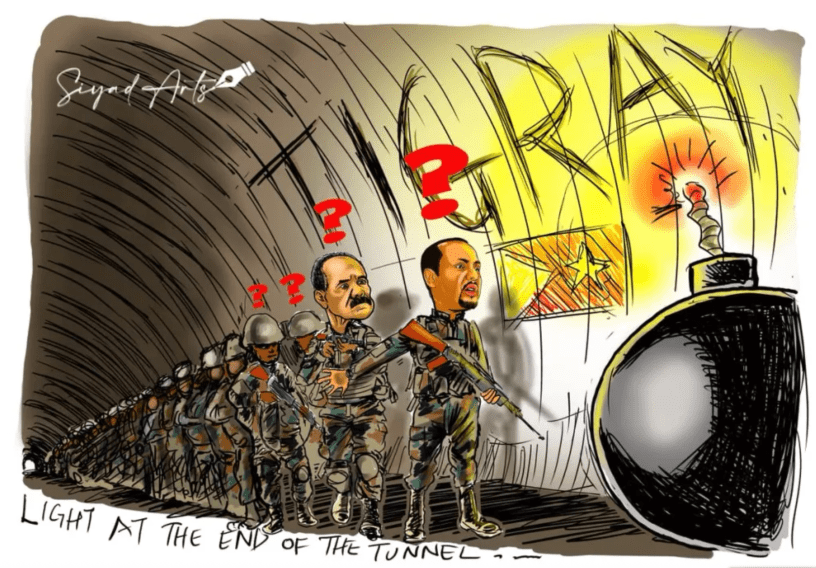
The Horn’s tragedy is not that elites lack plans. It is that their plans repeatedly treat human beings as expendable inputs.
By Selam Kidane

A dangerous political culture is hardening across the Horn of Africa: one in which moral inversion becomes governance, and the public is asked to accept cruelty as “realism”. In this Pathocratic culture, the most ruthless actors do not merely seize power. They normalise deception, weaponise grievance, and trade human lives for political position.Cartoon: Siyad Arts (reproduced from the artist’s work; rights belong to the creator)
What makes this moment especially perilous is not only the risk of renewed conflict, but the speed with which elites are attempting to launder their own histories. Yesterday’s perpetrators are offered as today’s partners. Yesterday’s allies reinvent themselves as today’s avengers. And yesterday’s victims are suddenly declared “brothers” when it becomes tactically useful.
The scripts are changing. The method is constant: promise a noble end, legitimise criminal means.
Rehabilitation as “pragmatism”
One of the most alarming manoeuvres in the region is the growing willingness…explicit or implied…to rehabilitate Isaias Afwerki and the People’s Front for Democracy and Justice (PFDJ/ሻዕብያ) as plausible agents of stability. This is presented as pragmatism: a hard-headed response to the region’s shifting threat perceptions.
But pragmatism that ignores the human record is not realism, it is complicity.
Human rights reporting has documented grave abuses in the Tigray war, including systematic sexual violence by Ethiopian and Eritrean forces and continuing violations after the ceasefire. Abiy Ahmed himself has now publicly accused Eritrean troops of mass killings during the war, an extraordinary pivot, given Eritrea’s role as a core wartime ally at the outset.
Rehabilitation, in this context, is not a peace strategy. It is an impunity strategy, one that tells survivors that their suffering is negotiable, and tells perpetrators that time and narrative management can substitute for accountability.
The siege logic: starving a society into submission
The moral heart of the problem is not only who shakes hands with whom. It is the acceptance of a governing logic in which siege, starvation, and collective punishment are treated as legitimate tools.
During the war, the humanitarian catastrophe in Tigray was widely linked to severe restrictions on aid and basic services. UN briefings described the region as being under a “de facto humanitarian blockade,” driving famine-like conditions. Reporting and analysis repeatedly highlighted how the cutting of banking, electricity, telecommunications, fuel, and the obstruction of humanitarian access helped create mass deprivation.
In 2021, Reuters reported allegations from a senior UN official that starvation was being used as a weapon of war and accused Eritrean forces of deliberately starving the population—claims Eritrean authorities rejected.
The point is not to litigate every actor’s intent here. The point is this: once siege logic enters political life, it rarely exits. It becomes reusable. It becomes thinkable. It becomes “an option”.
That is why the “end justifies the means” argument is a trap. In reality, the means do not merely lead to the end…the means become the end: a society restructured by hunger, trauma, stigma, and broken trust.
The convenient reversal: from architect to avenger
Pathocracy thrives on reversal. Leaders who were central to escalation later recast themselves as correctives to the very disaster they helped enable.
This is visible in Abiy Ahmed’s evolving story about Eritrea. This month, he accused Eritrean troops of mass killings in Tigray while emphasising Ethiopia’s current grievances against Asmara. The reframing is politically efficient: it moves the speaker from implicated actor to moral prosecutor. It compresses shared responsibility into a single external villain. It invites the public to forget that alliances were chosen…and that civilians paid the price.
This rhetorical pivot would be less alarming if it were paired with a serious, credible accountability agenda. Instead, it is unfolding in parallel with the return of nationalist mobilisation around a strategic prize: the Red Sea.
Assab as mythic prize
Assab…Red Sea access rhetoric is now being presented as an “existential” question for Ethiopia, a framing that can calm audiences with assurances of peace while keeping grievance permanently primed. In 2025, Reuters quoted Abiy saying Ethiopia had no intention of going to war with Eritrea for sea access, even as tensions rose and observers warned of conflict. Al Jazeera reported the same message: “no conflict for sea access,” delivered amid renewed fears of war between the neighbours.
This is precisely how pathocratic mobilisation works. A leader can promise restraint while sustaining a national narrative that makes confrontation feel inevitable…or later, feel justified.
And on the Eritrean side, the response is equally familiar: sovereignty panic, external threat inflation, and moral inversion. The public is warned that Ethiopia’s “dreams” must be thwarted, while the same voices soften their language toward the very people who were recently demonised.
“They are our brothers”: the late-stage rebrand
There is a particular cruelty in watching elites discover “brotherhood” only after the killing has been done, and only when a new alliance cycle is needed.
When leaders who presided over destruction suddenly call yesterday’s targets “brothers,” (ጽምዶ) it is not moral growth. It is risk management:
- insulating against accountability,
- re-entering legitimacy through the language of unity,
- recruiting survivors as political cover.
This is why rehabilitation narratives are so dangerous. They convert profound trauma into a bargaining chip and invite survivors into a politics that is designed to erase them.
A different standard: accountability before alliances
The region does not need another round of tactical partnerships among elites. It needs a different standard…one that refuses to treat civilian suffering as an instrument of statecraft.
That standard starts with four non-negotiables:
- No perpetrator rehabilitation without accountability.
- No strategic “prize” worth another mass atrocity (Assab included!).
- No future built on siege logic…because societies starved into submission do not emerge stable; they emerge shattered.
- No peace without truth…not curated narratives, not convenient reversals, but credible investigations, reparations, and guarantees of non-repetition.
The Horn’s tragedy is not that elites lack plans. It is that their plans repeatedly treat human beings as expendable inputs. In this theatre of moral inversion, everyone claims a glorious end. But the means: hunger, repression, and the laundering of violence, will annihilate the people long before any promised end is realised.
 Martin Plaut