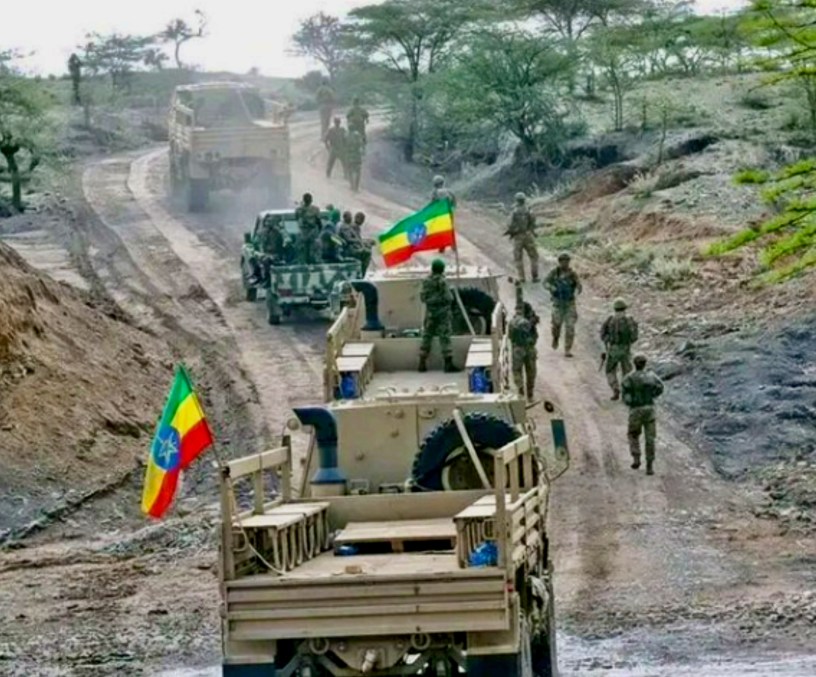
A state of maximum alert and artillery convoys heading north does not feel like posturing, nor the substantial mobilisation of forces to the detriment of security elsewhere. War may yet be avoided, and hopefully it is– the country and particularly the Tigrayan people cannot afford another calamitous war. Ethiopia has stood on this precipice and stepped back, especially under concerted pressure from the US and others. But logistics rarely lie, and armies do not redeploy across half a country without intent, and even if this is brinkmanship, it is extraordinarily perilous.
Source: Sahan – Ethiopia cable Issue 319 | 17 February, 2026
In the days before the full-scale Russian invasion of Ukraine in February 2022, Moscow quietly pre-positioned field blood supplies along the Ukrainian frontier. Contrary to those arguing that Russia was posturing to secure concessions from Kyiv and its allies, to military analysts, the deployment of plasma was a logistical signal that Russia was preparing for sustained combat, not bargaining. No one is tracking the movement of plasma —or lack thereof —towards Tigray in Ethiopia, but with thousands of soldiers streaming towards the northern region, it is hard not to feel an impending dread that full-scale war may soon return.
A caveat– Addis has been on the edge of conflict with Tigray and/or Eritrea for over 12 months now, repeatedly advancing forces coupled with surging belligerent rhetoric before pulling back. But recent clashes in western Tigray between Tigrayan forces and government forces, followed by a handful of drone strikes in central Tigray, have escalated these long-simmering tensions further still. And the large-scale troop movements of recent days appear to represent a sea change, with federal forces being pulled from Wollega in Oromia, Metekel in Benishangul-Gumuz, Jigjiga, Harar, and Dire Dawa in eastern Ethiopia, and across the Amhara region, including Bahir Dar, Debre Berhan, and Central Gonder, towards Tigray. Heavy weaponry appears to be on the move towards Tigray, too, with widely shared images of artillery units and requisitioned trucks heading northwards.
At some point, military logic may supersede the months of teetering peace and flurry of accusations from Addis, Asmara and Mekelle. Further fueling fears of war has been the Ministry of Defence’s declaration of a state of maximum alert and a call for thousands of discharged and retired officers to return to the army. The Ethiopian Army General Staff has now opened registration for experienced combat troops, though with stringent conditions to weed out any disloyalty to the federal government. Addis has been badly burnt by such ‘disloyalty’, with thousands of former Amhara Special Forces officers fighting for the raging Fano insurgency, most prominently former commander General Tefera Mamo–known as the ‘Simien Lion.’ The successive decimation of the Ethiopian military’s officer corps by defections and intense fighting in Tigray, and now in Amhara, has left the ENDF without experienced commanders. Accelerated training programmes for deployment in Amhara and Oromia had already been in place for some time.
Meanwhile, a series of last-ditch —and far too belated —attempts to plead with the Ethiopian prime minister have fallen on deaf ears, including those by the African Union and the Saudis. A particularly galling indictment of just how much the continent’s premier multilateral has waned, the African Union was reportedly told by the Ethiopian government to back off after it publicly offered to mediate at the end of January. This was followed by a visit to Addis by Saudi Foreign Minister Prince Faisal bin Farhan last week, who similarly sought reassurances that Ethiopia would not pursue a conflict with Eritrea, an increasingly close ally of Riyadh. Addis reportedly refused to give them. The presence of the Saudi foreign minister, however, also coincided with a flurry of attention on the activation of an Emirati-facilitated military base in Benishangul-Gumuz, training over 4,000 Rapid Support Forces (RSF) fighters for the Sudan war.
With the revelation that the RSF training base is now active, Addis has attracted criticism for abandoning its putative neutrality on the destructive Sudan war, and for further fuelling a conflict that is bleeding into Ethiopia as well. But any Saudi request for Addis to draw down this base, too, is likely to be dismissed, with Addis falling squarely into the rival Emirati camp that spans the RSF, Libya, Somaliland, Puntland, Chad, and beyond. Still, Prince Faisal is not the only senior politician anticipated in Addis from the opposing Red Sea axis in the coming days; however, Turkish President Recep Tayyip Erdogan is expected to travel to the Ethiopian capital this week. Hardly a calm moment for the Horn of Africa, Israeli recognition of Somaliland, the raging Sudanese conflict fuelled by rivalrous Middle Eastern powers, and the possible war involving Addis, Asmara and Mekelle are all likely to feature in their discussions. But while Erdogan helped broker the Ankara Accord in December 2024 and helped soothe the fraught Mogadishu-Addis relations, the Tigrayan situation is radically different. In the end, it will be Abiy that makes the call on war, as ever, in his resurrection of an imperial Ethiopia.
It is worth further reiterating that the scale and nature of any renewed conflict are difficult to gauge at this stage, but the mass redeployment of forces towards Tigray appears to go well beyond the persistent destabilisation attempts led by the Addis-backed Tigray Peace Forces (TPF) in Southern Tigray. But would Addis seek to capture and hold major Tigray towns such as Mekelle, Adwa, Adigrat and Axum again? Or seek to push out the Eritrean forces now positioned within Tigrayan territory and decapitate the Tigray People’s Liberation Front (TPLF), as it sought in November 2020? The vaguely termed ‘law enforcement operation’ provided the cover of the last war, which subsequently spiralled beyond Addis’s control. And conflict has its own momentum, particularly in an increasingly externalised region. The revelation of the RSF military camp makes it abundantly clear that any eruption of war in Ethiopia is certain to refract across its neighbours, pulling the country into a region-wide conflict system with untold consequences.
Eritrean troops are now positioned deep within Tigray, including at checkpoints near the regional capital, Mekelle. Though repeatedly denied by Asmara and the TPLF, linkages between the two have rapidly expanded in the past year, dubbed the ‘Tsimdo’ alliance, to Addis’s fury. On 10 February, the Amhara Regional State Peace and Security Bureau similarly accused Asmara and Mekelle of aiding the Fano insurgency, including by providing logistical support.
Further, the apparent large-scale military withdrawal from Oromia and Amhara nay leave a security vacuum, only partially stymied by the deployment of a host of government-allied ethnic militias. In Amhara, the Fano insurgency now numbers tens of thousands, increasingly well-armed and coordinated —quite the volte-face from the disparate bands of militias in 2023. Much of rural Amhara is now loosely held by the forces, constraining government positions to the handful of militarised towns in the region. But last week, following the partial withdrawal of government troops from the city of Debre Tahor, Fano overran it, setting ablaze a number of police and government buildings over 24 hours. Though the government retook the city, aided– as usual– by pumelling drone strikes in the Kidane Mihret and Abba Aregaw areas, Fano declared that it was expanding operations to counter the “existential threat” by federal forces.
If Abiy imagines that somehow ‘this time’ the fighting will be different in Tigray, that Tigray can be easily subdued and the TPLF cast out, he is likely mistaken. Though there is little appetite for renewed conflict, the mountainous region and the well-armed, well-trained TDF are positioned for a return to war. Nor are they blockaded, with potential access to supplies and weaponry via Eritrea if required. But despite the pleadings of other Tigrayan factions, TPLF Chairman Debretsion Gebremichael stated that the party would not “stay idle” if attacked. The gulf between the party, though, and the people it claims to represent has only grown since the end of the last destructive war in November 2022, and its persistent infighting and allegations of corruption have hardly endeared it to the Tigrayan public. Meanwhile, successive runs on banks and stockpiling of goods and fuel give an indication of the concerns that pervade the region over a possible return to war, which left an estimated 600,000 Tigrayans dead.
What is the Ethiopian comparison to Russian blood packs? A state of maximum alert and artillery convoys heading north does not feel like posturing, nor the substantial mobilisation of forces to the detriment of security elsewhere. War may yet be avoided, and hopefully it is– the country and particularly the Tigrayan people cannot afford another calamitous war. Ethiopia has stood on this precipice and stepped back, especially under concerted pressure from the US and others. But logistics rarely lie, and armies do not redeploy across half a country without intent, and even if this is brinkmanship, it is extraordinarily perilous.
The Ethiopian Cable Team
 Martin Plaut
Yes your wife is ms. TPLF