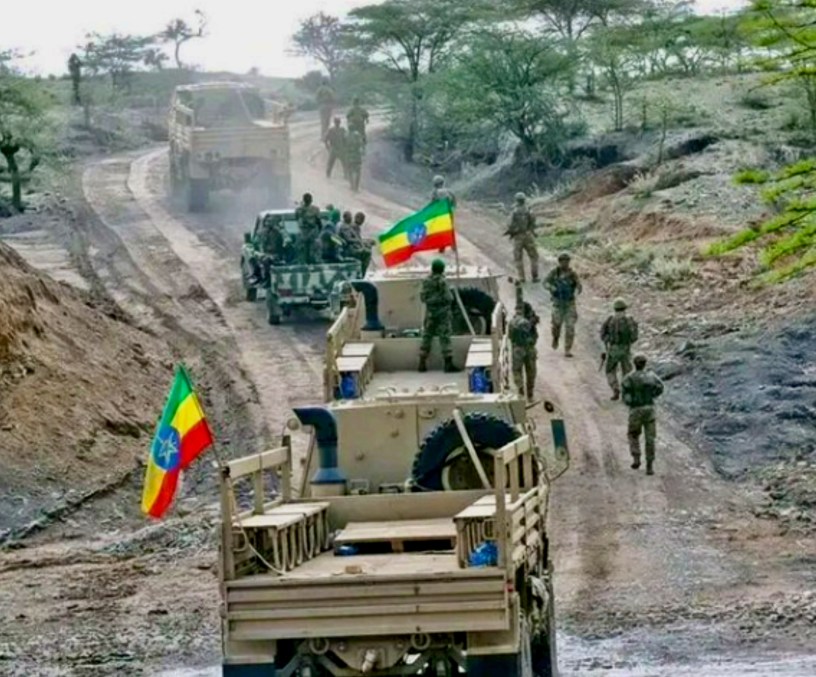
Ethiopia, Eritrea and Tigray are at risk of descending into a new conflict only four years after the region’s last major conflagration ended. While all sides appear wary of igniting a new war, simmering grievances, overblown rhetoric and military preparations indicate that they are readying themselves for that eventuality
Source: International Crisis Group
What’s new? Tensions are running high among the Ethiopian federal government, Ethiopia’s northern Tigray region and neighbouring Eritrea, threatening a return to deadly conflict three years after the last war ended. With several possible triggers, a slide toward hostilities would be easy to start but much more difficult to stop.
Why does it matter? A war would be devastating for all three players in a region where past conflicts have cost hundreds of thousands of lives. It would also overlap with the fighting in neighbouring Sudan, dragging in powerful states from outside the Horn of Africa and further roiling the volatile Red Sea region.
What should be done? Influential African states, alongside outside powers with interests in the Horn of Africa, should engage in quiet diplomacy to deter the onset of conflict. Concerned states should initiate efforts to address each side’s grievances, including Ethiopia’s desire for reliable sea access and Eritrea’s fears of an attack on its sovereignty.
I.Overview
The risk of a new war involving Ethiopia, its neighbour Eritrea and its northernmost Tigray region remains palpable just three years after the last round of deadly conflict. That war ended with the Tigrayans’ defeat by a coalition including Ethiopia, Eritrea and local forces, an alliance that disintegrated soon after a peace deal was inked in November 2022. Relations dipped further when Ethiopian Prime Minister Abiy Ahmed announced his intention to secure sovereign sea access for his landlocked country, which Eritrea fears he will try to achieve by invading. With Ethiopia and Eritrea at loggerheads, Addis Ababa accuses the leaders of the Tigray People’s Liberation Front (TPLF), its foe in the last war, of forging a clandestine alliance with Eritrea. Tensions are running high as all sides prepare for a fight, though the huge costs of another conflict are helping hold them back. To stave off a descent into war, states in Africa as well as international partners should urgently establish back channels among Addis Ababa, Asmara and the TPLF to address their differences.
Today’s jockeying among Ethiopia, Eritrea and Tigray stems from the messy aftermath of the 2020-2022 war in Ethiopia’s north east. Hostilities broke out in November 2020 after tensions between Prime Minister Abiy, who had taken power in April 2018, and the TPLF came to a boil. The war pitted Tigrayan forces against a coalition including Ethiopian and Eritrean troops, as well as paramilitary forces from Ethiopia’s Amhara and Afar regions. As in previous Ethiopian conflicts, the human toll of the battle was shockingly high, with tens of thousands killed and hundreds of thousands displaced.
A peace agreement signed in Pretoria, South Africa in November 2022 stilled the fighting, but opened new fault lines in its wake.
A peace agreement signed in Pretoria, South Africa in November 2022 stilled the fighting, but opened new fault lines in its wake. It left the TPLF weakened but still standing, laying out a vague roadmap for reintegrating Tigray into the Ethiopian federation. Meanwhile, Abiy’s wartime coalition crumbled. Both Eritrea and the Amhara felt let down by the peace deal. A network of Amhara militias rebelled against the federal government after an effort by Abiy to dismantle them. The brief rapprochement between Ethiopia and Eritrea also soured. Abiy’s publicly stated quest to regain sea access for Ethiopia angered Eritrea, which regarded it as a threat to the Red Sea coastline that Ethiopia lost following Eritrea’s 1993 independence. Ethiopia, for its part, accused its neighbour of redoubling its support for armed opposition groups and occupying Ethiopian territory in Tigray.
The peace agreement also plunged the TPLF into bitter factionalism. A core of the front’s senior leaders (often referred to as the “old guard”) turned against the deal, which had been signed when the TPLF’s military was staring at defeat. They subsequently accused the new Tigray administration under Getachew Reda, who represented the TPLF at the Pretoria talks, of allying with Abiy. In partnership with Tigrayan generals, they overthrew Getachew’s administration in March 2025, forcing its leaders to flee to Addis Ababa. Ethiopian authorities and their Tigrayan allies in turn accused the TPLF’s old guard, who had wrested back control of the movement, of forging common cause with Eritrea.
A low-level intra-Tigrayan conflict, with the TPLF arrayed against an Addis Ababa-backed group, is now escalating. Meanwhile, fighting flared in Tselemti, a district claimed by both Tigray and its neighbouring region of Amhara: in January, the TPLF sent forces into the area, where they clashed with federal troops and Amhara militias, raising the prospect that the TPLF might try to recapture better defended Western Tigray, which remains under Amhara control. The federal government responded with drone strikes and a military build-up on Tigray’s boundaries. These and other disputes, including federal efforts to prevent the TPLF from participating in forthcoming elections as well as pauses in Tigray’s federal budget subsidies, are stoking animosity between Addis Ababa and the Tigrayan capital, Mekelle, as well as embittering relations between Ethiopia and Eritrea.
Civil war in neighbouring Sudan has fuelled these tensions. Abiy is close to the United Arab Emirates, which in turn supports the paramilitary Rapid Support Forces (RSF) in Sudan’s grinding conflict. Eritrea, for its part, has sided with the Sudanese army and the associated government. It has forged a relationship with another of the army’s backers, Egypt – which happens to be a big rival of Addis Ababa’s at present due to frictions over Nile River waters. The TPLF has also tilted toward the army’s side in Sudan. With a rift also opening between the UAE and Saudi Arabia (which also favours the army), Horn of Africa politics are suffused with mistrust and apprehension about expanding conflict, while foreign mediation faces seemingly insurmountable challenges.
Until now, all sides … appear to have understood the appalling risks of outright war, which could cost many thousands of lives.
Until now, all sides nonetheless appear to have understood the appalling risks of outright war, which could cost many thousands of lives and set off an unpredictable chain reaction throughout the region. While Ethiopia remains the stronger power, with a much larger population and economy, its military chiefs seem wary of initiating a new full-scale war with Eritrea even as they go about boosting the preparedness of the armed forces. Even a limited campaign aimed at seizing an Eritrean seaport – most likely Assab – could place Ethiopia in a wider conflict with a determined adversary. Abiy may also fear the economic consequences of international censure, especially the suspension of support from the International Monetary Fund (IMF). Asmara, for its part, is in defensive mode. It is unlikely to start a major new conflict, at least not intentionally, given the existential threat that war with Ethiopia could pose. This time round, all the belligerent noises about the injustice of Ethiopia lacking its own seaport and the veiled threats to remedy it have come from Addis Ababa.
As for Tigray, federal authorities may still be reluctant to resort to all-out force to remove the TPLF from power, despite the clashes in Tselemti and its frustrations with the region’s leaders. Instead, it could opt to weaken, divide and contain the Tigrayan authorities. Tigray’s rulers may also prefer to avoid another bout of direct confrontation with Addis Ababa, given the damage to Tigrayan forces done by the last war and the resistance of much of the region’s exhausted population to fresh mobilisation.
Even so, the stakes are high and the flashpoints are numerous, making it imperative that Addis Ababa, Asmara and the TPLF establish more effective communication. Contacts should aim at the very least at stopping any skirmish or misunderstanding from escalating. To achieve this end, the main African states involved in the 2022 peace agreement – Kenya, South Africa and Nigeria – should work through the African Union to broker talks between the federal government and the TPLF. A first step would be to ease the tensions between the TPLF and its Addis Ababa-backed rival, the Tigray Peace Forces, and halt the build-up of proxy forces on both sides.
Healing the Ethiopia-Eritrea rift will be harder, but more can be done to that effect. Major powers, including the U.S., the European Union, China, Türkiye, Saudi Arabia and others, should reiterate that Ethiopian military action against Eritrea is unacceptable, while looking for ways to mediate discreetly between the sides. All those with access to Asmara from the Horn of Africa and beyond, including Kenya, Saudi Arabia and China, should urge it to end its meddling in Ethiopia so as not to provoke a direct conflict that Eritrea does not want. Foreign powers could also engage in a candid discussion with Ethiopia and its neighbours about Addis Ababa’s aspirations for more reliable sea access. Short of a devastating war, it is hard to see how Ethiopia will achieve the most ambitious versions of its demand for coastal territory. Still, the country’s neighbours, especially Eritrea, Djibouti, breakaway Somaliland, Somalia and Kenya, should be ready to talk with Ethiopia about how its legitimate concerns as a landlocked state might be addressed, including through diversifying its commercial port usage.
While all sides appear to be preparing for a return to fighting – and ominous reports of troop movements in northern Ethiopia emerged in early February – the fact that at present no one seems to be seeking to start a new war offers hope that it can be averted.
II.From Ruinous War to Fragile Peace
Ethiopia is gripped by rising tensions between the federal government in Addis Ababa, on one side, and the Tigray region and its northern neighbour, Eritrea, on the other. The standoff is partly a relic of the 2020-2022 war, which pitted the TPLF – the dominant political party in Tigray – against an alliance among the Ethiopian federal government, various armed groups and Eritrea. That war followed a rapid deterioration in relations between Addis Ababa and Mekelle after the Ethiopian People’s Revolutionary Democratic Front (EPRDF) national government, which the TPLF had dominated, collapsed in 2018.1
The prime minister who then took charge of Ethiopia and continues to rule the country to this day, Abiy Ahmed, hails from the country’s largest ethnic group, the Oromo. After his accession, Abiy purged leading officials, many of them Tigrayan, who had served under the EPRDF regime. Numerous other senior Tigrayan officials, for their part, were unwilling to work with Abiy or join his newly created Prosperity Party.2 Dozens of Tigrayans previously in positions of influence subsequently decamped to their home region to protect their interests and prepare for a possible confrontation with Abiy’s government.
Matters soon took a turn for the worse. In September 2020, the TPLF held regional elections in Tigray in defiance of Addis Ababa, which had postponed nationwide polls due to the COVID-19 pandemic. Relations between Tigray and Addis Ababa worsened quickly. Tigrayan troops staged a mutiny that November, capturing the army’s Northern Command based in Mekelle. The federal government responded with a full-scale offensive. Two years of brutal conflict ensued. Ethiopia’s national army, paramilitary forces from the Amhara and Afar regions, and the Eritrean military, which backed the federal government after a rapprochement between the long-time antagonists in 2018, made up one side.3 On the other were the newly established Tigrayan Defence Forces (TDF), formed out of Tigrayan members of the armed forces, the paramilitary Tigray Special Forces and locally recruited militias. The war ebbed and flowed, but in the second half of 2022 Abiy’s coalition made a decisive advance into Tigray, forcing the outgunned TPLF to sue for peace in November 2022.
The deal that ended the war came with a promise to restore federal authority and essential services to Tigray, in return for which the TPLF’s forces would demobilise.4 It was also agreed that the region would be governed by an interim administration, funded from the federal budget. Led by the TPLF’s former spokesperson, Getachew Reda, who had signed the peace accord on the group’s behalf, the administration would have a two-year mandate. Getachew had narrowly won an internal election to lead it, though many senior TPLF figures were unhappy with this outcome. Their original choice was Debretsion Gebremichael, Tigray’s pre-war president, but Abiy, who retained veto power in selecting the administration’s leader, had ruled him out.5 Abiy’s refusal sowed seeds of division within the TPLF that would grow over the next two years.
As well as fracturing Tigray’s main political force, the messy end to the war scrambled relations among the main belligerents.
As well as fracturing Tigray’s main political force, the messy end to the war scrambled relations among the main belligerents. A first casualty was the short-lived alliance between Ethiopia and Eritrea. The federal government’s decision to make peace with the TPLF angered Isaias Afwerki, the Eritrean president, who harboured a deep enmity for the movement due to its role as the dominant party in the EPRDF coalition that had fought a border war with Eritrea from 1998-2000. Isaias stated in early 2023 that the peace agreement was designed to “[halt] the military progress and advances of the counter-offensive [against the TPLF]”, when his preference was to inflict a thorough defeat.6 Abiy, in contrast, was prepared to allow a weakened TPLF to retain political control of Tigray so long as the new regional leadership stayed under his influence.7
Relations between the Amhara region and the federal government also nosedived. In April 2023, Abiy decided to disband Ethiopia’s regional special forces in an attempt to centralise control of the country’s security apparatus. This decision went down badly in Amhara, whose special forces, alongside locally recruited militias known as Fano, had played an important role in fighting the TPLF and occupied swathes of Tigray to which the Amhara staked historical claims. With its ranks swollen by former special forces members, the Fano launched an insurgency against the federal government in August 2023.8 Soon thereafter, Addis Ababa accused Asmara, which had invested heavily in building up the Amhara militias to fight the TPLF, of channelling support to the Fano.9 The insurgency has since dragged on for more than two years, causing thousands of deaths and spurring a mass deployment of Ethiopian soldiers to the region.10
Later in 2023, Abiy raised the stakes further by stating that Ethiopia must be free of its “geographic prison” – its landlocked status – which he and many Ethiopians regard as a constraint on its security and prosperity.11 Ethiopia lost its Red Sea coast when Eritrea seceded – initially amicably – in 1993. During Eritrea’s first five years of independence, Ethiopia continued to rely on the port of Assab in southern Eritrea for most of its foreign trade. This arrangement ended, however, when the two countries fought a war between 1998 and 2000 sparked by a dispute over the Badme border region. After the war ended, ties remained frozen and Ethiopia’s sea access via Assab was lost, leaving it reliant on neighbouring Djibouti’s port.12 Nor was Ethiopia able to use Assab during the short-lived warming of relations with Eritrea from 2018 to 2022.13 Abiy has denied accusations that he is considering taking control of a port on Eritrea’s Red Sea coast by force, but many in Asmara fear that such action is precisely what he has in mind.14
In January 2024, Abiy briefly assuaged these concerns in Eritrea when he unexpectedly came to an agreement with neighbouring Somaliland. Somaliland broke away from Somalia in 1991, but its declared independence remains unrecognised by any country except Israel. The deal reportedly gave Ethiopia access to a strip of land on Somaliland’s coastline to construct a naval base in return for promising to grant such recognition. The Somali authorities in Mogadishu reacted furiously to this announcement, while Asmara and Cairo took advantage of the spat to press their own grievances with Addis Ababa.15 For several months, relations between Addis Ababa and Mogadishu were so parlous that it seemed possible Ethiopian troops in the African Union peacekeeping mission aimed at countering Al-Shabaab, an Islamist insurgency in Somalia, would be expelled.16 But in late 2024, Türkiye intervened to broker a deal between Addis Ababa and Mogadishu (the Ankara Declaration), which in effect spelled the end of Abiy’s aspirations for a naval base in Somaliland.17 As a result, the focus of Ethiopia’s maritime ambitions appeared to shift back to Assab.
III.High Stakes in Tigray after the Conflict
With relations between Ethiopia and Eritrea on the decline, political disputes in Tigray also started to heat up as various factions of the TPLF wrestled with one another. The TPLF old guard blamed Getachew Reda for signing a peace deal they had come to refer to as the “surrender document”. Feeling sidelined under the new regional authorities, they coalesced around TPLF chair Debretsion Gebremichael and started a campaign to oust Getachew and his allies.18 They accused the interim administration of failing to kick-start Tigray’s post-war recovery and to ensure that key parts of the peace agreement were honoured. Chief among these was what they claim was Addis Ababa’s promise to return the disputed Western Tigray area (known as Welkait in Amhara), which has remained under Amhara’s control after its militias overran it during the war, to Tigray.19 Tens of thousands of Tigrayans displaced from the area have been unable or unwilling to go home.
Control of Tigray’s economy also fuelled rancour. The boom in gold mining, in which senior TDF officers are deeply involved, has stirred competition for the profits.20 TPLF factions have also struggled bitterly for authority over the Endowment Fund for the Rehabilitation of Tigray – a conglomerate of TPLF-controlled companies – and its subsidiaries.21
In August 2024, Debretsion’s faction made its move against Getachew, attempting to expel him from the party and replace him as regional president via a vote by delegates to a TPLF party congress. Getachew and allies boycotted the congress, refusing to relinquish their positions in the interim administration. The federal government sided with Getachew, stating that only Abiy could remove him from power.
At the same time as the TPLF factions were facing off, Tigray was becoming the centre of a tug of war between Ethiopia and Eritrea.
At the same time as the TPLF factions were facing off, Tigray was becoming the centre of a tug of war between Ethiopia and Eritrea. Toward the end of the 2020-2022 war, Abiy had tried to convince the TPLF leaders then in charge of Tigray, which sits on Eritrea’s southern border, to ally with Addis Ababa as a bulwark against Asmara.22 Instead, after the peace agreement, the Debretsion faction of the TPLF began to explore the polar opposite: a détente with Eritrea, built around their shared antipathy for Abiy’s government and the new administration in Mekelle, which they saw as aligned with Addis Ababa.23
Parts of the TPLF appeared to believe that a better relationship with Eritrea would protect Tigray from a future conflict in which it might again be confronted by both Addis Ababa and Asmara, the alliance that brought the region to its knees in 2022.24 Eritrean authorities, for their part, may see strategic advantage in improving relations with Tigray to deter future Ethiopian aggression. By depriving Addis Ababa of Tigrayan support, or so the thinking goes, Eritrea could establish a buffer zone on its southern border.
Another element in the warming relations between Tigray and Eritrea is their shared backing for the Sudanese army in its fight with the RSF, a war in which rival powers in the Horn of Africa have aligned with different sides. Eritrea has come to see the Sudanese army, which controls Khartoum and most of Sudan’s centre and east, as the best available ally to manage security along its western border. President Isaias is also chary of the widening footprint of the UAE, the RSF’s chief sponsor, in the Horn.25 Several thousand Tigrayans, mostly from Western Tigray/Welkait, have fought alongside the Sudanese army after being stranded in eastern Sudan during the Tigray war.26 Egypt, Ethiopia’s other most important regional rival, is also a close wartime ally of the Sudanese army.
For much of the war, Ethiopia was careful to maintain an official stance of neutrality, though it cultivated friendly ties to the RSF whereas its relations with Sudan’s army were often strained. From late 2025, however, the Sudanese army started to accuse Ethiopia of providing military and logistical support to the RSF through its western Benishangul-Gumuz region, which borders Sudan, as well as by air.27 Addis Ababa’s perception that it is facing the emergence of a hostile regional alliance, including Egypt, Eritrea, the Sudanese army and the TDF, appears to be pulling Ethiopia further into the Sudan war, including through the alleged construction of an RSF training camp in Benishangul-Gumuz.28 A deeper relationship between Addis Ababa and the RSF would exacerbate the antagonism with Asmara and Mekelle. An additional factor that could inflame regional tensions is the quarrel between Saudi Arabia and the UAE that began in late December 2025.29
The resulting thaw between Eritrea and the most powerful TPLF faction, headed by Debretsion, has infuriated Addis Ababa. Many observers worried that a move by this group to dislodge Getachew, the leader of a regional administration backed by the Ethiopian federal government, and then seize power in Tigray with Eritrean support, would trigger a forthright military response from Addis Ababa.
A decision by TDF officers in January 2025 to shift from neutrality in the TPLF’s internal dispute toward support for Debretsion’s faction aggravated these concerns.30 These Tigrayan forces immediately set about removing local authorities and mayors appointed by the interim administration.31 Getachew announced the suspension of three senior TDF officers whom his administration had identified as commanding the operations.32 All three refused to stop performing their duties. With his power ebbing away, Getachew and his close ally General Tsadkan Gebretensae, a senior TDF commander during the war, fled Tigray for Addis Ababa in March 2025, accusing their opponents within the TPLF and TDF of carrying out a coup.33
Despite fears that Getachew’s ouster would spark military intervention by Addis Ababa, cooler heads prevailed. In late March, with the regional administration’s two-year term running out, Abiy replaced Getachew with Lieutenant General Tadesse Werede, the TDF commander and Getachew’s deputy, whose mandate would run until elections planned to be held nationwide in 2026. Having remained publicly neutral in the standoff between Getachew and Debretsion’s TPLF faction, Tadesse was seen as a compromise figure. Both the new powers in Tigray and the federal government believed they could work with him.34 Still, though Ethiopia had avoided a new round of conflict, the confrontation involving Abiy, the TPLF and Asmara continued to worsen.
IV.Power Struggles Intensify
Following the reconfiguration of Tigray’s regional administration, its relations with the federal government have become ever more fractious. At the same time, Addis Ababa and Asmara have traded increasingly venomous accusations and engaged in a military build-up, either directly or through proxy forces. With the danger of conflict between Ethiopia and Eritrea on the rise, Tigray risks becoming a pawn in a wider interstate struggle that could drag in Sudan, Egypt and Gulf Arab states.
Since Tadesse Werede came to power in April 2025, relations between Tigray and Ethiopian authorities have deteriorated further, while the influence of the TPLF (now in effect controlled by the old guard led by Debretsion, who have ousted Getachew and allies from the party) over the interim administration has risen.35 The regional authorities blame economic restrictions imposed by the federal government for the miserable state of Tigray’s economy, including reported constraints on fuel supplies and, even more seriously, the freezing of federal budget subsidies for a time in late 2025.36 In early December, Tadesse claimed that his administration was unable to pay civil servants and that banks were running out of cash.37
Addis Ababa also says Mekelle has made little progress in fulfilling commitments Tadesse made to Abiy when he took office.38 In particular, the federal government accuses TPLF leaders of deepening their relations with Eritrea. According to the federal authorities, the TPLF and Asmara have continued a relationship of “cooperation and coordination”, as Foreign Minister Gedion Timothewos asserted in a strongly worded letter sent to diplomatic missions in 2025.39
Addis Ababa has responded by seeking to undermine the TPLF’s hold on Tigray, capitalising on its already fraying popularity among an exhausted population. In May 2025, the National Election Board of Ethiopia deregistered the TPLF as a political party after a dispute over the organisation of a party congress.40 The same month, the election board swiftly registered the newly formed Tigray Democratic Solidarity Party (known as Semret, “solidarity” in Tigrinya), headed by Getachew from his exile in Addis Ababa.41 Rivalry among Getachew, the TPLF and the regional administration (seen as TPLF-aligned) has in turn accentuated political fragmentation in Tigray. Notably, a rift has opened between the interim administration and the Southern Tigray zone – a stronghold for Getachew, who hails from the area. An attempt by the interim administration in August to replace the local authorities in Southern Tigray triggered clashes between residents and security forces in major towns, leading to the deaths of several people.
This political rift has also emboldened an embryonic armed opposition group – the Tigray Peace Forces (TPF, known as Hara Meret in Tigrinya) – that split from the TDF earlier in 2025 and is active in the lands connecting Tigray to the Afar region.42 The group, which allegedly receives support from the federal government, has clashed with the TDF on several occasions.43 In early November, TPF-TDF skirmishes on the Tigray-Afar boundary reportedly prompted the federal government to carry out drone strikes on TDF units, which it claims had crossed into Afar territory.44
As for Tigray and Eritrea, the true depth of their current relationship is difficult to gauge.
As for Tigray and Eritrea, the true depth of their current relationship is difficult to gauge. Senior TPLF members had previously admitted to meeting with the Eritrean regime, including in Asmara, but they now deny that such close ties exist.45 Some observers nonetheless suggest that the two sides have forged a military alliance to counter Ethiopia. Others believe it is more likely that they have a looser non-aggression pact.46
More recently, the federal government has accused the TPLF of forging an alliance with the Amhara Fano, including providing military advice to the militias and acting as a conduit for weapons and ammunition from Eritrea to the groups.47 Improbable as this charge may seem, given how fiercely the Tigrayans and Amhara fought in the 2020-2022 war, it does seem likely that the TPLF and certain Fano groups have piloted local arrangements with sympathetic TDF commanders, particularly in areas of Amhara such as Wollo, which borders southern Tigray. That said, the lack of a cohesive Fano organisation, despite efforts to centralise command structures, makes a more consolidated partnership unlikely, while many in Amhara harbour deep mistrust of Tigray and Eritrea due to past antagonism.48
Beyond the issue of military alliances, a more general rapprochement between Tigray and Eritrea, known as tsimdo (meaning “engagement” in Tigrinya), does appear to be under way. The border also opened temporarily at a number of locations.49 In early October 2025, the TPLF released a carefully worded statement expressing its “appreciation and support for … people-to-people relations” and declaring its “commitment to contribute our share to elevate [them] to greater heights”.50
As relations between Tigray and Eritrea have apparently grown closer, Prime Minister Abiy has responded by stoking bilateral tensions between Addis Ababa and Asmara. He has doubled down on his plan to acquire a seaport, preferably on the Red Sea. In early September 2025, Abiy stated that the loss of the Red Sea, which “was in our hands 30 years ago … will be corrected” – giving rise to widespread speculation that he may be planning a military operation to acquire Assab.51 In a parliamentary address in late October, Abiy openly questioned the legitimacy of Eritrea’s secession, claiming that no official record of it exists, thereby implying that it was illegal.52
Alongside the bellicose rhetoric, Addis Ababa is beginning to engage with the Eritrean political and armed opposition based outside the country. Since early 2025, Ethiopia has openly hosted Brigade N’hamedu (Blue Revolution), a group that aims to overthrow the Eritrean regime. Abiy has also strengthened the federal government’s alliances in Ethiopia’s Afar region, which borders the narrow strip of southern Eritrea where Assab lies along the coast. Ethiopia is also now hosting an Afari nationalist armed group, which lays claim to southern Eritrea, including Assab.53 (The Afari people are spread among north-eastern Ethiopia, southern Eritrea and northern Djibouti.)54
At the same time, the federal government appears devoted to upgrading its military, including by recruiting more troops and expanding Ethiopia’s capacity to produce ammunition and drones, as well as by importing more drones and aircraft from outside the country.55 While such activities are not surprising on their own – given the military’s battered state after the Tigray war, as well as the number of insurgencies it is now fighting – some worry that Ethiopia is amassing stockpiles for a larger conflict.56
V.Weighing Conflict Risks
With relations among Addis Ababa, Asmara and the TPLF coming under huge strain, all sides have engaged in perilous shows of provocation. There are reasons to hope that none of the main players in a potential conflict – the Ethiopian federal government, Eritrea and the TPLF – is prepared to go to war in the immediate future. But equally, the flare-up of fighting between the TDF and federal forces in the disputed Tselemti area (see below) indicates that the region remains a tinderbox. The TPLF and Ethiopian federal authorities appear primed to test each other’s resolve. Either could edge toward the use of force despite the dangers it could entail.
Despite his belligerent rhetoric, Abiy may still be reluctant to launch a new war in Tigray. Fighting the TPLF again in its challenging home mountainous terrain is a forbidding prospect, no matter how depleted the Tigrayan forces. Ethiopia’s armed forces have also been stretched thin by fighting insurgents in the Amhara and Oromia regions.57 Another war would consume resources that a cash-strapped Ethiopia can ill afford and might draw in Eritrea, too, either directly or through military support for the Tigrayans. For these reasons, Abiy may prefer to keep undermining the TPLF for the time being, by asphyxiating Tigray through economic restrictions and political destabilisation, including backing for opposition groups.
Likewise, Abiy has cause to doubt the wisdom of attempting a military campaign in Eritrea. First, the Ethiopian top brass appear uncertain as to whether the armed forces could achieve the objectives set for them, fearing they might become bogged down in an exhausting conflict against a dogged opponent.58 An attack on Assab would leave Ethiopia dangerously exposed on other fronts, including the long boundary between Tigray and other regions, particularly given the rapprochement between the TPLF and Eritrea as well as Eritrean support for the Amhara Fano militias. Secondly, Abiy may fear the reaction of international partners, particularly the U.S. and European countries. Their support is essential for the continuation of Ethiopia’s IMF program, which in turn is integral to the government’s efforts to shore up the ailing economy.59 A war with Eritrea would also likely scare away the foreign investors whom Abiy is courting.
Eritrea is also pursuing a generally cautious approach, ensuring that its military is entrenched in strategic border areas. Given the disparity between the size and strength of the Ethiopian and Eritrean armed forces – the former dwarfs the latter – it is unlikely that Asmara would attempt a pre-emptive strike, which could also backfire, providing Abiy with a perfect excuse to attack Eritrea.60 For now, Isaias seems to be focused on nurturing relationships with Ethiopian opposition groups – notably the TPLF and Fano – as a means of overstretching and unsettling Addis Ababa. Asmara has used the same strategy with other Ethiopian opposition groups since the 1998-2000 border war, though it poses the risk for Eritrea of provoking Addis Ababa into a military riposte.
Finally, the TDF, which lost many fighters and much of its heavy weaponry during the last war, and whose numbers have been further thinned by partial demobilisation since then, has for the most part appeared loath to launch a military campaign that would bring it into sustained confrontation with federal forces.61 The TPLF’s support base in Tigray has eroded, particularly since the party has become consumed by infighting. Local people also show little appetite for more fighting, making mass recruitment for a new war with the federal authorities far more challenging.62
Displays of bravado on all sides raise the threat that a new conflict could be stirred.
That said, displays of bravado on all sides raise the threat that a new conflict could be stirred. The TPLF leadership still seems to believe that an attack on Western Tigray (Welkait), which would bring it into direct confrontation with federal forces and Amhara militias deployed there, is an option.63 There are signs that the TDF is considering this move, including a late January operation to seize control of the Tselemti district, which is also disputed with the Amhara region.64 The TDF clashed sporadically with federal forces for several days, occupying parts of the area.65 While some federal troops chose to withdraw rather than fight the TDF, the government responded robustly, immediately cancelling flights to Tigray and reportedly carrying out drone strikes on TPLF targets in other parts of the region.66 In early February, the federal government also appeared to move part of its military previously deployed in the Amhara region closer to the boundary with Tigray.67
Amid this uncertainty, the Ethiopian federal government seems to be weighing its options. Despite strong reasons for restraint, top officials still appear to be open to a major military strike on the TPLF or Eritrea.68 Neither Mekelle nor Asmara may want to start a full-scale war, but so long as the tensions with Addis Ababa continue to heighten, the danger is that a sudden move by any side could escalate at high speed. The unsettled status quo, involving the unresolved political status of Tigray, support for proxy groups from all sides and frequent angry diplomatic exchanges between Ethiopia and Eritrea, suggests that the pretexts and possible triggers of conflict are many.
Bad blood between Abiy and the TPLF over Tigray will continue to rankle in various ways. The federal elections scheduled to take place by June 2026 could be a hazardous moment, since the TPLF is barred from taking part. Given the group’s control of Tigray’s interim administration and forces, staging an election in the region would be impossible without the party’s cooperation. In the absence of a deal to re-register the TPLF with the electoral authorities, which at present seems unlikely, a more plausible scenario is that national polls take place without Tigray’s involvement.
An attempt by the TPLF to stage its own elections, with the goal of seating a new regional government to replace the interim administration, would be especially dangerous. It is unclear whether Abiy, in that event, would decide to assume federal control of Tigray or leave it be as a rogue region outside the federal system. The last such dispute over Tigrayan elections offers a worrying precedent: the TPLF’s decision to push ahead with regional polls in September 2020, which the government had postponed due to the COVID-19 pandemic, triggered a rapid escalation toward war in November that year.
On the Ethiopia-Eritrea front, two issues give cause for alarm. First, Asmara’s strategy of partnering with groups in conflict with the Ethiopian federal government – whether the Fano, TPLF or others – could backfire if Addis Ababa considers Eritrea’s interference to have reached intolerable levels. It also makes rapprochement between the neighbouring states difficult unless Eritrea can persuade Ethiopia that it has ceased its support for proxy groups. Secondly, as mentioned above, Ethiopia appears to have been making preparations for war, with a number of senior officers in the military and intelligence services working full-time to coordinate the government’s strategy toward Eritrea.69 The steady stream of accusations against Asmara can also be seen as laying out a justification for military action against Eritrea, as well as building up public support for a future offensive.
Abiy is showing no sign of backing down from his ambition of restoring Ethiopia’s toehold on the Red Sea, which he appears to view as a pillar of his eventual legacy.
Furthermore, Abiy is showing no sign of backing down from his ambition of restoring Ethiopia’s toehold on the Red Sea, which he appears to view as a pillar of his eventual legacy. In a speech to the Ethiopian parliament in early February, Abiy referred to Ethiopia’s lack of access to the Red Sea as “[un]natural”, adding that “the Red Sea and Ethiopia cannot remain eternally apart”.70 Abiy’s routes to regaining sea access by peaceful means do not look promising, raising fears he will resort to aggression despite the strong motives for restraint. Indeed, in his appearance in parliament he said, “when Ethiopians are provoked and attacked, it is inevitable that we will cause problems, not only on our own land but also in the land they call theirs” – seemingly a thinly veiled threat of action against Eritrea.71
Any effort to stave off conflict by mediating between Eritrea and Ethiopia is sure to face major obstacles. To start with, Eritrea has so far rejected direct mediation without preconditions on the sea access question, believing that Ethiopia is trying to bully it into making concessions. Furthermore, Eritrea is highly isolated on the international stage, as its authoritarian regime has few powerful friends. Even fewer outside actors have close ties with both Asmara and Addis Ababa, and some of those that do may prize their relationship with Addis Ababa above the other because of Ethiopia’s economic and political clout. As a result, Asmara distrusts the neutrality of many would-be mediators. Even if those immediate mediation challenges were overcome, it remains unlikely that Ethiopia and Eritrea could find much common ground on the core issues dividing them, whether Eritrea’s meddling inside Ethiopia or Ethiopia’s hopes of regaining its coastline.
VI.Preventing a New War
Tensions among the potential belligerents in Tigray, Addis Ababa and Asmara are high, as mistrust between the sides festers and potential flashpoints proliferate. Foreign powers with influence in the Horn should pay heed to the threat and look for ways to curb the risks of further escalation before it is too late.
The first step should be to develop back channels among all the main players that could help ensure conflict triggers are managed peacefully. The brokers of the peace agreement between the federal government and the TPLF – Kenya, South Africa and Nigeria – should endeavour to re-engage both sides under the aegis of the African Union.72 Rather than attempting to solve all the thorny problems surrounding the agreement, their objective should be to prevent the rapid unwinding of an already fragile peace. Approaches could include kindling talks between Addis Ababa and more pragmatic leaders in Mekelle, including Tadesse Werede, head of the regional administration. Key areas to focus on are preventing escalation of the clashes between the TPLF and the breakaway TPF militia, backed by the Ethiopian federal government; deterring further military action by the TPLF in territories disputed with the Amhara region; and stopping the build-up of proxy forces by Addis Ababa and Asmara.
Another focus should be the path to the 2026 federal elections. In the absence of a deal allowing the TPLF to re-register as a political party, and by extension participate in a vote, the two sides should seek to settle on a pragmatic compromise. A continuation of the administrative status quo in Tigray – through another extension of the interim administration’s mandate – appears the most realistic option, given the huge political barriers to holding polls in the region that would be recognised by the federal government.
A diplomatic back channel could also be useful in enabling Addis Ababa to convey to Tigrayan authorities what it regards as the acceptable limits to their relationship with Eritrea. The federal government could signal that it is prepared to accept continuation of the tsimdo cross-border cultural rapprochement, while drawing the line at an Eritrean military presence inside Tigray and deepening military contacts between the TPLF and Asmara.
To dilute the ill-will [between Ethiopia and Eritrea], outside powers should aim to provide space for discussions that could help avert the most disastrous outcomes.
Foreign involvement could also help manage tensions between Ethiopia and Eritrea. Relations between the two capitals are now steeped in acrimony. To dilute the ill-will, outside powers should aim to provide space for discussions that could help avert the most disastrous outcomes. Major powers, including the U.S., the EU and its member states, China, Saudi Arabia and Türkiye, should reiterate that they reject any attempt by either side to use military force against the other, even if indirectly, and that any further move toward war will badly damage the international standing of the party that makes it. As for Ethiopia, foreign powers with influence over the IMF and World Bank, particularly the U.S. and European states, should make clear that a grab for the port of Assab would force them to reconsider support from these institutions.73 They should also stress their recognition of both Ethiopian and Eritrean sovereignty and territorial integrity, as well as the terms of the Algiers Agreement, which ended the last Ethiopia-Eritrea war, and the findings of the 2002 Eritrea-Ethiopia Boundary Commission.74
There are several parties whose intervention could help turn down the temperature in different ways. Saudi Arabia, which sits across the Red Sea from Eritrea, is a major diplomatic power in the region, and is already discreetly engaging both sides, including on the risks of a conflict.75 Despite scaling back its presence in the Horn of Africa in recent years, the U.S. is also trying to deter military action, particularly through private warnings to Ethiopia. It has the diplomatic muscle to influence Addis Ababa.76 The EU, especially in conjunction with Italy, which has cultivated friendly relations with both Addis Ababa and Asmara, can transmit the same message.77 China, which has major investments in Ethiopia and in Eritrea’s mining sector as well a military base in neighbouring Djibouti, would have much to lose from a war and could throw its weight behind preventing one. Finally, the UN, whose special envoy for the Horn is based in Addis Ababa, should continue playing a coordinating role, bringing interested parties together.
In the near term, these foreign powers should work to secure commitments from Addis Ababa that it will not resort to direct military confrontation to secure its objectives; and from Asmara that it will cease its proxy activities within Ethiopia. Nearby states, especially Djibouti, Somalia (and breakaway Somaliland), Eritrea and Kenya, could in turn encourage Ethiopia to seek credible ways of satisfying the country’s legitimate desire for improved sea access. They should redouble efforts to diversify the number of seaports available for Ethiopian use and improve the infrastructure needed to reach them.78 While Addis Ababa’s ambitions to become a Red Sea power would remain unfulfilled, these steps would demonstrate that Ethiopia’s neighbours are taking its concerns seriously, especially its search for affordable, diversified, secure and reliable outlets for maritime commerce.
VII.Conclusion
Ethiopia, Eritrea and Tigray are at risk of descending into a new conflict only four years after the region’s last major conflagration ended. While all sides appear wary of igniting a new war, simmering grievances, overblown rhetoric and military preparations indicate that they are readying themselves for that eventuality. Recent skirmishes between Tigrayan and federal forces, which triggered a response from Addis Ababa involving drone strikes on TPLF targets, illustrate how local flare-ups could set a wider fight in motion. If that were to happen, Eritrea could be drawn into an interstate conflict.
Such a catastrophic turn of events is by no means inevitable. But without concerted regional and international action aimed at curbing tensions, Ethiopia, Eritrea and Tigray could find themselves party to a new regional war that would prove difficult to contain or end. Every effort should be made to avert it.
Nairobi/Brussels, 18 February 2026
 Martin Plaut