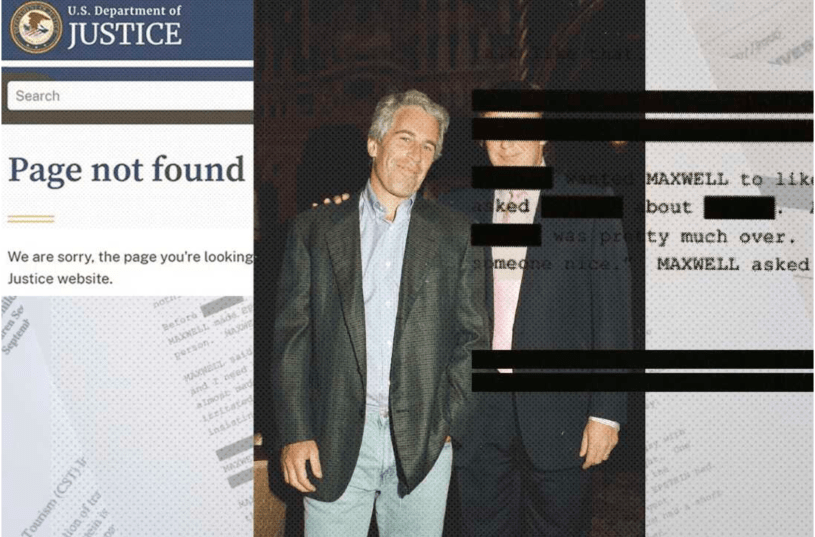
“The woman who directly named Trump in her abuse allegation claimed that around 1983, when she was around 13 years old, Epstein introduced her to Trump, “who subsequently forced her head down to his exposed penis which she subsequently bit. In response, Trump punched her in the head and kicked her out.”
Drugged, abused and told to find ‘fresh meat.’ A Hilton Head girl’s encounter with Jeffrey Epstein.
- By Marilyn W. Thompson and Mitchell Black mthompson@postandcourier.com mblack@postandcourier.com
- Feb 8, 2026
- Source: Post and Courier
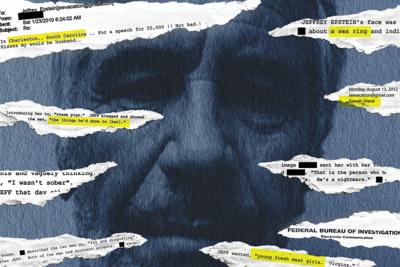
HILTON HEAD ISLAND — The call came into the FBI tip line two days after authorities arrested multi-millionaire Jeffrey Epstein. A woman said she was raped on this resort island as a teenager and was ready to tell her story.
The FBI found her details convincing enough to hurriedly arrange a meeting between agents and her lawyer.
She was one of Epstein’s earliest victims, abused, she said, at a vacation condo in Sea Pines. After her mother offered her babysitting services to rental customers and owners, Epstein lured the girl there. When she arrived, he had no children.
Before speaking to the FBI, the woman had only disclosed her story to her mother and a trusted friend. She had lived for 30 years with her memories of repeated assaults, drugging, the trauma of two other men with Southern accents in the room, and her own role recruiting other girls for Epstein on a South Carolina beach.
The summary of her interview with federal agents was among the nearly 3.5 million documents disclosed by the U.S. Department of Justice on Jan. 30 in response to a mandate passed by Congress and signed into law by President Donald Trump November. It is the most detailed allegation to date that Epstein committed crimes in South Carolina.
The documents include references to three victims who used legal services from the S.C. Victims Assistance Network as prosecutors in Florida built a case against the globe-trotting child predator.
The extensive network of victims and their attorneys railed against the DOJ for how it handled the release, complaining that materials were made public without proper redactions — including the names of victims.

The documents also offer clues about Epstein’s business connections in the state, which included dealings with several companies in Greenville and may help explain his occasional travel to the Savannah-Hilton Head airport. Of note in the files was his correspondence with a longtime friend — Gerald “Jerry” Barton — who helped develop Kiawah Island and its famous Ocean Course.
In one email exchange in early 2010, a woman identified only as “Sarah” and who called Epstein her “would-be husband” excitedly reported that she was in Charleston giving a speech for $55,000. The message coincides with a speech Sarah Ferguson, who then was British royalty and the Duchess of York, delivered at a donor appreciation event gala for a Charleston medical foundation.
Details of her assault
Among the files in the most recent disclosure were witness materials gathered for the trial against Epstein associate and longtime girlfriend Ghislaine Maxwell. Her roles included recruiting underage girls to service him at his properties in New York, West Palm Beach, Fla., New Mexico, Paris and the U.S. Virgin Islands in the Caribbean. Maxwell was convicted in 2021 of a series of sex trafficking crimes. She remains in prison.
Included among Maxwell’s trial evidence was an FBI transcription of an interview with the woman who said Epstein assaulted her on Hilton Head in the 1980s. She was among hundreds of women who said they had been molested, many of them underaged. The timing of her case would make her one of the youngest and earliest known victims.
In 2019, the woman called a hotline the FBI set up for Epstein victims. The FBI had not interviewed the woman in its initial sweep in Florida in the early 2000s. Victims have filed a federal lawsuit against the agency, accusing it of foot-dragging in investigating their claims. Epstein’s victims included many underaged girls from underprivileged backgrounds.
The woman told the FBI that her mother, who handled Hilton Head real estate in the 1980s, included her name as a possible babysitter in a flyer for renters and property owners. She arrived at Epstein’s condo thinking she was going to get paid, but he had no children.
Epstein offered her cocaine, alcohol and marijuana. Soon, things became blurry. She told agents that the experience was “like a dream,” causing her to think that Epstein slipped something into her drink.
Then Epstein began to abuse her. She said she was so young she remembered thinking, “Oh, that’s a grown man’s penis.”

Her account includes graphic details. She left that day while the sky was still light. Still in a fog, she thought, “My friends are going to love me, I found a guy with drugs.” Epstein never paid her, but she went back to see him.
The woman told agents that her assault took place inside a villa at Sea Pines Plantation, one of the earliest planned communities in Hilton Head that sprawls the southern portion of the island. It is home to an iconic red-and-white striped lighthouse and hosts the annual RBC Heritage golf tournament at Harbour Town Golf Links.
Sea Pines has changed ownership several times since the allegations. A representative with the resort said in a statement that the incidents “occurred more than two decades before The Sea Pines Resort was in existence.” They added that the resort was not contacted by the FBI.
Hilton Head shooting victim previously filed domestic violence complaint against her killer
The woman’s testimony bears close similarity to claims in a 2019 federal lawsuit filed by a Jane Doe, which included her details about the timing and the babysitting job. Her attorney previously told The Post and Courier that she got a settlement from Epstein’s estate. He did not respond to multiple requests to confirm the interview notes in the latest DOJ document release.
In recounting details of her experiences with Epstein, the teen remembered at one point wearing red sweatpants with silver material on the knees. During another meeting, she discovered a drawer filled with Polaroids.
She saw photographs of herself and wanted them to piece together what happened with Epstein during her past encounters. She was embarrassed that she was naked in the photos.
She said Epstein caught her leafing through the photos, and he told her “being nosy isn’t good for you” as he violently sexually assaulted her.
She said Epstein eventually directed her to recruit others to join him, asking her to bring “fresh meat.” She decided to seek girls nearby, hoping that providing others might spare her more abuse. Another attorney stepped in during the FBI interview to say their client mentioned the financier to girls on the beach and suggested, “If you want to party, go to Epstein’s.”

A different time, Epstein brought two other men to the house. She indicated to agents that she knew one of their names, but didn’t feel comfortable sharing it. When agents asked whether the men assaulted her, she became emotional, ending the interview for the day.
Because some of the events were 30 years old, the woman told agents she had trouble remembering every element of her interactions with Epstein. Time had blurred some details and the order of what she endured.
The woman did not tell many people before she spoke to federal agents. She said she told her mother, who is now dead, and one close friend, who appears to have lived on Hilton Head with her.
For years, she only knew Epstein as “Jeff.” Only after her friend presented a photo did she realize who he was.
A catalogue of the documents provided for the Maxwell case indicates there were additional interviews about her allegations, but those are not apparent in the DOJ files.
Epstein’s connections to South Carolina
Epstein, who started his own financial consulting business after leaving Wall Street in 2001, had an extensive global business empire. The documents include thousands of communications with clients, friends seeking financial counseling and potential investment opportunities. He followed many distressed companies, including some in South Carolina.
After serving 13 months for a 2008 Florida conviction, he returned to New York as a registered sex offender. But he remained part of Manhattan’s elite social circle and communicated with friends like Sarah Ferguson, a former member of the British royal family who was divorced from Prince Andrew. The prince was stripped of his title last year because of his involvement in the Epstein scandal.
In 2010, Epstein wrote “Sarah” asking her whereabouts. She replied, “In Charleston.. South Carolina. For a speech for $55,000. Kisses my would be husband.” A press account from the time described her arrival in the Palmetto State to deliver a speech at a fundraiser sponsored by the Roper St. Francis Foundation’s Rx Society. A hospital spokesperson confirmed her appearance but said the payment record is not readily available.
Epstein closely followed a failed investment company in Summerville, Southern Financial Group, that ran into legal troubles with the Securities and Exchange Commission. The SEC alleged that it raised money through a fraudulent scheme, and it ceased operations in 2002.
Epstein’s email correspondence with Jerry Barton, one of the Kiawah Island developers, included a 2012 exchange in which Barton bragged to Epstein about the PGA Championship in golf being hosted at Kiawah, which he called “one of the greatest second home communities in the world.”
On numerous dates, Epstein’s assistant arranged for Barton and family members to stay at an apartment building the financier owned in Manhattan, according to the documents. Barton died in 2018.
A South Carolina woman who flew on Epstein’s plane in 2002 wrote to him years later to catch up on her family and job developments.
Epstein cryptically answered her email, “Send photos.”
Justice Department withheld and removed some Epstein files related to Trump
Source: NPR – National Public Radio
Updated February 24, 20262:55 PM ET
Heard on Morning Edition
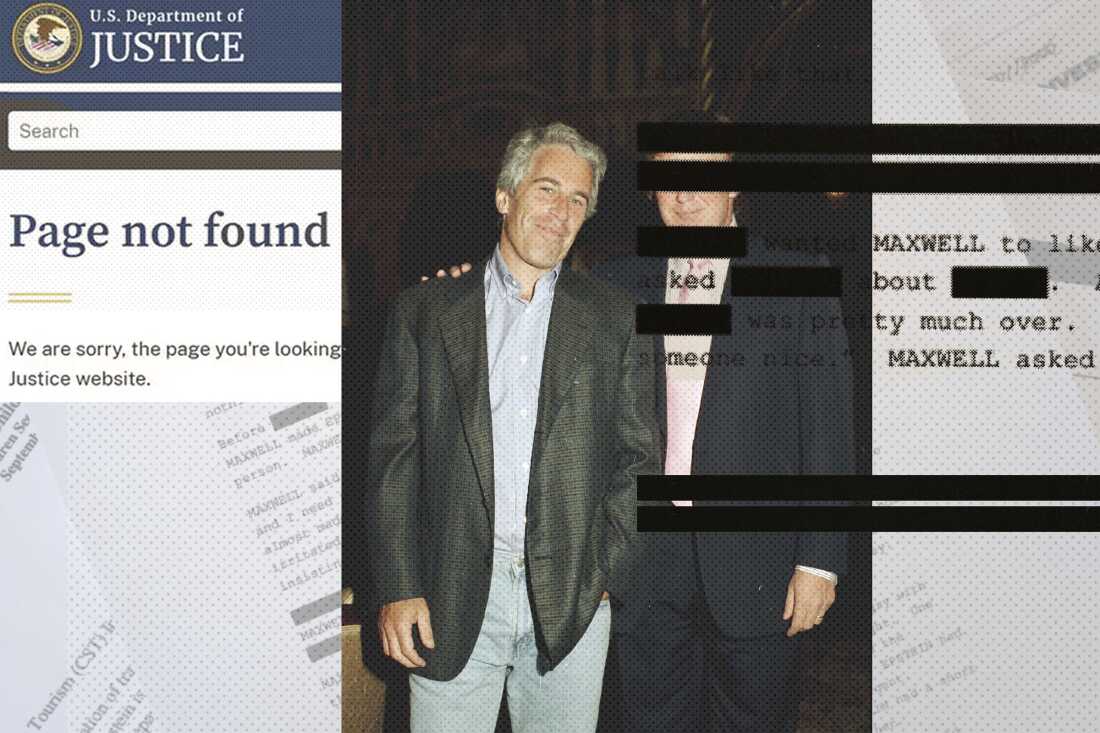
An NPR investigation finds the Justice Department has removed or withheld Epstein files related to President Trump.
Department of Justice and Getty Images/Collage by Danielle A. Scruggs/NPR
The Justice Department has withheld some Epstein files related to allegations that President Trump sexually abused a minor, an NPR investigation finds. It also removed some documents from the public database where accusations against Jeffrey Epstein also mention Trump.
Some files have not been made public despite a law mandating their release. These include what appear to be more than 50 pages of FBI interviews, as well as notes from conversations with a woman who accused Trump of sexual abuse decades ago when she was a minor.
NPR reviewed multiple sets of unique serial numbers appearing before and after the pages in question, stamped onto documents in the Epstein files database, FBI case records, emails and discovery document logs in the latest tranche of documents published at the end of January. NPR’s investigation found dozens of pages that appear to be catalogued by the Justice Department but not shared publicly.
The Justice Department declined to answer NPR’s questions on the record about these specific files, what’s in them and why they are not published. After publication, the Justice Department reached out to NPR, taking issue with how its responses to questions were framed. Department of Justice spokeswoman Natalie Baldassarre reiterated DOJ’s stance that any documents not published are privileged, are duplicates or relate to an ongoing federal investigation.
Following NPR’s reporting, the House Oversight Committee’s ranking member, Rep. Robert Garcia, D-Calif., released a statement about the missing files.
“Yesterday, I reviewed unredacted evidence logs at the Department of Justice. Oversight Democrats can confirm that the DOJ appears to have illegally withheld FBI interviews with this survivor who accused President Trump of heinous crimes,” Garcia stated.
Democrats on the House Oversight Committee have already been investigating this allegation against the president and will now open a parallel investigation into the DOJ’s decision not to release these particular documents.
How Epstein and Maxwell used an elite Midwest arts school to prey on girls
Other files scrubbed from public view pertain to a separate woman who was a key witness for the prosecution in the criminal trial of Epstein’s co-conspirator, Ghislaine Maxwell, who is serving a 20-year prison sentence for sex trafficking. Maxwell is seeking clemency from Trump.
Some of those documents were briefly taken down and put back online last week, while others remain hidden, according to NPR’s comparison of the initial dataset from Jan. 30 with document metadata of those files currently on the Justice Department’s website.
NPR does not name victims of sexual abuse.
When asked for comment about the missing pages and the accusations against the president, a White House spokeswoman told NPR that Trump “has done more for Epstein’s victims than anyone before him.”
“Just as President Trump has said, he’s been totally exonerated on anything relating to Epstein,” White House spokeswoman Abigail Jackson told NPR in a statement. “And by releasing thousands of pages of documents, cooperating with the House Oversight Committee’s subpoena request, signing the Epstein Files Transparency Act, and calling for more investigations into Epstein’s Democrat friends, President Trump has done more for Epstein’s victims than anyone before him. Meanwhile, Democrats like Hakeem Jeffries and Stacey Plaskett have yet to explain why they were soliciting money and meetings from Epstein after he was a convicted sex offender.”
The White House has previously pointed to a statement from the Justice Department that says the Epstein files contain “untrue and sensationalist claims” about the president.
In a Feb. 14 letter to members of Congress first reported by Politico, Attorney General Pam Bondi and Deputy Attorney General Todd Blanche insist that no records were withheld or redacted “on the basis of embarrassment, reputational harm, or political sensitivity, including to any government official, public figure, or foreign dignitary.”
First woman accuses Trump of sexual abuse
According to the newly released files, the FBI internally circulated Epstein-related allegations that mention Trump in late July and early August 2025. The list, collected from the FBI’s National Threat Operations Center, included numerous salacious allegations. Agents marked most of the accusations as unverifiable or not credible.
But one lead was sent to the FBI’s Washington office with the purpose of setting up an interview with the accuser. The lead was included in an internal PowerPoint slide deck detailing “prominent names” in the Epstein and Maxwell investigations last fall.
The woman who directly named Trump in her abuse allegation claimed that around 1983, when she was around 13 years old, Epstein introduced her to Trump, “who subsequently forced her head down to his exposed penis which she subsequently bit. In response, Trump punched her in the head and kicked her out.”
Out of more than 3 million pages of files released by the Justice Department in recent months, this specific allegation against Trump appears only in copies of the FBI list of claims and the DOJ slideshow.
But a review of FBI case file logs and discovery documents turned over to Maxwell and her attorneys in the criminal case against her point to one place the claim could have come from — and how serious investigators took it.
The FBI interviewed this Trump and Epstein accuser four times. That is according to an FBI “Serial Report” and a list of Non-Testifying Witness Material in the Maxwell case that were also released under the Epstein Files Transparency Act.
Only the first interview, conducted July 24, 2019, is in the public database. That interview does not mention Trump.
Of 15 documents listed in a log of the Maxwell discovery material for this first accuser, only seven are in the Epstein files database. Those missing also include notes that accompany three of the interviews. The discrepancy in the file for the Trump accuser was first reported by independent journalist Roger Sollenberger.
Powerful people, random redactions: 4 things to know about the latest Epstein files
According to NPR’s review of three different sets of serial numbers stamped onto the files, there appear to be 53 pages of interview documents and notes missing from the public Epstein database.
Source: Roger Sollenberg
FBI Interviewed Trump Accuser, Epstein Files Show
Trump was credibly accused of sexual assault in the Epstein files. It’s unclear what became of the DOJ’s investigation.
Feb 15, 2026
The FBI spoke to a victim of Jeffrey Epstein who also accused Donald Trump of sexually and violently assaulting her, according to records in the Justice Department’s publicly searchable Epstein database.
The records don’t show what became of the DOJ’s investigation into the allegations, but the documents indicate the government found her to be a credible accuser. Records elsewhere in the files reveal that a woman with matching biographical details sued Epstein’s estate and won a settlement in 2021.
The allegations and FBI interview are landmark revelations, undermining the White House’s protestations that Trump hasn’t been accused of wrongdoing and showing instead that the U.S. government has been aware of a credible Trump accuser in the Epstein files.
The DOJ included the woman’s allegation in a comprehensive 21-page internal slideshow presentation about the government’s investigations into Epstein and convicted co-conspirator Ghislaine Maxwell, well as in an internal email chain collecting information for the presentation. Her accusation is one of two about Trump that the FBI’s child sex trafficking and violent crimes task forces noted on the slide, which listed a number of then-nonpublic accusations involving prominent figures.
“[REDACTED] stated Epstein introduced her to Trump who subsequently forced her head down to his exposed penis which she subsequently bit,” the presentation says. “In response, Trump punched her in the head and kicked her out.” The victim would have been “approximately 13-15 years old when this occurred,” according to the presentation. The alleged assault took place in the early-mid 1980s, and the same woman also claimed to be an Epstein victim.
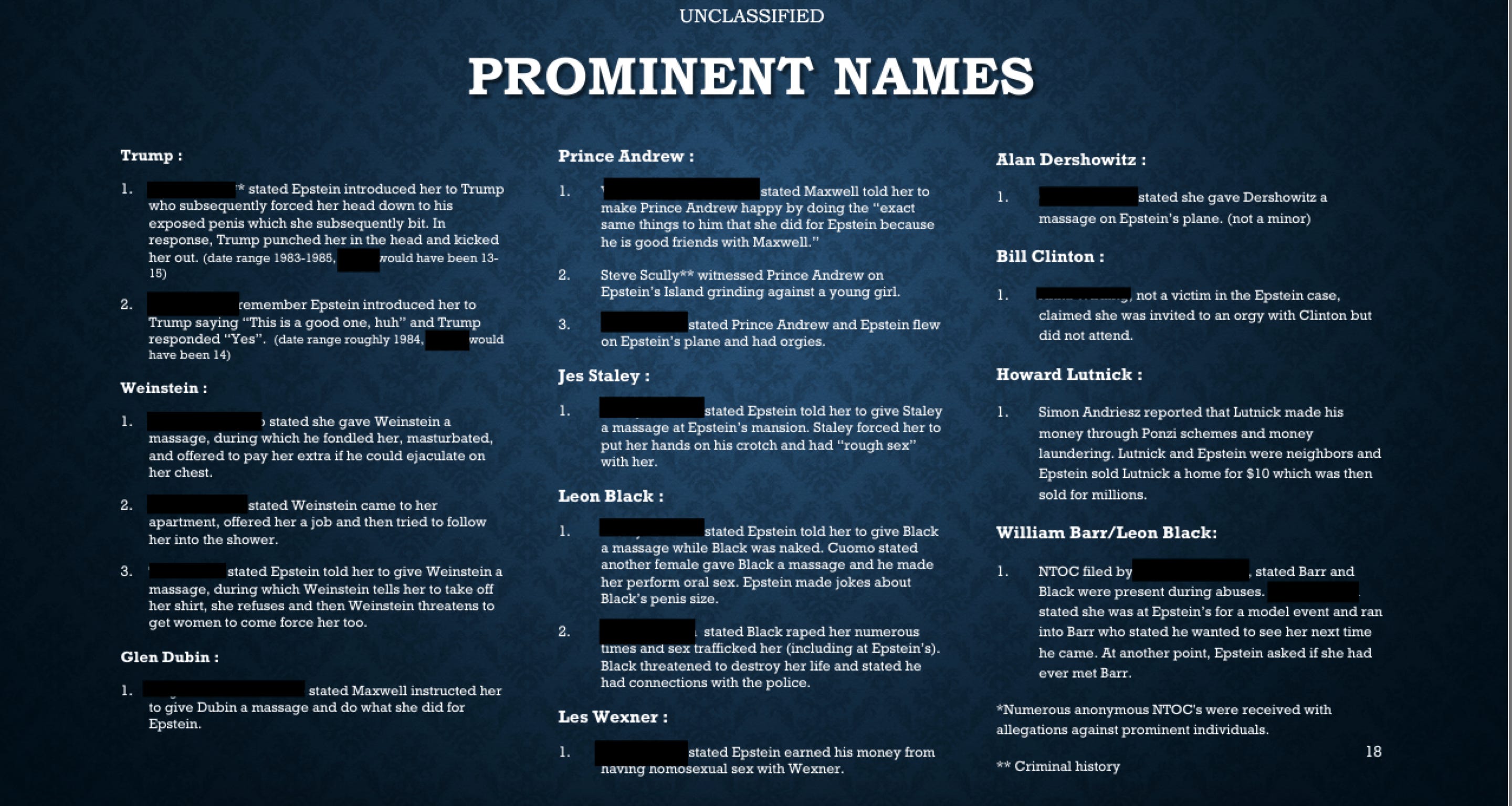
The second Trump claim on the slide — that Epstein introduced a victim to Trump when she was 14 years old, saying, “This is a good one, right?”, to which Trump agreed — carries immense credibility within the DOJ: That claim, about an incident at Trump’s Mar-a-Lago club in 1994, came from a key government witness whose testimony at trial helped DOJ prosecutors convict Maxwell, the files reveal.
Both the presentation and the email chain were created last summer, around the time Deputy Attorney General Todd Blanche interviewed Maxwell for an anachronistic jailhouse proffer.
Thanks for reading! Subscribe for free to receive new posts and support my work.Subscribe
The assault allegation initially came via a lead called into an FBI hotline, according to internal records about the hotline tips. The Trump accusation sits at the top of that list, which also contains salacious, unverified, and often bizarre accusations against Trump. The notes show the FBI followed up on the tip, learning the victim’s identity from the caller and preparing to dispatch agents to the “Washington Office” for an interview.
But the slideshow presentation and the internal emails last summer don’t cite the hotline as the source for the tip, as they do for a tip about Bill Barr. Instead, both cite the victim herself as the source of the claim, showing the FBI spoke directly with the Trump accuser. (Elsewhere on the slide, a claim about former President Bill Clinton is attributed to someone specified as “not a victim.”)
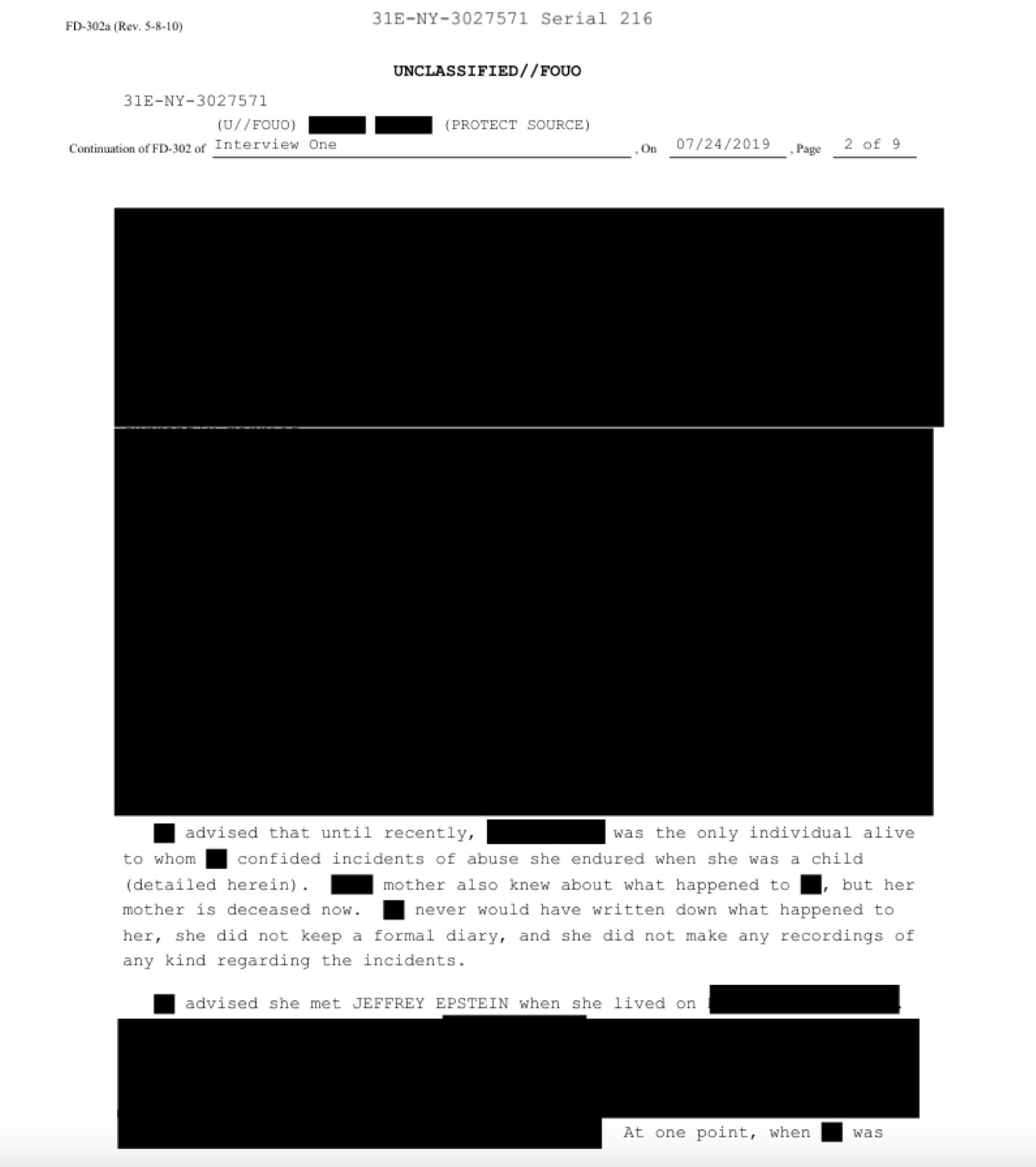
While it’s not clear what became of the investigation into the Trump claim, details from the tip match other records in the files, including an FBI writeup (known as a “302” form) of an interview with an Esptein victim and her lawyer. The interview was conducted July 24, 2019, and entered into the FBI’s case files on August 9, the day before Epstein was found dead in his jail cell.
The first two pages of the interview feature redacted blocks of text.
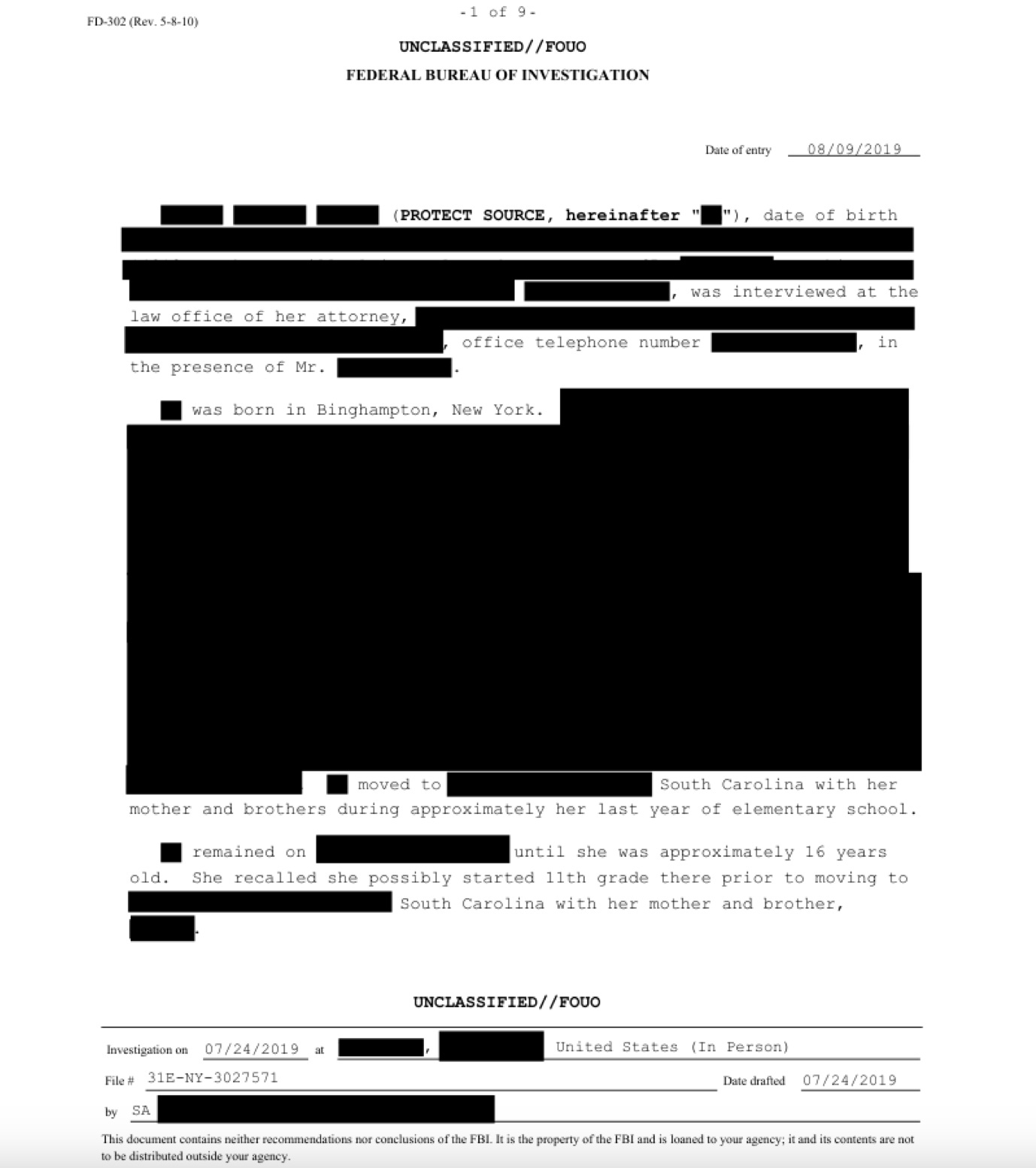
Later in the interview, the woman discussed a photo of Epstein and Trump that someone had sent her, which was still saved in her phone. The victim asked the agents if she could crop someone out of the picture — Donald Trump. When the FBI agents asked if she could explain why she wanted to crop Trump out, the woman hesitated, and her attorney answered, saying “[REDACTED] was concerned about implicating additional individuals, and specifically any that were well known, due to fear of retaliation,” the 302 says.
”Of note, the particular image sent to her by was recognized by Agents as a widely distributed photograph of JEFFREY EPSTEIN and current United States President DONALD TRUMP,” the 302 says.
Epstein database searches for this victim’s case number — 3501.045 — turn up other affiliated documents, including a July 19, 2019, memo showing the FBI’s Seattle, Washington, field office handled the interview.
The woman’s Epstein “victimization occurred in the 1980’s when the caller was approximately 13 to 15 years old and resided in the [REDACTED] Island area of South Carolina. The reported victim provided enough preliminary information to warrant a follow-up interview,” the memo says.
Those biographical details match the initial tip, which notes a criminal history in South Carolina. They also match public reporting about a South Carolina victim relocated to Vancouver, WA — close to Seattle — who filed a lawsuit against Epstein, receiving a settlement from his estate in 2021.
According to reports about the lawsuit, the victim claimed she had also been assaulted and raped by “other prominent, wealthy men” she met in other states, most specifically when Epstein took her to “intimate gatherings” in New York City. The alleged sexual and violent assault at Trump’s hands took place in New Jersey, according to FBI notes.
The woman’s reported settlement with the Epstein estate came despite a seeming paucity of hard evidence to support her claims. The 302 notes that the victim said she “never would have written down what happened to her,” only told two people about the abuse — one of whom, her mother, had passed away — and “did not keep a formal diary, and she did not make any recordings of any kind regarding the incidents.”
There’s also a seeming paucity of information about this victim in the Esptein files. Searches for the victim’s case number pull up some records — including the cropped photo of Epstein mentioned in the 302 — but some gaps appear in the FBI’s ordinal record-keeping of the files.
A master Epstein evidence manifest shows the government “acquired” at least four pieces of evidence in late February and March of last year—around the time the DOJ was conducting its initial all-hands review of Epstein records, and around the time the DOJ was returning to Trump troves of sensitive government documents he took with him to Mar-a-Lago upon leaving office in 2021.
I’ve reached out to a DOJ spokesperson for comment, and will update this piece with any response.
So far, Trump — thanks in part to false statements, misdirection, public confusion, and excessive redactions from his own DOJ — has evaded the crosshairs of credible allegations in the Epstein files.
However, this claim would contradict the narrative that the sitting president has not been credibly accused of wrongdoing in the Epstein saga.
The second claim against Trump on the slide — that “Epstein introduced [a victim] to Trump saying ‘This is a good one, huh’ and Trump responded ‘Yes’” — would appear to carry substantial credibility within the DOJ, because it came from an Epstein-Maxwell victim whose testimony helped the government convict Maxwell at trial.
A separate internal DOJ email about allegations involving Maxwell victims and prominent figures dated around the same time — July 22, 2025, days before Blanche’s jailhouse interview — includes this allegation, noting the victim “testified at trial.” The encounter occurred at Trump’s resort compound at Mar-a-Lago when the victim was 14 or 15 years old, the email states. That matches a claim in handwritten notes from 2019, where the victim recounts over several pages her traumatic history with Epstein and Maxwell. The encounter with Trump occurred around 1994-1995, the notes say.
“This is my friend [REDACTED],” the notes say about what Epstein said at the time. “Think he said friend.”
With the help of allies in Congress and the media, Trump has bulled through dozens of allegations of sexual misconduct, emerging with little political damage. But the courts have delivered significant verdicts against him: In 2023 and 2024, juries in New York found Trump liable for sexually abusing and defaming writer E. Jean Carroll, awarding her a total $88.3 million, then convicted him on 34 felony counts for fraudulently disguising payments to buy the silence of adult film star Stormy Daniels ahead of the 2016 election, weeks after leaked Access Hollywood footage revealed Trump bragging in 2005 about assaulting women “by the pussy” without fear of consequences.
While this Maxwell witness says she was not a victim of Trump, she does meaningfully undermine one of the president’s central defenses — that despite years of close friendship and socializing, Trump had not been aware that Epstein preyed on underage girls and cut ties with him once he did learn about it. Maria Farmer, an Epstein and Maxwell victim and the sister of Annie Farmer, another key witness against Maxwell, says she told the FBI twice to look into the now-dead predator’s ties to the president, in 2006 and 1996.
The 1994 Mar-a-Lago encounter with the 14-year-old came two years before Farmer’s first tip and at least a decade before Trump claims to have kicked Epstein out of his club “for being a creep,” as the White House has maintained in statements for months.
The claim adds to a growing pile of information challenging what Trump knew about his dead friend’s history of abusing and raping young women, and when he knew it. That evidence includes a lewd birthday card Trump sent Epstein in 2003, the long and deeply reported history of their socializing in the 1980s and 90s, a fully redacted email between Epstein and Maxwell discussing Epstein and Trump’s relationship, and an FBI interview with Palm Beach chief of police Michael Reiter, who said Trump told him in a 2006 phone call that Epstein’s disgusting behavior was widely known and Maxwell was “evil.”
Asked about that call last week, the White House wouldn’t confirm or deny that it occurred.
“Thank goodness you’re stopping him, everyone has known he’s been doing this,” Reiter recalled Trump saying. The chief also recalled Trump claiming he’d once encountered Epstein around a group of teenagers and “got the hell out of there.”
Epstein Files Are Missing Records About Woman Who Made Claim Against Trump
Documents released by the Justice Department briefly mention a woman’s unverified accusation that Donald J. Trump assaulted her in the 1980s, when she was a minor. But several memos related to her account are not in the files.

By Mike Baker and Michael Gold
Feb. 25, 2026Updated 12:41 p.m. ET
The vast trove of documents released by the Justice Department from its investigations into the convicted sex offender Jeffrey Epstein failed to include some key materials related to a woman who made an accusation against President Trump, according to a review by The New York Times.
The materials are F.B.I. memos summarizing interviews the bureau did in connection to claims made in 2019 by a woman who came forward after Mr. Epstein’s arrest to say she had been sexually assaulted by both Mr. Trump and the financier decades earlier, when she was a minor.
The existence of the memos was revealed in an index listing the investigative materials related to her account, which was publicly released. According to that index, the F.B.I. conducted four interviews in connection with her claims and wrote summaries about each one. But only one summary of the four interviews, which describes her accusations against Mr. Epstein, was released by the Justice Department. The other three are missing.
The public files also do not include the underlying interview notes, which the index also indicates are part of the file. The Justice Department released similar interview notes in connection to F.B.I. interviews with other potential witnesses and victims.
It is unclear why the materials are missing. The Justice Department said in a statement to The Times on Monday that “the only materials that have been withheld were either privileged or duplicates.” In a new statement on Tuesday, the department also noted that documents could have been withheld because of “an ongoing federal investigation.” Officials did not directly address why the memos related to the woman’s claim were not released.
The woman’s description of being assaulted by Mr. Trump in the 1980s is among a number of uncorroborated accusations against well-known men, including the president, that are contained in the millions of documents released by the Justice Department.
When the files were made public late last month, officials described the trove as including all material sent by the public to the F.B.I. “Some of the documents contain untrue and sensationalist claims against President Trump that were submitted to the F.B.I. right before the 2020 election,” the department said in a statement at the time, calling such claims “unfounded and false.”
Mr. Trump has repeatedly denied wrongdoing. In a statement on Tuesday, a White House spokeswoman, Abigail Jackson, said Mr. Trump had “been totally exonerated on anything relating to Epstein.”
A lawyer who previously represented the woman in a lawsuit against Mr. Epstein’s estate declined to comment.
The missing records deepen questions about how the Justice Department has handled the release of the Epstein files, which was mandated by a law signed by Mr. Trump last year after bipartisan congressional pressure.

Under the law, the Justice Department can redact material that could be used to identify Mr. Epstein’s victims, depicted violence or child sexual abuse, or would hurt a continuing federal investigation. But the law expressly prohibited federal officials from withholding or redacting materials “on the basis of embarrassment, reputational harm or political sensitivity” to public figures.
Some lawmakers and survivors of Mr. Epstein’s abuse have strongly condemned the department for how it handled redactions, noting that details identifying some victims were left exposed and nude photographs of young women were included in the public release, while material related to claims of abuse by other men had been heavily redacted.
The woman who made the accusation about Mr. Trump came forward in July 2019, days after federal investigators arrested Mr. Epstein on sex-trafficking charges, according to records in the public files of tips the F.B.I. received during that period. She claimed that she had been repeatedly assaulted by Mr. Epstein when she was a minor in the 1980s, according to a summary of an F.B.I. interview with her on July 24, 2019.
The F.B.I. did three subsequent interviews to assess her account in August and October 2019 and made a summary of each interview, according to the index of records compiled in the case. But the memos describing those three interviews were not publicly released.
The public files do contain a 2025 description of her account, as well as other accusations against prominent men contained in the documents. In that 2025 memo, federal officials wrote that the woman had said that Mr. Epstein introduced her to Mr. Trump, and that she claimed Mr. Trump had assaulted her in a violent and lurid encounter. The documents say the alleged incident would have occurred in the mid-1980s when she was 13 to 15 years old, but they do not include any assessment by the F.B.I. about the credibility of her accusation.
The Times’s examination of a set of serial numbers on the individual pages in the public files suggests that more than 50 pages of investigative materials related to her claims are not in the publicly available files. The missing materials were reported earlier by the journalist Roger Sollenberger on Substack and by NPR.
Representative Robert Garcia of California, the top Democrat on the House Oversight Committee, said that when he reviewed unredacted versions of the Epstein files at the Justice Department on Monday, interview summaries related to the woman’s claim were also missing from that trove.
“Documents that are listed, which should be included, which are referenced in other documents, are not in the files,” Mr. Garcia said. He added that the Justice Department had also not provided them to the Oversight Committee, which issued a subpoena last year for all of the Justice Department’s investigative material regarding Mr. Epstein.

Mr. Garcia said the Justice Department had not provided a proper explanation for why the materials were missing. Democrats plan to open a separate investigation into why the documents are not available.
In the sole summary of the F.B.I. interview that was released, the woman told investigators that she did not know Mr. Epstein’s full identity until 2019, when a friend sent her a photograph of Mr. Epstein. She said she then recognized the person who she said had raped her.
The woman told the agents she still had the photo on her phone, and they noted that it was a widely distributed photo of Mr. Epstein and Mr. Trump, according to the document. She gave the agents permission to take a photograph of the image but asked them to crop out Mr. Trump. When asked why, her lawyer interjected that the woman “was concerned about implicating additional individuals, and specifically any that were well known, due to fear of retaliation,” according to the F.B.I. memo.
It is unclear exactly what F.B.I. agents learned about her claims related to Mr. Trump in their three subsequent interviews.
The woman spent most of the interview on July 24, 2019, describing in detail what she said were repeated violent assaults by Mr. Epstein that she had endured, as reported earlier by The Post and Courier. She said that as a teenager in South Carolina, she was asked to babysit at a house on Hilton Head Island. But after she arrived, there were no children to babysit, and only a man she came to know as Jeff who she said plied her with alcohol, marijuana and cocaine. She described him raping her on multiple occasions.
The woman joined a lawsuit later in 2019 against Mr. Epstein’s estate. She subsequently dropped her claim. Court records do not indicate if she received any financial settlement. A court record from 2021 said she was separately deemed ineligible for compensation from a fund set up for Epstein victims, but it did not specify why.
Julie Tate and Dylan Freedman contributed reporting.
Mike Baker is a national investigative reporter for The Times, based in Seattle.
Michael Gold covers Congress for The Times, with a focus on immigration policy and congressional oversight.
 Martin Plaut