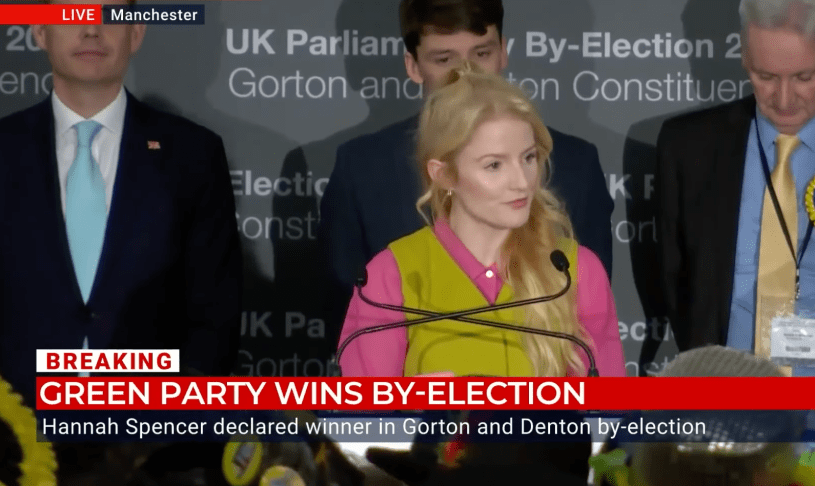
Yes, the political scenario is changing and the historical two-party system does not exists any longer, and yes, Labour (especially at the next local elections in May) will face two threats, one from the Greens and the Left-wings independents, and one from the right, not to mention the very strong competition from the Lib-Dems, but I would not exaggerate the result of Gorton and Denton.
I would stress that this is not by me, but by a friend. I think he is right. The Green Party’s candidate, Hannah Spencer won, overturning at 13,000 vote majority by Labour.
Martin
By-elections are strange beasts – they can be the indicator of a political trend at national level or the result of very specific local campaign.
In the case of Gorton and Denton it is difficult to say whether there is something deep and it is really a “seismic shift” (as the Greens try to portray it) or instead the national media attention, thousands of activists from all parties, a difficult period (to say the least!) for the national government made this result a clear exception (which is going very difficult to reproduce on a wider scale at the next general election).
Looking at some facts and recent by-elections results, I would be more inclined to support this latter analysis.
1) First of all, Labour still has a massive majority in Parliament and one single addition to the Green Party is not going to change the balance of forces in Westminster. Plus the next general election is not due for another three years, so many things can change in this very long period.
2) When voting for their local MP in a by-election, voters can use their ballots to send a message to the national government, to the national party, or to express their rage and dissatisfaction in a way that is very different from when they are called in a General Election to vote not only for their local MP but also for the Government they want to see (for this reason in the 1980s and 1990s the Lib-Dems used to gain lot of support at by-elections, but they never managed to win a General Election).
3) As I said above, the particular circumstances of this by-elections with the Greens pouring 2000 activists (and Reform 500, and the Labour party a swarm of Ministers and local councillors) every weekend in the constituency are going to be very difficult to reproduce at the next General Election.
4) If we look at the results of some recent by-elections, it is clear that the consequences of those votes in the following national elections are not so “defining” as they were described at the time of the by-election result:
ROCHDALE (February 2024) – it was the first time none of the three major historical parties(Labour, Tory and Lib-Dem) was in the first two position at a by-election.
George Galloway won against an independent, with Labour pushed in 4th position (though they disqualified their own candidate): it clearly signalled a disaffection of Labour voters for the war in Gaza and presaged a success of left-wing independent candidates at the next GE, but Labour regained the constituency a few month later (and only a handful of independent left-wing candidates managed to be elected in July 2024).
MID-BEDFORDSHIRE (October 2023) – Labour Alistair Strathern managed to overturn a 24,664 conservative majority (Labour in Gorton had a majority of 13 thousand). Clearly a message to the national Government that they had lost the confidence of the general public, though at the next General Election the Conservatives managed to re-gain the seat (despite the massive national swing for Labour).
CLACTON (October 2014) and ROCHESTER AND STROOD (November 2014) – the first two Parliamentary victories for UKIP: the sitting Tory MPs defected to Farage’s party and resigned; both were re-elected at the by-election, creating speculation that the party was ready to replace the Tory. At the next GE in 2015, the Tory managed to regain Rochester, while Carswell in Clacton was the only UKIP member elected.
On the other hand, I can mention many by-elections that were signalling a real shift in the public opinion’s attitude: the most recent are Tamworth (October 2023), Wellingborough and Kingswood (both on the same day in February 2024), where the Labour gains at the by-elections were later confirmed at the next General Election in July, but I would also like to mention the Richmond Park by-election in 2016, where the surprising victory of Sarah Olney was a real change and the shift to the Lib-Dems continued in the following General Elections (though she lost for 45 votes the the next General Election in 2017).
So, while the result of Gorton and Denton is clearly a stunning victory for the Greens, and an alarm bell for the Labour Government, I would be extremely cautious to see in this by-election an historic shift, or even a precedent for the next General Elections.
Yes, the political scenario is changing and the historical two-party system does not exists any longer, and yes, Labour (especially at the next local elections in May) will face two threats, one from the Greens and the Left-wings independents, and one from the right, not to mention the very strong competition from the Lib-Dems, but I would not exaggerate the result of Gorton and Denton.
 Martin Plaut