
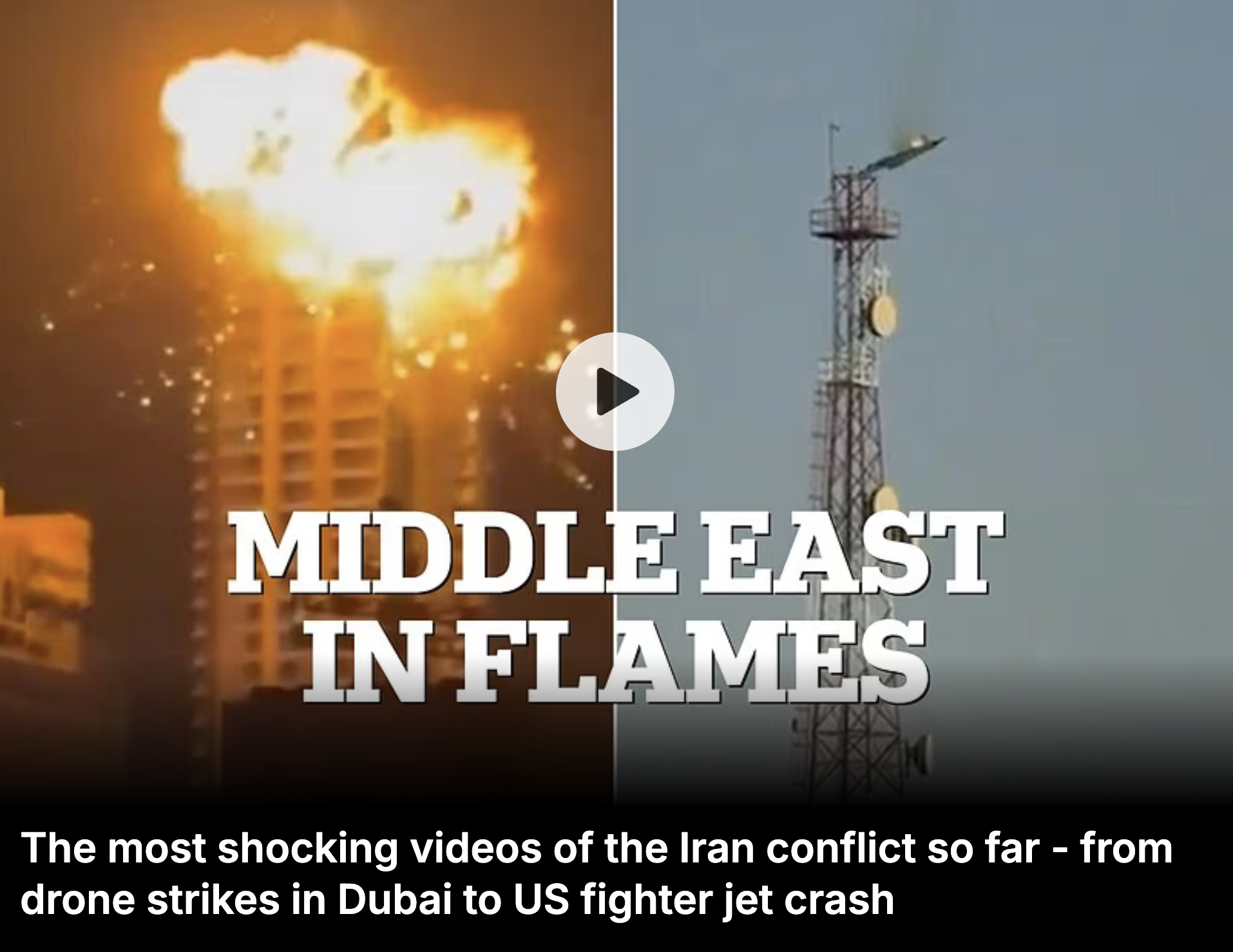
The current campaign by Israel and the USA against Iran, and Hezbollah in Lebanon is being seen as the beginning of a war that threatens to drag all the Middle East into the conflict. The headline above, by the Daily Mail, is typical.
Jeremy Bowen, BBC International Editor, warned:
“The decision by the United States and Israel to plunge into a new war with Iran creates a highly dangerous moment with unpredictable consequences…Given the capacity of the Middle East to export trouble, the eruption of renewed and intensified war deepens the instability of a region and wider world that is already turbulent, violent and dangerous.”
UN Secretary‑General António Guterres took a similar stand:
“We are witnessing a grave threat to international peace and security. Military action carries the risk of igniting a chain of events that no one can control in the most volatile region of the world.”
The evidence seems to point in the opposite direction
These are the major wars Israel has fought against its neighbours.
1948–49 at Israel’s Independence – against Egypt, Transjordan (Jordan), Iraq, Syria, Lebanon.
1956 Suez Crisis – primarily Egypt versus Israel, Britain, France.
1967 Six-Day War – Egypt, Jordan, Syria versus Israel.
1973 Yom Kippur (October) War – Egypt and Syria versus Israel.
1982 Lebanon War – Israeli invasion of Lebanon against PLO and Syrian forces.
2006 Lebanon War – Israel versus Hezbollah in Lebanon, with the Lebanese state heavily affected.
What this shows is that a declining number of states have been prepared to confront Israel militarily. In 1948 Israel fought no fewer than five Arab nations. Now it faces only Iran (which is not an Arab state) and Hezbollah (which is of course not a state).
This may be because they fear what the Israeli military might do to their armed forces (given the backing of the United States). It may also be because Arab leaders are fed up with a confrontation that has now lasted 78 years and see little to show for their bloodshed and financial commitments.
Ask yourself this
Where are Egyptian tanks, aircraft and troops? They fought Israel three times. Now they are not involved. What about Syria, Jordan and Lebanon? They are not engaged.
Saudi Arabia and the Gulf states are currently being attacked by Iran. This is because the United States maintains around 10 major military bases and facilities across Gulf states and the Arabian Peninsula (Bahrain, Kuwait, Qatar, Saudi Arabia, UAE, Oman), with additional smaller sites or access agreements. There are reported to be 40,000 – 50,000 American troops in these bases.
The question is how Arab states will respond to the current barrage of Iranian drones and rockets, designed to provoke them into striking back at Tehran. So far, they have only taken defensive action.
What about other members of the 22 strong Arab League, like Algeria, Morocco, Mauritania or Somalia? They are keeping their heads down.
Israel’s Arab communities (about 20% of Israel’s population, mostly Muslim) have historically protested Israeli military actions in Gaza, Lebanon, or the West Bank, often aligning with Palestinian causes or expressing solidarity with regional Muslim populations. However, coverage of the 2026 US–Israeli strikes on Iran shows no such demonstrations by them.
The conclusion from the evidence – so far – is that the war initiated by President Trump and Prime Minister Netanyahu has not drawn the region into the conflict. Rather, it appears to be uniting many Arab states against their Iranian neighbours.
 Martin Plaut
So this does lead me to wonder, as does the mix of celebration and grief in Tehran at the assassinations of top leaders—including Komenie. But there’s also the question, raised early and often here in the US, regarding the extent to which this war is intended as a distraction from the possible (likely?) revelations of the Epstein files as these are gradually released.
As my father used to say, We’ll see!
>
Your father was right!