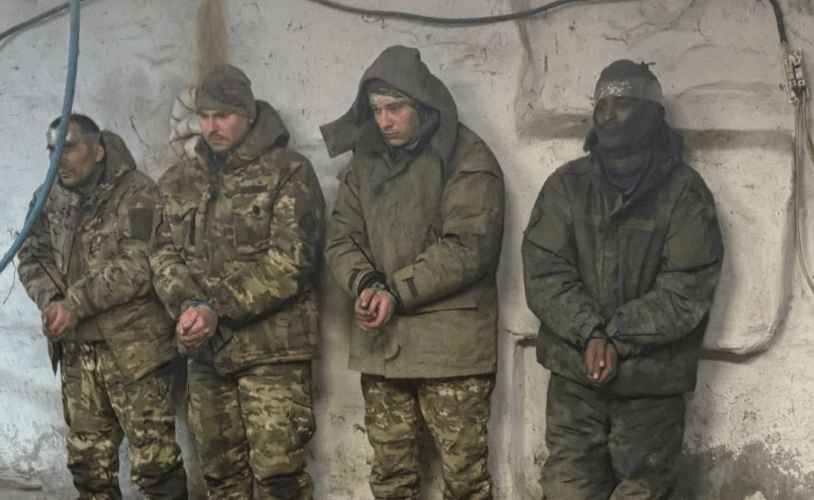
At least 1,436 people from 36 countries in Africa have been identified by Ukrainian authorities as front-line fighters for Russia. An independent French researcher suggests that as many as 3,000-4,000 Africans in total are fighting alongside the 18,000-20,000 foreign fighters in the Russian military.
Source: Financial Mail
Why Africans are dying in Putin’s war
There’s cold comfort for thousands scammed into fighting for Russia in its war on Ukraine
February 26, 2026 at 05:00 am By Chris Roper
Another Youtube report here.

There was a time when war could be romanticised, both its triumphs and tragedies. It’s not a time we should hark back to, and we certainly shouldn’t feel any sort of nostalgia. In the 21st century, we know war is just a commercial vehicle for the great powers, a terrible toss of the dice for the lesser powers, and an indiscriminate destroyer mostly of the powerless.
This is not to say that there are no wars being fought where it isn’t possible to characterise one side as brave defenders of freedom and the other as self-evident tyrants looking to impose violent regime change in defiance of international law and common reality. The Russian invasion of Ukraine is one such war, but even there the lines can be blurred.
Rupert Brooke’s World War 1 poem The Soldier is narrated by a British soldier imagining his own death in war and taking comfort from the idea that it will be a patriotic sacrifice that will help to embed the idea of Englishness into the fabric of the country in which he fought and dies. The poem begins with an octave:
“If I should die, think only this of me: / That there’s some corner of a foreign field / That is forever England. There shall be / In that rich earth a richer dust concealed; / A dust whom England bore, shaped, made aware, / Gave, once, her flowers to love, her ways to roam, / A body of England’s, breathing English air, / Washed by the rivers, blest by suns of home.”
It can, I suppose, be a comforting thought. Even though you’ve been sent to die as cannon fodder in the horrific trench warfare of World War 1, you are doing it for a purpose. The imperial aggression that has placed you in harm’s way (and Brooke did die during the war, at age 27) serves the purpose of imposing your national essence on the world. Some corner of a foreign land, where you died, will be forever England. Your death is not meaningless; you died for England. One assumes that, for the people you leave behind, this will make it feel as if it has purpose.
I can’t help thinking that the African soldiers fighting for Russia in the war in Ukraine can have no such comfort. There is no corner of a Ukrainian field that is forever Africa, or forever Cameroon, Burkina Faso or Egypt. I don’t pick those countries randomly. According to a new report by Code for Africa (CfA), there are estimates that 150 Cameroonians, 50 Burkinabe and 25 Egyptians have died in Russia’s war. (Disclosure: I am a senior strategist at CfA.)
At least 1,436 people from 36 countries in Africa have been identified by Ukrainian authorities as front-line fighters for Russia. An independent French researcher suggests that as many as 3,000-4,000 Africans in total are fighting alongside the 18,000-20,000 foreign fighters in the Russian military.
This estimate is likely to rise. Kenya’s National Intelligence Service told its parliament in late February that more than 1,000 Kenyans have been recruited to fight for Russia. Data supplied by Ukrainian authorities indicates that 42% of foreign fighters die within four months of service in the Russian army.
A February 2026 analysis by the French Institute of International Relations (Ifri) estimates that as many as 4,000 Africans are involved in Russia’s war on Ukraine, which “represents the largest involvement of Africans in an international war since the French Indochina War in Vietnam in the 1950s”.
The good news is that the last of the 17 South Africans who were conned into fighting for Russia appear to be heading home. Four of the original group who had been fighting on the front line in Ukraine’s eastern Donbas region returned last week and, according to Daily Maverick, most of the remaining men will soon fly home. A relative of one of the men was quoted as saying: “According to our knowledge, it’s 13, though we are not certain. All we can say is that the remaining men are now in Russia. We hope it’s 13.”
Not all the men are returning whole. According to eNCA, “two South Africans have been severely injured in the war in Ukraine, another is presumed captured or dead. The Russian army deployed a 39-year-old KwaZulu-Natal man to the Donbas in Ukraine. He was injured in a drone attack in December, resulting in the amputation of a foot. Another 45-year-old from the same province is in a wheelchair after a drone strike. His colleagues are unsure if his condition is permanent.”
There’s not much chance that these victims of Vladimir Putin’s war will console themselves with the idea that a bit of a frozen foreign field will be forever KZN.
How do Africans end up fighting an unjust war on the side of the aggressors? One way, according to the CfA report, is that they get recruited by Russo‑African networks of commission-based agents. Freelance African diaspora fixers in Moscow work with travel agencies in African countries. These agencies have names you’d think would raise a red flag, such as Fly Away Travel and Tour in Ghana, and St Fortunes Travels and Logistics in Nigeria.
There is no corner of a Ukrainian field that is forever Africa, or forever Cameroon, Burkina Faso or Egypt
These fixers are assisted by the Africa Corps (formerly the Wagner Group) across West Africa and the Sahel, alongside Russian embassy-supported affinity groups. They stealthily recruit and transport men, offering misleading job opportunities such as working in security, as was the case with the South African men the MK Party’s Duduzile Zuma-Sambudla allegedly sold to Russia.
Social media platforms such as Facebook, Telegram, TikTok, X and Russia’s VKontakte play an important role here. Posts promoting military service to foreigners on VKontakte alone rose from 621 to 4,600 between June and September 2025.
CfA spoke to several Uber drivers in South Africa who recounted how more than a dozen drivers were successfully recruited via WhatsApp between October and November 2025 by a Zimbabwean agent based in Russia. Some of them have since been unreachable or reported killed by landmines and drone attacks.
Recruitment is largely conducted through agents and influencers who receive payment for each secured hire. To add insult to injury, in addition to commission for agents, victims are also charged fees, “with some agents taking a substantial cut of the promised bonuses, such as one agent who received over $25,000 from the signing bonuses of 14 trafficked Ghanaians”. Agents advertise high financial rewards, including salaries of up to $3,500 and sign-on bonuses as high as $13,000.
Africans aren’t just recruited to go and die as pointless cannon fodder in Ukraine. “For factory workers, recruiters target 18- to 22‑year‑old women with secondary education by promising hospitality/automotive jobs but placing them in drone assembly.”
This recruitment is far more public and institutional, running directly through Russian embassies, African education ministries, universities, businesspeople, Brics‑linked women’s and youth organisations and pro‑Russia civil society groups that market the scheme as scholarships and career opportunities.
African nations have responded in different ways to this trafficking of Africans to die for Russia. In Cameroon, where Ifri noted an estimated 150 active service soldiers deserting from the Cameroonian military to Russia, the state has issued internal orders to restrict foreign travel and training for lower ranks.
The Egyptian government said it would revoke the nationality of any citizen who fights for Russia and warned that serving in any foreign military force can result in a life prison sentence upon return to Egypt.
The National Intelligence Service told Kenya’s parliament that some of the 1,000-plus Kenyans lured by “rogue recruitment agencies” to fight in Russia qualify as victims of human trafficking scams.
And here in South Africa we’ve benefited from the airing of Zuma-Sambudla’s alleged selling of citizens to Russia, with even our avaricious influencers for hire walking back support of Russian employment scams.
It’s all a long way from the quaint patriotism expressed in Brooke’s poem. With Africans who have been sent to die as cannon meat (the more expressive Russian term for cannon fodder), it’s more a case of “If I should die, think only this of me: that there’s some corner of a foreign field that is forever a memory of a social media scam, and of the evil aims of a colonising dictator”.
The CfA report, Techniques Used to Recruit and Co-opt African Nationals into Fighting in the Russian-Ukrainian War, can be found on disinfo.africa
 Martin Plaut