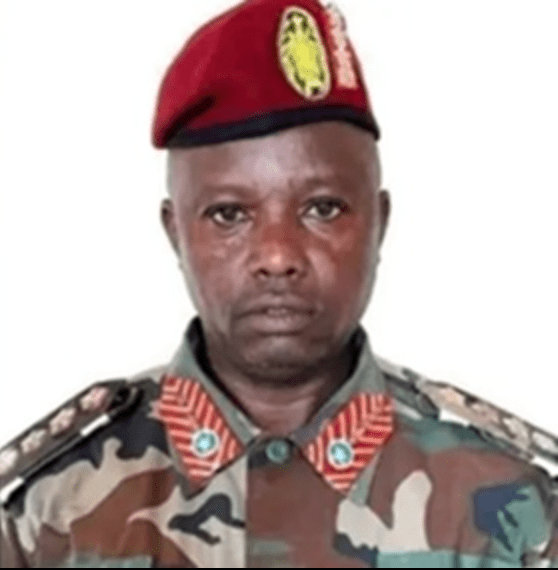
Source: Sahan Somali Wire Issue 938 | March 16, 2026
Last April, General Sheegow Ahmed Ali– once the highest-ranking military officer hailing from the Somali Bantu– died in ignominy in a Mogadishu hospital. A senior commander who had previously spearheaded operations in south-central Somalia, Sheegow had been summarily sentenced to 10 years in prison in 2023 for operating a militia in the capital. His death– mourned widely and protested in Mogadishu and Beledweyne– returned the spotlight to the pernicious issues of discrimination in the Somali National Army (SNA).
In the 20th century, American political scientist Harold Lasswell once aptly defined politics as “who gets, what, when, how.” Many years after the creation of Somalia’s so-called ‘4.5 formula’ intended to distribute power and capital across the clans equitably, the nation’s most influential political movements–intimately shaped by clan–are still awarded the lion’s share of the country’s resources, be it jobs, contracts, aid, weapons, or remittances. Attempts to address such deep-rooted discrimination within Somali society and the state have repeatedly floundered, coming up against ingrained socio-political forces– as well as centralising federal administrations. And so to borrow another maxim from Thucydides, “the weak suffer what they must”– and in Somalia, they most certainly do, with the lower-caste clans and communities bearing the brunt of Somalia’s stratified society.
Perhaps nowhere else is this more evident than in the SNA, which has a sordid history of clannism and politicisation dating back to the regime of Siyaad Barre. Having collapsed in the 1990s and subsequently reconstituted by foreign partners, the military today is still a bulging, unwieldy force, though with pockets of capacity in the US-trained Danab commandos and slivers of the Turkish-backed Gorgor troops. Precise numbers of the army, built primarily with European, Turkish and American backing, are unknown, but are estimated to have ballooned past 25,000 as Ankara continues to arm and equip new units by the day. Yet the SNA remains a cobbled-together morass of essentially clan-based militias, despite the billions of foreign dollars that have poured into it. Meanwhile, the National Intelligence and Security Agency (NISA) similarly numbers in the thousands, having degenerated into a politicised paramilitary force in recent years. Little connects these men in uniform — and they are nearly wholly male — be it Haram’ad police in Mogadishu or the 60th Brigade in Baidoa.
Yet lower-caste clans and communities are glaringly absent from both the rank-and-file and senior positions within Somalia’s security architecture, including the Somali Bantu, the Banaadiri, and the Gabooye. All three groups and many more have faced distinct forms of discrimination for decades, and particularly during and since the 1990s at the hands of more powerful warring clan militias in the wake of state collapse. In the 21st-century, though the skyline of Mogadishu may have changed, the socio-economic disadvantages for the Bantu have barely wavered as the state-building agenda has ‘progressed.’ Indeed, despite nominal reforms, soldiers from minority or lower-caste clans are still routinely overlooked within the army today, while those from dominant clans—not least the Hawiye/Abgaal in the central army—are elevated to the military’s senior echelons, regardless of competence. Even military strategy is driven by particular clan interests, with the federal government accused of diverting the best armaments to federal units dominated by the Hawiye/Abgaal and allied militias in 2025 as Al-Shabaab stormed across central Somalia.
Nor is this issue of favouritism and discrimination limited solely to the federal government; it is reflected — albeit to varying degrees — across the Federal Member States. Jubaland’s security forces, for instance, are still dominated by the Darood/Ogaden, and are especially drawn from the regional leader’s former Ras Kambooni militia. And while this may have maintained Ahmed Madoobe’s hold over Kismaayo against Al-Shabaab and the federal government, it has nevertheless accentuated resentments within the Mareehaan, who dominate the Gedo region. And it is in these legitimate grievances that Al-Shabaab percolates, playing the ‘clan card’ better than any other force in the country– despite their nominal eschewing.
Sheegow was thus a rare exception, a brilliant and symbolic officer who had risen through the ranks despite numerous hurdles, playing an influential role in offensives such as the 2014 African Union-led ‘Operation Indian Ocean.’ And for his marginalised community, Sheegow’s arrest in August 2023 was considered politically motivated, perceived as an attempt to stymy the Bantus’ gradual political mobilisation and particularly the commanders’ anticipated role in the then-forthcoming ‘Operation Black Lion’ intended to liberate southern Somalia from Al-Shabaab. The promised offensive– to be backed by Kenya and Ethiopia– planned to displace the jihadists from territories historically occupied by the Bantu or Jareer Weyne. And so Sheegow’s summary arrest, which turned violent, was considered yet another ploy by more powerful clans to pave the way for a carving up– again– of the Bantu’s homelands.
Of course, Somalia is hardly alone when it comes to discrimination shaping society, with prejudice and intolerance coming in all shapes and sizes across the globe. But gender cuts across nearly all forms of exclusion, with women’s access to power and resources doubly limited in marginalised communities. The patrilineal nature of Somalia’s clan-based social hierarchies further reflects this, with women unable to access the same levers of justice as their male counterparts despite suffering considerable gender- and sex-based violence in Somalia, for instance. And within the security sector, women are almost wholly absent as well– despite playing roles for Al-Shabaab within their much-feared Amniyaat, such as helping to smuggle and store weapons and explosives in Mogadishu. Neglecting women and marginalised communities from national security continues to represent a self-inflicted blow by successive federal governments. It is readily apparent that incorporating and promoting greater numbers of soldiers from marginalised communities would no doubt help to starve Al-Shabaab of the political vacuum in which it thrives.
Instead, Villa Somalia’s current military model of central fiat —backed by foreign hardware from Ankara, Doha, and Cairo —is no substitute for the hard yards of force generation, and has proven unable to weave together Somalia’s disparate armed forces and militias. Of course, that does not appear to be the government’s intention; rather, Villa Somalia has sought to overhaul the established frameworks of negotiated power and security for its own survival and enrichment. And that raises an incendiary issue in Somali society: who is being armed and for what purposes? And who, then, is being excluded?
It is broadly accepted that a successful military should reflect a country’s national character. But despite years of nominal capacity-building and promised reforms, the SNA still wholly fails to reflect the nuances, complexities, and tensions within Somali society– and in recent years has dwindled to a haphazard coalition of clan militias on Villa Somalia’s payroll. Until this finally changes and the government sheds its predatory nature towards its own citizens, restoring a ‘monopoly of force’ across the country will remain impossible, and Al-Shabaab will continue to fester and proliferate in the sores of the country’s body politic. And so, nearly a year after the death of Sheegow, it is hard to envisage another officer from Somalia’s marginalised communities rising so far through the ranks—let alone dying with his reputation intact.
The Somali Wire Team
 Martin Plaut