By The editorial staff of Mondafrique–
March 17, 2026
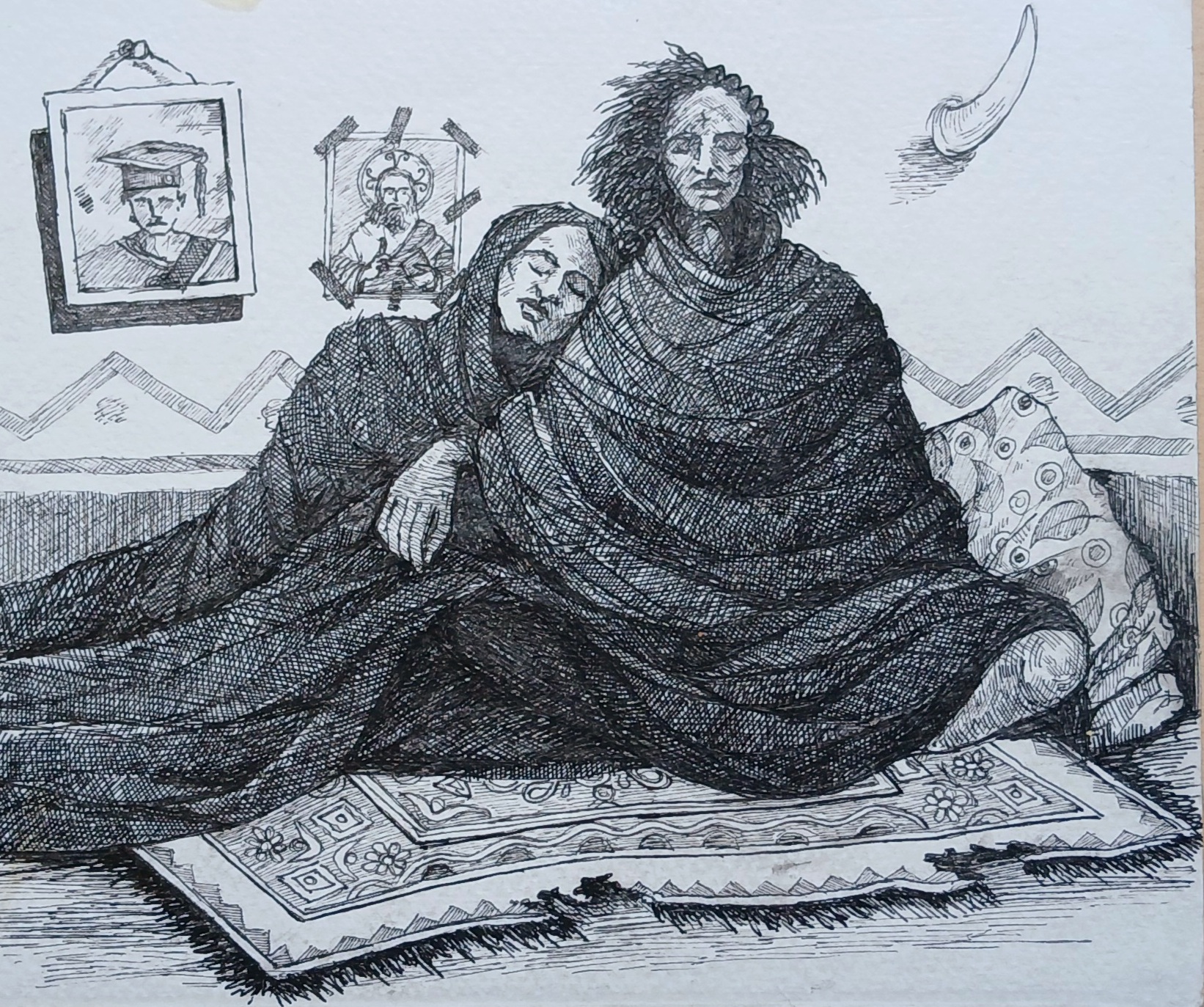
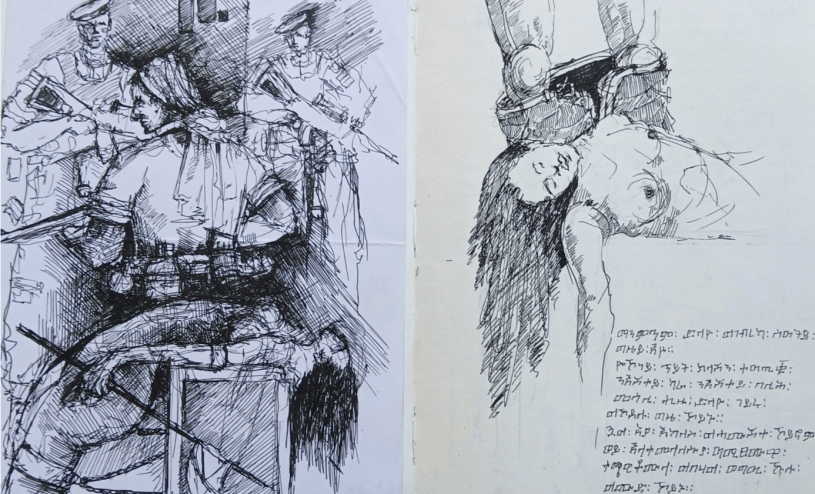
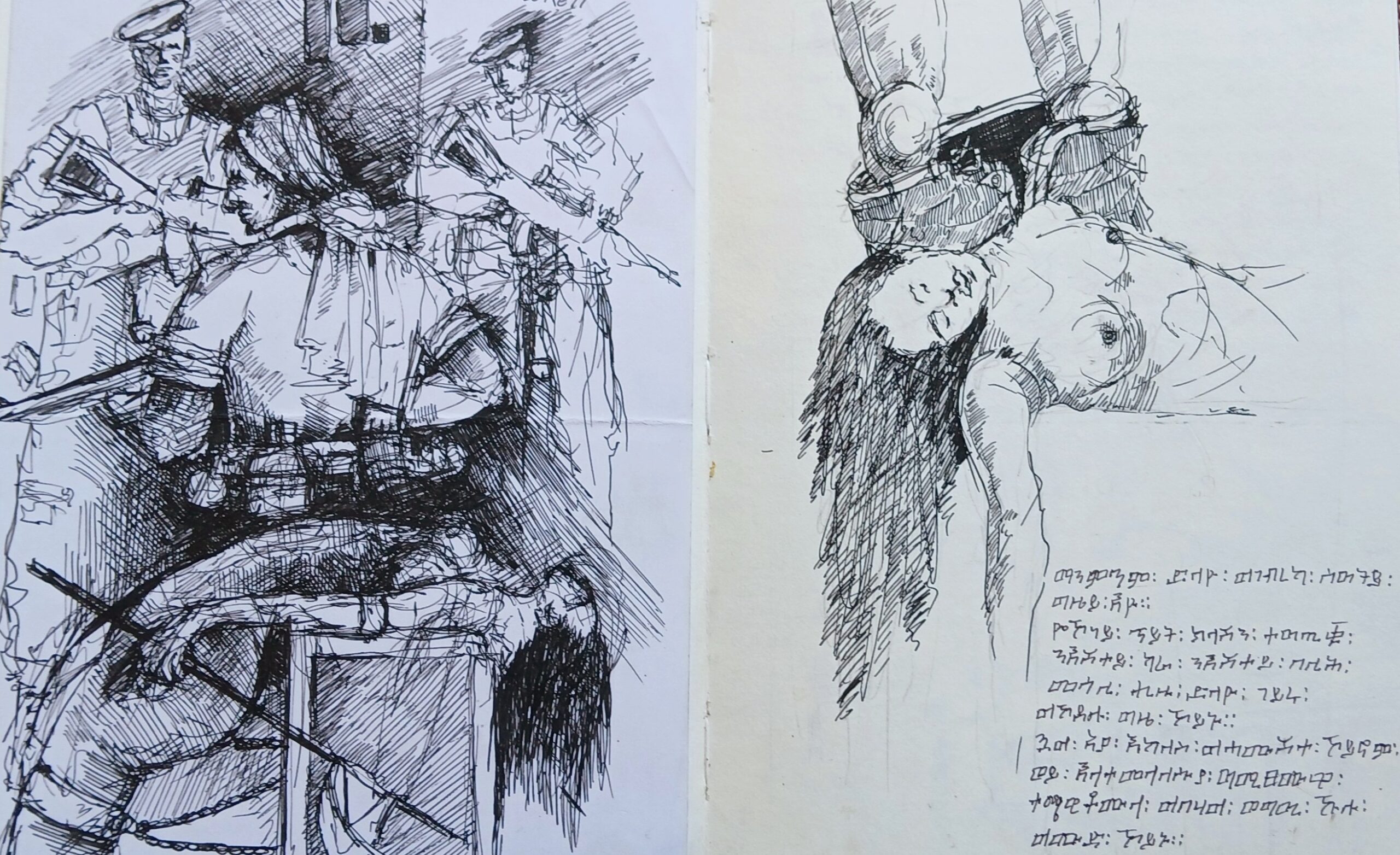
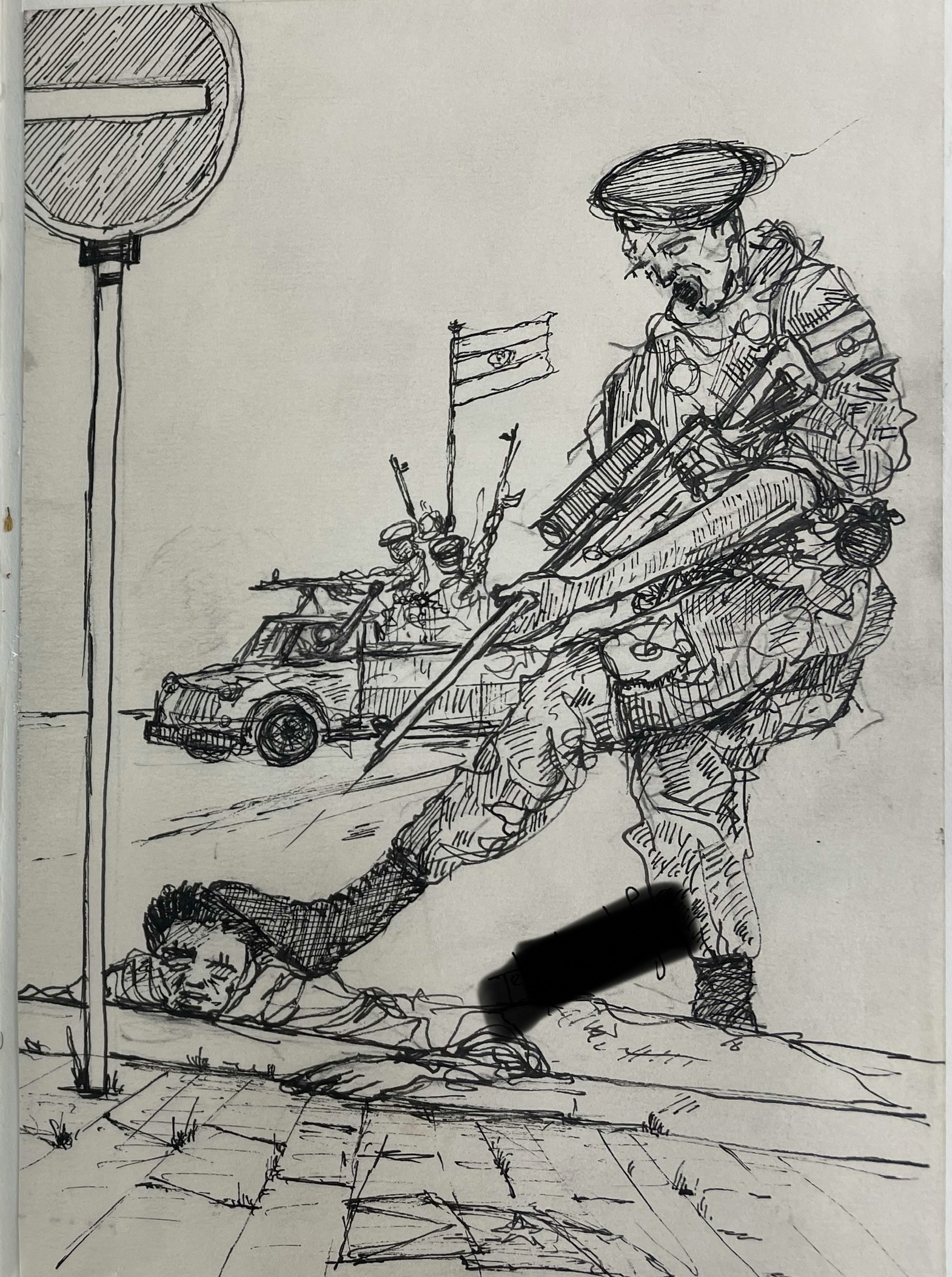
As the rumblings of renewed conflict raise fears of a resumption of the Tigray war, which two years ago triggered a major humanitarian disaster in the Horn of Africa, Mondafrique publishes excerpts from a sketchbook by a local painter, an exceptional testimony to the atrocities committed by the Ethiopian army. (The drawings have been cropped to obscure the artist’s signature; he is forced to remain anonymous for his safety.)
By Charlotte Touati
Between November 2020 and November 2022, the Tigray War profoundly destabilized Ethiopia and the entire Horn of Africa. Pitting the federal government led by Abiy Ahmed against the forces of the Tigray People’s Liberation Front (TPLF), the conflict quickly took on a regional dimension with the intervention of Eritrea and militias from the Amhara region. Marked by massacres of civilians, widespread sexual violence, population displacement, and a prolonged blockade, the war triggered one of the most serious humanitarian crises in recent history on the African continent. The Pretoria Agreement, signed in November 2022, officially ended the fighting between Addis Ababa and the Tigrayan forces. But several factors – the unresolved issue of control of Western Tigray, persistent tensions between Ethiopia and Eritrea, and recent statements from Addis Ababa on access to the Red Sea – are reviving concerns and raising fears of a resumption of the conflict.
The Tigray War, which raged in northern Ethiopia from 2020 to 2022, did not unfold before the world’s eyes. Conducted under a total blockade of communications, humanitarian aid, and the media, one of the worst human catastrophes of the early 21st century had no witnesses.
In a region where history has been transmitted for centuries through liturgical manuscripts, monastic chronicles, and sacred images, the collapse of modern networks has had the unexpected effect of returning testimony to its most ancient forms: the hand, ink, and paper. Among these surviving records, a unique testimony has emerged: the clandestine notebook of a Tigrayan artist trained in Orthodox iconography and the art of magic scrolls. Kept at the heart of the siege, sometimes hidden in garbage cans to avoid searches, this series of drawings constitutes at once a diary, an archive, and an act of resistance.
Icons, rolls and protective images
Wedi Tsion is a renowned icon painter in Tigray. He protects his identity with a pseudonym to ensure his safety and that of his family. Wedi Tsion means “Son of Zion,” a tribute to the Solomonic myth , as the Ark of the Covenant is believed to rest in the Tigrayan city of Axum, the New Zion according to Ethiopian tradition. He is currently living in hiding somewhere in Ethiopia. Before the war, he painted large-format religious subjects in the Ethiopian Orthodox style. The Ethiopian icon is not conceived as a simple representation. It is presence, mediation, protection. The frontal figures with large eyes, the flat planes of color, and the hieratic stylization all contribute to a theology of visibility: the image sees as much as it is seen.
Wedi Tsion is also a master craftsman of magic scrolls. Widespread among the people of the Ethiopian highlands, these artifacts are made of long strips of parchment, a few centimeters wide, their length corresponding to the height of the person who will wear them. The artist inscribes prayers, magic formulas, and apotropaic diagrams to protect the wearer. The strip is then rolled tightly and sewn into a leather pouch worn as a pendant. Each scroll is strictly unique.
In this context, Wedi Tsion’s writing, and more materially, his pen strokes, are performative. The style of the drawings he traced in black ink on a notebook, between whose pages loose sheets are inserted, visually recalls magic scrolls, blending drawing and writing.
Transposed into the context of war, these traditions lend the sketchbook an ambivalent dimension. It documents destruction, but it can also be understood as an attempt at conjuring away. Drawing the violence, the deaths, the ruins, is an attempt to contain them symbolically, to impose a form upon them. The artist does not work in a cultural vacuum: he mobilizes a visual vocabulary laden with history, spirituality, and protective power.
Birth of a diary of terror
During the first days of the war in late 2020, Wedi Tsion barely thought about drawing. He was focused on saving his life and the lives of his loved ones. Shelling and artillery fire were constant, while Ethiopian aircraft pounded Mekele, the Tigrayan capital. Crimes multiplied, and ground troops committed the worst atrocities: rape, mass killings, and humiliation. Added to this were hunger and epidemics, consequences of the siege.
Painting was a daily ritual for Wedi Tsion, a necessity in normal times, but in this hell, he fears giving form to what haunts him, translating through his hand and his art what he wants to keep hidden, and thus repeating the trauma. Then, on a day more fateful than the others, his friend and fellow teacher asks him to accompany him to the hospital. Quickly! The man’s aunt is there, or rather, her mutilated corpse, covered in bruises, her face swollen. She has succumbed in a rape camp , a common sight during the Tigrayan war, where she was used as a sex slave, like tens of thousands of Tigrayan women . For reasons unknown—cynicism or a desire to terrorize?—the perpetrators have brought back the body. They forbid the two men from taking photos and order them to remain silent. For the artist, this is the turning point: no words, no photos. He will draw!
But the conditions are not those of his studio work. He must remain mobile, able to hide and conceal these drawings that now emerge almost compulsively. All the scenes Wedi Tsion drew, he saw with his own eyes. As he confesses, after this event and the shock of the early days of the siege, the daily horror becomes a normal spectacle. These words echo the “habituation to horror” described by Primo Levy in relation to the Nazi camps, and they recall Dostoevsky’s own observation, a survivor of the Siberian camps, in Notes from the House of the Dead : “Man is an animal that gets used to everything.”
Dazed like animals on the run
This feeling of dehumanization overwhelmed Wedi Tsion as he hid on a farm outside Mekele with a group of twenty people, including children. After three days of exchanging fire, heavy artillery blasted the barn and stable to pieces. The bewildered livestock fled amidst the fighting. And so did the survivors. Like the animals.
February 2021: time to go back to the city. Drones, fighter jets, death everywhere, even in his mind. The memory of the mangled flesh of men and cattle, intertwined, constantly flashes before his eyes. Drawing becomes a necessity as the ground trembles continuously. Wedi Tsion’s production peaks during this period.
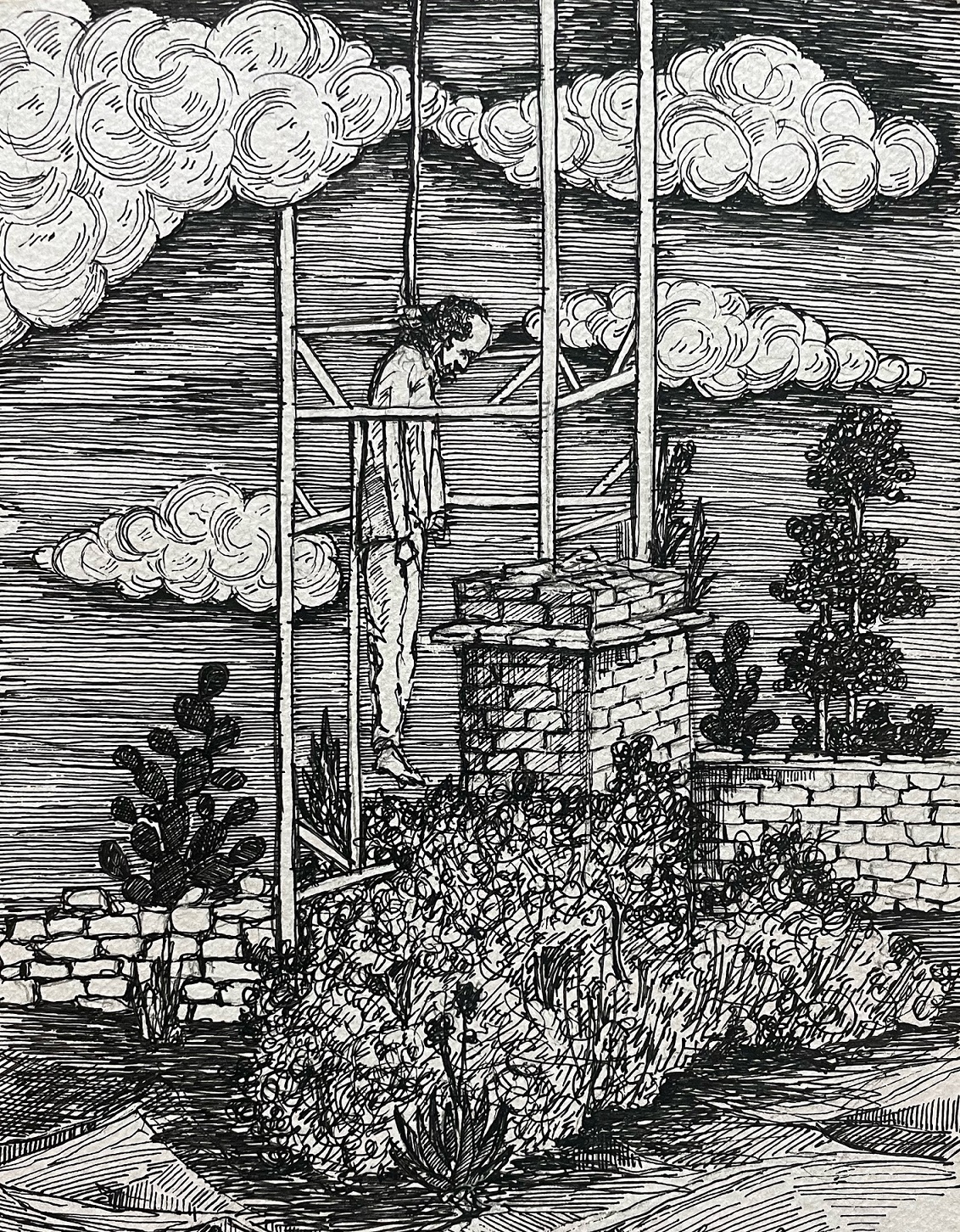
After a few months, the painter managed to leave Tigray and take refuge in the federal capital, Addis Ababa, which was not under siege, but where Tigrayans were a persecuted minority. The government had declared a state of emergency, and the police were conducting door-to-door searches to round up Tigrayans. Employers, landlords, and neighbors were encouraged to denounce them. They were then detained in concentration camps outside the capital.
Talisman and compromising object
Wedi Tsion realizes how compromising his sketchbook is. It reveals who he is, what he has seen, and what he has created from it. Because Wedi Tsion continues to draw. He hides this object, which has become a talisman, in the most unlikely places.
The guns officially fell silent in November 2022 with the signing of the Pretoria Agreement, but peace has never truly returned to Tigray, where entire areas remain occupied by Amhara special forces or the Eritrean army. By 2026, the return of the conflict seems closer than ever. Wedi Tsion has not found peace either. He has reopened his studio and returned to work on canvases and large-format paintings, but he fears, once again, being discovered. His sketchbook remains hidden, and the artist longs to bring it out, secure it, and share it with the world.
His graphic testimony is part of both a thousand-year-old Ethiopian tradition and a tragic genealogy of works created under extreme constraint.
Existential threat in a land of books and images
Tigray is not a cultural periphery: it is one of the original centers of Ethiopian civilization. The ancient kingdom of Aksum, whose monumental stelae still dominate the horizon, was a major crossroads between Africa, the Mediterranean, and Arabia. But the region’s true uniqueness perhaps lies elsewhere: in the almost uninterrupted continuity of an Eastern Christian literary culture, transmitted in the Ge’ez language and preserved in monasteries often clinging to cliffs or hidden in the mountains.
These monasteries are not merely places of worship. They are living libraries. They house illuminated manuscripts, medical treatises, legal texts, royal chronicles, genealogies – a written record of rare density. The scribes and scholars who copy these monks play a role comparable to that of medieval Europe.
Attacking monasteries, looting churches, or dispersing their collections, as the Ethiopian army did during the 2020-2022 war, is not collateral damage. Rather, it is an attack on the very heart of the Horn of Africa’s historical identity. Several religious sites were damaged or looted; the accounts of massacres in and around sacred precincts are unequivocal. The Church of St. Mary of Zion in Axum—a major center of Ethiopian Christianity—was the scene of violence. The objective was clear: to strike holy places in order to sever the thread linking past, present, and salvation. Moreover, the bearers of knowledge—priests, deacons, teachers, scribes—were targeted. In a society where written memory relies heavily on religious institutions, their disappearance amounts to an accelerated erasure of history.
The seat as a device for erasure
One of the defining characteristics of the Tigrayan war was the deliberate attempt to erase the Tigrayans. This annihilation took the physical form, with nearly 800,000 victims , but also the memorialization through the destruction of their culture and history, and ultimately, the rendering of their suffering invisible. Communication infrastructure was disrupted for extended periods; electricity, banking services, and access for foreign media were cut off. Journalists were either absent or prevented from entering the region.
Thus unfolded a war without images.
Resisting through memory
Wedi Tsion’s notebook carries a profound ethical dimension. Keeping a graphic journal under threat of death is a gamble on the future—on the possibility that one day someone will look, read, and understand. It is a refusal to let violence end in silence.
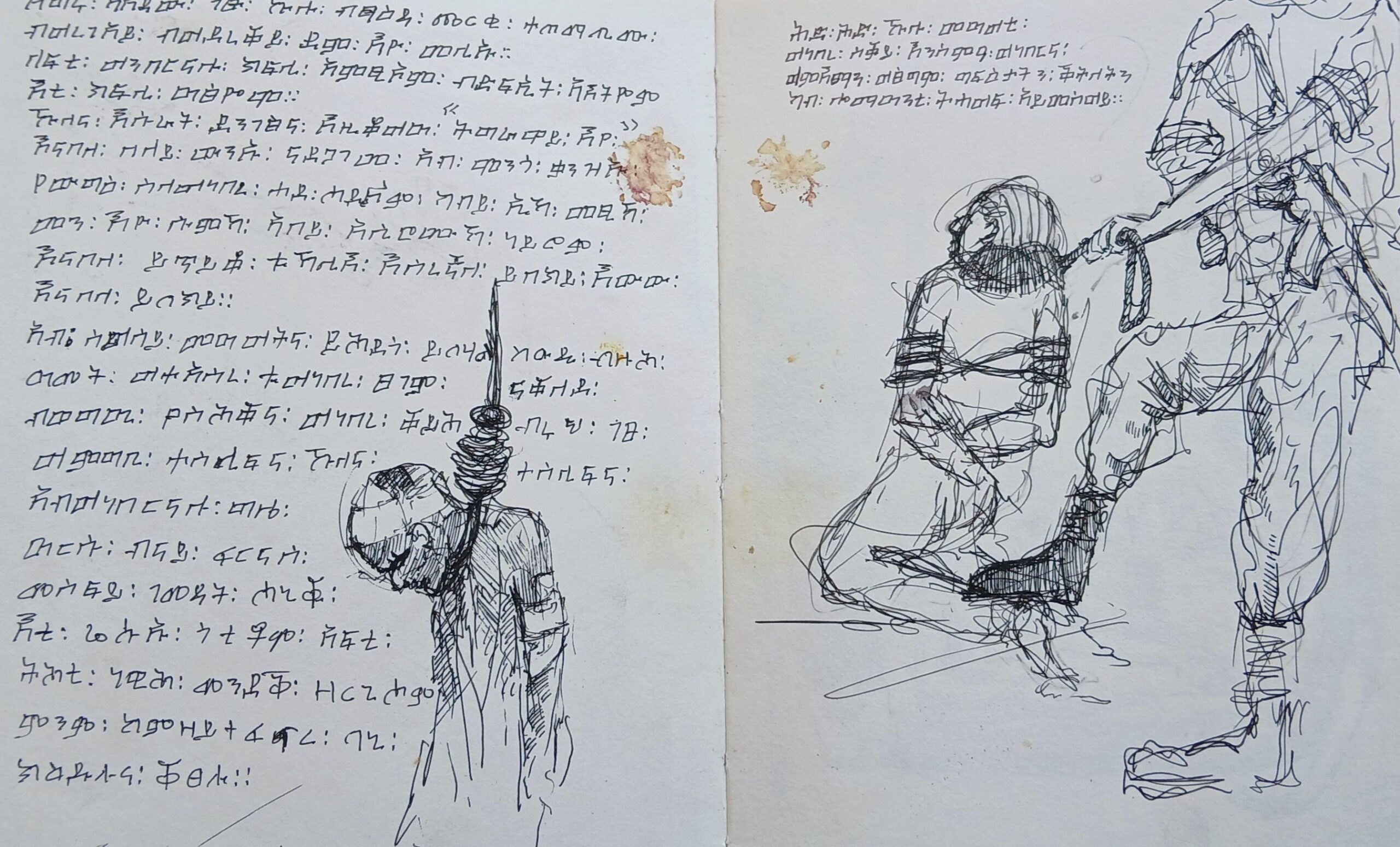
The need to hide the notebook in trash cans encapsulates this tension: what is destined to become an archive is temporarily relegated to the status of waste. History, here, literally survives among the remains.
The philologist thinks of palimpsests, those medieval manuscripts found in bindings, of documents saved from book burnings, of letters thrown over prison walls. Transmission often takes indirect, precarious, humiliating paths.
After the darkness…
The Tigray War officially ended in November 2022, but its humanitarian and cultural consequences remain immense. Devastated cities, destroyed infrastructure, displaced populations – and a memory fragmented by imposed silence.
In this landscape, a sketchbook might seem like a tiny object. Yet history shows that sometimes these individual traces become the most valuable documents for understanding an era. They capture not only the facts, but the very fabric of human experience.
Faced with attempts at erasure, clandestine art affirms a simple and radical truth: as long as an individual can draw a line, destruction is not total.
Boxed text: a lineage of clandestine works
Wedi Tsion’s notebook joins a constellation of objects produced under conditions of extreme oppression, often without any certainty of ever being seen. The drawings of children from the Terezín ghetto, the works created clandestinely in Nazi camps, the improvised engravings in the Soviet gulag, the notebooks kept by political prisoners in Latin America or the Middle East: all bear witness to a common obstinacy.
These creations are not merely artistic expressions. They simultaneously fulfill several functions. First, they document. When all official archives are impossible, the individual work becomes the primary historical source. They maintain an identity. To produce an image is to affirm that one remains a human subject, not an object. Finally, they challenge the monopoly of narrative. Power can control the media, but it can hardly control the inner imagination.
Many of these works have been hidden – buried, sewn into clothing, concealed in walls, entrusted to third parties. Their survival often amounts to a physical miracle.
In the case of Tigray, where the lack of contemporary images contributed to international indifference, such a diary acquires exceptional documentary value. It constitutes not only a testimony about the war, but about the war as it was experienced in almost total isolation.
 Martin Plaut