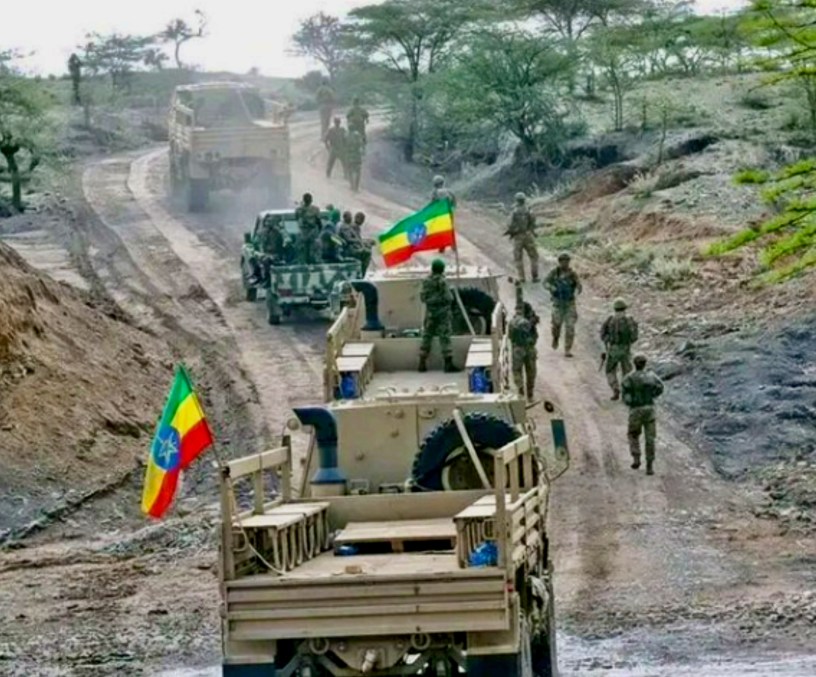
Losing ground in Amhara and Oromia may yet force Addis Ababa to reconsider its northern gamble, pulling back forces from Tigray to stabilise an increasingly frayed core.
The Ethiopian Cable, Issue 324 | 24 March, 2026
War has been averted in Tigray– for now. In early February, tens of thousands of Ethiopian federal soldiers and heavy artillery streamed northwards, readying themselves on the edges of the northernmost region for seemingly imminent conflict. Their historic enmity patched over, Mekelle and Asmara coordinated a military response for an Ethiopian incursion, with the momentum unerringly towards renewed war. But the conflict has not yet erupted, and a strange limbo endures with Tigray remaining on tenterhooks as security in Amhara and Oromia collapses.
The shock-and-awe US-Israeli campaign on Iran– with its proliferating macro-economic and geopolitical shockwaves– appears to have compounded Addis’s already acute fiscal and external constraints. Predicting the next move of the mercurial Abiy Ahmed is fraught, but the repositioning of much of the Ethiopian National Defence Forces (ENDF) towards Tigray, limiting journalists’ access, and deploying existential rhetoric suggested that Addis was planning to ‘finish the job’ in Tigray. But already struggling with limited foreign exchange, Abiy’s government is instead facing the prospect of another tidal wave of financial pain. Ethiopia is heavily dependent on fuel and hydrocarbon imports via Djibouti, and each day that the war drags on —and the reverberations in the globalised oil economy continue —the grimmer the fiscal drag will be for Ethiopia. War, too, requires substantial amounts of fuel, and existing structural shortages—now exacerbated by global price volatility—raise serious questions about the sustainability of any large-scale campaign.
The government had planned to procure more than 4.2 million metric tons of fuel in 2026, with an allocated budget of approximately USD 4.2 billion. However, with crude prices fluctuating above USD 100 per barrel, import costs have increased while supply has tightened, with these likely to remain constrained for some time to come. A sudden raft of anti-corruption measures targeting distribution has underscored concerns about limited fuel, with nearly 20 trade bureaucrats in Addis and the Ethiopian Fuel Supply Enterprise CEO subsequently arrested. In Oromia, senior police commanders in Jimma have also been detained for alleged involvement in fuel smuggling. Wars, too, are a costly business, even without surging fuel costs, with the Ministry of Finance estimating in mid-2023 that economic losses and damage to infrastructure due to conflict had reached USD 28.7bn. Nearly three years of grinding attritional warfare in Oromia and Amhara later, the toll is surely far higher.
Ethiopia’s principal foreign patron of the UAE, too, has been sucked into the contorted Iranian conflict, weathering a sporadic barrage of ballistic missiles and drones from Tehran on key commercial infrastructure, including Dubai’s airport. Decades of exceptionalism of the Gulf– underwritten by the American military– have now been shattered, and how this shakes out in the weeks, months, and years to come will have to be seen. It may be that an extended economic crunch forces the Emirates to reassess their patronage of the littoral states of the Red Sea —and beyond into the Horn of Africa —or to double down as the strategic importance of the Bab al-Mandab and Red Sea rises with Hormuz under pressure. It may well prove the latter, with flight trackers from Emirates recording no letup in Ilyushin Il-78s and other cargo flights landing in Ethiopia, and some alleging these are still ferrying weapons for the Rapid Support Forces (RSF) in Sudan.
Abiy is well aware of his strategic dependence on the Emirates, particularly with the Saudis, Turks, and Americans all having made their preference for peace in northern Ethiopia explicit in recent weeks. And so in a show of solidarity with Abu Dhabi, the Ethiopian PM dashed to the Emirates in mid-March to meet with Emirati President Mohamed bin Zayed (MBZ). And last week, Abiy spoke with the Emirati leader on the phone again, reiterating his fawning condemnation of Iran. It may well be that if Addis can secure the UAE’s financial and military backing, Ethiopia will resume preparations for war as soon as the situation in the Middle East cools. But whether Abu Dhabi has the stomach for another of its clients to engage in another large-scale conflict, with the high probability of spilling over into the brutal morass of the Sudan conflict, is a major unknown.
But in the meantime —as all predicted —these preparations are imposing a steep cost on the government elsewhere in the country, with the Fano insurgents in Amhara and the Oromo Liberation Army (OLA) in Oromia exacting heavy losses in recent weeks. The ENDF, and particularly its officer corps, have been badly depleted by years of war and successive purges —particularly Tigrayan —and the alternative of hastily trained allied militias are proving little substitute. Tens of thousands of assembled paramilitaries, militia, and federal soldiers remain across Amhara and Oromia, but appear broadly demotivated and poorly led, with Fano and the OLA continuing to overrun them in a number of instances. Each day the federal army remains in stasis, encircling Tigray, the further the control of Oromia and Amhara slips from its control.
Under the command of Zemane Kassie and Tefera Mamo, known as the ‘Simien Lion’, the coalescing Fano insurgency– in growing coordination with Mekelle and Asmara– has continued to rack up a number of significant battlefield wins. In Gondar in particular, Fano now controls much of the territory’s rural areas and villages, as well as continuing to launch raids into major urban centres themselves– killing 5 local officials in South Gondar in a single attack just last week. And on 18 March, Fano forces– including three corps of the Menelik Command– overran the town of Nefas Mewcha, seizing dozens of government personnel, weapons, and even the mayor. At the same time, the government– while insisting that the region is under control– continues to announce large-scale “coordinated operations” across Gojjam, Gondar, and other regions, claiming over 130 fighters of the “extremist group” killed in one update in early March. Inevitably, federal and regional elections in Amhara in June will have to be constrained —if they happen at all —to a handful of urban centres like Bahir Dar, with Fano making it explicit that any participation will be considered collaboration.
Moreover, Fano is expanding its theatre of operations southward into the Amhara region, another concerning prospect for Addis —and others. Many within the disparate militia forces harbour irredentist aspirations for parts of Oromia, Benishangul-Gumuz, Tigray, and Afar, and have participated in ethnic cleansing and a host of attacks on civilians, including before the insurgency escalated in April 2023. The dynamic and overlap between Fano, which is sometimes used as an umbrella term for Amhara nationalist forces, and the Amhara militias responsible for many of the worst atrocities in Western Tigray and separately in Oromia is often blurry. But last August, in one particularly unpleasant incursion, heavily armed alleged Fano fighters were reported to have killed several dozen Oromo civilians in the Hoomaa Gaaleessa village in the Horro Guduru Wollega, displacing thousands more. The incident called to mind some of the worst retaliatory massacres of Amhara and Oromo civilians in the early 2020s, where several hundred Amhara were slaughtered in Tole in one incursion.
In Oromia, meanwhile, the region’s long-simmering conflict has escalated once more– and spread eastward– with the OLA similarly clashing with remaining government forces and militias. The frontlines of the conflict have moved from the remote areas of western Oromia, such as Guji, into East Shewa and Arsi, with multiple intense blows between the OLA and government-allied militias reported. Hundreds of these militia are believed to have been killed in the subsequent fighting, while they are being deployed in ever-greater numbers to plug the gap of the withdrawn federal troops to no avail. In February, just days after the ENDF were pulled from Oromia, OLA fighters were reported to have been sighted along the aortic Modjo-Hawassa highway.
Apparently unwilling to withdraw substantial forces from Tigray’s border, the federal government has responded with yet more militia– and airstrikes, with a substantial increase recorded across East and North Shewa. Videos from locals earlier this month in the Duga woreda– just a few dozen kilometres from Adama– revealed federal helicopter gunships being deployed against the OLA. Some — including the Oromo politician Jawar Mohammed — have posited that this renewed offensive is part of the OLA quietly repositioning its battle-hardened fighters from western and southern Oromia into the region’s strategic centre over the past year. Air bombardment, however intense, is unlikely to deter the insurgents’ repositioning alone.
Losing ground in Amhara and Oromia may yet force Addis Ababa to reconsider its northern gamble, pulling back forces from Tigray to stabilise an increasingly frayed core. But the inverse is equally plausible, with a cooling of tensions in the Middle East—alongside renewed financial or military backing from Abu Dhabi—could rapidly tilt calculations back towards confrontation. But the more salient reality is that the initiative no longer rests solely with Addis, with the TPLF in Mekelle seemingly itching to break from the region’s renewed isolation. And so the prospect of a pre-emptive move by Tigray cannot be discounted either, particularly with its growing alignment with Asmara and Fano. What has emerged, then, is not a stable deterrence but remains a crowded and combustible context, with the possibility for miscalculation still all too high. The forces that nearly brought Ethiopia back to full-scale national—and possibly regional—war have not dissipated—they have merely been deferred.
The Ethiopian Cable Team
 Martin Plaut