Source: Institute of Commonwealth Studies by Martin Plaut, Senior Research Fellow
The history of slavery in the Indian Ocean has, until recently, received far less attention than the Trans-Atlantic slave trade. There is, for example, no equivalent to the vast digital database that documents Atlantic voyages in the Slave Voyages project. Although this imbalance has begun to be corrected, much research remains to be done. “The eastward dimension of captivity and trading in Africans was neglected until the turn of the twenty-first century.”
This study focuses primarily on East Africa and the wider Indian Ocean world. While European involvement is considered, particular attention is given to the role of non-European powers whose participation in slavery has received less scholarly scrutiny.
Another reason for the historical “silence” surrounding Indian Ocean slavery may be the reluctance of some scholars in the Muslim world to engage with the subject. Bernard Freamon argues that although Western scholarship on slavery and abolition in Muslim societies has grown substantially, discussion among Muslim communities themselves remains “deeply impoverished and shockingly uninformed.” Whether because the topic is troubling or politically sensitive, scholars within affected regions have only recently begun to examine it seriously. This absence has left major gaps in the historical record.
Scale of the Indian Ocean Slave Trade
Human trafficking across the Indian Ocean lasted far longer than the Atlantic trade and may have involved comparable numbers of enslaved people. Robert Collins has pointed out that estimates for the two systems are strikingly similar: approximately 11.3 million Africans were transported across the Atlantic between 1450 and 1900, while around 12.5 million were sent eastward to Asia between 800 and 1900. The key difference lies in the duration of the trade. The Asian system stretched across more than a millennium, and the commonly cited figure almost certainly underestimates the total, since slave trading began well before 800 and continued after 1900.
Arab traders played a central role in this network long before Europeans entered the region. When European powers arrived in the sixteenth century they encountered a complex system already in operation. Among the most powerful participants were the Omanis, who eventually dominated much of the western Indian Ocean trade. Their control of Zanzibar allowed the Omani sultanate to serve as a central hub linking Africa, Arabia, Persia and India. Indian merchants administered financial networks, while Baluchi mercenaries provided military force.
Africans transported across the Indian Ocean were used in many ways. In China they were often objects of curiosity or prestige. Indian rulers employed thousands as soldiers and guards. Women were incorporated into Arabian harems, while eunuchs became trusted household officials. European powers also relied heavily on enslaved Africans in the region: the British transported slaves from the Gold Coast to Sumatra, the French relied on them in the Mascarenes, the Dutch used them in the Cape and Batavia, and the Portuguese moved them around the Cape to Brazil and occasionally even North America.
Slavery before European Expansion
The Indian Ocean slave trade cannot be understood in isolation. For centuries it formed part of a vast commercial network connecting East Africa to the Middle East, India, Central Asia and China. These routes also intersected with the overland Silk Road, linking markets thousands of kilometres apart. At one end of this trading world stood the slave markets of Europe, such as Dublin, where Viking raiders sold captives. At the other end were markets in China, including one established in Shandong for the sale of Korean captives. Arab merchants travelled along the Red Sea and the East African coast, trading goods and enslaved people as they moved eastward.
China itself possessed an ancient system of slavery dating back to at least the third century BCE. By the time of the Tang dynasty (618–907 CE), Africans may already have been present among enslaved populations in southern Chinese cities such as Guangzhou. Arab traders operating between East Africa and China transported both goods and people until a major rebellion destroyed the port in 878.
A Song dynasty scholar, Zhu Yu, described African slaves in Guangzhou in vivid terms, noting their dark skin, curly hair and distinctive appearance. Such descriptions illustrate the presence of Africans in East Asian societies centuries before European maritime expansion.
Slavery in India
Like China, India had longstanding systems of slavery that predated the arrival of Africans. Africans arrived later, transported primarily by Arab traders. Arab merchants dominated Indian Ocean trade from the sixth century until the arrival of the Portuguese in the late fifteenth century. During this period they were the principal agents bringing Africans to India.
Africans were not always enslaved. Merchants, sailors and religious scholars also travelled voluntarily across the Indian Ocean. One of the most famous visitors was the traveller Ibn Battuta, whose journeys across Africa, the Middle East, India and China covered some 117,000 kilometres. During his travels in India he frequently encountered African slaves, known locally as Habashis, serving as guards and soldiers. When Ibn Battuta visited Sri Lanka he observed that the local ruler was guarded by “about five hundred Abyssinians.” In the Indian port of Calicut he saw large Chinese ships carrying hundreds of soldiers, where African guards provided security.
Malik Ambar: From Slave to Power Broker
The most famous African slave in Indian history was Malik Ambar (1548–1626), an Ethiopian who became a powerful political and military leader in the Deccan. Born among the Oromo people in eastern Ethiopia, Ambar was captured by slave traders, taken to Arabia and later sold in Baghdad before being transported to India.
He eventually came into the service of Chengiz Khan, himself a former Ethiopian slave who had risen to become prime minister of the Sultanate of Ahmadnagar. African military slaves were valued because they stood outside local kinship networks and were therefore seen as loyal to their masters. After gaining his freedom, Ambar built his own military following. When the Mughal Empire attempted to expand into the Deccan, he organised resistance through guerrilla warfare. At the height of his power, he commanded thousands of troops and successfully resisted Mughal armies for decades.
Ambar’s career illustrates the complex and sometimes paradoxical nature of slavery in the Indian Ocean world: although enslaved, individuals could occasionally rise to extraordinary prominence.
Slavery in Arabia
The history of slavery in Arabia is less well documented than in many other regions. Yet links between Arabia and the Horn of Africa date back at least three millennia, and slavery was an important element of these relationships. A Persian traveller in the tenth century described tens of thousands of African slaves working in agricultural estates in eastern Arabia. Some scholars believe that between 250,000 and 500,000 Africans were absorbed into Arabia during that century alone.
Many slaves worked in agriculture, particularly in date plantations. Others served in domestic households in cities such as Mecca. Conditions could be extremely harsh. Travellers described African labourers living in poverty while working lands owned by Bedouin landlords. Slave raiding continued well into the twentieth century. Slavery was formally abolished in Saudi Arabia only in 1962.
Omani Expansion and the East African Slave Trade
Among the Arab states, Oman had perhaps the greatest impact on the history of slavery in East Africa. With limited natural resources at home, the Omani economy relied heavily on maritime trade. Omani merchants had traded along the Swahili coast since the early centuries of the Common Era. Several factors strengthened their power. Indian merchants served as bankers and commercial intermediaries, while Baluchi mercenaries formed the backbone of the Omani military. Together they supported an expanding trading empire that stretched across the western Indian Ocean.
European powers eventually entered this system. When Portuguese ships reached the East African coast in 1498 they encountered prosperous Swahili port cities such as Kilwa, Mombasa and Mogadishu. These cities were already connected to extensive slave-trading networks linking Madagascar, the Persian Gulf and Arabia. Rather than creating an entirely new system, Europeans largely tapped into these existing networks. As historian Richard Allen notes, European traders built upon commercial structures that had long been operated by Swahili and Arab merchants.
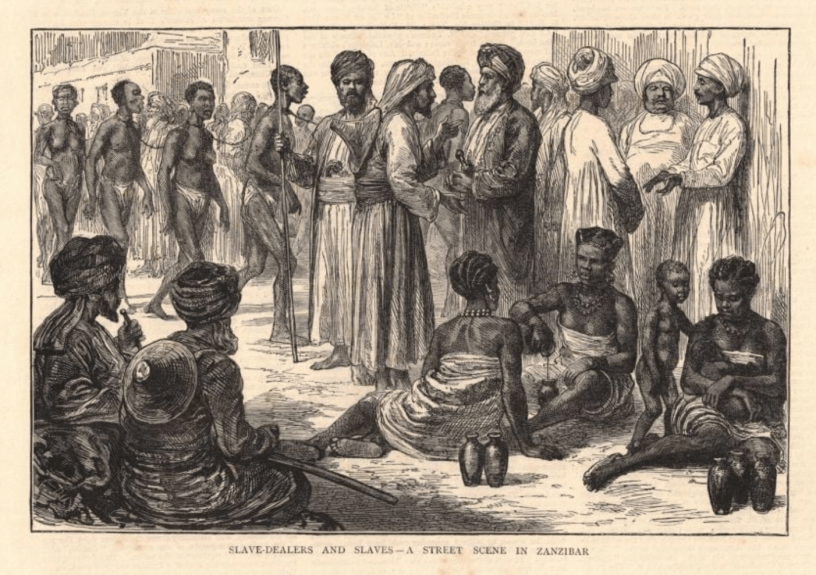
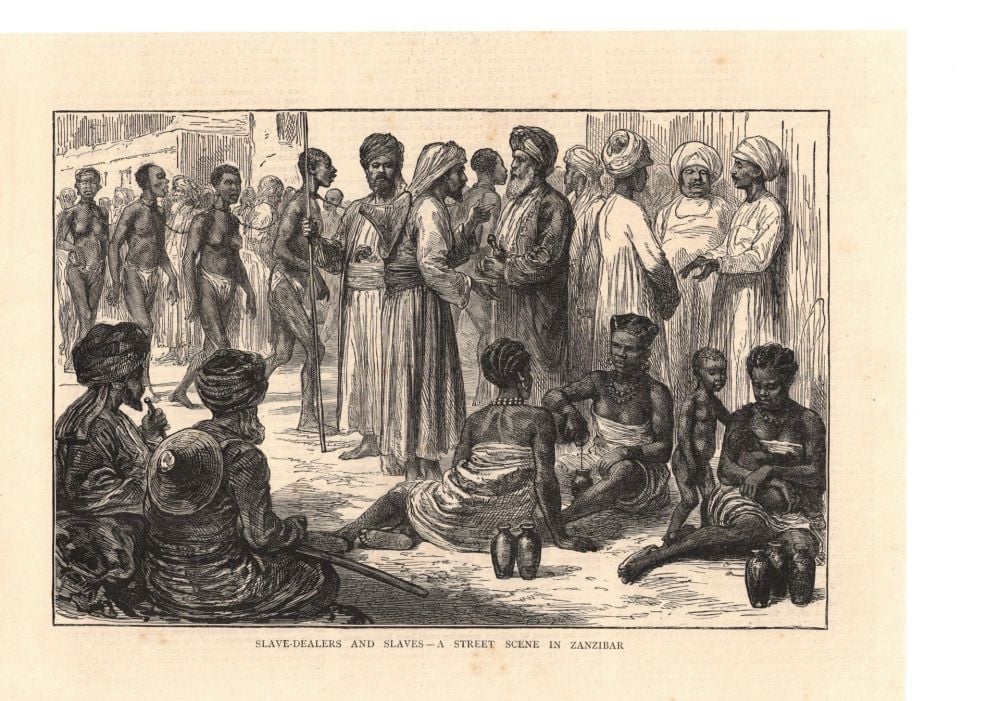
Oman eventually drove the Portuguese from much of East Africa, capturing key ports and consolidating its control over the region. Under Sultan Said bin Sultan in the nineteenth century, Zanzibar became the centre of a powerful commercial empire built on cloves, ivory and slaves.
Penetration of the African Interior
From Zanzibar, Omani and Swahili traders pushed ever deeper into the African interior, until they reached the Angolan coast, often working with local African leaders who sold prisoners of war. Enslaved people were forced to march long distances to the coast under brutal conditions, as many as one in five dying along the way.
By the mid-nineteenth century the scale of this trade had grown dramatically. Estimates suggest that around 20,000 enslaved people were being sent annually to Zanzibar during the 1860s. Some worked on plantations producing cloves and other crops, while others were exported to Arabia and Persia. The impact on African societies was devastating.
European Intervention and the “Scramble for Africa”
European imperial expansion eventually transformed the region. The Berlin Conference of 1884–85 divided Africa among competing colonial powers and provided justification for European intervention against slave traders.
King Leopold II of Belgium claimed that his Congo Free State would help suppress Arab slave trading in Central Africa. His regime became notorious for brutal exploitation of local populations in the rubber trade. Nevertheless, Belgian expansion brought conflict with Arab-Swahili trading networks. In 1892–93 Belgian forces defeated Arab-Swahili armies in eastern Congo. The defeat ended the dominance of powerful traders such as Tippu Tip in Central Africa, although many retained wealth and influence in Zanzibar.
British Efforts to Suppress the Slave Trade
Britain’s abolition of the slave trade in 1807 eventually affected the Indian Ocean as well as the Atlantic. The Royal Navy began patrolling the seas around East Africa, capturing slave ships and attempting to disrupt the trade. These patrols were costly and often ineffective. Small dhows could easily evade larger naval vessels by beaching themselves along the coast. Despite these efforts, thousands of Africans were still transported across the Indian Ocean each year during the mid-nineteenth century.
Nevertheless, British pressure gradually forced regional rulers to sign treaties restricting slavery. As Huw Lewis-Jones observed of British attempts to end the slave trade off both African coasts: ‘The Royal Navy’s role in the suppression of the transoceanic slave trades represents a remarkable episode of sustained humanitarian activity, involving patient diplomacy and problematic wrangling over treaty arrangements, dangerous and exacting naval operations, and intense political debate at home questioning the cost and purpose of the patrols.’
Slavery Today
Slavery did not disappear entirely with the end of legal slave trading. Although illegal in most countries, forms of chattel slavery still exist in parts of Africa. Paul Lovejoy notes that since independence in the twentieth century slavery has often become a “subterranean force,” continuing quietly in some regions.
Countries such as Mauritania, Niger, Mali, Libya and Sudan have all struggled with forms of hereditary or forced servitude. Social hierarchies, poverty and conflict have allowed these practices to persist despite international condemnation.
Despite this reality, the issue has often received limited attention from regional organisations such as the African Union or the Arab League. The continuing silence surrounding the history of slavery in the Indian Ocean world mirrors the reluctance to confront its modern legacy. As Kwesi Kwaa Prah has observed, while the Atlantic slave trade is widely discussed, the history of Arab slavery of Africans is still frequently treated as a subject better left unspoken.
Yet confronting this history is essential. Slavery in the Indian Ocean lasted for more than two millennia and shaped societies across Africa, the Middle East and Asia. Its consequences continue to influence social and political relations today, reminding us that the legacy of enslavement remains far from resolved.
 Martin Plaut