Source: Sahan, Ethiopia Cable, Issue 325 | 31 March, 2026
Dammed If They Do
Why have one mega-dam when you can have three more? Details are scarce, but Ethiopia has unveiled plans to build three more dams on the Blue Nile, just a few months after the Grand Ethiopian Renaissance Dam (GERD) was completed. A further provocation toward Egypt and Sudan, Addis appears emboldened by the inauguration of GERD—even as its relationships with Cairo and Khartoum’s military government crumble further.
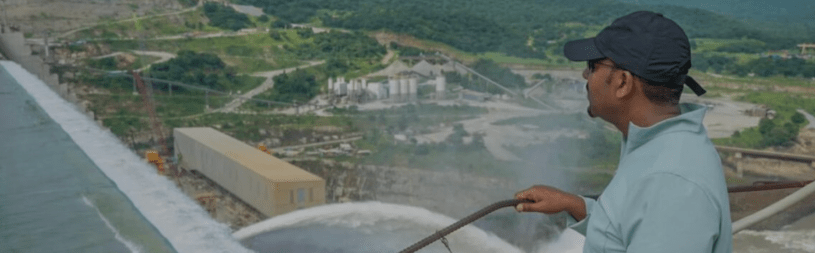
In early September, the GERD was inaugurated with great pomp as the continent’s largest hydroelectric facility, with PM Abiy Ahmed– and a raft of regional leaders– standing atop the vast structure. Conspicuously absent, however, were representatives from Egypt and Sudan, the two downstream nations most dependent on the Nile. And in the months since failing to halt the completion of GERD, Cairo has sought to isolate Addis—a strategy complicated by Ethiopia’s increasingly assertive regional posture—within the Horn of Africa. Though poorer than its own Saudi sponsor, Egypt has had some success, securing several agreements with Eritrea and Djibouti, whilst continuing its vacillation over troop deployment in Somalia. The Cairo-Asmara axis may be of particular concern to Ethiopia, as reported arms transfers suggest Eritrea is preparing for a possible return to conflict in northern Ethiopia.
But the announcement of three new dams, framed around a vision of up to 10 more sites, represents Addis’s clearest signal yet that it intends to further consolidate sovereign control over the Blue Nile. The three likely sites for the dams are Mendaia, Beko Abo, and Karadoboi, all with a forecast capacity of over 1,500 MW, which, together, are expected to increase Ethiopia’s electricity generation by 20-25%. Each dam is estimated to cost roughly USD 3.5bn and is intended to be constructed within four to seven years. For decades, Ethiopia has argued that its national development cannot be constrained or held hostage to the 1929 Anglo-Egyptian Treaty and the 1959 Egypt-Sudan agreement, colonial-era frameworks that excluded Addis despite its highlands supplying over 86% of Nile waters. Egypt, on the other hand, remains overwhelmingly dependent on the Nile River and views its constant flow as paramount to its national security.
Pre-Sudanese war, the handful of attempts to mediate between Cairo and Addis, with Khartoum leaning towards Egypt, floundered. And though the US offered to mediate between Egypt and Ethiopia, with Trump bizarrely claiming that he ended their ‘war’, no progress has been made to date. Instead, much like Trump’s intervention on Sudan, it was regarded as a partisan support for an ally, rather than positioned as a neutral arbiter. As such, the Ethiopians have largely ignored the entreats and clearly feel they can move to further consolidate their hold over the Blue Nile with a series of dams. While Egypt’s protestations that GERD has exacerbated water crises in the country are more rooted in nationalist sentiment than reality, a series of additional dams on the upper Blue Nile could expand Ethiopia’s control not only over volume but also over seasonal flows, with multiple reservoirs allowing staggered storage and release.
Perhaps the story of the mega-dams is a red herring, with it unclear where Ethiopia’s ailing economy might cough up several more billion USD to construct them. Not least because GERD was several decades in the making, though the first stones were laid for the feat of hydroelectric engineering by Meles Zenawi in April 2011, a veritable geopolitical lifetime ago. But GERD reveals the complexity of the Ethiopian state as well, and just how outdated linear concepts of ‘state-building’, ‘democratic progress’, or ‘capacity’ are. The Ethiopian state is simultaneously becoming more militarised, with healthcare, education, and social services collapsing in much of the country’s peripheries. And yet– at the same time– it is able to muster tens of thousands of troops for internal conflicts, as well as rip up much of Addis and construct a bizarre quasi-Dubai in its place.
It is not only Cairo that will protest the construction of three more dams, but Khartoum as well. Addis’s relationship with the Sudanese army– heavily dependent on Egyptian military support– has badly deteriorated since the end of 2025, after details emerged of a sprawling Emirati-facilitated training base for the RSF in western Benishangul-Gumuz. While Ethiopia tended towards the paramilitary Rapid Support Forces (RSF) during the destructive war, Addis had broadly avoided the fray, even despite its clientelist relationship with the UAE. That has now changed, however, and Khartoum has also accused Ethiopia of participating in drone strikes launched from its territory into Sudan in February and March. Addis firmly rejected these accusations, insisting that it remains neutral on the conflagration on its western border.
But last week, on 23 March, around 3,000 RSF and Sudan People’s Liberation Movement-North (SPLM-N) fighters were reported to have moved from Ethiopia’s Benishangul-Gumuz region into Sudan, pushing toward the strategic town of Kurmuk. Heavy drone strikes on Sudanese military positions accompanied the advance, forcing the military to fall back before the town fell entirely on the 24th. The fall of Kurmuk was the first substantial win for the allied Tasiis forces, who have had a fractious relationship since the two groups formed their alliance last year. And Blue Nile State had been largely spared from the ravages of Sudan’s conflict until earlier this year, when RSF forces began moving through Ethiopia into historic SPLM-N territory near Kurmuk. The latest assault prompted the displacement of more than 73,000 civilians to the state capital of Ed Damazin, while the town’s fall has further raised concerns about the Roseires Dam downstream, which supplies electricity to large parts of Sudan and supports irrigation for major agricultural schemes.
Ethiopia is far from the only neighbour of Sudan to tacitly– or explicitly– permit the RSF to use their territory, most at the behest of the UAE. Chad, South Sudan, the Central African Republic and Libyan territory under Khalifa Haftar all provide varying degrees of arms and havens for the paramilitary rebels, while the transnational Sahelian nature of the RSF continues to draw in mercenaries and fighters from across the continent. But beyond the Emirates, Ethiopia’s support for the Tasiis forces in Blue Nile State may also be influenced by a consideration of a buffer zone for GERD against the Sudanese army—and its Egyptian patrons. That said, though it was famously threatened in 2020 by Cairo, it is unlikely that Egypt would seek to inflict substantial damage on the mega-dam, given the high risk of flooding in Sudan.
More broadly, the deterioration of Addis’s relations with the Sudanese army and Cairo—and the new plans to build three further dams—reflect a convergence of several distinct and mutually reinforcing crises. There is a long-running dispute over the legal architecture to govern transboundary water; the new reality defined by Ethiopia’s demonstration that it can build regardless of downstream objections; Sudan’s internationalised civil war that has drawn in the Gulf, Egypt, Eritrea, and increasingly Ethiopia; and the broader wrestle for supremacy across the Red Sea and Horn of Africa.
A renewed conflict between Eritrea and Ethiopia would intersect directly with these dynamics. With Asmara, Cairo, and Sudan’s military tied into the same axis, any escalation in northern Ethiopia could spill into the Blue Nile theatre, effectively linking the Nile dispute with the Sudan war and transforming these contested borderlands into a multi-front conflict zone. And if Ethiopia lives out its belligerent rhetoric against Tigray and Eritrea, Addis will no doubt want to secure its vulnerable western border against the Asmara and Cairo-allied Sudanese army. What binds all this together is the absence of a functioning diplomatic framework capable of managing any of these crises. Neither the AU, the Nile Basin Initiative, nor the US are in a position to intervene, whilst the states most impacted—Egypt, Sudan, Ethiopia—continue to pursue unilateral strategies that reject compromise. The Nile waters continue to flow, for now, but the politics have never been more combustible.
The Ethiopian Cable Team
 Martin Plaut