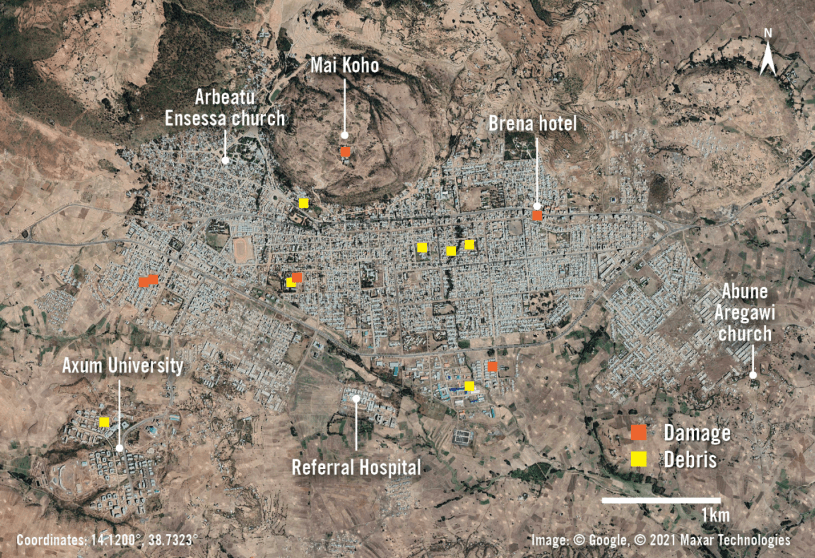
What has taken place in Tigray and Gaza are crimes that they world must not forget. So why not use the modern definition of “genocide” which was originally defined in 1944 by Raphael Lemkin?
“By ‘genocide’ we mean the destruction of a nation or of an ethnic group.”
Genocide is not an atrocity or a massacre. Genocide is an attempt to extinguish an entire nation or ethnic group: it is a different concept.
This is clearly explained by the Holocaust Encyclopedia.
Raphael Lemkin, a Polish-Jewish jurist, was born in 1900 on a small farm near the Polish town of Wolkowysk.
From childhood, Lemkin was fascinated with the history of religious and ethnic persecution. He was also keenly aware of antisemitic pogroms. Then, as a law student in his twenties, Lemkin learned about the Ottoman destruction of the Armenians during World War I (known today as the Armenian Genocide). His outrage about historical and contemporary events of group-targeted mass violence inspired his belief that there should be an international law against the destruction of groups.
During the 1930s, Lemkin sought to introduce legal safeguards for ethnic, religious, and social groups at international forums, but without success. When the German army invaded Poland, he escaped from Europe, eventually reaching safety in the United States, where he took up a teaching position at Duke University. He moved to Washington, DC, in the summer of 1942, to join the War Department as an analyst and went on to document Nazi atrocities in his 1944 book, Axis Rule in Occupied Europe. In this text, he introduced the word “genocide.”
“By ‘genocide’ we mean the destruction of a nation or of an ethnic group. This new word, coined by the author to denote an old practice in its modern development, is made from the ancient Greek word genos (race, tribe) and the Latin cide (killing)…. Generally speaking, genocide does not necessarily mean the immediate destruction of a nation, except when accomplished by mass killings of all members of a nation. It is intended rather to signify a coordinated plan of different actions aiming at the destruction of essential foundations of the life of national groups, with the aim of annihilating the groups themselves. Genocide is directed against the national group as an entity, and the actions involved are directed against individuals, not in their individual capacity, but as members of the national group”
Genocide redefined
Since this original definition the term has been redefined and effectively watered down.
The United Nations Genocide Convention, external in December 1948, which came into effect in January 1951.
Article Two of the convention defines genocide as “any of the following acts committed with the intent to destroy, in whole or in part, a national, ethnic, racial or religious group, as such”:
- Killing members of the group
- Causing serious bodily or mental harm to members of the group
- Deliberately inflicting on the group conditions of life calculated to bring about its physical destruction in whole or in part
- Imposing measures intended to prevent births within the group
- Forcibly transferring children of the group to another group
The convention also imposes a general duty on states that are signatories to “prevent and to punish” genocide.
As the BBC made clear in its excellent analysis of genocide the term has since been criticised.
In his book Rwanda and Genocide in the 20th Century, the former secretary-general of Medecins Sans Frontieres (MSF), Alain Destexhe, wrote: “Genocide is distinguishable from all other crimes by the motivation behind it. “Genocide is a crime on a different scale to all other crimes against humanity and implies an intention to completely exterminate the chosen group. Genocide is therefore both the gravest and greatest of the crimes against humanity.”
Mr Destexhe has voiced concern that the term genocide has fallen victim to “a sort of verbal inflation, in much the same way as happened with the word fascist”, becoming “dangerously commonplace”.
Michael Ignatieff, former director of the Carr Centre for Human Rights Policy at Harvard University, has agreed, arguing that the term has come to be used as a “validation of every kind of victimhood”.
“Slavery, for example, is called genocide when – whatever it was, and it was an infamy – it was a system to exploit, rather than to exterminate the living,” Mr Ignatieff said in a lecture.
The differences over how genocide should be defined have also led to disagreements on how many genocides occurred during the 20th Century.
How many genocides have there been?
Some say there was only one genocide in the last century: the Holocaust.
Others say there have been at least three genocides as defined by the terms of the 1948 UN convention:
- The mass killing of Armenians by Ottoman Turks between 1915-1920, an accusation that the Turks deny
- The Holocaust, during which more than six million Jews were killed
- Rwanda, where an estimated 800,000 Tutsis and moderate Hutus died in the 1994 genocide
But in recent years this list has been added to. Other terrible events inflicted by and on mankind have been added.
The word genocide has gradually been eroded so that it is increasingly thrown around so that it now means almost any event the author wants to attack. This is “genocide inflation.” The word has degraded and begun to lose its meaning and the force it carried with it.
Why not use the term genocide in Tigray or Gaza?
The crimes committed in both of these conflicts are terrible. Of that there is no doubt and those who committed them should be held to account.
However, in the case of Tigray, despite some 600,000 deaths and the most appalling sexual abuse inflicted on men and women, civilians as well as troops, there were many Tigrayans who continued to live and work in the rest of Ethiopia, including Addis Ababa at the height of the war. Some were arrested, many were assaulted, but they were not rounded up and systematically massacred.
This was not the “mass killings of all members of a nation.”
Much the same can be said of Gaza. As Wikipedia reports, the Gaza war began on 7 October 2023, when the Palestinian militant group Hamas led a surprise attack on Israel, in which 1,195 Israelis and foreign nationals were killed and 251 were taken hostage. Since the start of the Israeli offensive that followed, over 72,000 Palestinians in Gaza have been killed.
The deaths of both the Palestinians and the Israelis have been horrific. But Israel has controlled Gaza for almost three years, yet some 2.1 million Palestinians continue to live in the rubble of the cities they once built. I have been to Gaza and remember it as it was. We still don’t know what its future will be.
Palestinians still live in Gaza; Tigrayans still live in Tigray. Using the term “genocide” for their suffering violates the use of the term as originally envisaged.
 Martin Plaut