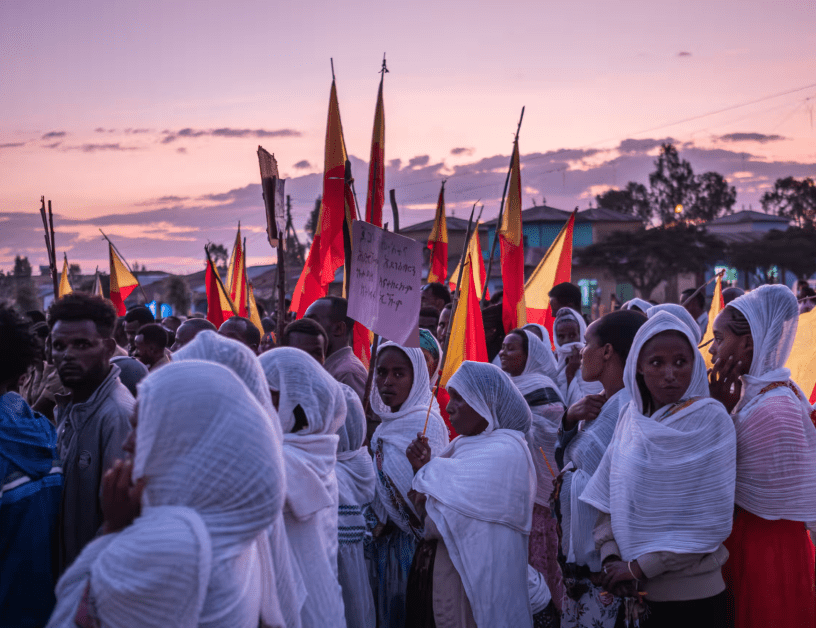
Tigray: a fragile post-war reality
More than three years after the Pretoria Cessation of Hostilities Agreement (CoHA), Tigray remains in a state of uncertainty and fragility. Tigrayan authorities have taken visible steps toward compliance, including the demobilisation of thousands of fighters and the handover of heavy weapons. Active fighting has ended, but key provisions of the agreement have not been implemented: Eritrean forces and non-federal armed actors continue to occupy parts of Tigrayan territory, millions of Tigrayans displaced from western and other areas remain in camps, and basic services have only been partially restored.
A region under strain
The economic and humanitarian situation in Tigray has further deteriorated in recent months. Access to cash remains severely restricted, with bank withdrawals either fully blocked or limited to a few hundred birr. Fuel shortages persist, while essential agricultural inputs such as fertiliser are largely unavailable, placing future harvests at risk. Much of the health system remains severely degraded, with many facilities either closed or operating at minimal capacity.
At the same time, political and military tensions are rising. Reports of mobilisation by Ethiopian forces near Tigray, alongside support for armed groups, including factions involving former Tigrayan fighters, have heightened fears of renewed conflict. Rhetoric targeting Tigrayans has also intensified.
Overlaying this is the unresolved legacy of the 2020–2022 war. Eritrean forces, Ethiopian federal troops, and allied militias were implicated in widespread atrocities, including war crimes and crimes against humanity. Under current conditions, justice and accountability for atrocities committed during the war in Tigray remain a distant prospect
Tigray itself remains economically weakened, politically fragile, and institutionally strained. The Tigray People’s Liberation Front has faced internal divisions and sustained efforts by the federal government to delegitimise and weaken its political position.
Is war imminent?
Tigrayans have borne the costs of war and continue to endure significant hardship in the hope that the CoHA will hold and pave the way for lasting peace. Across society, there is a strong and widely shared appeal to avoid a return to conflict.
The failure to fully implement the Pretoria Agreement, the absence of meaningful political dialogue, continued territorial occupation, deteriorating economic conditions, and renewed military posturing have created a highly volatile environment.
The lack of engagement between Tigray and the Ethiopian government, the shift from a partial to a near-total blockade—including restrictions on services and the suspension of budgetary support—alongside military mobilisation toward Tigray’s borders and an intensified political campaign, have deepened fears that war may be imminent.
Broader geopolitical tensions, including conflicts in the Middle East and resulting economic pressures, may divert the attention of external actors with leverage, reducing pressure on the parties to the conflict to pursue dialogue.
If war breaks out, what options would Tigray have?
In the event of renewed conflict, Tigray would face the imperative of defending itself, despite a stark asymmetry in power. Its leadership and military forces are acutely aware of both the costs and the nature of such a war, yet regard self-defence as both a necessity and a right. The Tigray People’s Liberation Front has faced internal divisions and struggled to consolidate a unified defence effort, particularly in the aftermath of the CoHA Agreement. However, these challenges do not negate Tigray’s resolve to defend itself, nor do they justify the imposition of war upon it.
Recent speculation has raised the possibility of Tigrayan engagement with neighbouring actors, including Eritrean or Fano forces. There is, however, no credible evidence of any formal alliance or operational coordination, beyond limited people-to-people engagement in border areas. Even so, questions remain: in the face of an existential threat, would a non-confrontation pact with actors such as Fano or the Eritrean state be inherently illegitimate?
Any rapprochement between Tigray and Fano or Eritrea would understandably raise serious concerns, given the roles these actors have played during the 2020–2022 war, including war crimes and crimes against humanity. Any engagement with these actors, absent meaningful accountability and justice, risks undermining both moral legitimacy and long-term stability.
At the same time, conflict environments often compel difficult and imperfect choices. Any agreement involving Tigray and Fano or Eritrea would need to be assessed in terms of intent and context. Tigray is not seeking an offensive against Ethiopian federal forces; rather, any cooperation would, if it occurred, be defensive in nature, in response to an existential threat.
The contours of such agreements are inherently uncertain. Reproachment, particularly with Eritrea, would unlikely offer any strategic benefit and could instead expose Tigray to greater vulnerability, potentially reducing it to a buffer in a wider geopolitical contest.
What is best for all?
The most viable path forward remains full implementation of the Pretoria Agreement. This requires restoring essential services at scale, ensuring the withdrawal of all non-federal forces, facilitating the safe and voluntary return of displaced populations, advancing inclusive political dialogue, and establishing credible mechanisms for justice and accountability.
In the event of renewed conflict, Tigray’s right to self-defence would not be contingent on external support or alliances. At the same time, pragmatic arrangements—such as mutual non-confrontation understandings—should not be dismissed, particularly where they reduce the number of actors aligned against Tigray and lower the risk of escalation.
About the author:
Hadush Gebremedhin is a junior academic at a tertiary institution in Ethiopia. He was in Tigray during the 2020–22 war and currently resides in the region. Can be reached at: hash57332@gmail.com
 Martin Plaut