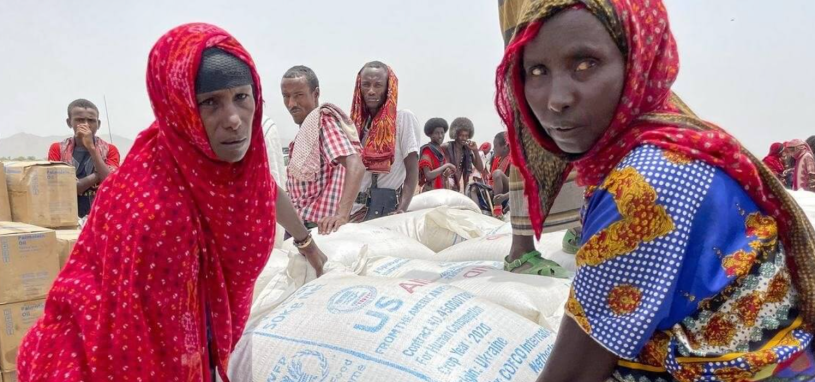
This story has rocked both Ethiopia and the international donor community. Perhaps the first thing to say is that rumours of aid diversion have been around for years, but have generally been ignored. For the WFP and USAID to go public indicates just how grave the issues are.
- The investigators visited a total of 63 flour mills located across nine regions in Ethiopia and discovered a consistent pattern. A notable portion of food donations coming from several countries including the United States, Ukraine, Japan, and France was being redirected and distributed to non-humanitarian recipients. These findings, as reported by The Washington Post, indicated a systematic diversion rather than isolated incidents of misappropriation.
- USAID released a statement to The Washington Post outlining their position and findings, “After a country-wide review, USAID determined, in coordination with the Government of Ethiopia, that a widespread and coordinated campaign is diverting food assistance … We cannot move forward with distribution of food assistance until reforms are in place.”
- This was an important point made by The Washington Post: “A day after USAID’s Tigray announcement, the World Food Program, whose former executive director David Beasley bonded with Ethiopian Prime Minister Abiy Ahmed over their shared evangelism, said it had also suspended aid in Tigray last month over diversion concerns. WFP plans to carry out real-time needs assessments, strengthen its checks on beneficiary lists, reinforce centralized oversight and improve the tracking of commodities, spokeswoman Annabel Symington said.”
- The Ethiopia Government Communication Service Minister, Legesse Tulu, said on Friday evening the United Nation’s World Food Program (WFP) is buying wheat from Ethiopia in foreign currency to feed citizens who are suffering from food shortages. In a Facebook post, Legesse said, the WFP is currently buying 35,000 metric tons of wheat domestically that will be made available to drought affected parts of the east African country. Legesse further said the World Bank has also bought 127,000 metric tons of wheat from Ethiopia Cooperative Unions in U.S. dollars and made it available for similar purposes to other parts of the country. But was some of the “Ethiopian wheat” actually aid that had been diverted? This is not clear.
- The aid scandal has angered American politicians. U.S. Senator Jim Risch (R-Idaho), ranking member of the Senate Foreign Relations Committee, released a statement on the diversion of U.S. food aid in Ethiopia: “It is deplorable that U.S. government food aid, which was intended to help prevent the mass starvation of innocent civilians in Ethiopia, has been diverted by criminals in a carefully coordinated, widespread, and systematic scheme to profit materially and strategically from that aid. This should infuriate every American taxpayer. The first principle of effective foreign aid is to do no harm – which the Biden Administration has failed miserably to do here. U.S. agencies have been busy highlighting their self-proclaimed progress at getting food to those in need and ending a war that has destroyed millions of innocent lives. Yet, we now know that leaders at the top of these organizations in Washington, New York, and Rome were aware that implementers on the ground could not guarantee the aid was getting into the right hands. It adds insult to injury that this occurred as the world experiences a global food shortage. This is unacceptable. The issue of food diversion is just part of a pattern of behavior with the Ethiopian government. It is foolish to think that the Ethiopian government is working with us in good faith – and we cannot be fooled again. The lack of oversight and guardrails of U.S. humanitarian assistance should not stand.”
- But the Ethiopian government has rejected allegations of their involvement. Briefing journalist on Saturday, the Government Communication Service Minister Legesse Tulu accused the USAID of making “continuous efforts to defame the Ethiopian government, its National Defense Force, and regional governments in its frequent statements and reports.” Largesse said “the government had assigned an investigation team to assess the food aid diversion allegation. The two agencies conducted the investigation without the involvement of government officials at any level. Areas where the investigation are said to be conducted are under the full supervision of the charity organizations. Even if there were perpetrators, holding the perpetrators accountable together is a right thing to do,” Legesse said.
- It is worth noting that USAID provided aid to Ethiopia in 2022 worth over two billion dollars: $2,053,870,880 to be exact. Ethiopia is the largest recipient of American aid in sub-Saharan Africa. It is – by far – the largest foreign donor to Ethiopia and millions of Ethiopians rely on the generosity of the American people.
 Martin Plaut
“USAID provided aid to Ethiopia in 2022 worth over two billion dollars: $2,053,870,880 to be exact. Ethiopia is the largest recipient of American aid in sub-Saharan Africa.”
Amusing! None a single grain or tablet was sent to Tigray from Ethiopia.
*It only was blocking from reaching the starving people, the dying children.
* It only was diverting the donations from the the IC.
*It only was putting obstacles to continue the weaponized starvation to finalize its long term project of creating a Tegaru free nation and possess a Tegaru free Tigray and holdings without them.
* It only was feeding its army in the name of the war affected Tegaru.
* It only was distributing to its bread baking industries to feed its urban ppl; and so on.
SHAME!