The “Bibi Stockholm” now moored in Portland, Dorset and receiving asylum seekers and refugees, is a revival of a very similar policy used by the British government in 1776.
Then the “Hulk Act” was passed to receive prisoners who could no longer be sent to the American colonies. The decaying naval vessels were moored in the Thames and became notorious for the terrible conditions they provided.

Below is a description of what the hulks were like. More can be found here.
In some ways the accommodation on the ancient hulks seems more spacious than on the barge!
Convict Hulks of 1776
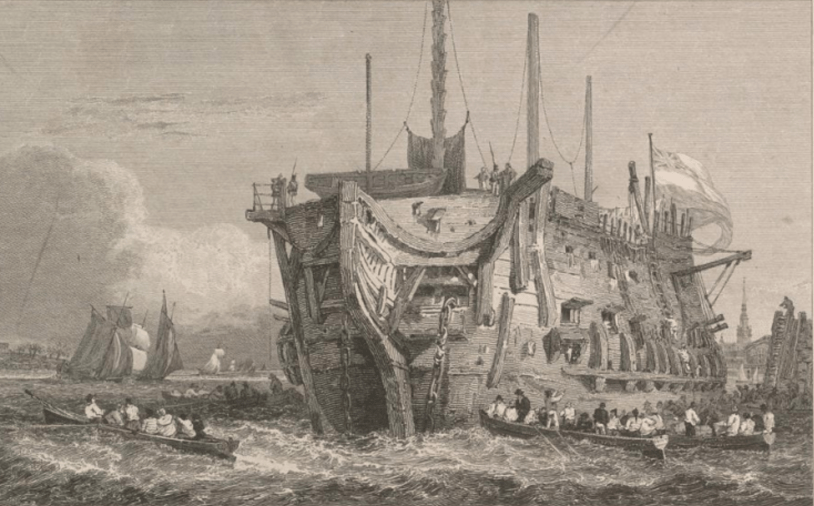
Hulks were decommissioned (and often unseaworthy) ships that were moored in rivers and estuaries and refitted to become floating prisons. The outbreak of war in America in 1775 meant that it was no longer possible to transport British convicts there. Transportation as a form of punishment had started in the late seventeenth century, and following the Transportation Act of 1718, some 44,000 British convicts were sent to the American colonies. The end of this punishment presented a major problem for the authorities in London, since in the decade before 1775, two-thirds of convicts at the Old Bailey received a sentence of transportation – on average 283 convicts a year. As a result, London’s prisons quickly filled to overflowing with convicted prisoners who were sentenced to transportation but had no place to go.

To increase London’s prison capacity, in 1776 Parliament passed the “Hulks Act” (16 Geo III, c.43). Although overseen by local justices of the peace, the hulks were to be directly managed and maintained by private contractors. The first contract to run a hulk was awarded to Duncan Campbell, a former transportation contractor. In August 1776, the Justicia, a former transportation ship moored in the River Thames, became the first prison hulk. This ship soon became full and Campbell quickly introduced a number of other hulks in London; by 1778 the fleet of hulks on the Thames held 510 prisoners.
Demand was so great that new hulks were introduced across the country. There were hulks located at Deptford, Chatham, Woolwich, Gosport, Plymouth, Portsmouth, Sheerness and Cork. The hulks themselves varied greatly in shape and size. Many were decommissioned former naval vessels, but civilian ships were also used. For example, the Warrior at Woolwich could hold up to 400 inmates, whereas the Discovery, moored at Deptford, only held half that number.

[Anonymous], Prison Hulks on the River Thames, Woolwich (c. 1856). © Greenwich Local History Library.
The Hulks as a Form of Punishment
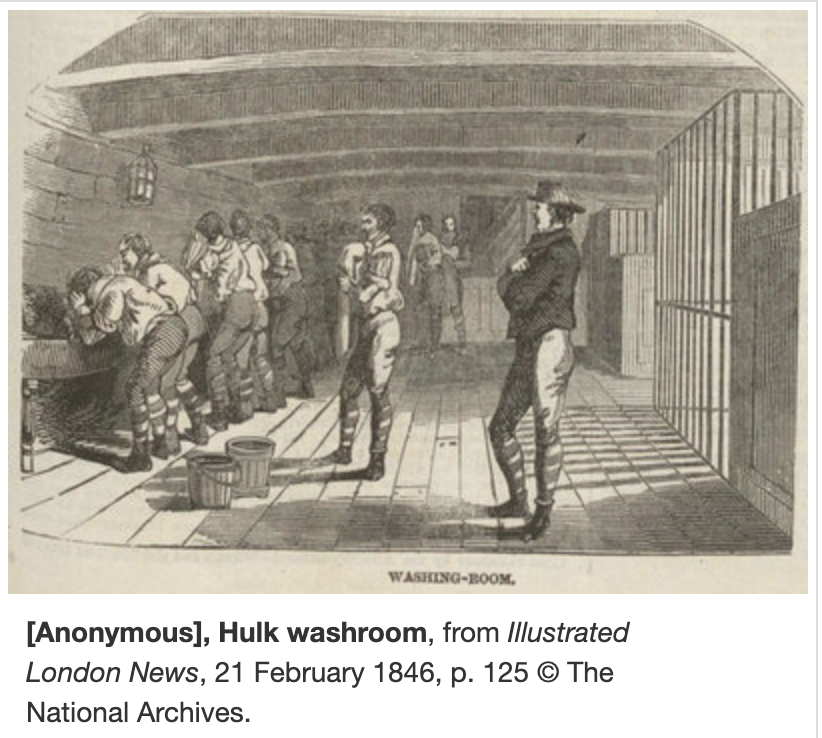
Prisoners kept in the hulks were set to hard labour in dockyards or on the banks of rivers. Those on the Thames were put to work improving the navigability of the river by removing gravel and soil from its shores. This work was backbreaking, exhausting and very public; convict chain gangs provided a moral spectacle and example for all who saw them. The rations provided by the contractors were inadequate, in that they did not provide the convicts with the energy or nutrition required to perform such arduous work. This was done on purpose – the parliamentary act authorising the use of hulks stipulated that convicts were to be fed little other than bread, “any coarse or inferior food”, water and small beer. Convicts frequently went hungry and often became malnourished. This was exacerbated by the fact that there were no charitable food handouts available to convicts on the hulks, as there were in conventional gaols. In fact, visiting was extremely limited for fear that tools used to escape could be smuggled aboard.
This regime was so punishing that, after a short time, men became demoralized, weak and susceptible to disease. The poor sanitation and cramped conditions meant that infection could spread particularly quickly. From the first introduction of the hulks, diseases such as Cholera, Dysentery and Typhus were rife. The convict mortality rate was exceptionally high – about a third perished in the first few years. In response, the diet was improved and better medical care was provided.
Prisoners’ mental health was also compromised. Among other observers, the reformer John Howard noted, following a visit to the Justicia in October 1776, that the prisoners suffered from a “depression of the spirits” (Hitchcock and Shoemaker, pp. 334-336).
 Martin Plaut