
Shila survived three months of sexual enslavement during Ethiopia’s civil war and then the birth of a son fathered by an attacker. She told no one, maintaining that her youngest child was the result of a clandestine visit by her husband, a Tigrayan militiaman.
Source: Washington Post By Katharine Houreld November 26, 2023 at 3:00 a.m. EST
MEKELLE, Ethiopia — Shila survived three months of sexual enslavement during Ethiopia’s civil war and then the birth of a son fathered by an attacker. She told no one, maintaining that her youngest child was the result of a clandestine visit by her husband, a Tigrayan militiaman.
Then, after three long years, her husband finally returned, Shila recalled. She’d thought he was dead. When he took off his hat and she saw his silhouette in the darkness, she collapsed.
“For years, I longed for him to come home,” she said, tears sliding down her face. “But I also feared he would tell people what happened and reject me.”
More than 100,000 women may have been raped during the two-year civil war in Ethiopia’s northern Tigray region, according to the most comprehensive study so far of these attacks in research conducted by the Columbia University biostatistician Kiros Berhane. And countless women who gave birth as a result are struggling with a hidden agony, often ostracized even by their families. They have been victimized twice, once during the conflict that pitted Ethiopia’s military and allied soldiers from Eritrea against Tigrayan rebels, and a second time by their own communities, even after a cease-fire a year ago quieted the hostilities.
A dozen rape survivors, most raising young children, recounted in interviews their efforts to rebuild shattered lives. They all spoke on the condition of anonymity.
During the war, all sides committed rapes, human rights groups and victims report, but the most sustained and organized violence was committed against Tigrayan women, who said they were raped by Ethiopian and Eritrean soldiers and by militiamen from Ethiopia’s Amhara region.
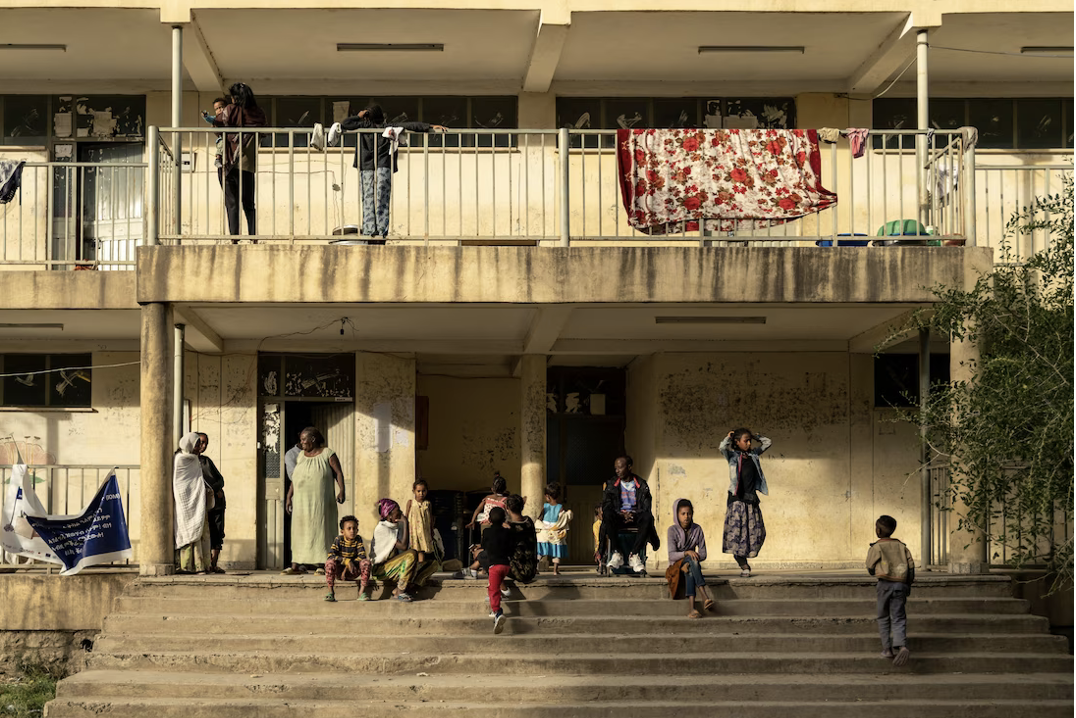
Shila and her husband and children are among a group of families sheltering at a site for internal refugees in the town of Mekelle in northern Ethiopia. (Arlette Bashizi for The Washington Post)
A survey of more than 5,000 women of reproductive age in Tigray, reported in July in the medical journal BMJ Global Health, found that nearly 8 percent said they had been raped. Of these, more than two-thirds said they were gang raped, and a quarter said they were raped on multiple occasions. That is likely to be an undercount, because of stigma and because some areas where violence was highest — such as in Shila’s hometown — are inaccessible with Eritrean soldiers still occupying them. (Ethiopia and Eritrea have denied that their soldiers committed widespread rapes.)
According to the government-run Women’s Bureau, more than half the women who reached a string of hospital rape centers were pregnant.
Medical staffers, counselors, nuns and priests said in interviews that most men rejected wives who had been raped — especially those who had children as a result. “In most cases, the man leaves if she has a child,” said Abel Gebreyohannes, a counselor working with rape victims. “Some families also won’t accept the woman. So she keeps it secret.”
Another counselor noted that although church leadership preached tolerance, religious leaders in some rural areas said women had been raped because God did not love them, and that some residents reviled the women and their children as rapists’ “leftovers.”
One 25-year-old woman said her parents refused to let her return to the family home and withheld her 7-year-old daughter — the product of her marriage — after she kept a baby boy fathered by one of her rapists.
“Mum said, ‘Give him away’. When I went home, she would not even let me see my little girl,” she said. “When I speak to my daughter on the phone, she cries and begs me to come and take her.”
A second woman said her husband came home after the war, walked in without a word and took their older daughter, leaving behind a baby boy born of a rape. A third woman said her husband had called to say he heard that she had been raped and had a baby — so he had married someone else and was abandoning her and their four children. Yet another woman said that she had been too afraid to tell her husband about her gang rape but that her subsequent terror of intimacy meant he left anyway.
Shila’s tale
Before the war, Shila’s family lived near the border of Ethiopia and Eritrea. Shila took care of the three children and ran a hairdressing salon. Her husband was in the regional militia. Then the Eritrean troops arrived, Shila said. The younger children fled as the soldiers dragged off Shila’s eldest daughter, a 13-year-old nicknamed Mita, “the sweet one.” She loved jumping rope, playing with her mother’s makeup and studying hard to become an accountant.
The soldiers demanded that Shila tell them where her husband was. She insisted he was dead, but they did not believe her. She was passed around groups of Eritrean soldiers and repeatedly raped along with other women.
Shila became pregnant. When she reached the regional capital, Mekelle, Shila said, she sought an abortion. But she was nearly five months along, and doctors said she had to deliver the baby. She dreamed of giving birth to the child and smothering it.
Weeks later, doctors wheeled Mita into Shila’s hospital room. The girl had been attacked so brutally that she could no longer walk or control her urine and needed a wheelchair. Shila broke. She was largely confined to a psychiatric ward for the next five months and was often physically constrained.
After she gave birth, doctors bound her wrists and ankles to the bed and brought her son to be breastfed, Shila recalled. With no humanitarian aid reaching the area, this was the boy’s only shot at survival.
Food was scarce. The little ones cried and developed rashes. When Mita was finally discharged after an abortion and multiple operations, she was starving, cold and in pain. She lashed out at her mother repeatedly. One night, Shila ran to a church and prayed until morning — for food, help, patience, mercy.
Share this articleShare
“I hated my [baby] son. I used to beat him,” she said. “Push him away, throw him. My other children didn’t understand, because I had not beaten them. They would say, ‘Mum, what are you doing?’ I couldn’t help it.”
Over the months, the baby started crawling and speaking. He called Shila “mama.” He toddled back when she pushed him away. Gradually, she stopped pushing. She nicknamed him Hero. She told her other children that Hero was their full sibling.
A year later — in October — her husband showed up.
He had heard that Shila had been raped but not that she had had a baby. When she saw him, she fainted, banging her head so hard he had to take her to a hospital. The doctors told him her story.
Beating their own children
Etsgingl Hadera, a mental health professional at Ayder Referral Hospital who has treated about 500 rape survivors,said some women have become suicidal; some have attacked male relatives or their own children.
The shame surrounding the rapes has been compounded by a shortage of trained counselors. “Untreated trauma breeds revenge,” he said.
Eight women said in interviews that they beat the babies born of their rapes. Four said they also began beating their older children. Those who stopped did so only after counseling.
[ Divisions in Ethiopia’s ancient church pose new threat to war-weary country ]

Bedla Salomon, center, instructs her students at the Daughters of Charity training center in the art of making pizza. (Arlette Bashizi for The Washington Post)
The One Stop Shop, Ayder’s rape crisis center, has only one assigned counselor for 4,000 patients, according to Sister Mulu Mesfin, the nurse in charge. It is the largest and best equipped of the hospital rape centers — but still desperately undersupplied.
“Yes, we need more counselors. We need medication, we need food. We have no more HIV drugs, and some of these women were deliberately infected with HIV. Drug resistance is on the rise,” she said wearily.
“This is where we are supposed to keep the medications,” said Mulu, her hot-pink nails clacking on a glass cupboard with a handful of boxes and a stack of files inside. “See, nothing. Only papers. We are also out of HIV testing kits, and laboratory reagents.”
Mulu’s phone is constantly alight with calls from women in crisis. Shadows encircle her eyes. She wants to figure out a way to work with Tigray’s Orthodox Christian Church, the only organization with the gravitas and the reach to sway public opinion, but she has neither time nor money.
Turning away
Shila finally got a break. A doctor referred her to a Catholic order of nuns, the Daughters of Charity. They offered food, vocational training and counseling. This gave her enough hope to pick a new name: Shila. It means “Eagle.” (The Washington Post is withholding her given name to avoid identifying her.)
She said she doesn’t know what will happen to her family, whether her husband will stay with her or leave. Unable to return to their town, which is still occupied by Eritrean soldiers, Shila and her family are staying in a classroom with 19 other families, sleeping on scraps of cardboard. There’s little opportunity for husband and wife to have an intimate conversation.
Shila watches Hero run toward her husband with their other children, calling him “daddy.” And she sees her husband turn away and embrace the other children. She said she swallows her hurt and anger, remembering her own murderous instincts when Hero was born.

Shila prays at an Orthodox Christian church in Mekelle. She does not know whether her fragile family will remain intact. She fears that her husband will leave her because she was raped and had a child not his. (Arlette Bashizi for The Washington Post)
She tries to focus on how her daughter Mita has blossomed since her husband returned. He reads to her and has found some drawing materials for her.
If he leaves, she knows it will devastate Mita, already so fragile. But if he can’t accept Hero, she doesn’t know if he will stay. She doesn’t know if she can stay. Whatever happens, Shila said, she must deal with it.
“For so long, I was always angry and afraid,” she said, her voice still raw but finally steady. “But everything I ever feared has come true, and I have survived.”
 Martin Plaut
This is very disappointing to hear, because this is what the rapists wanted, what they expected. And now these communities are cooperating with the rapists.
Good evening, ladies and gentlemen.
This article’s title is deceptive, misleading, and might pose a major query. Finfine is the legitimate and official name of formely named Addis Ababa
The inherent representational bias exhibited by a few diaspora Amhara ethnic members, as seen in the above article, to deceitfully portray all ninety ethnic groups in the country is a source of confusion for many. All the above-listed 20 groups can be reduced to one ethnic group. These individuals boldly claim to speak for the entire ethnic group in Ethiopia, simply calling themselves Ethiopian associations, while displaying blatant contempt and scorn for the constitutional rights granted to other ethnic groups.
The title must be 20 fannatic fanno sponsors from Amhara ethnic groups write an open letter to the U.S. Secretary of State.