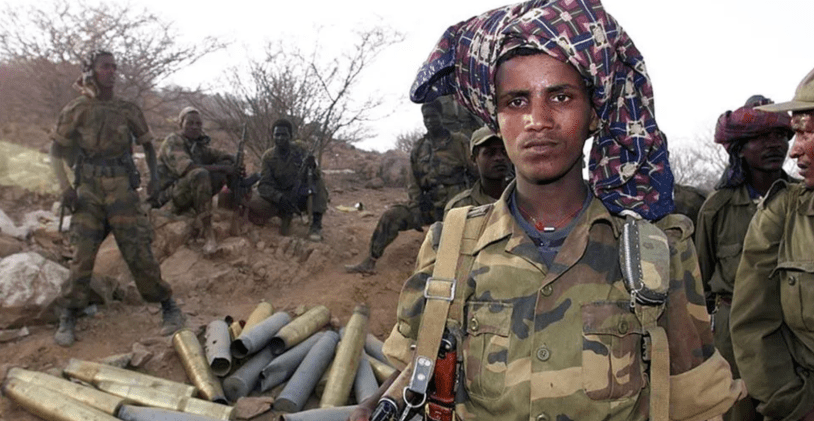
What began as a minor skirmish, over a dusty town that few in either capital had ever heard of, had transformed the prospects of both Ethiopia and Eritrea beyond recognition.
There is renewed interest in the tragic border war as communities in both Ethiopia and Eritrea attempt to find a new relationship. The article below is taken from the book that I wrote for a book with the marvelous scholar, and sadly missed, Dominique Jacquin Berdal. Unfinished Business: Ethiopia and Eritrea at war, edited by Dominique Jacquin-Berdal and Martin Plaut, The Red Sea Press, 2005.
I would amend it if I re-visited this subject, but I hope it provides some context for the current debates.
Martin
The 1998 – 2000 Eritrea-Ethiopia border war
Background to war – from friends to foes
Martin Plaut
Introduction
The war that broke out between Ethiopia and Eritrea on 6th May 1998, and was finally concluded by a peace treaty in the Algerian capital, Algiers, on 12th December 2000 can be summarised in a paragraph.
The neighbouring states, previously on good terms, were involved in a skirmish at the little known border town of Badme. The town lies in an inhospitable area towards the western end of the one thousand-kilometer border separating the two countries, not far from Sudan. The initial clash escalated dramatically. The conflagration spiraled out of control, and resulted in all-out war along the length of border. The international community, including the United States, Rwanda, the Organisation of African Unity, the United Nations and the European Union attempted to end the hostilities. They met with little success. Eritrea made initial gains on the battlefield, including taking Badme, but the frontlines soon solidified. After a month of fighting President Bill Clinton managed to persuade both sides to observe a temporary truce in order to allow further diplomatic efforts. However, these failed to bear fruit, and in February 1999 Ethiopia successfully re-captured Badme. Despite heavy fighting in May that year, Eritrea was unable to re-capture the area. For almost a year diplomats unsuccessfully sought to end the conflict, but to little effect. In May 2000 a frustrated Ethiopia launched its largest offensive of the war, breaking through Eritrean lines in the Western and Central sectors, and advancing deep into Eritrean territory. Having re-captured Badme and other land it had lost, and under considerable pressure from the international community, Ethiopia halted its advance and both sides signed a cease-fire on 18 June 2000. Six months later a final peace treaty was signed, with both countries agreeing to resolve the dispute through binding international arbitration.
These are the bare bones of this war – a conflict that cost as many as 100,000 lives, and resulted in over a million people being displaced. For two of the poorest countries in the world the economic costs were also immense. Yet the war remains something of a mystery to military analysts and historians. Despite being one of the bloodiest conflicts of the last decade of the twentieth century, involving over half a million troops, using some of the most sophisticated military technology, even the progress of the fighting is little understood.
At its outbreak the leaders of both countries professed ignorance as to its causes. Ethiopian Prime Minister Meles Zenawi told Ethiopian journalists on May 21st, 1998 that he had no satisfactory explanation for why relations had deteriorated so badly.
“I really cannot make head or tail of this puzzling development. In fact I may have my own guesses, but they can not be satisfactory. As you all know there were certain misunderstandings between the two governments arising from measures taken after changes in currency on both sides. There were more or less certain misunderstandings even before this change, but it is very difficult for me to believe that the composite effect of all this would draw us into open conflict. That is why I still maintain I have no satisfactory answer for this baffling question.” [1]
Eritrean President, Isaias Afwerki responded in similar terms when asked by a reporter from the Washington Post why he thought the conflict had come about. “It’s very difficult to easily find an answer”, he replied. [2]
It is, of course, possible to treat these replies with a fair degree of scepticism. Both leaders were attempting to explain why force had been unleashed with so little warning; why so much military muscle had been deployed over such an apparently insubstantial prize. But it may also be that both were numbed by the turn of events. It is certainly possible that they unleashed far more than either had bargained for, since the war ended an alliance that had put both men in their respective seats of power.
So why was there a war? As one writer suggested within months of the war beginning, the answer is anything but obvious. [3] “International wars are usually fought to acquire territory, to gain economic advantage, to overthrow a hated or dangerous neighbouring regime, for religious or ethnic reasons or in order to improve a country’s position on a regional or international geo-strategic chessboard.” The complexity of the relations that brought about this war means that none of these appear to be provide satisfactory explanations on their own.
Before considering any other factor the idea that this was a struggle for Badme – the flash point that ignited this conflict – can be easily disposed of. This is what a visitor had to say about the town.
“The focus of the conflict lies in the village of Badme, on the Mereb-Setit stretch” (of the frontier), “which is located 5km West of the internationally-recognised border, as calculated by GPS, and its surroundings, particularly to the South. This is a broken, stony table-land, with few wells, but which in lucky, rainier years can be persuaded, after the thorn-bush and prickly-pear have been cleared with a bulldozer, to produce a fair crop of cereals, such as sorghum or wheat. Badme itself, home to 300 families, is an unprepossessing element of human settlement – though that does not preclude the smiling welcome, with the traditional two glasses of tea, given to the occasional visitor. It is a dusty-one-street place, sited on a slight eminence, and consisting of crude huts, including the traditional conical tukul,” (traditional hut) “interspersed with vegetation, a hamlet which nothing whatsoever – so the new cliché has it – predisposed it for its elevation overnight from total obscurity to the corridors of the Security Council.
Badme is unlikely to detain the attention of the Ministry of Tourism, which is carrying out a national survey of tourist potential, for long. At one end of the ‘town’ as its former, Ethiopian administrators style it, a flagpole outside the only more modern house, on a small hill, indicates the office where the shooting incident which marked the start of hostilities took place.”[4]
Ethiopian Prime Minister Meles Zenawi, made it clear that Badme itself was not the issue. “For us Badme is nothing, but the principle behind invading Badme is everything. For us, what is at stake in Badme is not a piece of real estate but a cardinal principle of international law.” [5]
In fact anyone searching for a simple, easy to understand reason for the conflict is likely to end up confused and frustrated. This war had many causes; most of them intertwined. The history of Ethiopia, and the Horn of Africa, with its many disputes and diverse and overlapping ethnicities, religions and languages predisposes the region to conflicts. Unraveling the factors that contributed to the Ethiopia – Eritrea war is no easy task. Both sides are secretive by nature, and this impedes any investigation of these events. Both countries have long memories, and seldom forgive or forget past wrongs, whether real or imagined. At the same time issues that were important at one time were sometimes laid aside when there were more pressing issues at hand. There is no doubt that at times peace and harmony prevailed, and movements and individuals worked closely together. Indeed, ties were sealed in blood, as troops fought and died together to overthrow Mengistu Haile Mariam’s dictatorship. In the end, however, the divisions that separated the two sides were allowed to fester.
No single issue caused this war. It was the outcome of years of suspicion and hostility that finally exploded into open conflict.
A troubled history
Until the end of the nineteenth century Ethiopia was rarely more than a loose confederation of kingdoms. The Ethiopian empire was alternatively dominated by Amhara or Oromo princes from the provinces of Gondar and Wollo in the centre of the country, or by Tigrean rulers from the northern region of Tigray, which at times included the Tigrinya speaking areas of what is now Eritrea. The empire’s boundaries were fluid. When Tigrayan princes were in the ascendancy they extended their influence towards Eritrea’s Red Sea Coast, exacting tribute from the Muslim lowland chiefs around Massawa or in the West. They brought Coptic Christianity to the Eritrean highlands, while the lowlands along the coast and towards the western border with Sudan remained Muslim.
In the sixteenth century the coastal plain of Eritrea became part of the Ottoman empire, though for most of the 17th and 18th centuries the rulers of the coast who were appointed by the Ottoman Pasha of Jeddah, sporadically acknowledging the overlordship of Tigray’s rulers. As the Ottoman Empire declined, Egypt inherited its place along the Red Sea coasts, first taking over Massawa in the 1820’s. In the 1870’s, the Tigrean Emperor, Yohannis IV (1872 – 1889) defeated two Egyptian attempts to penetrate the Eritrean highlands. Subsequently he believed that in return for allowing the evacuation of Egyptian garrisons from Sudan after the rise of the Mahdi, he had British and Egyptian agreement to take over Massawa. In the event, Britain, worried about expanding French influence in Africa, encouraged Italy (which had laid claim to Assab in 1870) to take Massawa in 1885. Yohannis, rightly, felt betrayed, the more so as Italy promptly attempted to use the port as a base from which to extend its influence into Ethiopia. These hopes were dashed when the Italians were defeated in 1896 by Ethiopian forces of Emperor Menelik in the battle of Adua. The Italians accepted their reverse, and signed treaties with the Emperor in 1900, 1902 and 1908 establishing the border between their new colony of Eritrea and Ethiopia.
With the rise of fascism under Mussolini, Italy was determined to extend its presence in the Horn of Africa. In October 1935 Italy invaded Ethiopia. Despite the League of Nation’s condemnation of the Italian action aggression it was not until the outbreak of the Second World War that the world took a decisive stand against their aggression. By 1941 Emperor Haile Selassie had been returned to his throne by a combined force of British, South African, Indian and Sudanese troops fighting alongside Ethiopian patriots. While Ethiopia was independent once more, the international community was left with the problem of what to do with Eritrea, which was under temporary British Military Administration. It took until 1952 for the United Nations finally to decide that the territory should be federated with Ethiopia. There matters might have rested. However, the Emperor’s absolutist rule alienated the Eritrean population by a series of decrees. These included outlawing the teaching of Eritrean languages, dismantling industries and removing them to Addis Ababa and repressing the trade union movement and political parties allowed under the British military administration.
By the early 1960’s this repression was being met by armed resistance from the Eritrean Liberation Front. Despite this there was still considerable support inside Eritrea for unity with Ethiopia, particularly from among the Christian highlanders. In November 1962, after intense pressure from Addis Ababa, the federation was ended, and Eritrea was absorbed into Ethiopia. This served to spur on the opposition, led at first by the Eritrean Liberation Front [ELF], whose origins can partly be traced back to the Muslim League of the 1940’s. It found most of its support from the Muslim community, although some Christian highlanders, including the future leader of Eritrea, Isayas Afeworki, were also drawn into membership. Disputes within the ELF, and particularly hostility towards Christian recruits, resulted in the formation of the Eritrean Peoples Liberation Front (EPLF) in the early 1970’s. The EPLF rejected ethnic differences and stood for a secular and socialist state. An uneasy truce between the two ended in a bitter civil war that the EPLF finally won in 1981, forcing the ELF out of Eritrea.
Despite these divisions, Ethiopia’s campaign against Eritrean self determination did not go well. Discontent inside the Ethiopian army over the conduct of the war and the handling of a devastating famine, led to the overthrow of the Emperor in 1974. Haile Selassie was killed and his rule was replaced by a committee, the Dergue. In time this came under the dictatorial rule of Mengistu Haile Mariam. After initial discussions with the Eritreans failed, the war was continued and intensified. But the events of 1974 led to a second, equally important development. Students from Tigray, angered by the lack of development of their province, and building on the ancient claims of Tigray to be the centre of the Ethiopian state, launched their own campaign to break Amhara rule. In 1975 the Tigray People’s Liberation Front (TPLF) was formed, and began waging its own war against Addis Ababa.
Nationalism
On the face of it the EPLF and the TPLF had much in common, since they both opposed Ethiopian absolutism, whether exercised by Haile Selassie or Mengistu Haile Mariam. In reality, however, the forms of national identity that the two movements pursued, and in a sense embodied, were rather different. These factors contributed to the origins of the current conflict. The Eritreans saw their struggle as an anti-colonial movement designed to regain a lost political independence. The Tigrayan leadership, on the other hand, moved from a Tigrayan nationalism, to an acceptance that they were part of the Ethiopian empire. The TPLF came to see their rightful place as being at the heart of events in Ethiopia, as had occurred during the reign of the Tigrean Emperor, Johannes IV. They regarded the current regime as an oppressive state, which should be overthrown, although they reserved the right to self-determination up to and including independence.
Eritrean identity was more complex and more difficult to forge precisely because it reflected a more diverse population. Eritrea’s 3.5 million people are divided between two major religions and speak nine different languages. The Christian agriculturalists of the central highlands share a common language, religion and ethnic background with the mainly Tigrinya speakers inside the Ethiopian region of Tigray, south of the Mereb river. Intermarriage between Tigrinya speakers of Eritrea and Tigray has traditionally been common. As an Eritrean put it in 1994, “Tigrayans are our brethren, part of our soul.”[6] These areas had been part of the Ethiopian Empire; the mainly Muslim lowland pastoralists, on the other hand, who live to the West, North and East of the highlands, had little in common with them. The lowlanders support for the ELF was predominantly motivated by a sense of alienation from a highland government, speaking a different language and espousing a different religion. The first decade of the armed struggle, from 1961 to 1974 was largely confined to the Muslim lowlands, and driven more by this sense of alienation than a positive sense of Eritrean nationalism.
The EPLF attempted to mobilise Eritrean opinion irrespective of religion, but came up against considerable difficulties. Not all of the Christians in the highlands supported the cause of independence, and as late as 1982 some were still willing to act as armed militia for the Ethiopian administration. Outside the highlands, despite the terror employed by the Mengistu regime, a majority within the Kunama and the Afar people were at best ambivalent about the EPLF, while some actually supported continued unity with Ethiopia. As a result the EPLF had to fight a vigorous campaign within its own community to win their support, or acquiescence.
While it recognised and even celebrated Eritrea’s ethnic diversity, the EPLF resolutely refused to allow ethnicity to undermine its campaign for an independent state. This is not to suggest that ethnicity did not play any part in the Front’s activities; great care was taken to represent the whole of the population within the leadership, even when they were not as well represented among its membership. The EPLF also spent a good deal of time and effort inculcating a wider sense of Eritrean identity in its new recruits.
For the TPLF mobilisation in Tigray was relatively simple, since it could call upon an existing concept of Tigrayan nationalism and a history of oppression common to all the areas in which it operated. They shared a common language, religion and mode of livelihood. The TPLF’s activities were an attempt to end Amhara rule. In Tigrayan eyes the Amhara had usurped the traditional power base of Ethiopian society, and transferred it from the ancient Tigrayan capital of Axum to Addis Ababa. In its first political programme, released in 1976, the TPLF specified that it was fighting for the independence of Tigray from Ethiopia. [7] Shortly thereafter a TPLF congress repudiated the manifesto, but it was not publicly disowned for some time. This has been a recurrent issue for the movement, and has also been seized upon by its critics.
Since the TPLF’s war aims, at least in the beginning, centred on achieving power in Tigray itself, its successes against the forces of the Dergue posed something of a problem for the movement, and led to considerable internal debate. Would the movement be satisfied with capturing Tigray, or would a hostile government in Addis Ababa require them to fight for the control of all Ethiopia? By early 1989 the TPLF exercised almost total control over the Tigrayan countryside, and was having increasing success against Ethiopian troops in garrisons across the province. In February 1989 TPLF forces, bolstered by an EPLF armoured brigade, took the area around Endaselasie, in western Tigray. Within two weeks garrisoned towns across the province were abandoned, sometimes without a fight.
The TPLF had achieved its initial objectives, and held most of Tigray. The question now was whether to press on to Addis Ababa. The movement had by this time established the Ethiopian People’s Revolutionary Democratic Front (EPRDF), together with a number of other Ethiopian organisations, with the aim of taking power in Addis Ababa. Its leadership had ambitions to rule the whole of Ethiopia but were frustrated by many of its own supporters who, to use Lenin’s famous phrase, voted with their feet. In 1990 some 10,000 TPLF fighters spontaneously returned home.[8] After months of protracted discussion the leadership managed to convince its followers that they should continue prosecuting the war. Tigrayan nationalism was, at least for the time being, to be subordinated within a wider Ethiopian identity.
The EPLF and the TPLF therefore relied upon completely different nationalisms. The Eritrean struggle, from 1961, generated a powerful sense of collective identity, as did the increasingly genocidal responses of the Dergue towards Tigrayans and Eritreans during the 1980s. It was nationalism forged in blood and with a clear objective in mind, namely an independent Eritrea.[9] Moreover, it was a nationalism that could justly claim that it was shaped by its own experience of colonialism. Italian rule had fashioned Eritrea just as other European colonisers had brought into being the other states of the continent, after the scramble for Africa at the end of the nineteenth century. Moreover, Italian colonialism had brought with it some of the benefits of European rule, in the shape of modern port facilities, roads and railways. The city of Asmara had developed into a pleasant town, with coffee shops, an opera house and fine government buildings. Eritrea also had political parties and a labour movement, neither of which were to be found across the border. By the time the Italians were driven out by the Allied forces in 1941, they left behind a far more developed state than the feudal empire that existed in Ethiopia.
The Tigrayans also had much to be proud of. They could hark back to past greatness, including the rule of the last “Tigrayan” emperor and to a history of rebellions against imperial rule. The most important of these was the “woyane” rebellion of 1943 against Haile Selassie, from which the TPLF took its inspiration. But while Eritrean nationalism was clearly associated with a nation state, Tigrayan nationalism played a difficult balancing act – at once recognising the aspirations of the Tigrayan people, but within the framework of the wider Ethiopian state. It was a problem that was to dog the relationship between the TPLF and the EPLF.
Co-operation and confrontation
Opposition to the dictatorial rule exercised from Addis Ababa temporarily united the two liberation movements, but divisions existed on a number of grounds, including ideology, strategy and tactics. Over time these grew in importance.
In 1974 as the founders of the TPLF were preparing to launch an armed struggle, they made contact with the Eritrean movements, an obvious source of assistance. They sought support from the EPLF, rather than the ELF. This was partly because another group of Tigrayans (The Tigray Liberation Front) had been established in 1972 – 73 and had formed a prior alliance with the ELF. From the EPLF the TPLF obtained promises of military training as well as arms, and, significantly, two EPLF veterans. They were Mahari Haile (who took the field name ‘Mussie’ and went on to be the first military commander) and Yemane Kidane (who took the name ‘Jamaica’) who is a member of the present Ethiopian government. The first group of TPLF trainees, twenty in all, was deployed to Eritrea at the same time.
This co-operation was fruitful and they learned much from the Eritreans. However, not all of it was to their liking. Ideology came to play a significant part in their differences. On the face of it both shared a Marxist analysis. In reality this was more of an impediment than a spur to unity. The EPLF’s Marxism tended to be mainly ‘third worldist’ – long on anti-imperialist rhetoric and slogans. It considered the Soviet bloc ‘strategic allies’, even though they never received direct assistance from Moscow. States in the region that were close to the Soviets, like South Yemen provided some training and support in the initial stages. This disappeared after the Dergue seized power in 1974, since it had the backing of the Soviet Union.
The TPLF, on the other hand, was influenced by Maoism, and admired Albania as an example of an anti-Soviet socialist state. In the early 1980’s Meles Zenawi rose to authority in the movement, and in 1984 the Marxist-Leninist League of Tigray (MLLT) was formed, as a vanguard party within the TPLF. The MLLT established links with what it saw as ‘genuine’ Eritrean Marxist groups, notably the Democratic Movement, later the Democratic Movement for the Liberation of Eritrea.[10] The Democratic Movement (itself a faction of the ELF which broke apart after its defeat by the EPLF in 1981) was allowed to continue to have bases in the Tigray region until about 1996, much to the annoyance of the EPLF.
The United States had openly backed the emperor, Haile Selassie, but his fall and the assumption of power by a military committee, known as the Dergue, led to a change in international support. Now it was Moscow, rather than Washington that backed the Ethiopian government. This tested the EPLF’s ideological commitment to Marxism. However, the EPLF resisted labelling the Soviet Union as imperialist, realising that they might one day need its support as a permanent member of the Security Council if they were to facilitate the emergence of an independent Eritrea. [11] The Tigrayans had no such difficulties, and had no hesitation in condemning the Soviets as imperialist. Arcane as such arguments might now seem, they were an important source of friction between the two movements. [12]
Ideology was not the only issue to divide the movements. There was also the question of military tactics. While the TPLF’s military strategy was one of mobile guerrilla warfare, the EPLF combined mobile with fixed positional warfare, based on a securely defended rear area. In this base area they established a considerable infrastructure, including schools, hospitals and workshops. As the Eritreans moved towards more conventional forms of warfare, the Tigrayans became increasingly critical of their tactics.
Matters came to a head during Ethiopia’s ‘Red Star’ campaign of 1982. It was the most sustained offensive the government forces ever undertook and came within an ace of capturing the EPLF’s base area, and with it Nakfa, the last town in rebel hands. Tigrayan fighters training with the EPLF were called upon to go into action, apparently without the permission of the TPLF Central Committee, who were furious at not being asked. After heroic efforts their combined forces just managed to repel the Ethiopian onslaught. Casualties were heavy, however, and the TPLF was deeply critical of the tactics employed by the EPLF, accusing them of moving too rapidly from guerrilla warfare to positional encounters with the enemy.
According to senior members of the TPLF, the Eritreans wanted TPLF fighters to remain in Eritrea to defend Eritrean positions. By this time, however, the TPLF leadership had become determined to overthrow the Dergue. Its strategy, therefore, was to make alliances with other Ethiopian opposition movements and to take the military struggle South to the gates of the capital. They therefore withdrew their fighters from Eritrea. This did nothing to endear them to their allies, but worse was to follow.
In the mid 1980’s the simmering differences culminated in a major public row. Insults were exchanged. The TPLF defined the EPLF as “social imperialist”. The EPLF in turn labelled the TPLF “childish”. This row masked a serious theoretical difference with major political ramifications for the national question in Ethiopia.[13] The issue was which of its peoples had the right to self-determination up to, and including, secession. It had been a critical issue for the student radicals at Addis Ababa university in the 1960’s and 1970’s – many of whom went on to lead the Eritrean and Tigrayan liberation movements. The TPLF recognised Eritrea’s unique status as a former colonial state. But they also came to promote the right to secession of the various nationalities within Ethiopia and – far more controversially – of those within Eritrea as well. During its exchange of polemics with the EPLF in 1986/87, the TPLF stated that “a truly democratic” Eritrea would have to respect “the right of its own nationalities up to and including secession”. [14]
This appalled and infuriated the EPLF, which argued that it was precisely because Eritrea was a former colonial state that they had the right to independence. They argued that Ethiopian nationalities had a right to self-determination, but not to independence, as this was conditional on a colonial experience.[15] The EPLF was aware that any widening of the definition of self-determination to include independence for Ethiopian nationalities would detract from Eritrea’s special status, as a colonially defined territory. Moreover, giving Eritrean nationalities the right to secede would also jeopardise Eritrea’s future cohesion, not least because the Tigrayan and Afar peoples live on both sides of the border.
The TPLF argued that the EPLF’s refusal to recognise the right of its own nationalities to secede was an example of its undemocratic nature. For this reason the TPLF regarded its relationship with the EPLF as tactical, rather than enduring, and consequently the TPLF provided support to other Eritrean movements, such as the Democratic Marxist League of Eritrea.
According to EPLF documents, the TPLF’s flirtation with other movements came as a surprise and a disappointment and led to a rupture in their alliance.
‘…the TPLF had concluded that the EPLF was not a democratic organisation and that its relationship with the EPLF was “tactical”. The EPLF had thought that its co-operation with the TPLF was genuine and not based on temporary tactical considerations. And so, when the TPLF’s secret stand became public the EPLF realised its naiveté and although it did not regret its past actions, decided to break its relationship with the TPLF and not enter into polemics with it.’ [16]
It was at this critical juncture, when relations were at their most difficult, that the movements sought to resolve the question of just where the border ran between Eritrea and Tigray. For a long time this had appeared of little real importance since both rebel groups ranged freely across the border, as did the Ethiopian army. Very little has been heard of the negotiations that took place in late 1984, but a founder member of the TPLF, Ghidey Zeratsion, has offered an insight into the negotiations. [17] He indicates why the issue became so critical for the Eritreans.
“The border issue was raised for the first time at the meeting between the TPLF and EPLF in November 1984. At this meeting, the EPLF raised the issue and wanted to demarcate the boundary based on international agreements and documents. The areas under consideration were Badme, Tsorena-Zalambessa, and Bada. The TPLF agreed that there are areas between Ethiopia and Eritrea where they are not clearly demarcated. At the same time it argued that it was not prepared for such discussion and had not made documentary studies on the issue. Furthermore, the TPLF argued that it was not in a position to sign border agreements on behalf of Ethiopia because it did not have the legitimacy to do so. And hence, the TPLF proposed to maintain the existing administrative areas as they are and prepare the necessary documents for the final demarcation after the fall of the Derg. The EPLF was convinced by the argument and both agreed to postpone the demarcation and maintain the existing administrative regions.
One may ask why the border issue was so important for EPLF while it was still trenched in the Sahel area?
The EPLF was very much constrained by its ability to get recruits for its army. It has been rounding up and forcefully recruiting people all over Eritrea. In such a situation, border areas like Badme were safe havens for people who wanted to escape recruitment. At the same time, there are a number of Eritreans living in these areas who were attractive for EPLF’s quest of recruits. As a result, the EPLF was intruding these border areas and provoking a reaction from the TPLF. At one instant the two fronts were at the verge of war if the EPLF had not withdrawn. The EPLF could not afford to open another front while it was confined in the Sahel trenches by the Derg’s army. [18]
By early 1985 relations between the two movements had become mired in distrust. As the relationship deteriorated the TPLF began providing assistance to Eritrean movements hostile to the EPLF. [19]
In June 1985 the EPLF decided to teach the TPLF a brutal lesson in power politics. The Eritreans cut the TPLF’s supply lines to the Sudan that passed through their territory. [20] This was done at the height of one of the worst famine in modern times, denying Tigrayas access to food aid at a crucial juncture. Nothing was said publicly about the incident at the time, but it is not hard to imagine the animosity that it generated. The TPLF responded with characteristic efficiency, mobilising 100,000 peasants to build an alternative route through to Sudan that did not go via Eritrea.
While the EPLF leadership still refuses to speak about these events, Tigrayans recall it with great bitterness. As one put it: “…the EPLF behaviour was a savage act…..I do not hesitate to categorise it as a ‘savage act’. It must be recorded in history like that!” [21]
Despite this rupture the imperatives of war continued to drive the two movements to co-operate with each other. By 1987 both Fronts had had considerable military success, but further advances required co-ordinated action. In April 1988, after four days of discussions in Khartoum, a joint statement was issued, indicating that their differences had been set aside. At the same time there was no suggestion that they had been resolved. This was a military pact, not an alliance of like-minded organisations – a point stressed by the TPLF’s Yemane Kidane. The two fronts were not reconciled ideologically or politically: “Never, never. Only a military relationship. Ideologically never, politically never. We maintained our differences. So we always say it is a tactical relationship, not a strategic relationship. If they call it strategic, it is up to them.” [22]
Military co-operation led to military success. By the time the Eritreans finally took Asmara in May 1991 and the Ethiopian rebels marched into Addis Ababa, supported by units of the EPLF, the movements had forged strong bonds.[23] Their members had fought side by side against appalling odds, while their leadership had come to know and rely upon one another, even if past differences had not been forgotten. Divisions remained, but there appeared every chance that these could be overcome, given the goodwill that existed. Agreements were made in 1991 and 1993 allowing the free movement of labour across their common border; for Eritrea’s use of Ethiopian currency, the birr; for regulated Ethiopian use of the port of Assab to minimise the effects of its loss of a coastline, and so on. Above all, the TPLF honoured its promise to allow an Eritrean independence referendum in 1993, despite strong hostility from many sections of Ethiopian society. When the Ethiopian Prime Minister went to Asmara take part in the formal declaration of independence in late May 1993 in his capacity as an Ethiopian head of state Meles offered a warning to his audience. Although the speech made appealed for reconciliation it went on to call for both sides not to “scratch the wounds” of the past. The speech was well received in Asmara and relations between the two capitals appeared to be on a firm footing.
Indeed, co-operation between the two governing parties was so strong that a senior Eritrean could seriously look forward to the day when the two countries were united once more in a federal structure. [24] Extraordinary as such sentiments might seem today, they genuinely reflected the optimism of the time.
From the euphoria of liberation to a cooling of relations
Even at the moment of victory, cracks were appearing in the relationship. The EPLF expelled from its soil the Ethiopian army of occupation. It also insisted that tens of thousands of Ethiopian citizens, who had been involved in the Ethiopian administration, leave as well. Between 1991 and 1992 around 120,000 Ethiopians were forced to go, although a large number who had not participated in Addis Ababa’s rule were allowed to stay. Some of those who were expelled had worked in Eritrea all their lives. Some knew no other home. One Ethiopian complained: ‘The Eritrean soldiers told us we were strangers. But I was born in Eritrea like everyone else in my family.’ [25] Many were not allowed to take their possessions when they left, and some had to abandon houses, businesses and cars.
The deportees included a significant number of Eritrean born women and children who had married or cohabited with civil servants and soldiers from other parts of Ethiopia. It was made clear that ‘collaborators’ of this kind were considered traitors, and some who were not expelled suffered social ostracism. The newly installed Ethiopian government neither officially complained, nor retaliated.[26] It continued to allow around half a million Ethiopians of Eritrean origin to live inside Ethiopia. Reportedly, the Eritrean community inside Addis Ababa had been one of the most reliable sources of intelligence for the Tigrayans and their allies when they took the capital.
The Ethiopian victory threw up its own difficulties. Eritrean support for the Tigrayans in capturing Addis Ababa was seen as a sign by many Ethiopians that the TPLF was in the EPLF’s pocket. This was particularly strongly felt among Amhara, whom the Tigrayans displaced from power. Their accusation that Meles Zenawi was too pro Eritrean in his policies was a potential liability to the new Prime Minister. He could be seen as either failing to be robust enough in his defence of Ethiopian interests, or – from the perspective of the TPLF – insufficiently strong in prosecuting policies that favoured Tigray.
The question of secession, referred to above, also served to drive the movements apart, since their views of state administration were diametrically opposed. The new Ethiopian government reformed the state along ethnic lines. The constitution of 1995 allowed for ‘a voluntary union of the nationalities of Ethiopia’ which included the right to secession. [27] It was a position that was abhorrent to the EPLF.[28] By contrast, the Eritreans, building on their vision of their country as a product of colonialism, opted for a unitary state. The Eritrean constitution specifically forbids religious or ethnically based parties. In practice neither government tolerated much in the way of dissent. Political parties, other than the People’s Front for Democracy and Justice – the successor to the EPLF – were not permitted to operate in Eritrea. In Ethiopia political parties were tolerated, but tightly controlled.
Despite these tensions the outward signs were that all was well between Addis Ababa and Asmara. Government delegations came and went, and life proceeded as normal. Yet relations between the governments of Ethiopia and Eritrea were not put upon the kind of solid footing that would stand the strains of office. Part of the problem was the fact that Eritrea achieved de facto independence in May 1991, but this was not formalised until May 1993. In the interim there were few official channels of communication. [29]
Even after 1993 the leaderships of the two victorious movements continued to treat relations between the two countries as if they were relations between liberation movements, or even between individuals. This may have been because both sides distrusted institutions, or because of a lack of experience of government structures. [30] Hence the bureaucratic infrastructure that should supports interstate relations was either not established or else sidelined. If President Isaias had a serious issue that he wished to raise concerning Ethiopia he simply contacted Prime Minister Meles Zenawi, and vice versa. The kind of institutional checks and balances that might have served as restraining influences on both leaders in democratic states were either poorly developed, or entirely absent.
This weakened the relations between the states in two crucial ways. Firstly, it left plenty of scope for misinterpretations and recriminations. Secondly, it meant that if the relationships between individuals broke down, there was no official position to fall back upon. Even when committees were established, they operated with such informality that when challenged by the critical events that led to the recent clashes, they failed to function effectively.
While the Eritreans and Tigrayans were coming to grips with the administration of their countries events were taking place on their border. After 1991 a series of localised, small scale disputes took place in a number of locations. These were the sort conflicts that flare up along any ill-defined border that is straddled by farming communities. Frequently these took place during the ploughing season, as farmers clashed over the exact boundaries of their fields. Eritrean farmers, living in border areas under Tigrayan administration, found themselves being penalised for infractions of Ethiopian laws. [31] In earlier times village elders would have sorted out these kinds of incidents, for in reality these were ‘intra-village’ disputes, rather than cross border conflicts. Traditional approaches to conflict-resolution were well established, tried and tested means of reducing tension. But since 1991 these methods had largely been abandoned in the border areas, and their place had been taken by government to government, or even party to party meetings. Low level discussions did take place between local officials in an attempt to resolve these matters, but to little avail. According to the Eritreans, no fewer than six such meetings took place between November 1993 and March 1996. [32]
When these talks failed to resolve matters a further series of discussions were held, this time involving senior party officials at a regional level. Again these failed to produce the desired results. Following a more serious conflict over the Bada area of southern Eritrea, President Isaias Afwerki wrote to Prime Minister Meles Zenawi on 25th of August 1997, proposing that a Joint Border Commission be established at governmental level. [33] Ethiopia presents a rather different picture of these events, maintaining that the initiative for establishing the Commission came from its side, following a deterioration in relations ‘…as a consequence of economic issues,…’[34]
The first meeting of the Commission took place in Asmara on 13th November 1997. The Eritrean side evidently pressed for a speedy resolution of the border issue, given the deteriorating situation on the ground. According to Ethiopia, a common understanding was reached at the meeting:
“To assign to a technical sub-committee drawn from both countries to examine the border question and to report to the commission to be formed.
That each party should declare to the other side the list of its members to be represented in the sub-committee.
That both sides respect the status quo and take measures to alleviate impending border disputes until such time that a lasting solution is attained.” [35]
Despite this no further meeting took place until the 8th May 1998 with the Eritreans blaming Ethiopian procrastination for the delay.
In the meantime an apparently minor, unrelated event occurred that convinced the Eritreans that the Tigrayans were up to no good. The German government aid agency, the GTZ, operated in three regions of Ethiopia. Early in 1997 the Regional Education Board of Tigray approached the GTZ. They were asked to help fund the printing of a new map of Tigray for distribution to primary schools. The GTZ agreed and printed 1,000 maps with its logo on the bottom. The map turned out to be deeply controversial, for it portrayed the border with Eritrea in a completely new light. Several areas that had been the subject of the heated discussions between the two countries were now shown as being part of Tigray. For the Eritreans this was proof positive of the hostile intentions of the Tigrayans. Although it was the Tigrayan regional authority that undertook the printing, the Eritreans believed that this could not have taken place without the collusion of the government in Addis. Some interpreted it as the result of the long held TPLF dream of a ‘Greater Tigray’, that would encompass all Tigrean speakers, as outlined in the TPLF manifesto of 1976. [36]
The German government was horrified that they were caught up in this controversy, and came in for considerable criticism, both in the Horn of Africa and in the German parliament, where several MP’s supported the Eritrean cause. The GTZ insisted that all it had done was to finance the project, and that they had no responsibility whatsoever for the map’s contents, which was drawn up by the Ethiopian Mapping Authority.
It was against this background that a high level Eritrean delegation left Asmara on the 7th of May 1998 for a meeting of the Border Commission the following day. Led by Defence Minister Sebhat Efrem, it was en route to Addis Ababa when the incident at Badme took place. At first the clash was apparently not regarded as particularly serious, and the Commission’s discussions proceeded according to plan. Both sides say the meeting on the 8th went well. According to the Ethiopians it was agreed that two members of the Commission would meet in Asmara in a month’s time to hammer out an agreement and report back to the larger group. They say that it was further agreed that Eritrean armed units that had crossed into Ethiopian territory since May 6th would return to Eritrea and that the status quo ante would prevail until a final agreement had been reached. [37] When the meeting ended the Commission agreed to meet at 10.00 a.m. the following day. But when the Ethiopians arrived to pick up their guests, they discovered that the Eritreans had checked out of their hotel, and flown back to Asmara. In Ethiopian eyes this was a clear indication of a lack of good faith on the part of their guests. [38]
Economic relations deteriorate
Economics also helped to sour relations between the two states. Indeed, an examination of the economic issues is crucial to both the origins and implications of the conflict. In terms of origins, economics was the only sphere of public disagreement between the authorities prior to the outbreak of hostilities. Indeed, until then relations between the two countries appeared to be remarkably good, with economic co-operation reinforcing the political ties that had been forged during the years preceding the overthrow of the Dergue. Open animosity over bilateral trade relations surfaced in late 1997 following Eritrea’s introduction of its new currency, the Nakfa. While apparently not a causal factor in the immediate crisis of mid-May, the new currency and ensuing dispute over trade relations had three consequences.
Firstly, the introduction of Eritrea’s new currency necessitated a clear delineation of the border from mid-1997 in order to regulate cross border trade, taxation and foreign exchange flows. Secondly, the new currency prompted a dispute in late 1997 over the precise nature of post-Nakfa trade relations between Eritrea and Ethiopia, tarnishing relations between the two administrations. Thirdly, friction was exacerbated as the currency and trade dispute severely disrupted the flow of goods, remittances and labourers across the border, generating new political pressures on both governments. Taken together, these economic factors appear to have rekindled old animosities between the ruling groups of both countries, eroding their willingness to compromise or negotiate over disagreements.
The conflict’s most significant short-term economic consequence was the suspension of all trade and communications links between Ethiopia and Eritrea. In December 1997, a de-facto, partial trade embargo was applied, largely at Asmara’s instigation, following the dispute over the introduction of Eritrea’s new currency. Nevertheless, normal air, road and telecommunications links remained open. It was only after the fighting at Badme, in mid-May 1998, thatthe rupture became total as the Ethiopian authorities suspended all links and halted the use of the ports of Massawa and Assab, for foreign trade, which has since been channelled via Djibouti.
Cultural factors
A number of factors came into play in this complex relationship that can broadly be called cultural. One could be described as a question of perception. The EPLF had given training and succour to the TPLF in its early stages, and tended to treat the movement as its ‘younger brother’. Ordinary Tigrayans not involved in the politics of the Fronts also felt patronised by Eritreans. They had for many years taken low paid, low status jobs in Eritrea, as casual labourers and domestic servants. Tigrayans were denigrated as ‘agame’ – a term that implied that they were all uncouth peasants.[39] Most Tigrayan men working in Eritrea were hired as labourers. Some got work slaughtering farm animals, while others took up jobs such as woodcutters, potters and shepherds. Women were hired as waitresses, housemaids and washer-women. Many prostitutes in Asmara were Tigrayan. Eritreans, on the other hand, used their skills and capital to buy into or build up businesses in Ethiopia. Class, privilege, snobbery and envy were unspoken elements that ate away at the relationship between the Fronts.
A further issue that is easily ignored is the question of communication. Neither Ethiopians nor Eritreans are given to clear, open dialogue. Secrecy, always a necessity for guerrilla movements, was almost turned into a cult during the long years of fighting the Ethiopian government. Often this was required by the unfolding events. Eritreans, for example, insisted that all recruits take a nom de guerre, and forbade all discussion of family and origins. This was vital given that the entire Eritrean population numbered around three million people, and it would have been all too easy to extract information that might have endangered families still living behind enemy lines. But secrecy was not thrown off once the exigencies of war came to an end. While this cult of confidentiality may have served both movements well during the years of turmoil, it allowed for misunderstandings to multiply and for rumour to replace open debate that might have resolved genuine differences.
Finally there was the machismo that was an accretion of the long years of struggle. Both movements and both leaderships had been hardened by battle. They had developed a resolution that saw them through the most difficult of times. The Front inculcated in their members a determination to press ahead, no matter the cost. Anything less than a steely will was seen as a sign of weakness. This too militated against resolving differences through compromise.
None of these issues were insurmountable. Given time and patience they could and probably would have been resolved. But instead of eliminating their differences after they came to power in 1991 they were allowed to accumulate. Some analysts who knew both Fronts well warned that there could be trouble in store. John Young predicted as early as 1996 that “….political differences between the TPLF and the EPLF during their years of struggle will be reflected in their present and future relations, and as a result they may be far more problematic than is generally imagined.” [40]
By mid-1998 old differences, compounded by fresh divisions and irritations, had turned former allies into bitter adversaries. [41]
The conflict and its aftermath
Phase one: May – June 1998
The confrontation between Eritrean troops and Ethiopian forces in Badme on 6th May 1998 led to the outbreak of war. Exactly what transpired in that initial clash is not entirely clear, but the situation was certainly tense even before the first bullet was fired. As the Ethiopian Prime Minister put it later, the incident was like: “Sarajevo, 1914. It was an accident waiting to happen.” [42]
Ethiopia says Eritrean troops refused to leave their arms on the outskirts of the town, as they had done many times before. The conflict took place”…when armed Eritrean units entered some localities under the Badme administration. According to the already existing understanding nationals of both countries could freely enter each other’s territory unarmed. Thus, members of the Ethiopian police and militia who were on guard in the area brought to the attention of the Eritrean armed units that, according to the agreement of both sides, it was prohibited to cross each other’s territory with arms. Hence, they proposed that the Eritreans could only freely enter Ethiopian territory by leaving their arms in their areas or keep them under the custody of the Ethiopian side and collect them later on return to their position. The armed Eritrean group retorted by defying the Ethiopian plea and resorted to violence by opening fire and the ensuing clash claimed lives on both sides.” [43]
At first Eritrea gave little in the way of explanation for the confrontation. Officially they said no more than that: “The present crisis in relations between Eritrea and Ethiopia was triggered on May 6, 1998, by an unprovoked attack on Eritrean troops in southwestern Eritrea.” [44] But as the confrontation grew in intensity, President Isaias Afwerki offered this assessment of the causes of the conflict.
“After struggling side by side for a long period we never thought that border problems would arise in the end, for after 1991 our thoughts for both of us was focused only on our future years. Our mutual relations have always been positive on many domains and border issues were taken lightly as isolated local problems. But over the last year things started to assume larger dimensions especially in the environs of Badme where people were beaten and forced to flee their villages. This resulted in continuous complaints by the people as to the lack of response from the government. On our part we deemed it wise to handle the case carefully and restrained ourselves knowing full well that our people were suffering. Similar problems have also occurred in the Zoba Debubawi Keyih Bahri where certain administrative offices were forced to move. Still we preferred to look at the problem as local border problem and did not want to take it as intra-national issue.
Next, another misunderstanding occurred. Our border administrative post was asked to move further inside and it did. After this incident we decided to find a lasting solution to the problem and formed a joint committee to study the case. Although at first the meeting was decided to be between EPLF and EPRDF it was later agreed to include the government and hence a committee was formed which included the Minister of Defence, Sebhat Ephrem and two other members. Similar action was taken by the Ethiopian government and the dialogue started. But, even then the dialogue did not continue in a very serious way as the members still considered the matter a local one and no serious on-the-spot studies of the case was envisaged.
Finally, as the Ethiopian government decided to handle the case at a national level, the structure of the committee was changed. However, on our part we did not see the motive for changing the structure and we continued as before. Nevertheless, the committee could come up with nothing serious other than fixing appointments for further meetings. As things continued their course without any visible change, a new development took place around Badme during the last two or three months. People started to put up piles of stones here and there for border demarcation and this was accompanied by threats to those who moved around the place with their sheep and goats.
The case was reaching a critical stage and we decided to hold an urgent meeting in order to stop the crisis before it went out of control. About two weeks ago a committee was sent to Ethiopia. But, hardly had the committee set out on its trip, it was reported that an incident occurred where a certain unit posted there opened fire and killed and wounded some of the members of the army. Nevertheless, the committee, which was on its way to Addis, continued its mission with the aim of arriving at an understanding with the authorities in Addis. Unfortunately, things went out of control and led to the amassing of forces and violence on the part of Ethiopia.
This may be stated as a background for the present so-called border crisis.” [45]
Unofficially Eritrean diplomats told a similar story. They said that local people told Eritrean military units in the Gash Setit area that the Tigrayan administration had begun marking the border with stones 45 – 50 kilometres inside Eritrean territory. When they went to investigate they met a superior Ethiopian force, which accused them of being inside Ethiopia and instructed them to disarm or be shot. They were surrounded, and in the ensuing gunfire four Ethiopian soldiers were killed, including a senior officer. [46]
While controversy surrounds the build-up to the confrontation what is certain is that on May 6th shots were fired, and some deaths took place. When the Eritrean survivors returned to their base they, reported on what had taken place. The military were outraged. A BBC reporter in Asmara recounted: “As one general told me, banging his fist on the desk in his office: ‘To die on the battlefield is one thing, there is honour, but to be killed in cold blood is completely unacceptable. They must be punished.”’ [47]
The fighting escalated rapidly. In the next few days Eritrea sent in heavily armed troops including tanks. According to the Ethiopians, the Eritrean forces, of three brigades, one armoured, must have been prepared well in advance of the incident at Badme. There was insufficient time, they argued, for these units to have been mobilised after May 6th, since units of this size require several weeks, even months, of preparation time. Ethiopia said it had only local militia forces in the Badme area, and certainly whatever troops they had were unable to prevent the Eritreans overrunning Badme and the surrounding area. Eritrea’s response to the Ethiopian allegation that their action was premeditated was that its forces had been on Sudanese border duty, preventing infiltration by Eritrean Islamist rebels and were deployed from there.
The clashes that took place between May 6th and 12th left the area around Badme badly damaged. Ethiopia claims that the Eritrean action displaced over 24,000 people and destroyed twelve schools, a veterinary clinic, fertilisers and grain stores. After a lull of ten days the fighting grew in intensity with both sides issuing threats of a wider conflict.
Ethiopian foreign minister, Seyoum Mesfin warned that “all out war” was possible unless Eritrea withdrew from the territory it had seized, and declared: “Ethiopia’s patience has its limits.” [48]An Ethiopian cabinet meeting was called, and issued a statement condemning the Eritrean action and calling for a peaceful resolution of the dispute.
“Ethiopia demands that the Eritrean Government unconditionally and immediately withdraw from Ethiopian territory and cease its provocative and belligerent activity. In the event that the Eritrean Government and the Popular Front do not desist from this dangerous action and withdraw from Ethiopian territory without any precondition the Ethiopian Government will take all the necessary measures that the situation demands to safeguard the sovereignty and territorial integrity of our country”. [49]
The following day the Eritrean cabinet issued its own statement, again calling for a peaceful resolution of the conflict, and for the intervention of a neutral third party to oversee talks on the dispute.
“4. Areas under ‘dispute’ shall be demilitarized temporarily and be free from the presence of armies of both countries. The enforcement of this understanding shall be guaranteed by the Third Party.
5. If the above proposal for resolving the dispute through the involvement of a Third Party and without further complications is not acceptable, the matter is to be referred to international adjudication.” [50]
The position adopted by the two countries remained essentially unchanged throughout the dispute. Ethiopia demanded Eritrea’s unconditional withdrawal, since it asserted that Badme was part of its sovereign territory. Eritrea wanted a demilitarisation of the area, and arbitration, since it believed the ownership of Badme was under dispute. Neither position was unreasonable, from their own perspective, but they were, of course, mutually incompatible. Despite months of fruitless diplomacy this stalemate was only finally broken by events on the battlefield. [51]
In the meantime both sides prepared for war. Each reinforced its positions along the border, with reports of up to 200,000 soldiers being deployed. There were patriotic appeals from Addis Ababa to the farmers in Tigray, who were called upon to provide the Ethiopian army with food. In the event the first majorround of fighting, which took place between 22nd May and 11th June was brief and bloody, and largely confined to clashes close tothe border. [52] Both countries also began a massive purchase of arms and ammunition.
In almost every case, Ethiopian forces were on the defensive and unable to prevent Eritrean troops seizing all the disputed areas – around Badme, at Zalembessa and in Irob, Bada and on the Assab road. They dug in and set up defensive perimeters. Some of the heaviest fighting was in Irob where the local militia put up strong resistance. There were also battles on 31st May around Aigen and Alitiena, some 20 kilometres inside Ethiopia. By 3rd June almost all of Irob was overrun and Alitiena fell to Eritrean forces. The one area where the Eritreans were prevented from taking all their objectives was at Zalembessa. They captured the town but failed in attempts to move further south towards Adigrat to seize strategic hilltops commanding the road. Ethiopian forces managed to hang on but their attempts at a counter-offensive were unsuccessful.
Overall, the Eritrean battle plan at this stage of the conflict, when it held the initiative, was to seize all the areas along the border that were in dispute before Ethiopia could mobilise its forces, and then halt. In retrospect, it appears that Eritrea neither wanted, nor expected, the fighting to continue after early June. Its view was that Ethiopia would not fight, and indeed could not sustain a war for any length of time. At worst, it anticipated that Ethiopia would refer the issue to an international tribunal. This scenario was thrown out by the unexpectedly vigorous Ethiopian response, its declaration that it would fight for its territory and by the emotions released by Eritrea’s bombing of Mekele and Adigrat. During the attack on Mekele on 5th June an elementary school was hit and 51 civilians were killed and 132 wounded, arousing enormous anger across Ethiopia.
While the fighting was taking place on the ground, the international community attempted to intervene to end the dispute. On May 15th 1998, just two days after the conflict became public, President Hassan Gouled Aptidon of Djibouti arrived in Addis Ababa offering to mediate to end the hostilities. Two days later the United States Assistant Secretary of State for African Affairs, Susan Rice, flew into the Ethiopian capital, with a team of diplomats, on a mediation mission which she undertook in co-operation with Rwanda. President Aptidon, never in the best of health and well into his eighties, was an important regional actor, even if the state he led is one of the smallest and poorest in the world. The youthful Ms Rice came on behalf of the world’s only superpower.[53] That they should both arrive within days of the outbreak of hostilities is an indication of just how seriously both the countries of the region and the wider international community took the outbreak of fighting. From the first there was intensive, ongoing and energetic international diplomatic engagement with the problem.
A formal proposal for a full cease-fire, with an indication of how the conflict might be resolved, was actually worked out remarkably rapidly by the United States and Rwanda, and presented to both countries on May 30th. [54]
“The US. – Rwandan recommendations are summarised as follows:
1) Both parties should commit themselves to the following principles: resolving this and any other dispute between them by peaceful means; renouncing force as a means of imposing solutions; agreeing to undertake measures to reduce current tensions; and seeking the final disposition of their common border, on the basis of established colonial treaties and international law applicable to such treaties.
2) To reduce current tensions, and without prejudice to the territorial claims of either party; a small observer mission should be deployed to Badme; Eritrean forces should redeploy from Badme to positions held before May 6, 1998; the previous civilian administration should return; and there should be an investigation into the events of May 6, 1998.
3) To achieve lasting resolution of the underlying border dispute, both parties should agree to the swift and binding delimitation and demarcation of the Eritrea-Ethiopian border. Border delimitation should be determined on the basis of established colonial treaties and international law applicable to such treaties, and the delimitation and demarcation process should be completed by a qualified technical team as soon as possible. The demarcated border should be accepted and adhered to by both parties, and, upon completion of demarcation, the legitimate authorities assume jurisdiction over their respective sovereign territories.
4) Both parties should demilitarise the entire common border as soon as possible.”
This text was then taken up and worked on intensively by the Organisation of African Unity, and was tabled on 7th November as the Framework Agreement. [55]
What is remarkable about this draft is that although it was presented to both parties less than a month after the outbreak of hostilities, it contained most of the key elements to be found in the final peace treaty that was signed two and a half years later. These include the idea that an observer mission should be placed along the border, that Eritrea should withdraw from to the areas it held before May 6th, and that the border should be delimited on the basis of colonial treaties and international law.
Ethiopia was broadly satisfied with the US-Rwandan proposals, and declared as much, stating that they are ‘….in-line in substance with the position of the Ethiopian Government on the crisis.’ [56] Eritrea, on the other hand, was not at all happy with the plan. Privately they complained bitterly that the Americans under Susan Rice had attempted to ‘bounce’ them into accepting the proposals, copies of which were released to the press before Asmara had even had sight of them. [57] Eritrea was not prepared to withdraw from Badme, since this would leave the disputed town in Ethiopian hands. Although point two of the draft peace plan stated plainly that such a withdrawal would be ‘without prejudice to the territorial claims of either party’ the Eritreans believed that possession was nine-tenths of the law.
Eritrea’s concern was probably heightened by its experience during its dispute with Yemen over the Hanish islands in the Red Sea, which erupted in December 1995. After some clashes both countries were persuaded to submit their quarrel to the Permanent Court of Arbitration in the Hague. The initial hearings had taken place in February 1998. By the time war with Ethiopia erupted Eritrea knew they were not going well. In its final arbitration the Court awarded the majority of the islands to Yemen, a decision that Eritrea accepted despite considerable misgivings, since it had promised to be bound by the outcome. In essence Eritrea lost the case because it could be shown that such administration as had been exercised over the islands had come from Yemen. As the Tribunal put it, ‘…on balance…the weight of the evidence supports Yemen’s assertions of the exercise of the functions of state authority …’ [58]
Since Eritrea accepted that the Badme area had been continuously under Ethiopian authority for a considerable period of time, both before and after independence in 1993, this precedent was deeply worrying for Asmara. It is probably for this reason that Eritrea placed such weight on the evidence contained in the Ethiopian treaties with Italy, which defined where the border lay, rather than any more recent events.
The fighting, particularly around the central town of Zalambessa, left thousands of Ethiopians displaced from their homes. By mid June 1998 at least 16,000 men, women and children had fled from the front line. One of them, Shewainesh Meles said “I came here in only what I am wearing. All my clothes and possessions are there. Before this we were like brothers…Almost half of us were Eritreans…we were living together and eating together. We will not take revenge on them, but our husbands are fighting against them and they have made us displaced.” [59]
The conflict was not confined to the ground. On Friday 5th June at around 2 p.m. local time two Ethiopian MIG-23 jet aircraft attacked the airport at Asmara with rocket and cannon fire. An hour later a second wave of two Ethiopian MIGs attacked the airport again. One person was killed on the ground and five others injured, while a Zambian cargo aircraft was lightly damaged.
The Eritrean airforce retaliated, hitting civilian targets in the Tigrean regional capital, Mekele. One Eritrean plane was shot down and its pilot captured. Ethiopia claimed that its raid on Asmara was in response for the bombing of Mekele – a charge vehemently denied by Eritrean Air Force commander, Habtezion Hadgu, who said that Ethiopia had bombed Asmara airport first. But he made it plain that his airforce would replay any attack with interest. “This is tit for tat — one to 100, that’s the exchange rate. They hit us, I hit them harder.” Eritrean based western diplomats confirmed the commander’s version of events, saying the airport attack occurred shortly after 2 p.m. local time (1100 GMT) on Friday and 50 minutes later two Eritrean warplanes took off and headed south. [60]
Whoever launched this air war the civilian deaths in Mekele embarrassed the Eritrean government. President Afwerki insisted that the fatalities were not deliberate. “In a war there are flaws here and there and if an aircraft is bombing, it could miss a target and civilians get killed”. Later the president, in a rare public apology, expressed regrets at the deaths, while still insisting that military targets had also been hit. [61]Privately Eritreans blamed the deaths on the inexperience of their pilots. Either way, the air raids and the civilian deaths led to increasing bitterness, as well as the cancellation of commercial flights into Eritrea.
On Saturday 6th June the Ethiopians returned to the air attacking Asmara airport at 9.45 am, causing light damage. One aircraft was shot down and its pilot captured. He subsequently appears to have died in captivity. Eritrea’s refusal to comment on his disappearance was bitterly resented in Ethiopia. The raid prompted a flurry of diplomatic activity, and both sides agreed to suspend air raids for 13 hours from 5 p.m. local time to allow the evacuation of foreign nationals, some 2,000 of whom were stranded in Eritrea. American, Italian, German and British planes hurriedly evacuated their nationals during the temporary halt. Asmara was reported to be tense, with Eritreans watching the sky nervously, in case the Ethiopian jets returned. The authorities decided that children should be kept at home until Thursday, as a precaution against further raids.
Considerable diplomatic efforts were by now under way to end the fighting and one intervention now bore fruit. President Clinton, speaking to both President Afwerki and Prime Minister Zenawi from Air Force One, managed to secure an end to the air raids.
Eritrean welcomed the “air cease-fire” announced on Sunday 15th June as a first step towards ending the undeclared war, but Ethiopia issued a communiqué warning “We have agreed to an air cease-fire, but if our sovereignty is put under threat we will defend it.” [62] Although this agreement only covered combat in the air it took hold on the ground as well.
Phase two: June 1998 – May 1999
From 11th June a cease-fire took hold and there followed several months of uneasy calm. The onset of the rainy season also helped to end to the fighting. Apart from some shelling, no further major attacks took place for eight months.
This did not, however, mean that either side had stopped its preparations for war. Ethiopia deployed troops around the town of Adigrat, while the Eritreans strengthened their hold on Zalambessa. Ethiopian Foreign Minister, Seyoum Mesfin said “I cannot rule out an all-out war if Eritrea maintains its present intransigent attitude, but we will not rush to war”. [63]
Both sides used this period to continue to purchase arms and ammunition – particularly modern aircraft – and to build up their troop levels. Despite consistently emphasising the need for a peaceful solution to their difficulties, both Ethiopia and Eritrea were clearly prepared to spend, and to spend heavily on armaments after the conflict erupted.[64] Eritrea raised funds from the Eritrean communities overseas, which had been called on to increase their remittances and their donations to the government war effort. In December Asmara started the sale of treasury bonds to raise further finance for the war The result was a dramatic inflow of fund, but even this was not enough. Eritrea resorted to heavy international borrowing, pushing its external debt from 11 million dollars in 1997 to 60.8 million dollars in 2001. [65] Ethiopia also called on its disapora for financial support, as well as drawing on the financial support of wealthy industrialists.
In December 1998 both began to take delivery of significantly improved air capacity.[66] The first of 5 MiG 29s (Fulcrum) arrived in Asmara.[67] For its part Ethiopia acquired 8 Sukhoi 27s (Flanker), together with at least half a dozen Mi24 (helicopter gunships) and M8 (cargo helicopters). The planes were obtained from Russia (Ethiopia) and Ukraine (Eritrea), and according to Russian sources both countries paid for the deals with cash.
Ethiopia signed an upgrading deal for its stocks of MiG 21s (30) and MiG 23s (20) earlier in 1998 with the Israeli Company, Elbit. It also signed a supplementary deal to acquire 10 MiG 21s, already upgraded by Elbit for the Romanian airforce. However, all this was put on ice following Eritrea complaints to Israel.
Eritrea originally had no pilots trained on MiG 29s and Ethiopia none for its Sukhoi 27s, though it did send some to be trained for the upgraded MiG 21s in Romania. The planes which began to arrive in December were accompanied in both cases by a full complement of Russian and Ukrainian pilots and technicians. This was acknowledged by Ethiopian Prime Minister, Meles Zenawi, who told the French news agency: “We have foreign technicians to train our pilots. I assume the Eritreans have foreign technicians.” [68]
The two countries also bought extensive quantities of ammunition. Although both inherited huge stocks of ammunition and supplies from the previous regime, a good deal of this had deteriorated beyond use. Ethiopia bought from China and Eastern Europe, while Eritrea purchased supplies from Bulgaria and Romania.
Attempts were made to mediate between the two combatants, but as peace initiatives came and went the situation on the border became increasingly tense. Ethiopia grew restive at the lack of progress towards a negotiated settlement of the dispute and began issuing ominous warnings. In January 1999 the Ethiopian ambassador to Kenya said “We have restrained ourselves so far, but I don’t know how long we can restrain ourselves.” Then in February Ethiopian Prime Minister, Meles Zenawi warned that fighting could resume. Along the border, he said, there was a “very high level of tension that can get out of hand easily and at any time”. Ethiopia closed schools and colleges all along the border, and restricted the movements of foreigners in the area. For its part the Eritrean government declared that it had a number of reports, including some from western intelligence sources, that Ethiopia was planning a three pronged attack between mid-January and mid-February.
The international community also sounded the alarm. On the 26th January the Italian Foreign Under-secretary, Rino Serri warned that the border war could re-ignite at any time. “There is now a high possibility that the war will explode again in a big way”. The following day UN Secretary General, Kofi Annan’ declared that he was “very, very concerned” about the simmering conflict, and despatched his special representative, Mohammed Sahnoun to the region to try to avert a further conflict. There were strenuous and repeated calls for restraint from the UN, European Union and Organisation of African Unity, but all to no avail.
At dawn on Saturday 6th February 1999 the eight-month lull was abruptly brought to an end. Heavy fighting broke out on the Badme front. Ground forces, backed by artillery were locked in a fierce confrontation, as Ethiopian troops attempted to take Eritrean positions. Both sides accused the other of renewing the conflict. Over the next five days a series of clashes took place around Badme and Tserona. Ethiopian army units, supported by fighter planes and helicopter gunships pounded Eritrean troops positions. No journalists were allowed on the Ethiopian side of the lines, but those with the Eritreans reported soldiers holding their positions and apparently in good spirits.
With the fighting apparently stalemated on the Badme front, attention switched to the area around Bure, close to the Eastern Eritrean port of Assab. Ethiopia used its airforce to attack Eritrean positions and other targets, including the airport north of Assab. No ground troops were apparently deployed and the damage was light.
On Thursday 10th February a lull in the fighting took place, allowing further diplomatic activity. The UN Security Council called for an immediate cease-fire and strongly urged all states not to sell arms to either country – somewhat belatedly, given the massive re-armament that had taken place in the previous months. But neither belligerent appeared willing to consider an end to hostilities. “The Security Council should point the finger at the culprits,” Eritrean presidential spokesman, Yemane Gebremeskel said. “The Ethiopians initiated hostilities when we were both asked to show restraint”. Ethiopia’s response was equally uncompromising. “This call would be better directed at Eritrea,” said Ethiopian government spokeswoman, Salome Tadesse. “We have been invaded and stayed put for nine months. They cannot ask us not to defend our sovereignty”.
In late February 1999 there was yet more diplomatic activity. The United States issued a statement saying it deeply regretted Ethiopian use of air power in the conflict – a comment that was rejected by Addis Ababa as “out of synch with reality”. The European Union attempted to intervene, with German Deputy Foreign Minister, Ludger Volmer leading a troika ministerial mission to the region. They met the OAU as well as Ethiopian and Eritrean officials. But the Europeans left empty handed, accepting that they had been unable to persuade the parties to renew the cease-fire. The OAU also attempted to send a mediation committee to Asmara comprising the ambassadors of Burkina Faso, Djibouti and Zimbabwe but they too met with no success, never leaving Addis Ababa. First Eritrea objected to the Djibouti emissary’s presence on the team, and then fighting re-erupted on the Badme front.
On February 23rd Ethiopian troops, supported by heavy artillery, tanks, helicopter gun-ships and other aircraft, attacked Eritrean trenches along a 60-kilometre section of the Badme front. Western journalists reported a ‘seemingly endless river of thousands of troops’ being brought to the front from Tserona for “Operation Sunset”, as the Ethiopians named the offensive. [69] For three days the only news put out by Asmara and Addis Ababa was that fighting was intense. Then, on the 26th, Eritrea reported that Ethiopia’s “human wave” attacks had breached its defences and that its forces it had withdrawn about 20 kilometres to a new front line, leaving the town of Badme in Ethiopian hands.
In fact, Ethiopian forces had concentrated on three particular areas of the front, succeeding in punching holes in the Eritrean line. They then turned right and left to roll up long sections of the defence. Eritrea lost a significant number of troops but managed to withdraw in relatively good order. They failed to hold onto most of the strategic hills on the western side of the Baduma plains, something that was to cost them dearly in their three unsuccessful counter-attacks over the next four months. In this battle, as in the ones over the next few months, the same tactics were employed by both sides – artillery barrages, followed by infantry advances supported by tank units, and in the case of Ethiopian assaults, by helicopter gun-ships.
Until this breakthrough Eritrea had held the military advantage since they were dug into well defended positions. Ethiopia, however, had two crucial assets. It appears to have had access to US satellite information (at least until the US satellite moved to cover Kosovo) providing it with detailed knowledge of Eritrean strength.[70] It also had command of the air, with the Eritrean MiGs proving no match for Ethiopia’s Sukhois. This allowed it to pre-empt Eritrean attacks and conceal its own troop movements. In reality this was more of a psychological than a tactical advantage. Ordinary soldiers undertook most of the fighting, and it was their efforts that were decisive in the battles, rather than the dogfights in the skies above them. The shift of focus from Badme (on the Western Front) at the beginning of the month, to Tserona (in the Central Front) and then back to Badme towards the end of February apparently caught Eritrean defences on the wrong-foot with almost all reserves still guarding Tserona. Ethiopia had one other advantage. The Eritrean commanders on the Badme front displayed serious over-confidence and underestimated the strength and determination of the Ethiopian army. There was no defence in depth and only a single trench line for much of the front.
Ethiopia declared that it had won a “total victory”, adding that Eritrea had suffered a monumental and humiliating defeat, with thousands of casualties and prisoners. Ethiopians went wild with jubilation, celebrating a victory that came so close to the anniversary of the battle of Adua, 103 years earlier, when their forces trounced an Italian army. Western diplomats confirmed that Eritrean forces had suffered a major reversal.
The day after the breaching of its defences at Badme, February 27th, Eritrean President Isaias Afwerki wrote to the UN Security Council, formally accepting the OAU peace Framework. [71] After informal consultations the Security Council issued a statement welcoming Eritrea’s acceptance of the OAU plan and calling for an immediate halt to all hostilities so that the agreement could be implemented without delay.
Eritrea said it was waiting for a response from Addis Ababa, but none was forthcoming. Ethiopia remained sceptical of Eritrean intentions, and refused to accept that Asmara had complied with the OAU proposal by withdrawing from the area around Badme. On the 6th of March, Ethiopia accused the Eritreans of only attempting to buy time to reorganise its forces. “They continue to occupy the Zalambessa-Aiga region, the Bada-Bure region and the Egala region (near Tserona)…the Eritrean government has shown no signs of withdrawing its army from these territories, as it is required to do by the OAU”, the statement said, adding that these areas should be liberated.
The next blow fell at Tserona. Eritrea reported a heavy aerial and artillery bombardment by Ethiopia on the 13th of March, with a large-scale ground offensive the following day. This time it was Eritrea that emerged victorious, describing the attack on their well defended positions as having produced an Ethiopian ‘slaughter’. Eritrea had responded to its defeat at Badme by rapidly creating defence in depth at Tserona, tripling their trench lines. Ethiopian sources claim the Ethiopian troops broke through two defence lines, but faltered at the third, losing hundreds, if not thousands in an attempt to break the line. The Eritreans took western journalists to the scene of the fighting, and they described a narrow front littered with Ethiopian dead. Journalists saw that up to 20 Ethiopian tanks that had been destroyed in an area the size of a football field. Buoyed up by this success, Eritrea made an unsuccessful attempt at a counter-offensive on the Badme front. Again there was a heavy loss of life.
By early May 1999, the conflict had consolidated along the following lines: Ethiopia had succeeded in re-taking Badme, and Eritrea had failed to dislodge them, despite repeated attacks. Eritrea held the Central Sector, around Zalambessa and Tserona, and neither side had made any real progress in the East. Despite intense diplomatic activity by the United Nations, the Organisation of African Unity, the European Union and a number of individual countries, and organisations, there was no real progress towards a cease-fire. Both sides were locked in intransigent positions. Ethiopia insisted it would not talk to Eritrea until Eritrea withdrew from its territory. Eritrea would not withdraw until the issues that led to the war were resolved through discussion. Neither was prepared to budge.
Phase three: May 1999 – May 2000
The United Nations envoy, Mohammed Sahnoun warned that peace was on a knife-edge once more. He said that the region was living in a situation of “neither war nor peace”. A cease-fire was possible if the international community put pressure on both sides, but that if fighting erupted once more the result would be a “catastrophe” for both countries.
In mid-May, Ethiopia again bombed several locations, including the port of Massawa. This was the first attack on the port and warehouses were hit and a watchman killed. On May 22nd 1999 fighting re-commenced on the Western sectorwith Eritrea making its second attempt to retake Badme. As usual, the two sides produced different accounts of the fighting. Ethiopia said four Eritrean brigades (around 12,000 soldiers) had assaulted Badme, while the Eritrean spokesman, Yemane Gebremeskal told journalists that Ethiopia had attacked in division strength (between 7,000 and 11,000 men). The main battle appears to have taken place on May 23rd. . Eritrean forces lost heavily, failing to take any Ethiopian positions or make any progress towards Badme. An Ethiopian based Western diplomat commented: “The mediators have missed the boat in avoiding further fighting. There was some space for diplomatic activity, but it was bungled. Now we’re moving into the third phase of military activity.”
Speaking to the United States House of Representatives Sub-Committee on African Affairs, the Assistant Secretary of State for Africa, Susan Rice said that both sides had used the lull in the fighting to improve their military capabilities. “Both Ethiopia and Eritrea used the intervening months to acquire new military stockpiles, including state-of-the-art fighter aircraft and artillery, and to recruit, train and deploy tens of thousands of new soldiers. The United States actively discouraged suppliers to both parties, and the U.N. Security Council urged both governments not to provide weapons to exacerbate the problem”.
Between June 10th and 19th minor fighting occurred around Bure, seventy kilometres from the port of Assab, and much more heavily on the western sector. Eritrea launched the attack on Bure as a feint for a much larger offensive on the Mereb front, in what proved to be its last attempt to re-take Badme. It was the largest battle of the war involving at least 50,000 men on both sides. Some thirteen Eritrean divisions were involved in the assault, against at least seven Ethiopian divisions. Eritrean forces captured several strategic points and managed to advance a significant distance towards Badme. They were, however, unable to overcome the handicap of Ethiopian air superiority and the effect of very heavy losses from attacking Ethiopian defensive positions. Finally they failed to make a decisive breakthrough.
As usual, instead of announcing their own losses both sides declared how many of the enemy they had put out of action. Ethiopia said 24,450 Eritreans had been despatched; Eritrea said Ethiopia had lost 21,000 soldiers. All figures should be treated with considerable scepticism; in general, the side attacking fixed defences (as Ethiopia did at Badme in February 1999 and Tserona in March, and Eritrea at Badme in March, May and June) suffered far more heavily. In any event, losses on both sides were heavy. There were claims that casualties on both sides together had reached 70,000 by June, and that there were another 30,000 from the mid-June battles.[72]
During the engagements, Ethiopia bombed Bure and Assab airport. In mid-June, Eritrea claimed to have downed four Migs and an MI35 helicopter gunship which fell ‘behind Ethiopian lines’. The Ethiopian spokeswoman’s office dismissed these claims, saying they had been made ‘to ease the concern and pressure felt by the Eritrean soldiers’ because ‘the aircraft have caused the Eritrean army human and material losses’. [73]
Ethiopia and Eritrea both organised visits by journalists to their front lines towards the end of June 1999. They reported signs of heavy combat, including hand-to-hand fighting from trenches, at some points no more than 50 metres apart. All the visits were carefully stage-managed and neither side’s wider claims could be verified. On June 25th 1999 fighting was renewed on the western front, lasting for four days. The Ethiopian Airforce again attacked Assab airport.
Both sides had thrown their best troops into battle at heavy cost, but had been unable to score a decisive military victory. Another lull in the war followed and on this occasion lasted nearly a year.
During the stalemate, the United States and Algeria, supported by the OAU, UN and the European Union, reinitiated diplomatic efforts. The most difficult work was undertaken by Anthony Lake, representing President Clinton, and Ahmed Ouyahia, representing the Algerian President, Abelaziz Bouteflika, who was the Chairman of the OAU. Between July 1999 and May 2000 they were involved in intense discussions around the trio of texts that form the basis of the OAU plan for peace: the Framework Agreement, the Modalities and the Technical Agreement. [74] The diplomats gradually whittled away the differences between the combatants, but as one issue was resolved, another appeared. Negotiating with Ethiopia and Eritrea was time consuming, complex and endlessly frustrating.
On July 14th 1999 Eritrea announced that it had agreed to the OAU Framework Agreement and the Modalities, “as a mark of goodwill to the OAU”. President Isaias presented a letter to this effect to the OAU summit in Algiers. Ethiopia, for its part, said it was studying the Eritrean proposal. The next day Ethiopia declared it did not take Eritrea’s acceptance of the Framework document seriously. Foreign Minister Seyoum Mesfin said that Eritrea had placed conditions on the agreement – referring specifically to Eritrea’s demand for compensation for Ethiopian deportations. In reply Eritrea accused Ethiopia of stalling.
US Assistant Secretary for African Affairs, Susan Rice gave her support to the Framework document, saying it was the result of long, hard work. On 23rd July Anthony Lake gave this optimistic assessment to the Associated Press: “Each side has now made a decision to try to achieve peace, and those decisions have opened the door that I think each of them has decided to go through.”
Exactly what transpired in these meetings is not public knowledge, but the OAU threw its weight behind the peace initiative, sending its own special envoy, the Algerian diplomat, Ahmed Ouyahia to both capitals. The results were positive, and by 27th July President Bill Clinton was able to announce that both Ethiopia and Eritrea had accepted the OAU Framework Agreement and Modalities. He called it a “significant step towards peace”. To shore up this progress, experts from the US, UN and OAU met in Algiers to work out the technical details of the Framework Agreement. These were finalised in August, and transmitted to both countries.
On August 8th Eritrea announces its total acceptance of the OAU’s plans, pledging its “full co-operation” with their implementation. However, Ethiopia sought ‘clarifications’ from the OAU regarding the Technical Arrangements. On 22nd August Ahmed Ouyahia arrived in Addis to provide the requested information, which he took on to Asmara three days later. In late August 1999 senior American envoys, led by Susan Rice, sought to shore up the peace initiative by touring the region. On October 29th, Prime Minister Meles Zenawi announced after talks with Ahmed Ouyahia that discussions have been “very constructive” and the “peace process is still going on”.
Despite these optimistic remarks Ethiopia was still concerned that Eritrea would be able to use the proposal to “escape from its obligation to leave the Ethiopian territory that it occupied.” On 8th December Ethiopia said it was “awaiting a response” from the OAU to its queries regarding the “shortcomings” of the Technical agreement. On the 15th December, Prime Minister Meles complained to an assembly of African diplomats about the concessions being demanded of him: “Ethiopia bent backwards with the US/Rwanda proposals and has bent more with the Framework Agreement. Bending any further would break our back and we are not ready to do that”. Later that month the OAU provided Ethiopia with further clarification, which Addis said it would consider.
Prime Minister Meles’s essential objective was to portray Ethiopia as the victim of Eritrean aggression that was doing all in its power to find a formula that would put an end to the dispute. In general he found a receptive audience in Washington, but Ethiopia’s repeated requests for clarification begin to pall with some sections of the international community. At the start of 2000 the Chairman of the US House of Representatives International Relations Committee, Benjamin Gilman published an article in the Washington Post entitled: “Ethiopia needs a Push Towards Peace”. In it he argued that the time had come for the US and the wider international community to condemn Ethiopian intransigence and to urge them not to launch further military strikes. The article left Ethiopia seething, with Foreign Minister Seyoum Mesfin declaring that his country had not rejected the peace plan, but had a problem with the Technical Arrangements, which (in his view) was not consistent with the Framework Agreement and the Modalities.
In February 2000 another round of fighting occurred on the Bure front, but the outcome was again inconclusive. Anthony Lake and Ahmed Ouyia renewed their shuttle diplomacy, allowing the OAU Secretary General, Ahmed Salim Salim to express optimism at the end of the month about the progress being made. “The mediators will be in the area as long as it takes until the conflict is resolved”, he told a press conference.
The combined efforts of the mediators and the pressure of the international community finally resulted in the holding of proximity talks involving both countries in Algiers, starting on 29th April. Announcing this, the OAU chairman Algerian President Abelaziz Bouteflika said the discussions would be held in accordance with the Framework Agreement and the arrangements accepted by both sides and approved by the 35th OAU summit in July 1999.
The talks proved to be fruitless and on the 5th May, after six days of meetings, they collapsed. According to Ethiopia, attempts by the facilitators to get Eritrea to negotiate on substantive matters had failed, and Ethiopia had therefore been unable to find a partner for peace. Eritrea said the talks failed because Ethiopia had refused to sign the Framework Agreement and Modalities. Eritrea had insisted that the outline agreement and the terms of a ceasefire should be signed first. Ethiopia had maintained the position it adopted in July 1999 that such a signing could only take place after the finalisation of the Technical arrangements. Attempts at mediation by President Bouteflika, supported by the United States and the European Union, had been unsuccessful. Neither side was prepared to make the necessary concessions.
With diplomats warning that the failure of the talks could spell the onset of renewed conflict, the UN Security Council despatched a mission to the region, led by senior American diplomat, Richard Holbrook. The mission, which included seven Security Council ambassadors, saw Prime Minister Meles and President Isaias. At the end of their meeting in Asmara on 9th May 2000, Richard Holbrook offered the following assessment of the situation.
“We are very close to a resumption of hostilities. The outbreak of a new round of fighting would immediately constitute the largest war on the continent. Whatever happens now, the UN Security Council is now engaged in support of the OAU to help prevent a tragedy of enormous, perhaps historic proportions. The threat of war has not been removed by our trip, but perhaps we have offered a way, which is the additional involvement of the Security Council, to move forward and resume the talks. The differences between the two sides are real, but they are not enormous. Most of the issues have been resolved. The remaining issues are the sort which nations should and must resolve peacefully. The specifics remain in the hands of the two leaders, in whose hands the fate of millions of people depends. It would be tragic if a senseless and unnecessary war broke out over these differences. They can and should be resolved.”[75]
Richard Holbrook’s summary of the position came almost exactly two years after the outbreak of the conflict. In that time tens of thousands of soldiers had lost their lives. At least 600,000 people had been displaced from their homes. Each side had deployed around 300,000 troops to the battlefronts. The costs were enormous, yet the most intense efforts by diplomats had failed to achieve peace. The International Institute for Strategic Studies, in its annual report blamed this failure on a misunderstanding of the root causes of war on the part of the mediators, who had seen it as a border conflict. “It has been about regime legitimacy, state sovereignty, nation-building, currencies and access to port facilities.” The report concluded that the conflict had dragged on because of the personal pride of the two leaders, Prime Minister Meles and President Isaias.
Phase four: May – December 2000
The war, which had until this point been characterised by short but brutal set piece battles resulting in a huge loss of life, but tiny gains of territory, was about to undergo a transformation.
Prime Minister Meles made clear that his patience with the stalemate and the endless rounds of diplomacy had come to an end. He declared that Ethiopia could not continue to divert its meagre resources from development to war, at a time when the country was facing drought, after three years of poor rainfall. By May 2000 Ethiopia’s War Council had concluded that peace would be impossible as long as the Eritrean army remained intact. Its objective for the last few months of the war was to retake all areas occupied by Eritrea, including Zalembessa and Irob, and then destroy as much Eritrean military capacity as possible before international pressure forced a halt to the fighting. Eritrea subsequently claimed that Ethiopia had also intended to take Asmara, overthrow the regime and the capture the port of Assab. All three were considered, but although all were seen as possible, and even desirable, none was built into the strategy. The Ethiopian leadership was fully aware that they would not be internationally acceptable – the idea of regime change was not as unexceptionable in 2000 as it has now become. Ethiopia certainly hoped, however, that Eritreans might respond in the traditional way towards a defeated leader. While Ethiopia was clear this it could not be responsible for this, it did create space in western Eritrea where the opposition could have set up an administration, but the Alliance of Eritrean National Forces (now the Eritrean National Alliance) proved unable to take advantage of the offer.
In the early hours of 12th May, after a long build-up, Ethiopia launched an offensive on the Badme front, coupled with a successful flanking manoeuvre across the Merab river to the North of Badme, as well as an offensive against Zalembessa in the central sector. Eritrea appealed to the UN, which unanimously adopted resolution 1297, condemning the renewal of fighting, and demanding the reconvening, without preconditions of the peace talks. It gave 72 hours for this to be implemented, but to no effect. On May 16th, frustrated that none of its appeals were having any effect, the UN proposed resolution 1298, calling for an arms embargo on both countries. This, too, had little effect, and on May 18th the Security Council approved wide-ranging military sanctions for 12 months against Ethiopia and Eritrea. The sanctions were also ineffective since none of the members of the Security Council were willing to enforce the embargo and arms continued to flow into both countries.
Ethiopia rejected the UN’s activities and within 48 hours of starting its offensive it had broken the Eritrean defences west of Badme, and the Eritrean army was in full retreat. Ethiopia claimed it had “…completely destroyed the heavily fortified trenches of Eritrea along with eight divisions of the Eritrean army. The Eritrean army is retreating in disarray as the Ethiopian ground forces pursue them and destroy them as they flee”. Eritrea denied the claims, saying that after the experience of the past two years of war, claims of quick victories were “mind-boggling”. Eritrean presidential spokesman, Yemane Gebremeskel said “if Ethiopia is penetrating deep into Eritrean territory, its forces will be decimated.” On May 18th, a reporter travelling in western Eritea saw several trucks full of passengers fleeing east from Barentu towards the town of Keren.[76] On May 21st a French news agency journalist reported having visited over the previous three days a number of towns previously held by Eritrea, includingBarentu. He said all were in Ethiopian hands, and that Barentu had fallen without a shot being fired.
The Eritrean retreat from the western front was precipitous. The front collapsed and the troops fell back to Barentu and then retreated to Agordat, abandoning huge amounts of equipment. Army commanders who wanted to try and make a stand at Barentu were overruled by the president and ordered back to Agordat. The Ethiopian forces, after taking Barentu, left the remnants of Eritrea’s army at the western front at Agordat, and turned their attention to the rest of western Eritrea. Within a few days, the Ethiopians had overrun the whole of Gash-Setit and had captured Tessenai. An entire Eritrean battalion retreated into Sudan and surrendered to the Sudanese authorities. The governor of the Sudanese border town of Kassala, Ibfahim Mahoud Hamid, said 25,000 Eritreans had crossed the border, and the influx continued at a rate of 100 – 150 per hour. On the 19th May Eritrea called for emergency air drops to feed more than half a million people displaced by the fighting.
A significant element in the Ethiopian victory was an advance across the Mereb
River, with a force using animal transport to cross an unguarded area. They cut the road running north of the border from Barentu to Adi Quala. This outflanked all the Eritrean defences along the western front. It allowed some Ethiopian units to swing left towards Barentu, while others turned right to threaten Adi Quala, no more than 100 kilometres from Asmara on a good tarmac road, though they did not reach Adi Quala, halting well short of the town on May 22nd.
Intense diplomatic attempts were made to halt the fighting. The OAU President, Abelaziz Bouteflika expressed his readiness to hold immediate indirect talks with both sides to end the conflict. The European Union mediator, Rino Serri, visited the region to try to find a way of re-opening negotiations andon 23rd May he announced that Eritrea had agreed to resume negotiations “without preconditions”. President Bouteflika arrived in Addis Ababa, and conducted talks with Prime Minister Meles. The United State’s said it was “strongly supportive” of his efforts.
None of this was sufficient for Ethiopia, which was determined to destroy as much of the Eritrean army as possible. Ethiopia promptly launched another offensive, in the central sector around the strategic border town of Zalambessa, on May 23. The following day journalists reported that Eritrean fighters near Zalambessa were jubilant as they halted and then reversed the Ethiopian attack. However, their celebrations were short-lived. A day later Ethiopia announced that it had recaptured the town “completely annihilating the Eritrean army that was on the verge of collapsing”. Ethiopian radio celebrated what it called a “blitzkrieg” that had “demolished the Eritrean army”. Thousands of Ethiopians gathered in Addis Ababa to celebrate in Meskal square. Children bearing the Ethiopian flag of red, gold and green hung onto buses as bands played.
As news of this victory spread to the former residents of Zalambessa some ventured to return to their homes. Five hundred Ethiopian families, who had been living in caves around the town of Adigrat, moved back to the town, where they found that it had been systematically destroyed by Eritrean troops as they had departed. Amete Ghebre, a 52-year-old mother of six, whose husband was away at the front told a reporter: “When we heard Zalambessa had been freed, people began to run there. But when they reached the town, they were shocked. They started to cry, as if somebody had died. An entire town has been turned into a pile of stones”.[77]
Eritrea refused to admit that it had lost Zalambessa, merely saying it had withdrawn its forces from this zone of the Central front, which lay 130 kilometres South of Asmara. A government spokesman denied that it was a retreat, insisting that they had merely taken up new defensive positions. A senior Eritrean adviser, Yemane Gegreab said the decision to withdraw had been taken in response to an OAU request to re-deploy to pre-war boundaries. “I fail to see what more we can do” he said, as President Bouteflika arrived in Asmara.
The UN Security Council welcomed the Eritrean withdrawal (or retreat), and called on Ethiopia to do likewise. Ethiopia refused, and the Foreign Ministry issued a statement declaring: “The war can only come to an end when Ethiopia has verified that Eritrea has removed its forces of occupation from all the remaining Ethiopian territory under their control. Even now large chunks of territory in the eastern and north-eastern part of Ethiopia, in Afar Regional State, are still occupied by Eritrea”.
On May 26th Algerian President Abelaziz Bouteflika returned to Addis Ababa with an Eritrean agreement to withdraw from all remaining Ethiopian territory. The OAU said Eritrea would remove its troops from Bada and Bure on the eastern end of the border. With this promise the Algerian president finally convinced Ethiopia to attend fresh talks in Algiers on 29th May. But even then the fighting did not end. Ethiopian forces continued to advance, retaking the whole of Irob, and capturing Senafe. It also opened another front, seizing Tserona, and threatened to advance towards Adi Quala once more. Many Eritreans fled towards the town of Dekemhare. More than 250,000 were reported to have left the towns North of the border at Zalembessa. Despite the continued Ethiopian advances, Eritrea maintained its army was still intact and still holding its ground. On May 29th, Ethiopian planes renewed their attack on the airport in Asmara, a final indication of their superiority in the skies.
Talks finally opened in Algiers on 30th May. The meeting was convened by the Organisation of African Unity and attended by Anthony Lake, representing the United States and Rino Serri representing the European Union. Despite vitriolic comments from each side about the other, progress was remarkably swift. It soon became clear that Ethiopia’s victories on the battlefield had overcome Eritrean intransigence.
On 1st June Ethiopian Prime Minister Meles Zenawi announced the war was over, although some sporadic fighting continued around Assab for about a week. Finally, on June 18th, both sides formally agreed to end their two year old conflict. A cease-fire came into force, which allowed for United Nations peacekeepers to be deployed between the two sides. They were to take up their positions in a 25 kilometre wide, temporary security zone running inside Eritrea, North of the traditional border between the two countries. Indirect talks continued to flesh out the agreement, focussing on technical issues surrounding the role of the peacekeepers and their mandate.
Both countries maintained large armies along the border, with as many as two hundred thousand troops on each side facing each other in trenches that were as little as 50 meters apart. Despite this, the cease-fire held.
On 14th September 2000 the first fourty six UN military observers arrived in Addis Ababa and Asmara, at the start of the United Nations Mission to Ethiopia and Eritrea (Unmee). In November the Unmee force commander, Major General Patrick Cammaert arrived in Asmara, at the start of his assignment. A few days later he was joined in the region by the UN Secretary General’s special representative, Joseph Legwaila, who was in political charge of the mission. Finally, on 12th December 2000 the war was formally concluded when Ethiopian Prime Minister, Meles Zenawi and Eritrean President, Isaias Afwerki signed an agreement to formally bring the war to an end. The Algiers agreement allowed for the establishment of a number of independent commission to demarcate the border, examine the financial claims of both sides and investigate the causes of the war. The International Committee of the Red Cross received responsibility for the repatriation of prisoners of war and internees.
After signing the agreement President Afwerki said he hoped that “The chapter of cycles of conflicts and hatred can be closed…….(we can now) forget the past and look into a future of peace and hope for our two brother peoples”.[78] Prime Minister Meles was not as optimistic, saying that the peace agreement would not in itself bring about normal relations with Eritrea. That, he warned, would require a change of government. On that depressing note one of Africa’s bloodiest and bitterest wars drew to a close. The region could look forward, at best, to the embrace of a cold peace.
The details of the war as outlined above are tentative. Far more detailed work will have to be undertaken, with access to Eritrean and Ethiopian military sources, before we can have a definitive assessment of the conflict. Having said that, it is possible to make some tentative observations.
Firstly, both sides were able to rapidly move from a peacetime deployment of forces onto a wartime footing. This was particularly true for Eritrea, which was able to inflict defeats on its much larger (and more populous neighbour) in the first few weeks of the fighting. Eritrea benefited from its policy of national service, introduced in 1994 and which included a significant amount of military training. It also had the advantage of initiating the conflict with its forces in a far higher state of readiness than those of Ethiopia. Certainly there appears little evidence that Addis Ababa thought that its rather crotchety relations with Asmara would lead to war.
An assessment of the state of the Ethiopian armed forces, drawn from an article published a month before the outbreak of hostilities, pointed out that the government had dismantled the armed forces it inherited when it came to power in 1991 from the government of Mengistu Haile Mariam. It transformed the 250,000 strong armed forces into the Ethiopian National Defence Force of between 60,000 and 70,000 men “dependable and capable of properly executing its constitutional role”. [79] The article went on to quote a diplomat based in Addis Ababa as declaring that the country was “…in no position to deal with the spillover effects of regional wars in Sudan, Eritrea and Somalia.”
Despite this initial handicap, Ethiopia had little trouble in rapidly mobilising its population to its cause. The threat to Ethiopian sovereignty was, perhaps surprisingly, answered by all ethnic groups, despite the government’s policy of allowing ethnic differences to be clearly spelled out and of reforming the country’s provincial boundaries to reflect ethnic units. It also freed many former soldiers, especially those with technical skills (like pilots), who had been jailed when the TPLF came to power in 1991.
Eritrea too managed to motivate its people. Yemane Gebreab, senior policy adviser to the Eritrean president, said his country had been able to mobilise nearly 300,000 people, out of a population of 3.5 million. [80] This is remarkable, given that neither side was able to really explain to its people quite why they were at war. At the outbreak of hostilities a Washington Post journalist quoted both leaders as saying that the causes of the war remained something of a mystery. [81] These sentiments should, of course, be taken with a pinch of salt. Neither side lost any time in whipping up popular sentiment and patriotic fervour, but it remains a fact that there has never been a convincing, clear explanation of quite why the war came about, or why it was necessary. It is perhaps a sad commentary on the autocratic hold that many African leaders exercise over their people that none was required, since popular consent plays little role in the policies pursued by the continent’s leaders.
The second conclusion was that despite being among the poorest countries in the world, both Ethiopia and Eritrea were able to find the money they needed to fund their war. Some of the sources of finance are now clear. Yemane Gebreab, in the article cited above, stated that his government was able to raise “…something like US $150 million from Eritreans living abroad in defence of the nation….”. Ethiopia too mobilised its diaspora, although it is not clear exactly how much was raised. It is also clear just where most of these funds went – into purchasing arms from abroad. Eritrea had the most ground to make up, with its airforce outnumbered 10:1 by the Ethiopians at the start of the conflict. [82] The international community failed to adopt and then enforce an arms embargo against both combatants at any time during the hostilities. The United Nations and its member states must, therefore, bear a measure of responsibility for the war.
Thirdly it is possible to point to the inability of the international community to have make much of an impact on the fighting. Despite investing vast amounts of time and energy the combined efforts of the United States, Europe, the UN and the OAU were unable to have a perceptible impact on the course of the war. Pleas from individual presidents, resolutions of the UN Security Council and shuttle diplomacy were all ignored. This war was settled on the battlefield and since no nation or combination of nations was prepared to intervene directly no amount of diplomatic arm-twisting could change the minds of the combatants. Both leaders were equally stubborn in refusing to make concessions and managed to maintain the support of their political and military leaderships – at least as long as the conflict was active.
Finally, the war has resulted in a frozen peace between the two combatants. A detailed foreign policy document drawn up by Ethiopia described the current government in Eritrea as an “obstacle” to improved relations between the two countries. While dismissing suggestions that hostilities might be renewed, it ruled out any normalisation of ties while President Isaaias and his associates remained in power in Asmara. [83] Eritrea’s response was that Ethiopia should stick to administering its own people and territory. Clearly there is little likelihood of a warming of relations across the Mereb River within the foreseeable future.
Aftermath
The Algiers peace Agreement was designed not only to end the war but also to regulate
the postwar relationship between Ethiopia and Eritrea flows. It incorporated a number of earlier undertakings entered into by both sides, including the Agreement on the Cessation of Hostilities, and the earlier Framework Agreement and the Modalities for its Implementation, endorsed by the OAU summit, July 1999.
The Algiers Agreement established or called on four separate organisation to assist Ethiopia and Eritrea to move from war to peace. Each was assigned a specific task, with a separate system of reporting. The fifth – the United Nations peacekeeping mission had already been envisaged in the Cessation of Hostilities Agreement of 18 June 2000.
- The International Committee of the Red Cross was called on to ensure the safe repatriation of all prisoners of war.
- The Organisation of African Unity (which subsequently became the African Union) was asked to establish an investigation into the clash at Badme (or ‘the incidents of 6 May 1998’ as the treaty puts it) as well as other previous incidents which led to the border conflict.
- The border itself would be drawn by a Boundary Commission established under the United Nations Cartographer and working out of the Hague. Its findings would be binding on both parties.
- A Claims Commission would arbitrate on all damages and loss suffered by either government or their nationals. Its findings were also to be binding.
- The United Nations Mission in Ethiopia and Eritrea (Unmee) established by UN Security Council resolution 1320 of 15 September 2000, in accordance with the Agreement sited above. This authorised the deployment of 4,200 troops along the border to oversee the ceasefire and to assist with the delimitation and demarcation of the border.
The Red Cross and Prisoners of War
In keeping with tradition, the International Committee of the Red Cross said very little about its operations. It visited prisoners of war both during and after the war, but only issued bland press releases from time to time marking the gradual repatriation of prisoners. It even refused the Claims Commission access to its records (see below) In August 2002 the President of the ICRC, Jakob Kellenberger visited Asmara and Addis Ababa and saw the respective leaders. Apart from saying that he welcomed the steps to bring them home and promised to work for the removal of all obstacles to this taking place, nothing more was heard of the mission. [84] But the visit did prove fruitful and in November the Red Cross was able to report that the last of the prisoners of war had returned home: 2,067 Eritreans and 1,067 Ethiopians. In addition the Red Cross had assisted in the repatriation of 5,055 Ethiopian and 1,086 Eritrean civilian internees.[85]
The Organisation of African Union investigation
This was, potentially, the most contentious of all the decisions contained in the Algiers peace treaty, for it was designed to assign blame for the outbreak of the war. In reality it has proved something of a damp squib. No findings of any such investigation have ever been published. The OAU’s responsibilities were subsequently taken on by its successor, the African Union. This too has failed to act. In July 2003 the head of the African Union’s Peace and Security, Said Djinnit, said the report had not been compiled because its was deemed “not conducive” to the peace process.[86] “Every peace process has its own dynamics”, Mr Djinnit argued. “When we started we were faced with more serious difficulties and the issue was not pursued.” Off the record African officials indicate that it has in fact been written, but is buried at the bottom of some drawer, never to see the light of day.
The Boundary Commission
The Commission was based at the Permanent Court of Arbitration at the Hague and headed by one of the eminent legal authorities on borders and boundary disputes, Sir Elihu Lauterpacht. The five man commission took evidence from both parties, allowed each side to respond to the other and finally published its binding decision on the border on 13th April 2002. At no time did it visit the region.
The 125-page adjudication, with accompanying maps, was no easy read. It discussed the treaties drawn up between Ethiopia and Italy or 1900, 1902 and 1908. The reasoning behind their adjudication was long and complex, but turned on two specific points: the provisions of the treaties and then whether either party had established by administration a claim so strong that it superseded the provisions contained in the treaties.
The Commission decided that the position of the critical Western portion of the border, which covered the town of Badme, rested on one specific portion of the 1902 treaty (to which Britain was also a party since it related to the frontier between Eritrea and Sudan). Point three of this text indicated that part of the Ethiopia – Eritrea border would be drawn so that “…the Canama tribe belong to Eritrea.” From this single phrase the Commission decided that the Eritrean interpretation of the treaty was essentially correct. [87]
The Commission also went on to examine Ethiopia’s claim that it had administered the Badme area for such a long time that it had won effective title to the area, even if it had not been awarded it by treaty. Having looked at evidence like the collection of taxes, the establishment of an elementary school and the destruction of incense trees the Commission concluded as follows: “These references represent the bulk of the items adduced by Ethiopia in support of its claim to have exercised administrative authority west of the Eritrean claim line. The Commission does not find in them evidence of administration of the area sufficiently clear in location, substantial in scope or extensive in time to displace the title of Eritrea that had crystallized as of 1935.”[88]
That appeared to be clear enough. Certainly the legal team who drew it up thought they had made their decision crystal clear. Unfortunately the Commission did not indicate the location of Badme on the maps that accompanied the decision. Instead they gave the co-ordinates of the line along which the border would run. Exactly why the town was not shown on the maps is open to speculation. There is no doubt that a great deal rested on the location of this little town, since whoever had legitimate title to it could justifiably claim that they had only been defending their own sovereign territory when the initial conflict broke out. Or, to put it another way, whoever had title to Badme was in the right about war. It may be that the jurists in the Hague thought it would be too controversial to rub Ethiopia’s nose in this uncomfortable fact. In taking this decision they unwittingly unleashed a controversy that has yet to be resolved.
Both countries had their own legal teams at the Hague when the decision was given. So too were observers from the United Nations and the Organisation of African Unity. According to a senior official all those at the Hague were given very little time to study the lengthy judgement. One of the OAU staff in the Hague had been instructed to communicate with the Secretary General of the OAU, Omara Essy on the decision as soon as possible. So within an hour of it being given to them an email was sent to OAU headquarters outlining the ruling. The first point reads as follows:
“1. Western Sector. Delimitation line follows claim of Eritrea i.e. from common border with Sudan, follows Mereb river down to Setit point 6 and straight to Mai Ambessa, point 9. This confirms the Colonial boundary and Ethiopia retains Badme.”[89]
The email concludes with the following assessment.
“The decision appears to be balanced. It is a win-win situation.
- In the Western Sector Ethiopia retained Badme while the rest of the Eritrean claim in the Sector was confirmed.
- In Sector Central Ethiopia retained its claim on Zalambessa, Alitena in Irob and Bada while Eritrea retained Tsorena.
- In Sector East the decision is balanced, the disputed area in Bure/Moussa Ali is shared by an equidistant line between the two check points, one manned by Kenyan Battalion and the other by the Ethiopian Armed Forces.”
The contradiction between the statement that the line follows the Eritrea claim and that Ethiopia retains Badme was not explained. Instead, according to an official active in the border dispute, the information was immediately relayed to Ethiopian foreign minister, Seyoum Mesfin. [90]
The result was electric. The Foreign Minister called a press conference to announce the good news. This is from the official transcript of that conference made by the United Nations. [91] “Rarely are press conferences punctuated by applause but at Saturday’s press conference given by Minister of Foreign Affairs, Ethiopian journalists punched fists in the air and applauded Seyoum Mesfin as he told them that all the government’s territorial demands had been met….Minister Seyoum’s demeanor when he finally took the high table was one of wry vindication.….After the press conference journalists were in jubilant mood and treated to food and drinks in a party atmosphere. In town people were glued to radio sets and televisions listening to the minister’s statement.”
On the question of Badme the minister had this to say: “The rule of law has prevailed over the rule of jungle. This decision has rejected any attempt by Eritrea to get reward for its aggression. This decision was fair and legal. Badme and its surroundings which Eritrea invaded and occupied in May 1998 on the basis of its false claims, its now been decided by the Commission that Badme and its surroundings belong to Ethiopia.” [92]
Eritrea took the news more coolly, putting out a statement attacking the “flowery and bombastic statements” that were issued by Ethiopia and declaring simply that “it is the Eritrean people have emerged victorious.”[93]
When western journalists began to read to the decision it soon became clear that Seyoum Mesfin’s interpretation of the text was inaccurate and that whatever other decisions had been taken about the border, Badme had gone to Eritrea. Jubilation in Addis Ababa turned to disbelief and then to anger. [94] However, it soon became clear that academics and the United Nations shared this view. [95]
Whatever outsiders felt about the judgement the reactions of the two parties was rapidly established. Eritrea, although unhappy about aspects of the ruling other than Badme decided it had won a moral victory and asked for its speedy implementation. Ethiopia, on the other hand, was unwilling to accept the outcome and submitted a lengthy Comment on the Commission’s decision in January 2003, asking for the ruling to be re-considered. A statement from the Foreign Ministry said, “…the Commission made it known that its decision would be based not on the colonial treaty but the subsequent practice of the parties. It also affirmed in its decision that the boundary co-ordinates are provisional, and that they would only be final and binding after verification on the ground.”[96]
The normally rather reticent Commission defended itself robustly against these charges. [97] It pointed out that the decision had been based firmly on the treaties and that it had been given no scope for varying the co-ordinates by the Peace Agreement that ended the war, except for purely technical reasons. Certainly it was precluded from taking into account the human suffering that any of its decisions caused by the terms of the Agreement. The Commission was particularly tart about the question of Badme, saying that the Ethiopian evidence to it had been “inconsistent” about its location and that some of the Ethiopian maps presented to it also had Badme within Eritrea. As a result the Commission found in Eritrea’s favour on this point. “This conclusion followed from the inadequacy of Ethiopia’s evidence.”[98]
While this position may have been entirely consistent, it was not well received in Addis Ababa, which simply dug in its heels. Under intense pressure from his own political party, Prime Minister Meles Zenawi appealed informally to the international community for time and understanding. [99] Asmara continued to insist that demarcation proceed without delay, urging the United Nations to be “more courageous” and expressing its “frustration and impatience.”[100] The head of Unmee, Legwaila Joseph Legwaila, was left warning that peace in the region would be endangered, unless both sides started talking to each other. “The status quo, that is non-communcation between the two governments, complicates the situation. When you don’t talk to each other, misunderstandings can lead to conflict.” Warning of the possibility of stalemate, Mr Legwaila said, “It is not the intention of the UN Security Council to watch and see this become another Cyprus.” [101] He went on to point out that without demarcation the peace that Unmee had managed to maintain would be meaningless.
Mr Legwaila’s appeals fell on deaf ears. Neither side was prepared to talk to each other. On 9th September 2003 matters took a turn for the worse when Prime Minister Meles wrote to the Secretary General of the United Nations expressing open criticism of the Boundary Commission’s work. This was followed by a further letter to the Security Council on 22nd September urging it to salvage the peace process, and declaring that the Boundary Commission was in a “terminal crisis”. The three page letter urged the
UN body to “set up an alternative mechanism to demarcate the contested
parts of the boundary”.[102] “It is unimaginable for the Ethiopian people to accept such a blatant miscarriage of justice,” warned the Prime Minister.
The Boundary Commission responded forcefully to this attack on its legitimacy and its chairman, Sir Elihu Lauterpacht, rejected any notion of a terminal crisis. “The Commission does not accept that assessment: there is no ‘crisis’, terminal or otherwise, which cannot be cured by Ethiopia’s compliance with its obligations under the Algiers Agreement, in particular its obligations to treat the Commission’s delimitation determination as ‘final and binding’ (Article 4.15) and ‘to cooperate with the Commission, its experts and other staff in all respects during the process of …..demarcation” (Article 4.14).[103] Sir Elihu went on to point out that Ethiopia’s proposal to establish an alternative mechanism to demarcate the contested parts of the border was a “…repudiation of its repeated acceptance of the Commission’s Decision since it was rendered.”
The Claims Commission
While the Boundary Commission has been a relatively high profile operation, with its every decision dissected by both parties in the glare of publicity, the same cannot be said of the Claims Commission. Under the chairmanship of Professor Hans van Houtte, who had previously undertaken similar work in the Balkans, it has managed to make quiet, if unspectacular progress.
The Commission decided to begin by hearing claims in a number of areas and only then to begin to issue reports on the financial damages to which these give rise.
So far it has only looked at one subject – the treatment of prisoners of war by both countries. Two partial awards (or findings) based on infringements of the Geneva Convention by the other, and on 1st July 2003 the awards were made public, in which claims of mistreatment by both sides were considered, but no monetary awards were made. Other issues still to be investigated include the behaviour of troops towards civilians caught up in the fighting, the siezure of goods and firms of Eritreans living in Ethiopia and vice versa and the siezure of government property in either country.
The reports on the treatment of prisoners of war provides the first comprehensive insight into what befell the approximately 2,600 Eritrean and 1,100 Ethiopians who were taken captive. The reports assessed claims by both countries and their replies to the assertions of the other party. Before considering each case in detail both reports begin with the same paragraph.
“Based on the extensive evidence adduced during these proceedings, the Commission believes that both Paries had a commitment to the most fundamental principles bearing on prisoners of war. Both Paries conducted organised, official training programs to instruct their troops on procedures to be followed when POW’s are taken. In contrast to many other contemporary armed conflicts, both Eritrea and Ethiopia regularly and consistently took POW’s. Enemy personnel who were hors de combat were moved away from the battlefield to conditions of greater safety. Further, although these cases involve two of the poorest countries in the world, both made significant efforts to provide for the substance and care of the POW’s in their custody. There were deficiencies of performance on both sides, sometimes significant, occasionally grave. Nevertheless, the evidence in these cases shows that both Eritrea and Ethiopia endeavoured to observe their fundamental humanitarian obligations to collect and protect enemy soldiers unable to resist on the battlefield. The Awards in these cases, and the difficulties that they identify, must be read against this background.”[104]
This even-handed presentation of the evidence that was put before the Commission is somewhat at odds with the details contained in the reports. It is clear from reading this that Eritrea’s behaviour towards the prisoners was considerably worse than that of Ethiopia.
Ethiopia’s treatment was not beyond criticism. Eritrean POW’s were frequently hungry and the diet they were given was monotonous and lacked essential vitamins. Some of their water was unfit to drink and they had very uncomfortable conditions to live in. Ethiopian guards occasionally beat their prisoners and subjected them to severe punishments. And taking the shoes of captured Eritreans meant they had to walk for considerable distances over rough terrain on bear feet. But on the whole their treatment was not intolerable.
Eritrea, which had always prided itself on its treatment of POW’s during its war of liberation, seems to have forgotten many of its previous standards of behaviour. The Commission found that Eritrea sometimes inflicted brutal beatings and even killed Ethiopian prisoners. This took place both at the front and during evacuation. Eritrea too seized the footwear of their prisoners, forcing them to walk barefoot in rocky terrain. Prisoners were frequently beaten during interrogation – an allegation Eritrea did not even contest. Infringements of detention camp rules and regulations were severely punished with beatings that sometimes resulted in broken bones and unconsciousness. Ethiopians also complained about the quality of the food they were given and the filthy conditions of their camps. The health care was poor and prisoners were forced to work even when they were ill. All in all, it is a sorry catalogue of behaviour that brought shame on an Eritrean leadership that once demanded the highest standards of its fighters.
By the end of 2003 the Claims Commission was continuing its work. Professor van Houtte said both countries were co-operating with the Commission despite the apparent deadlock over the demarcation of the border. “The train continues to travel”, he said. [105] In 2004 the Commission would hold hearings into what took place on the battlefields and at the diplomatic and economic claims of each side. Only then would the Commission report on the questions of liability and compensation.
United Nations Mission to Ethiopia and Eritrea, Unmee
The role of Unmee is the subject of the chapter in this book by Ian Martin.
Dead, Displaced and Deported
With the war at an end and international organisations attempting to come to grips with the devastation that had been left behind, it was time to count the cost.
Tens of thousands of soldiers had been killed and wounded. Their exact number will probably never be known. In early 2001 Ethiopian officials began informing families individually of the deaths of their relatives. Each family received a lump sum of six month’s salary (of around $300) and a small pension. But there was no announcement of the overall death toll.[106] Eritrea waited until Martyr’s Day 2003 – the day in which it commemorates the sacrifice of its fighters during its war of independence – to announce that it had lost 19,000 in the latest conflict. There is no independent verification of this figure and no announcement of the numbers of wounded or disabled on either side.[107] But at least families could now grieve for those they had lost.
In addition to the dead and wounded, over a million Ethiopians and Eritreans were displaced by the fighting. The Ethiopian offensive of May 2000 forced more than a million Eritreans (out of a total population of 3.5 million) to flee as their troops advanced into the western and central regions of the country. [108] Catastrophic as this mass population movement was, it was only temporary. By November 2002 only 58,180 Eritreans were still displaced. [109] Despite this many were unable to work their lands, which were strewn with unexploded ordnance and 1.5 million mines.
Ethiopia too had its share of displaced, although the numbers concerned were considerably lower since Eritrean troops had not penetrated much beyond their mutual border region. Around 315,000 Ethiopians had to leave their homes, mostly in the Tigray region around towns like Zalambessa. A smaller number (approximately 29,000) were displaced in the Afar region. Many returned after the May 2000 offensive and by July 2001 all but 72,000 had been able to go back to their homes. [110]
Death, injury and even the flight of civilians are a tragic, but sadly all too predictable part of most modern conflicts. What was more remarkable about the Ethiopia – Eritrea war was that it was accompanied by the systematic expulsion of the citizens of the opposing country. It would not be possible to call this ‘ethnic cleansing’ since both countries share a common ethnicity. Nor were all ‘foreigners’ expelled. Nonetheless, a terrible price was exacted on ordinary people for the ‘sins’ of governments over whom they had no control.
“In June 1998 Ethiopia set in motion a campaign to round up, strip of all proof of Ethiopian citizenship, and deport Ethiopians of Eritrean origin from the country.”[111] Tens of thousands of Ethiopians of Eritrean origin were treated in this way: rounded up, often in the dead of night, stripped of their property and citizenship and bussed across the border. Families were broken up, children separated from their mothers. Travel papers were stamped ‘Expelled, never to return.’ Many of those who were treated in this way had never been to Eritrea and knew no home other than Ethiopia. In all, about 75,000 people were deported without due process of law.
Eritrea promised at the outbreak of war that Ethiopian residents would not be penalised for the war and at first this was broadly observed.[112] From August 1998 until January 1999 some 21,000 Ethiopians left Eritrea voluntarily. Many had been working in the port of Assab, which effectively closed down when the fighting got under way, as Ethiopia diverted its trade to neighbouring Djibouti. But as the war grew in intensity the attitude towards Ethiopians living in Eritrea became increasingly hostile. Individuals were beaten up and there were reports of rape after major battles. The Eritrean authorities began to initiate a programme of internment. After the major Ethiopian offensive in May 2000, Ethiopians were forced to register with local authorities in preparation for repatriation and shortly afterwards 7,500 were put across the border. The expulsions continued even after the Algiers peace agreement of December 2000. By March 2003 Unicef estimated that around 60,000 Ethiopians were living in difficult circumstances in Tigray. [113]
The result of two and a half years of fighting can therefore be summarised as follows.
The border between the two countries was left more or less where it had been before the first shot had been fired. By late 2003 it had been decided upon by the Boundary Commission, but still remained unmarked, with none of the 64 concrete pillars in place. At the same time the border was hermetically sealed and all trade across it had ceased. An estimated 100,000 people had lost their lives and many more had been wounded or crippled. At least 75,000 Eritreans had been forced to give up their homes and everything they had built up over generations as they were expelled from Ethiopia. Around 60,000 Ethiopians had gone in the opposite direction, sometimes willingly, but frequently at the point of a sword. The political elites of both countries had been deeply divided, with old friends transformed into bitter adversaries, who were locked up without trial (Eritrea) or disgraced and charged with corruption (Ethiopia). The diaspora of both countries, upon which each had relied, had become disenchanted and divided. The development programmes of two of the poorest countries on earth were put back by a generation, just as a major drought struck. Conflict and weaponry had been spread across neighbouring states. Regional organisations – fragile at the best of times – had been tested to breaking point. The goodwill of the international community towards both countries had been squandered.
All in all, one is forced to concluded that what began as a minor skirmish, over a dusty town that few in either capital had ever heard of, had transformed the prospects of both Ethiopia and Eritrea beyond recognition.
[1] Ethiopian television, Addis Ababa, Amharic 21 May, 1998. BBC Monitoring 22 May 1998
[2] Washington Post, 17th June 1998.
[3] Gerard Prunier. “The Ethio-Eritrean conflict: an essay in interpretation. November 1998. Writenet.
[4] Margaret Fielding. “Bad times in Badme: bitter warfare continues along the Eritrea-Ethiopia border”. IBRU Boundary and Security Bulletin, Spring 1999.
[5] “Report of the meeting between Prime Minister Meles Zenawi and the OAU Committee of Ambassadors on the Peaceful Resolution of the conflict between Ethiopia and Eritrea. 20 July 1998. Chronology of the Ethio-Eritrean Conflict and Basic Documents, Walta Information Centre, Addis Ababa, 2001, p.153
[6] Identity Jilted or re-imagining identity? Alemseged Abbay, Red Sea Press, 1998, p. 151
[7] Peasant Revolution in Ethiopia, John Young, Cambridge University Press, 1997, P99 – 100
[8]John Young, The Tigray People’s Liberation Front in ‘African Guerrillas’, Christopher Clapham [ed.], James Currey, London 1998, p 48
[9] The difficulty for the EPLF was that the original cradle of the liberation movement was the Muslim pastoral areas to the north and west of Asmara. EPLF support came primarlily from the Kebessa, the central Tigrean inhabited Christian agricultural areas of Eritrea – Akele Guzai, Serae and Hamasien regions. These had previously been an integral part of Ethiopia, sharing culture, history, language, religion and ethnicity with Tigray. The people of the Kebessa were slow to support the independence struggle against the Ethiopian government. The major factor, in the end, was the failure of the Ethiopian regime to produce an acceptable administration. See ‘Identity Jilted or re-imagining identity’, Alemeseged Abbay, op cit. ‘No medicine for the bite of a white snake: Notes on Nationalism and Resistance in Eritrea, 1890-1940’, Tekeste Negash, University of Uppsala, 1986.
[10] Peasant Revolution in Ethiopia: the Tigray People’s Liberation Front, 1975 –1991. Cambridge University Press, 1997, p. 157.
[11] In August 1977, the EPLF summed up its position. ‘The democratic forces of the Eritrean revolution led by the EPLF, while criticising and opposing the erroneous stands and baseless slanders of the socialist countries and democratic forces, have not wavered from its principled solidarity and alliances with these strategic friends.’ ‘The present political situation’, Memorandum, August 1978. Selected Articles from EPLF publications (1973-1980), EPLF, May 1982, p. 44
[12] See John Young, The Tigray and Eritrean Liberation Fronts: a History of Tensions and Pragmatism. Journal of Modern African Studies, 34,1. (1996) p. 115
[13]See Duffield, M and Prendergast, J. Without Troops and Tanks, humanitarian intervention in Ethiopia and Eritrea. Red Sea Press, 1994, p100.
[14] Peoples Voice, 1986, Special Issue
[15] Adulis, May 1985
[16] EPLF Political Report and NDP. March 1987, pp. 148-9. Quoted in John Young, The Tigray and Eritrean Peoples Liberation Fronts: A history of tensions and pragmatism’, Journal of Modern African Studies, 34,1.1996, p. 115
[17] Ghidey Zeratsion who a senior member of the TPLF until he left for Europe in 1987 when he fell out with the rest of the leadership. Some Ethiopians suggest that a deal between the TPLF and EPLF was concluded as early as 1977, but offer little explanation as to why conflict between the two movements continued long after that date. Belai Abbai, Ethiopia betrayed: Meles and co. cede sovereign territory to Eritrea by secret agreements. Unpublished paper.
[18] “The Ideological and Politial Causes of the Ethio-Eritrean War. An Insiders View” Ghidey Zeratsion. Paper for the International Conference on the Ethio-Eritrean Crises, Amsterdam, July 24, 1999. ” Ghidey Zeratsion concludes:
“To understand why the TPLF reacted violently to the intrusions, let us see what TPLF’s policy was on the border issue (from my personal notes of the joint MLLT and TPLF leadership 03.01.1978 Ethiopian cal.). It states as follows (interpretation is mine):
1. Our knowledge of the border issue between Eritrea and Tigray is not well supported by documents. The TPLF should make an endeavour to have a clear knowledge and understanding of the border.
2. If the EPLF trespasses the present borders, even if we are not sure that the contested areas belong to Tigray, we will consider the EPLF as an aggressor and we will go to war.
3. If the documents for demarcating the border areas, which now are under the Tigrean administration, prove the contrary we will consider them as a Tigrean territory because they have been under ‘effective administration of Tigray’. The identity of a people is determined by the unity and common history created under the same administration. This type of areas, which are under the Tigrean administration (areas in Belesa- Muna and in Erob, which in the maps are shown within the boundaries of Eritrea) will be under common administration of TPLF and EPLF. If the EPLF rejects this and tries to administer it alone, we will consider the EPLF as an aggressor.”
[19] Ibid.
[20] The Eritreans also shut down the TPLF’s radio station which had been operating from EPLF controlled territory.
[21] Tekleweini Assefa, Head of the Relief Society of Tigray, interviewed in Identity jilted or re-imagining identity? Alemseged Abbay, Red Sea Press, 1998, p 129.
[22] Yemane Kidane in Brothers at war: making sence of the Eritrean-Ethiopian War. Tekeste Negash and Kjetil Tronvoll. James Currey, Oxford, 2000, p. 20.
[23] Even this co-operation could be a cause of friction. ‘In the early years of its rule in Addis Ababa, from 1991 to 1995, the TPLF was still dependent on its ally to keep the rather hostile Ethiopian political and military situation under control. To many non-Tigrayan Ethiopians the presence of Eritrean forces in Ethiopia during those years was resentful and a cause of discomfort.’ Elias Habte Selassie. The Ethiop-Eritrean Conflict: Its causes and consequences. Life and Peace Institute, Nairobi, Kenya, unpublished paper, p. 4
[24] Eritrea and Ethiopia, from conflict to co-operation. Amare Tekle (ed.), Red Sea Press, 1994, p. 17
[25] The Independent 25 July 1991
[26] Eritrean officials account for this by saying that this purging of agents of the former government was a strategy worked out with the TPLF, who carried out their own purge of Tigray.
[27] J. Abbink, Briefing: The Eritrea-Ethiopian Border Dispute African Affairs, Vol. 97, 1998. p. 556
[28] Negash and Tronvoll, op cit, p.15 – 16.
[29] For example, it was only after 1993 that a Joint Ministerial Consultative Committee was established.
[30] Ruth Iyob. The Ethiopian – Eritrean conflict: diasporic versus hegemonic states in the Horn of Africa, 1991 – 2000. Journal of Modern African Studies, 38,4 p. 670
[31] Ruth Iyob, op cit., p 665
[32] A war without cause Network of Eritrean Professionals in Europe, London 1998, p. 5
[33] A war without cause, op cit. p 8
[34] Ethiopian Foreign Ministry Statement, August 12, 1998
[35] ibid.
[36]A war without cause. op cit. p. 10 – 11 Some Eritreans go further, arguing that the entire conflict was a deliberate attempt by the TPLF provoke a war so as to attain the long held goal of a Greater Tigray. This view portrays the TPLF as ‘trapping’ Eritrea into launching military retaliation after the initial clash in May 1998. Elias Habte Selassie, The Ethio-Eritrean Conflict: its causes and consequences. Life and Peace Institute, Nairobi, Kenya, unpublished paper, p. 7
[37] Background to and Chronology of Events on the Eritrean Aggression against Ethiopia, Ethiopian Ministry of Foreign Affairs, 24th June 1998
[38] Author’s discussions with members of the Ethiopian government.
[39] The term is derived from the name of one of the poorest areas of Tigray, which abuts onto Eritrea.
[40]John Young op cit., 1996. p 120
[41] “The events of 6 May 1998, when armed Tigrayan and Eritrean units confronted each other in Badme, took place amidst a heightened sense of resentment by both Eritreans and northern Ethiopians. When the bullets were fired, they were not only a cause for future hostilities, but a tragic consequence of an ill-defined and misused alliance that had outgrown its wartime raison-d’être….As the border war escalated into aerial bombardments, mass deportations of civilians, and the massing of troops on the border, it became clear to observers, mediators and the world at large that the old fraternal centre had not held, and that the alliance had ceased to exist.”
Ruth Iyob op cit pp 675 – 676.
[42] The Economist, 8 May 1999, p. 74.
[43] Ethiopian Foreign Ministry Statement on Ethio-Eritrean Conflict, 12 August 1998. In Chronology of the Ethio-Eritrean Conflict and Basic Document, Walta Information Centre, 2000, p 161- 162
[44] Statement by the Ministry of Foreign Affairs, Asmara, May 23, 1998
[45] Eritrea Profile, May 1998
[46] Informal discussion with the author.
[47] Alex Last, Focus on Africa Magazine, October – December 1998
p.22
[48] Al-Sharq al Awsat, London 3 June 1998
[49] Statement of the Council of Ministers of the Federal Democratic Republic of Ethiopia on the Dispute with Eritrea, 13 May 1998.
[50] Statement of the Cabinet of Ministers of the Government of Eritrea on the Dispute with Ethiopia, 14 May 1998.
[51] Negash and Tronvoll op cit, provide details of the United States and Rwandan initiative, together with a valuable account of the unfolding diplomatic efforts to end the war.
[52] The conduct of the war is drawn from a number of sources. The semi-official Walta Information Centre produced a very useful document, containing most of the documents pertaining to the conflict and a daily chronology of the fighting. Chronology of the Ethio-Eritrean Conflict and Basic Documents. Walta Information Centre, Addis Ababa, 2001. The United Nations also produced a daily chronology. Chronology of events: 1 May 1999 – 18 June 2000 (unpublished) produced by the United Nations Emergency Unit for Ethiopia. Additional material was provided by informal contacts with Ethiopian and Eritrea officials.
[53] For a critique of Ms Rice’s performance see ‘Irrational Exuberance: The Clinton Administration in Africa’. Peter Rosenblum, Current History, May 2002
[54] The United States – Rwandan plan, presented to both parties on 30 – 31 May 1998. Press Statement by James P. Rubin, US Department of State, 3 June 1998. The United States had joined forces with Rwanda since the country was an African third party, and an ally of both belligerents.
[55] Organisation of African Unity Proposal for a Framework Agreement for a peaceful settlement of the dispute between Eritrea and Ethiopia.
[56] Ethiopian Foreign Ministry Statement, 12 August 1998
[57] The Economist 8 May 1999, p. 77
[58] The Eritrea-Yemen Arbitration, Permanent Court of Arbitration, 9 October 1998, p.151
[59]Reuters 10 June 2000
[60]Associated Press 9 June
[61]Reuters 15 June
[62]Reuters 15 June
[63]Associated Press 15 June
[64] Journalists reported that neither side was particularly interested in a diplomatic solution. “The Italian Embassy in Asmara volunteered to dig out every map drawn during Italy’s occupation of Eritrea from 1890 to 1952, but, according to an Embassy official who asked that his name not be used, neither of the two parties expressed much interest.” Christian Science Monitor, 22 June 1998.
[65] Eritrea: Selected Issues and Statistical Appendix. International Monetary Fund Country Report, 03/166, June 2003. Table II-2.
[66] Fiona Lortan, The Ethiopia-Eritrea Conflict: a fragile peace. African Security Review, Vol 9 No 4, 2000. P. 2.
[67] George Bloch, No compromise for Eritrea and Ethiopia. Jane’s Intelligence Review, January 2000. P. 43.
[68]AFP 2 February 1999
[69] The Ethiopian offensive was named ‘Operation Sunset’ in mocking reference to President Afeworki’s statement on Eritrean radio on 10th August 1998. “What the world must know is we will never withdraw from Badme. Withdrawing from Badme is like the sun will never rise again.”
[70] There were also reports of that Ethiopia had contracted French commercial satellite services.
[71] According to the Eritrean government the timing was co-incidental.
[72] Ceasefire Under Threat: Africa Confidential Vol 40 no. 22, 5 November 1999
[73] Ethiopian Spokesperson’s Office, 16 June 1999.
[74] The titles of these documents are “OAU Frame work Agreement for a peaceful settlement of the dispute between Eritrea and Ethiopia”. 8 November 1998. “Modalities for the implementation of the OAU Framework Agreement on the settlement of the dispute between Ethiopia and Eritrea.” 14 July 1999. “Technical Arrangements for the implementation of the OAU Framework Agreement and its Modalities.” August 1999. See Appendices X,XX,XXX
[75] United Nations Emergency Unit for Ethiopia, Chronology of events: 1 May – 18 June 2000 op cit.
[76] United Nations Emergency Unit for Ethiopia, Chronology of events: 1 May – 18 June 2000 op cit
[77] Los Angeles Times, 30 May 2000.
[78] United Nations Emergency Unit for Ethiopia, Chronology of events: 1 May – 18 June 2000 op cit
[79] Ethiopia Tentatively Calls Defenses “Dependable”. Defence and Foreign Affairs Strategic Policy, 1/4/98.
[80] UN newsagency, Irin, 17 January 2003
[81] “It’s very difficult to easily find an answer”. President Isaias Afwerki. “I was surprised, shocked, puzzled.” Prime Minister Meles Zenawi. Washington Post, 17 June 1998.
[82] Air war between Ethiopia and Eritrea 1998 – 2000. Jonathan Kyzer and Tom Cooper, unpublished paper. ACIG website.
[83] Irin 22 July 2003
[84] ICRC press release, 23 August 2002
[85] ICRC press release, 29 November 2002
[86] Irin 11 August, 2003
[87] “Decision regarding delimitation of the border between the state of Eritrea and the Federal Democratic Republic of Ethiopia” Eritrea-Ethiopia Boundary Commission. April 2002. Paragraph 5.88, page 83.
[88] Ibid. Paragraph 5.95, page 84.
[89] Email dated April 13, 2002, in author’s possession.
[90] Interview with the author.
[91] “Transcript of Press Conference (compiled by Unmee public information office) Addis Ababa, 13 April 2002.
[92] (sic) ibid.
[93] “Statement on the Determination of the Eritrea-Ethiopia Border Commission”. Government of Eritrea, Asmara, 13 April 2002.
[94] The author was attacked by the Ethiopian Foreign Ministry: “The journalist, Martin Plaut, who wrongly interpreted the decision of the boundary commission, has been a supporter of the EPLF for over two decades, according to sources. Plaut has been also disseminating unfounded news with Alex Last (the BBC Asmara Correspondent. Ed) during the Ethio-Eritrea border conflict, they said. Ethiopia News Agency, 18 April 2002.
[95] Marc Lancey writing in the New York Times quoted UN officials as saying that Badme appeared to be on the Eritrean side of the borderline. New York Times 16 April 2002. Interview with Martin Pratt, Head of the Boundary Research Unit at Durham University, Irin, 16 April 2002.
[96] Statement issued by the Ministry of Foreign Affairs of the FDRE Concerning the Ethiopia-Eritrea Boundary Commission’s Observations. Undated, but on the Ministry website May 2003, p. 3.
[97] Observations. Ethiopia Eritrea Boundary Commission. 21 March 2003.
[98] Observations, paragraph 18.
[99] The conduct of the war provoked a split in the ruling Tigray People’s Liberation Party, with key members arrested on charges of corruption. Details of these political differences, as well as those that occurred within the Eritrean ruling party are beyond the scope of this paper. However, it is important to note that despite the Ethiopian crackdown, senior members of the TPLF remained openly opposed to allowing the Commission to demarcate the border. Dr Solomon Inquai, speaker of the Tigray regional council, said, “They cannot come. We will not let them. Nobody in their right mind will let them demarcate, because everyone is against this.” Irin 31 July 2003
[100] Irin, 1 August 2003
[101] Irin, 31 July 2003
[102] Irin, 24 September 2003
[103] Letter from Boundary Commission, 7 October 2003
[104] Partial Award Prisoners of War, Eritrea’s Claim 17. Ethiopia –Eritrea Claims Commission, p. 2,3. Partial Award Prisoners of War, Ethiopia’s Claim 4. Ethiopia – Eritrea Claims Commission. p 2,3. 1 July 2003.
[105] Phone interview with Professor Houtte, 19 December 2003.
[106] Associated Press 30 April 2001
[107] Irin 24 June 2003
[108] Eritrea Profile. The Global IDP Project of the Norwegian Refugee Council. (Internet)
[109] United Nations, November 2002, United Nations Consolidated Inter-Agency Appeal 2003, Eritrea (Internet)
[110] Ethiopia Profile.The Global IDP Project of the Norwegian Refugee Council. (Internet)
[111] The Horn of Africa War: Mass expulsions and the Nationality Issue (June 1998 – April 2002). Human Rights Watch, January 2003. (Internet)
[112] Ibid.
[113] Unicef Humanitarian Action: Ethiopia Donor Update. United Nations Children’s Fund (Unicef), 14 March 2003,. (Internet)
 Martin Plaut
Wether you like it or not, the border commission decision prevails and it is demarcated once and for all.It is final and binding under international observers. No more crying now.
They fought for foolish national pride, leadership ego, and historical tribal hatred.
Nice writing ✍️. I got information of the EPLF & TPLF.