Reflections on four years of data gathering: the Observatory for Religious Freedom in Africa (ORFA) Four Year Study

By Frans Vierhout, The Observatory for Religious Freedom in Africa
Data is clear: it does not tell lies. But then, perhaps a data scientist would say that.
For four years, a jigsaw of data evidence – more than 55,000 killings, and 21,000 abductions – has been our work here at ORFA. In Nigeria, a persistent team of researchers and data scientists have built the most detailed picture of violence in this period so far.
Nigeria – beautiful, exuberant Nigeria – has suffered Islamist atrocities over a decade, in one of the most mysterious conflicts of our age.
The ORFA data project began on a shoestring. Our team, drawn from the Dutch-Nigerian Observatory for Religious Freedom in Africa, began training volunteers in West Africa to cross-check reports of killings in 2019. To date, over fifty people have been through training; when it is safe, our recorders travel to the scenes of attacks, gathering evidence, questioning village leaders and checking secondary evidence against testimony.
Surprisingly, when atrocities like the Owo Church killings, the 2023 ‘Black Christmas’, or Umogidi market massacre occur, Nigeria’s authorities do not necessarily record all the deaths. Estimates of the numbers killed vary wildly. With our training scheme, our methodology and external examiners, ORFA set out to create the most detailed archive possible on this period.
Four years on, the data has astonished us – and reinforced our fears.
Our findings: Boko Haram and ISWAP (the local ISIS group) carry out only a fraction of civilian killings: just 10%.
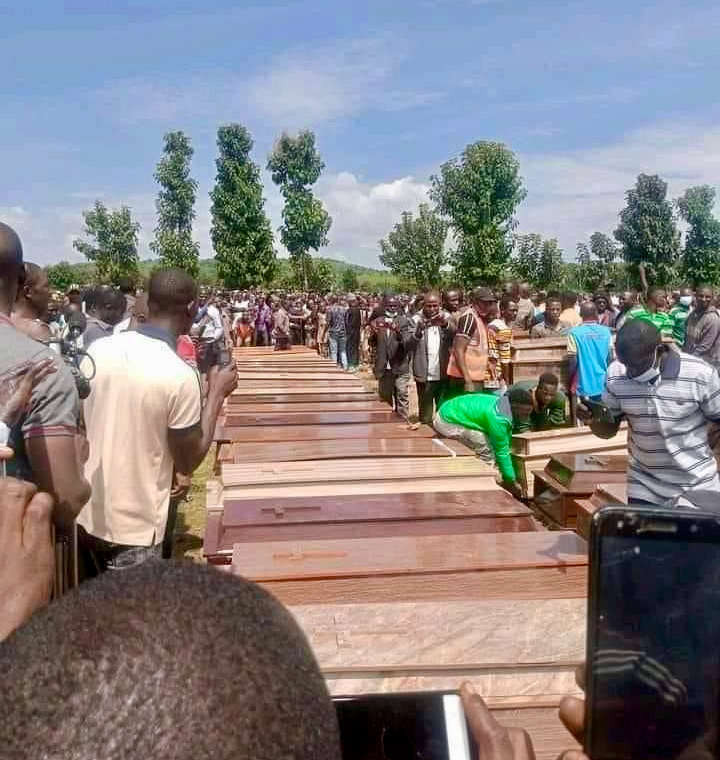
A terror group unrecognised outside the country murders far more people
The Fulani Ethnic Militia (FEM) – a loose network of Fulani Islamist militias – are behind at least 39% of all civilian killings, and probably more. Christian farmers are their special target. ‘Land-based attacks’ – planned invasions of selected villages or homes, and occupation of the land – are their strategy. Communities are chosen; this is jihadist violence.
Overall, 2.7 Christians were killed for every Muslim killed in the data period. Notably, Muslims are also terribly affected by the violence. In states where the attacks occur, proportional loss to Christian communities is far higher. In terms of local populations, 6.5 times as many Christians were murdered as Muslims. As the charity Open Doors notes, a vast flight of poor Nigerians is now underway.
Frustratingly, while the data reveals much, some features of it remain mysterious.
In the run-up to Nigeria’s 2023 elections, the pattern of terror attacks changed, significantly falling away. Why was this? And why did the killings return, after the election? Despite close examination, these figures are shrouded in mystery.
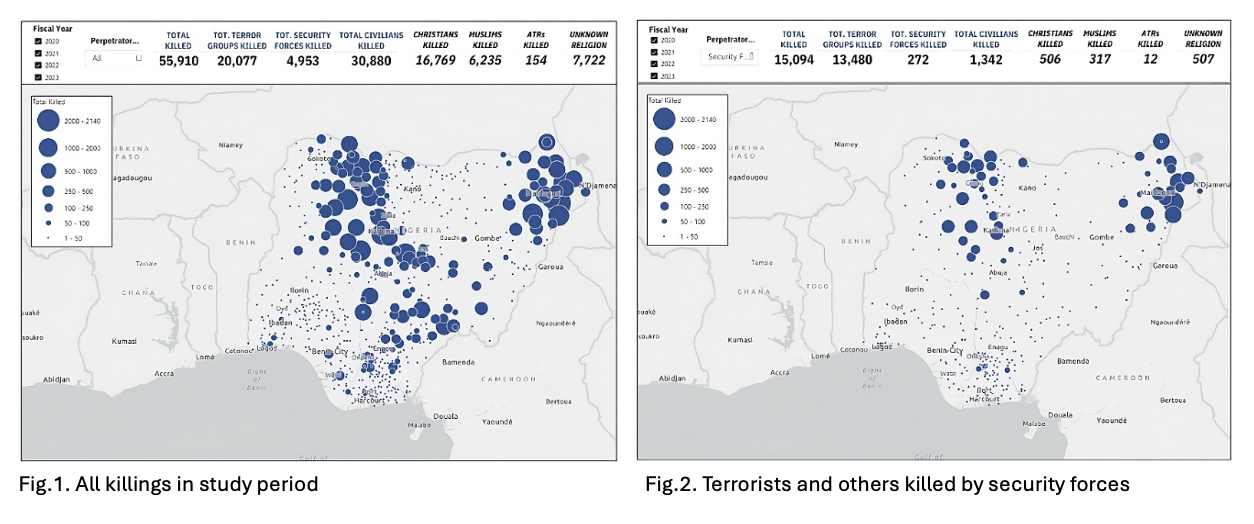
Another puzzle: our mapping of Nigeria’s military response reveals almost no security engagement at the scenes of many thousands of killings. Why?
Nigeria’s military does pursue terrorists. But our mapping reveals a highly selective focus on targets in the North-East and North-West – hundreds of miles from the fragile North Central zone, scene of thousands of attacks on families. At various times in the four-year period, this region became a murder free-for-all.
A first glance at these maps is shocking. They are horrifically clear. They depict the loss of thousands of lives.
The ORFA authors are calling for urgent research into this evidence.
Amidst this difficult picture, our researchers do point to one gleam of light: the fast-evolving world of AI.
For over a decade, Nigerian and Western leaders and policymakers have feigned ignorance over the truth of rights violations in West Africa.
Within just a few years, AI will make that difficult. Our researchers are keenly aware of new AI software coming to market. Data-gathering is transforming. Technologies are evolving fast –- satellite imaging, geo-location, voice recognition – and are being incorporated into traditional data archiving.
If the volunteers stand up to be trained, and the technology is placed into their hands, our ability to uncover evidence of this violence may be transformed.
 Martin Plaut
Even c tagging the violence unleashed by Fulani herder militia as “farmer-herder” clashes totally misses the point. What we are dealing with is a coordinated mass murder scheme, with financing and backing from powerful Fulani interests. The focus is to grab land, maim, intimidate and decimate indigenousChristian populations and basically subject many other communities to Fulani subjugation. The government and international community make a huge mistaking viewing this from the lenses of a struggle driven by climatic factors.
I appreciates this article so much but as a Nigerian it has always horrified me that the after numerous atrocities , kidnapping, raping murder on a mass scale have the Nigerian government never had an official inquiry ?no investigations into these damning reports and data. The government doesn’t do more about these so called bad actors, no arrests
there’s no care for the murderer and oppressed
it’s a disgrace and something has to be done
the genocide going on hasn’t stopped