Source: BBC Amharic
The Eritrean opposition movement N’Hamedu has said that its office in Addis Ababa will serve as a “headquarters” when “military bases are established in the future.”
The opposition movement also said it could have “military and diplomatic centers” in Ethiopia.
The movement’s leadership told the BBC that it has “discussed” with the Ethiopian government regarding ways in which Eritreans joining Brigade N’Hamedu can get [security] “guarantees.”
Brigade N’Hamedu, which is fighting to overthrow Eritrean President Isaias Afwerki, opened its office in a building in Haya Hulet [“22”] area of Addis Ababa in mid-February.
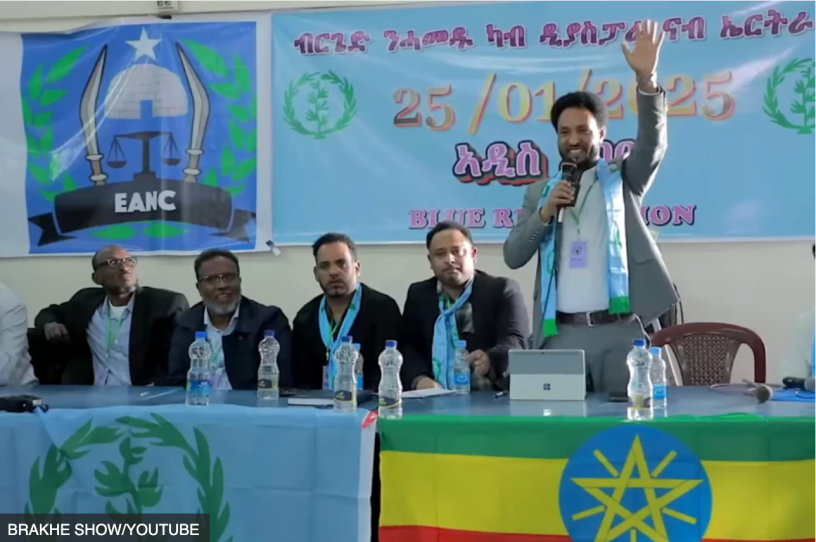
In a video showing the inauguration ceremony, Brigade N’Hamedu leaders are heard saying that the opening of the office is a “turning point” for the movement.
Beyene Gebreegzi, one of the visible leaders of the movement, has stated that the office has served as a “communication center” for the until then “fragmented” Brigade N’Hamedu movement.
The opening of the office comes about a month after Brigade N’Hamedu, along with another opposition organization, the Eritrean Afar National Congress, held a meeting in Addis Ababa on January 27, 2025, attended by Eritreans.
Beyene Gebreegzi, the head of Brigade N’Hamedu’s diplomatic department, told the BBC that the protest movement, which had previously been taking place in Western countries, “started in Ethiopia in a different way than in other countries.”
Beyene, who said that the movement’s representatives had spoken to Ethiopian government officials, stated: “Our request to the Ethiopian government is that we will bring about radical change in Eritrea.”
What is “Brigade N’Hamedu”?
“Brigade N’Hamedu” is an Eritrean protest movement that has been growing and attracting attention, especially in Western and Middle Eastern countries, over the past three years.
The movement, distinguished by the blue T-shirts worn by its supporters, is known as the “Blue Revolution.”
Supporters of Brigade N’Hamedu began their protest movement by disrupting festivals and events organized by the Eritrean government in various countries. The United States, the United Kingdom, Israel, Canada, Germany, Sweden, and Switzerland are among the countries where protests have occurred at festivals supporting the Eritrean government.
During these protests, clashes between pro-government and anti-government Eritreans have repeatedly resulted in injuries, including to security forces.
Eritreans who participated in these protests have been arrested by security forces in several countries.
Germany’s prosecutor’s office, which has labeled Brigade N’Hamedu a “domestic terrorist organization,” has announced that it is searching for 17 people “suspected of founding and being members of a terrorist organization.”
Eritreans abroad have been protesting the festivals because they are “a tool of the state,” Kiros Asfaha, one of the figures mentioned in the Brigade N’Hamedu movement, told the BBC.
“The money raised using these festivals as a pretext strengthened the regime, which is why this movement was carried out,” stated the Eritreans, explaining their reason for opposing the festivals.
The Brigade N’Hamedu movement may have started with the motive of “stopping the festivals,” but the group’s ultimate goal is to “remove” Isaias Afwerki’s government, which has been in power for more than 30 years.
Isaias Afwerki’s government, which has been in power since Eritrea’s founding as a country, has not held a national election in the past 32 years.
In Eritrea, the legislative, executive, and judicial branches of government are poorly organized and dysfunctional, and the government is accused of gross human rights violations.
The Eritrean government has been accused by the United Nations of detaining dissidents, journalists, and religious leaders without charge for years.
The country’s unlimited compulsory military service is also a major issue that has led to accusations of international human rights abuses.
What is the military capacity of Ethiopia’s neighboring countries?
Many Eritreans have fled their country to escape what the UN Commission of Inquiry has described as “forced labor and slavery.”
According to the UN High Commissioner for Human Rights’ report of May 2016, Eritrea, 17 percent of whose population lives in exile, has the highest number of asylum seekers relative to its population size.
The leader of Brigade N’Hamedu, Beyene, accuses the Eritrean government of “starting to create cross-border oppression and pressure” on the “political asylum and peace of the country’s citizens.”
Following this, Ato Beyene explains, the Brigade N’Hamedu movement is primarily aimed at “bringing about a radical change in Eritrea.”
He also stated that after the “regime change,” there is a plan of “establishing temporary transitional institutions through a national assembly.”
“First, the regime has to be removed from Eritrea. Then, at every level, government leaders who should be brought to justice will be brought to justice, and then this is followed by pardoning those who should be pardoned.
There will also be documents that will be presented at every level to stabilize and transform the country,” he said, citing the activities that the movement plans to carry out once it achieves its goal.
The leaders of the Brigade N’Hamedu movement do not believe that their goal can be achieved through a ‘peaceful struggle.’ Two of the movement’s coordinators told the BBC that the movement’s main method of struggle is armed struggle.
The two leaders cite the Eritrean government’s past torture and repression of opposition figures who have tried to bring about change through peaceful struggle as a reason for the movement’s choice of armed struggle.
Beyene stated, “The Eritrean government does not recognize the opposition and citizens who have grievances. The fate of a citizen with a different opinion is prison, a hole, execution, and disappearance.”
“The whereabouts of our citizens who tried to fight peacefully in the nineties are now unknown,” he explained.
Beyene, who considers it a good thing that all Eritreans have been forcefully made to undergo military training, says, “As most Eritreans come from Sawa, they are not citizens who need new military training, except perhaps regarding recently introduced modern weapons.”
Beyene says that the armed struggle waged by Brigade N’Hamedu is “at the beginning stages.” The leadership, which coordinates the diplomatic work of Brigade N’Hamedu, stated that talks have been held with “American, European Union, Canadian, and Swedish officials” to obtain support for the movement.
Ato Beyene, noting that the armed struggle of the resistance movement cannot be carried out from a distance, explained, “It is clear that this radical change will take place in our country,” pointing out the area where the struggle will be based.
Brigade N’Hamedu’s armed struggle from Ethiopia?
The two Brigade N’Hamedu movement coordinators who were interviewed by the BBC declined to say which area would be the base for their planned armed struggle.
When asked if there were plans for an armed struggle from Ethiopia, Ato Beyene, one of the coordinators, said: “There could be a deployment, campaign, organization, military and diplomatic centers in Ethiopia.”
Brigade N’Hamedu’s leadership said, “We are registering and organizing our members” to begin an armed struggle and added, “We are preparing leaders [who will command the military headquarters] to go to the designated location as soon as permission is granted.”
However, he did not explain from whom they were going to get the permission.
Beyene said that the leaders of the Brigade N’Hamedu movement had “talked” with Ethiopian government officials.
“The request we made to the Ethiopian government is that we will carry out a radical change in Eritrea. Therefore, military activity is not something that can be seen in isolation,” he said, pointing out how they explained the purpose of the movement to the Ethiopian government.
When asked if there had been talks with Ethiopian military commanders, the coordinator stated that there are “military wing leaders” designated to monitor this issue and that “I cannot say 100 percent whether there were or not.”
Ato Beyene, who states that the movement of Brigade N’Hamedu in Ethiopia is “different from what is happening in other countries,” cites three reasons for this.
The coordinator cites Ethiopia’s diplomatic status, particularly its hosting of the African Union, as one of the reasons.
The fact that Ethiopia and Eritrea are “economically and security-wise close” neighboring countries and that there are “more than 300 thousand” Eritreans in the country are other reasons cited for Brigade N’Hamedu operating there in a different manner.
Beyene said, “The third reason is to move our struggle, which originated in Western countries, to the area near the country.
When we say Ethiopia, we mean expanding the struggle by getting to different areas near Eritrea, such as Samara, Mekele, or Humera.”
They added that the presence of Brigade N’Hamedu in Ethiopia would help them closely monitor developments in Eritrea and the Horn of Africa.
They also said that this was one of the reasons for the movement opening an office in Addis Ababa.
The leadership said that the office would “replace” the Eritrean embassy in Addis Ababa and handle issues related to Eritrean refugees in Ethiopia.
Beyene said that there had been “talks with Ethiopian government bodies” regarding this matter and that discussions had been held to ensure that refugees who are members of Brigade N’Hamedu “are given an ID card, have a registration number, and provided guarantees.”
They explained that the “identification card” would help an Eritrean who is a member of Brigade N’Hamedu “not be arrested and taken to Eritrea.”
“Therefore, any citizen who was exiled from Eritrea and says, ‘I will support the ongoing struggle and shorten my life of exile,’ will first receive a Brigade N’Hamedu membership card, then he will be given security guarantees in Ethiopia,” he said, citing talks with Ethiopian government officials.
According to Beyene, the purpose of opening the Addis Ababa office is not limited to issues related to refugees. The leaders, explaining the role the office will have in the future of Brigade N’Hamedu’s armed struggle, said, “We opened the office so that when the military centers are opened in the future, it will become a headquarters and provide centralized command for all operations.”
Beyene said the Brigade N’Hamedu office in Addis Ababa was opened “following the request of the movement’s leaders to the Ethiopian government.”
He also indicated that there is a plan to open a similar office in the Afar region.
Beyene, who said that the movement’s leaders have visited the Afar and Tigray regions, stated, “We have done what we are allowed to do so far.”
He explained his relationship with the Ethiopian government by saying, “In addition to our internal security structure, the Ethiopian government provides us with guarantees so that we do not face security problems in our activities.”
Addis Ababa and Asmara, which have been at enmity for decades following the Ethio-Eritrean war, have a long history of supporting armed groups working to overthrow each other’s governments.
Eritrea has been secretly supporting for years the Oromo Liberation Front (OLF), the Ogaden National Liberation Front (ONLF), the Patriotic Ginbot 7, and the Tigray People’s Democratic Movement.
The Ethiopian government has at various times also hosted opposition groups that have been plotting to overthrow the Eritrean government.
In a 2007 expert analysis article published by Eritrean anthropologist Professor Abdulkadir Saleh Mohammed and Conflict Studies Professor Kjetil Tronvoll of the New University College in Oslo, Norway, it was stated that the Ethiopian government “helped establish” opposition groups that have risen up seeking to uphold the rights of ethnic groups in Eritrea.
The ethnic groups that are said to have been established with the help of the Ethiopian government are the “Red Sea Afar Democratic Party” and the “Eritrean Kunama Freedom Movement.”
In the report published ten years ago, it is stated that the Red Sea Afar Democratic Organization had 15,000 fighters. This militant group is still based in the Afar region.
The opposition party “Eritrean Afar National Congress” also operates in the Afar region. The opposition organization “Eritrean Youth Solidarity for National Salvation (Simret)” also had an office in Addis Ababa.
One of the events mentioned regarding the activities of Eritrean opposition organizations in Ethiopia was the conference held in Hawassa in 2003.
This conference, which lasted for ten days, was attended by more than 500 political organizations, civil society organizations, and youth representatives from various countries.
A study published in 2015 on the opposition activities of the Eritrean diaspora community recorded the participation of 21 political organizations in the Hawassa conference.
The Ethiopian Embassy in Tokyo, Japan, stated in a statement it released on its website at that time that more than 30 political parties participated in the conference.
The conference, which was held to “approve a major strategy to overthrow the Eritrean dictator [government],” was attended by Ambassador Redwan Hussein, then office head of the Ethiopian People’s Revolutionary Front (EPRDF), according to the embassy statement.
In his opening speech at the conference, Ambassador Redwan expressed his belief that “the conference would help Eritrean opposition forces resolve their differences and reach an agreement,” the statement said.
The embassy’s statement quoted Ambassador Redwan as saying, “The Ethiopian people and government have pledged their support for the struggle for peace and democracy in Eritrea.”
Journalist Khalid Abdu, who attended meetings in Addis Ababa and Bishoftu to prepare for the Hawassa conference, recalled that Eritrean opposition groups had offices in Addis Ababa and in towns in the Tigray region such as Adigrat and Shire.
The journalist, who is currently in Sweden, told the BBC that “they were given some money every month [from the government] to run their offices. They would especially help those who were conducting armed struggle.”
The Eritrean opposition groups received financial support from the Ethiopian government “based on their activities and the number of people they had,” Khalid explained, adding that the Afar and Kunama ethnic groups received more support than other groups. “The Afars and Kunamas received more funding because they had a larger army. Others would accuse the Ethiopian government of giving them greater support because EPRDF advocated ethno-nationalism,” he recalls.
In addition, there were disputes and disagreements between opposition parties and movements regarding the support from the Ethiopian government in general.
Eritrean opposition groups, which had been receiving support during the EPRDF era, saw their relationship with the government change after Prime Minister Abiy Ahmed came to power in 2010.
Following the signing of the Addis Ababa-Asmara peace agreement, the Ethiopian government “ordered Eritrean opposition parties operating in the country to cease their activities,” according to Freedom House, a US-based non-governmental organization that studies political freedom.
In August, the Ethiopian government cut off “financial and food” support to the Eritrean opposition, Africa Intelligence, a website that reports on African affairs, reported.
Journalist Khalid says that after the agreement, there were opposition members who were “kidnapped from Addis Ababa and taken to Eritrea.”
Khalid, who says that there were “citizens of European countries” among the Eritrean opposition members “taken” from Ethiopia, also mentions that “a large number” of protest participants left Ethiopia as a result.
Khalid, who is closely monitoring the current relationship between Brigade N’Hamedu and the Ethiopian government, asks: “Even now, what is the guarantee that this [relationship] will not be reversed the next day?”
Relations between Ethiopia and Eritrea, which had been friendly since 2010, have been strained since the signing of the Pretoria Agreement that ended the Tigray War.
The Ethiopian government’s repeated demands for a seaport on the Red Sea and the changing alignments in the region have also added to the tension between the two countries.
The Eritrean opposition Brigade N’Hamedu launched its campaign in Ethiopia after the “breakdown” of relations between the Addis Ababa and Asmara governments and “their differences [were] confirmed,” its leader, Beyene, told the BBC.
The leader explained, “We went to Ethiopia to be an alternative to avoid another war and problem when the Ethiopian government breaks off relations with Isaias’ government.”
Beyene, who is asking the Ethiopian government to “do its part” in the “radical change” that Brigade N’Hamedu plans to bring to Eritrea, says that if this happens, “we will be able to answer the sea outlet and other issues that the Ethiopian government raises.”
“First, let’s make the Eritrean people governed by the constitution in their territory—let the Ethiopian government help us with this. Then, Ethiopia should benefit from Assab port, which is close to it, and we should not have a problem handling this,” he stated, explaining the movement’s position.
Ato Beyene said that he does not believe that the current tension between Ethiopia and Eritrea will lead to war.
“There is a demand for ‘Shaa’biya’ to withdraw from Ethiopia. But I do not see a call saying ‘we will invade Eritrea,'” the leader said. If war breaks out, Brigade N’Hamedu will “discuss” the matter through its “own structure, form, and leadership,” he said.
The BBC’s emailed request and repeated phone calls for clarification from the Ministry of Foreign Affairs regarding Brigade N’Hamedu’s activities in Ethiopia did not receive a response.
BBC Amharic Website, 17/4/2025
 Martin Plaut
Martin, this seems preposterous to me. Isaias would quickly crush any military adventure. Mike
>