
Source: Ha’aretz
Crisis, Coup, Dictatorship? Netanyahu’s Assault on Israel’s Democracy, the Protest Movement and What’s Next
03.08.2023 | 19:29

In tandem with its gaslighting, intimidation, and bulldozer tactics, Prime Minister Benjamin Netanyahu’s extremist coalition is redoubling its efforts toward an anti-democratic power grab: A wholesale demolition of checks and balances between the branches of government, to strangle the judicial system, to grant the government untrammeled power, to annex the West Bank and to recast Israel in its own illiberal image.
Israel faces a key milestone on September 12. That’s when the Supreme Court will consider petitions calling for the disqualification of July’s “Reasonableness Law,” the first legislative slice in the power grab known as the judicial overhaul.
Although Israel does not have a constitution, it has a limited number of higher-status Basic Laws, and what the Knesset passed in July is effectively a constitutional amendment that grants Netanyahu’s government legal immunity from “extremely unreasonable” decisions.
Suiting the unprecedented times, all 15 justices of the Supreme Court will sit in September to decide the fate of the law. All eyes will be on the court in Jerusalem, not least those of Israel’s extraordinary pro-democracy protest movement, which has vowed to protect the rule of law, while the prime minister serially refuses to state for the record that he will commit to the court’s ruling.
Beyond Israel’s borders, the world is watching this momentous battle against illiberalism and autocracy, whether as inspiration or as a portent for their own societies.
What could happen in September? What would be the repercussions of the Supreme Court’s decision, if it nullifies the democracy-enfeebling law or not? What if the Netanyahu government rejects the rule of law, but the protest movement, the heads of the civil service, and the security forces defend the democratic order?
How near, or far, is Israel to a constitutional crisis, a civil uprising, or a dictatorship?
Haaretz explains the possible scenarios.

Timeline and future flashpoints
Ever since Netanyahu signed radical coalition agreements to establish his sixth government at the end of 2022 – and since Justice Minister Yariv Levin announced the parameters of the proposed judicial overhaul – the news pendulum has swung between incendiary government decisions and appointments and the response of a new Israeli phenomenon: A pro-democracy protest movement which has attracted worldwide interest for its remarkable size, stamina, focus and grassroots activism, notwithstanding the rising tide of police violence directed at its members.
Source: Ha’aretz
Tracking Netanyahu’s Judicial Coup: Where the Israeli Government’s Anti-democratic Legislation Stands
Israeli government’s legislative blitz bulldozes on ■ What is in each bill? What impact will each new law have? How near are these bills to becoming law?Share in TwitterShare in WhatsApp
Send in e-mailSend in e-mailGo to commentsPrint articleSaveSave article to reading listZen Read

FILE – Netanyahu and LevinChen MaanitNoa Shpigel
Dec 13, 2022
The judicial coup being advanced by the Benjamin Netanyahu-led government will weaken Israel’s justice system and prevent it from conducting judicial review of the government and Knesset. In a country that has no constitution, this plan strikes directly at the foundations of democracy.
The various bills comprising the judicial overhaul are moving through the legislative process rapidly. Together, they will give the ruling coalition almost unlimited power. Even now, as President Isaac Herzog is trying to hammer together a compromise plan, the bills are advancing swiftly in the Knesset.
In order for bills to become laws in Israel, the Knesset must approve them through a series of votes. Most bills will go through a preliminary vote in the Knesset plenum, then back to the relevant committee for changes and additions. Following this step, the bill is put up to a first vote in the Knesset before once again returning to the committee for changes. Afterwards, the bill is brought up to a vote for a second and third time. For bills that were introduced by the government (as opposed to an MK or group of MKs), the bill skips the preliminary vote and goes straight to the first vote. (In red: The stage at which each bill stands).
[Note – explanations not included]
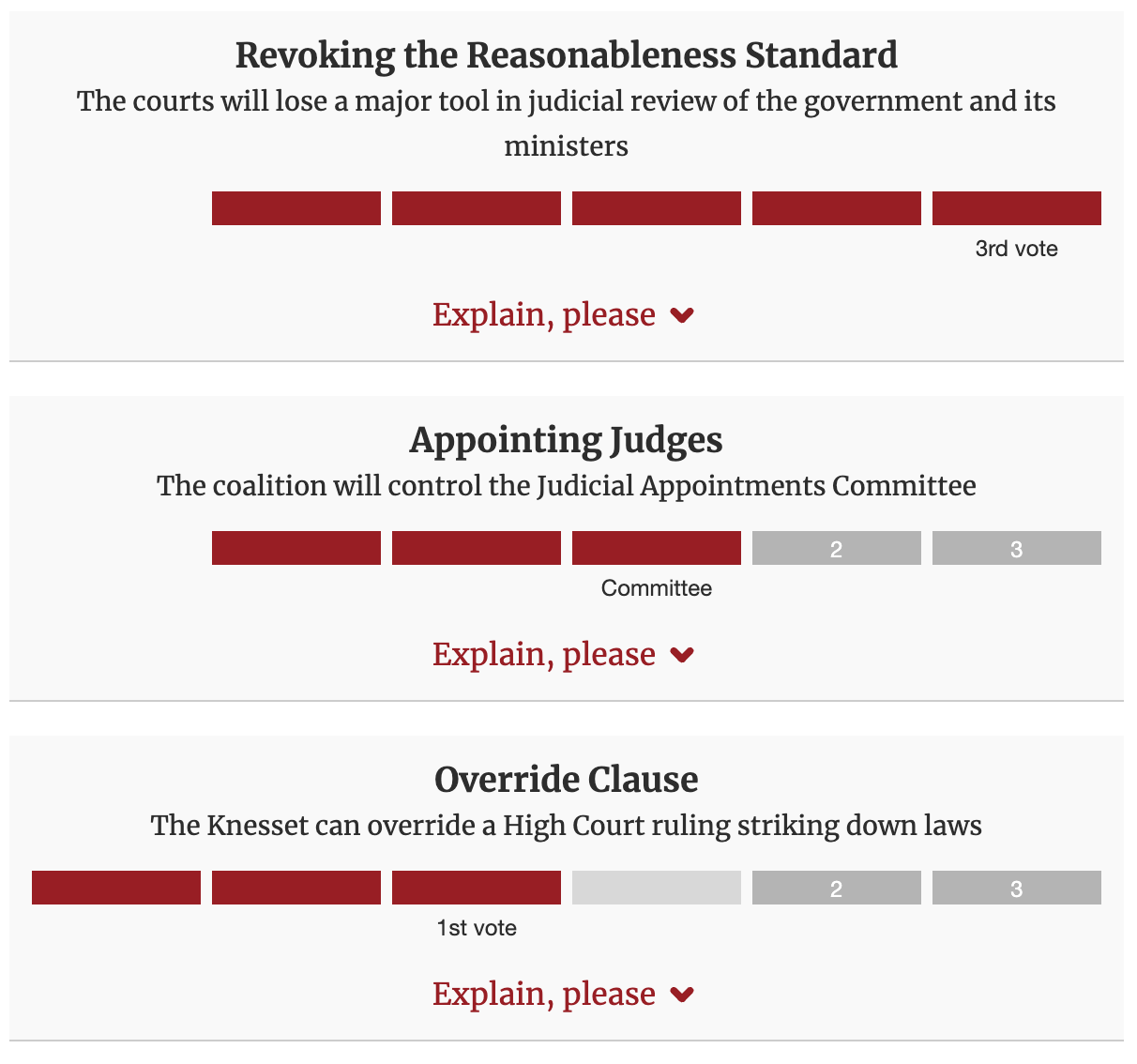

This is only the first stage
The bills being advanced now are just the first stage of a much broader plan to change the system of government in Israel. Prime Minister Benjamin Netanyahu and Justice Minister Yariv Levin also aspire to eventually change the status of the Basic Law on Human Dignity and Liberty into a regular law, limit the right of Israeli citizens’ right of standing before the High Court of Justice, politicize the appointment of legal advisers in government ministries, subordinating the process to ministerial judgment and to split the role of the attorney general, so that the cabinet will appoint a prosecutor general who will be responsible to prosecute cases against ministers and members of Knesset.
 Martin Plaut
Not mentioned in any of the above is that curtailing the power of the Supreme Court is about clearing the way further for unopposed control of the territory between the Jordan and the Mediterranean. See https://twitter.com/YairWallach/status/1687497799263203330?s=20 to understand the exponential increase in violence against Palestinians.
Laws passed in the Knesset the same week as the vote to curtail the Supreme Court: 1) expand the number of Israeli villages and towns that can vote to keep out Palestinian citizens of Israel 2) impose much longer sentances on Palestinians than on Jews who rape a Jewish woman.
What is already an ethnocratic state is mestatisizing into a theocratic state.