By Dawit Mesfin
London 23 Jul 2026
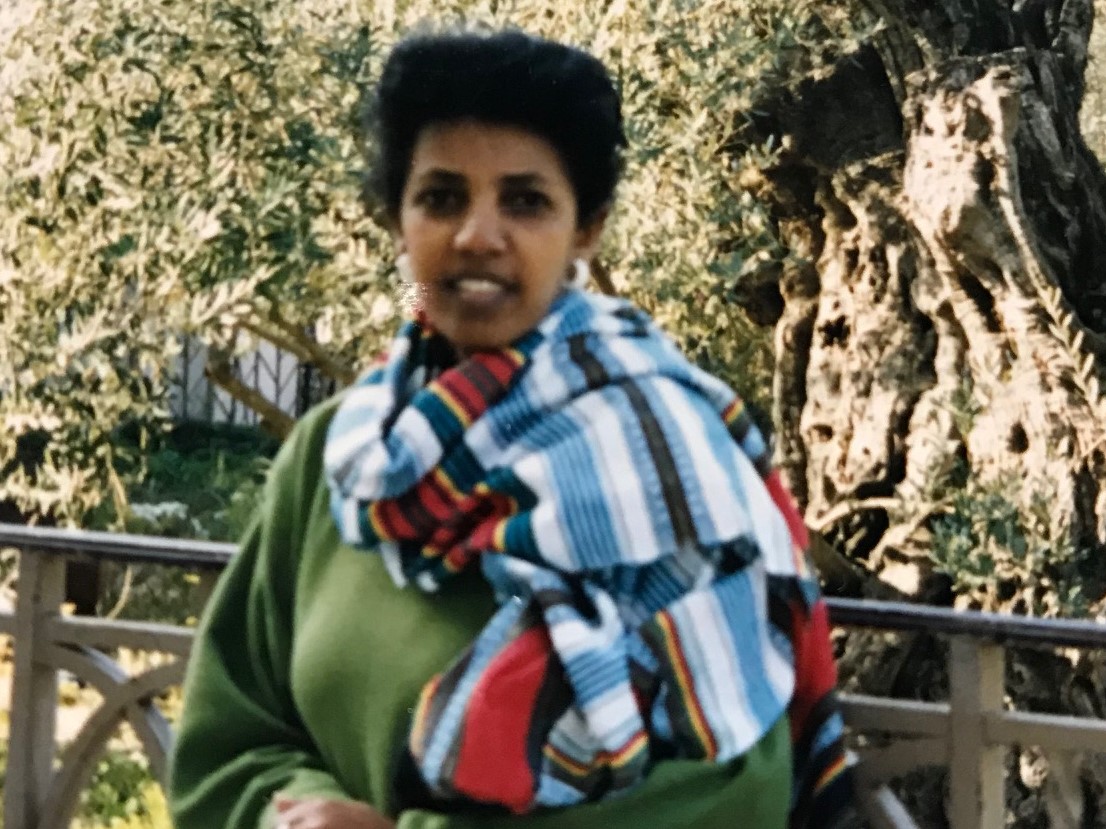
Betrayed prisoner of conscience: Aster Fesehazion
When I was in elementary school at Geza Kenisha – the Evangelical School of Asmara – one teacher etched himself into my memory more deeply than all the others: Memhr Tecletsion Debbas. He was stern, as most teachers were in those days, sometimes intimidating, yet capable of surprising us with flashes of humour. He possessed beautiful penmanship, an artist’s gift for drawing, and he taught us the Bible.
Whenever his lesson fell in the final hour of the day, none of the forty-odd pupils could leave before one final ritual. We had to sing his favourite hymn: the shortest in the hymnbook, No. 289, Nemesghino N’amlaKna – “Let Us Give Thanks to Our Lord.”
He would hum the opening line in a firm, resonant voice, giving us the key so we could begin as one. Then, with the quiet authority of a conductor before an orchestra, he would raise his hand to gather our attention and, with a swift downward motion, release us into song.
And we would sing – or rather, we would pour ourselves into the hymn – as though tomorrow had never been promised.
Yet of all the lessons I learned from him, one has remained with me more vividly than the rest. It was not the day he slapped me across the face after catching me chatting with the boy beside me in the upper gallery of our church. It was the day he spoke about the Passion of Christ – the final week of Jesus’ earthly life.
In his stammer-like voice, he told us about Judas Iscariot, one of the twelve disciples, who led the authorities to Jesus in the Garden of Gethsemane. I listened, spellbound. The story captivated me even as it filled me with an indescribable sadness. When I learned that Judas had surrendered his Master for thirty pieces of silver, and identified Him with a kiss, something in my young heart recoiled.
For centuries, Judas has stood as the enduring symbol of betrayal, even as scholars and theologians continue to wrestle with his motives and the mystery of his character.
As a child, however, there was no mystery. There was only outrage. How could a man betray someone who had trusted him? How could love curdle into treachery? How could the gentlest gesture of affection become an instrument of destruction? How could a kiss carry the weight of a knife?
Today, many decades later, I find myself returning to those questions – not because I have found their answers, but because life has taught me that betrayal is seldom confined to sacred history. It has a way of repeating itself in different forms, in different places, and among different people. Judas, it seems, never entirely leaves us. He simply changes his clothes.
Eritrea, too, is a nation whose history is marked by betrayal
At the centre of this tragedy stands President Isaias Afwerki – its principal architect and embodiment. Yet history reminds us that betrayals of this magnitude are rarely the work of one individual alone. They require institutions willing to surrender their purpose, colleagues willing to silence their conscience, and ordinary people who gradually become accustomed to what once would have shocked them. Loyalty comes to be measured not by devotion to the nation but by obedience to the ruler. Truth becomes expendable whenever it threatens power.
Then there were the men and women whom the Eritrean people trusted most: the freedom fighters. They were entrusted not merely with defeating successive rulers, but with something far more sacred – to return the country to its rightful owners, the Eritrean people themselves.
That trust has remained unfulfilled since independence.
Looking back, what strikes me most is not only what they did, but how deeply we believed. We entrusted them with our confidence, our dreams, and the memory of those who had died so that Eritrea might one day live in freedom. We imagined that sacrifice would naturally give birth to justice. We assumed that those who had fought oppression would instinctively reject becoming oppressors themselves.
History, however, has often refused to honour such assumptions.
Instead, our liberators became rulers, and the promise of freedom slowly hardened into the permanence of power.
History offers many images of this wound. One of its most enduring is the story of Julius Caesar and Marcus Junius Brutus. Caesar trusted Brutus as a friend; Brutus joined those who turned their blades against him. Whether the famous words are historical or Shakespearean matters less than the truth they express: “You too, Brutus?” remains humanity’s timeless cry upon discovering that the deepest wounds are inflicted not by enemies, but by those once embraced as friends.
Eritrea’s tragedy carries that same resonance. Nations rarely suffer their deepest injuries at the hands of declared enemies. Those wounds are painful enough. The wounds that endure, however, are inflicted by those in whom people invested their faith. It is not only freedom that is stolen; it is trust itself. And once trust is broken, rebuilding a nation becomes infinitely harder than liberating one.
Perhaps that is the ultimate betrayal: when those entrusted with delivering freedom become its jailers; when those who promised to serve the people instead expect to be served; when the dreams of an entire nation are exchanged for the ambitions of a few; and when those who once stood at the heart of the struggle become silent witnesses to its undoing.
Silence deserves reflection in its own right. Martin Luther King Jr. observed that the ultimate tragedy is not the oppression and cruelty of bad people, but the silence of good people. Silence, too, can become a form of betrayal – not because every silence is born of cowardice, but because prolonged silence can gradually lend legitimacy to injustice. What begins as caution may end as complicity.
That observation forces me to look not only at others, but also at myself.
It is tempting to divide history neatly into heroes and villains, betrayers and betrayed. Real life is seldom so accommodating. There is another category to which many of us belong: those who opposed injustice without ever fully accepting the cost of confronting it.
For years, I wrote articles, campaigned tirelessly, and spoke out whenever President Isaias Afwerki departed from the ideals that had inspired our struggle. I often believed I was doing my part. Yet, with the benefit of hindsight, I also recognise the limits of my own resistance.
Too often, my opposition remained within the relative safety of words. My indignation was genuine, but my sacrifices were measured. Looking back honestly, I cannot entirely escape the conclusion that much of my activism resembled what Chairman Mao once dismissed as a “paper tiger” – appearing formidable while lacking the power to alter reality. There was conviction, certainly, but also caution; determination, but also hesitation. Symbolic resistance sometimes became a substitute for transformational action.
This is not an exercise in false modesty. It is simply an acknowledgement that betrayal is not always committed through dramatic acts of treachery. Sometimes it appears in quieter forms – in compromises we justify, in responsibilities we postpone, and in opportunities we fail to seize.
Freedom Fighters
Seen through this wider lens, the former freedom fighters who shared the long struggle with President Isaias Afwerki followed three very different paths.
The first consists of those who continue to sustain his rule, whether out of conviction, dependence, fear, or self-interest. Their fortunes have become inseparable from the continuation of the existing order.
The second comprises those who eventually confronted him, insisting that the ideals for which Eritreans fought should finally be honoured. Many paid a devastating personal price for their courage.
The third group of ex-freedom fighters are slightly different. I am not sure of their defining characteristic. I cannot define them by ambiguity, hesitation, or political equivocation. I know some sought accommodation; others withdrew into exile to pursue new careers, choosing distance over direct confrontation.
What unites these three groups is not their destination but their beginning. They all fought courageously. They all sacrificed greatly. They all helped secure Eritrea’s independence.
Yet independence proved to be not the end of history, but the beginning of a far more difficult moral test.
Some became custodians of authoritarianism. Others became its prisoners. Still others became exiles, carrying both memories and regrets across continents.
Reflecting upon these divergent paths, I find myself asking a question that extends beyond Eritrea itself. At what point does a liberator cease to be a liberator? Is it when he first compromises his principles? When he remains silent before injustice? Or only when he actively participates in it?
I do not pretend to know the answer.
But I return, once again, to that childhood lesson about Judas.
Perhaps the greatest danger is not that history produces one Judas. It is that every generation must confront the possibility that betrayal may begin in ordinary human choices – ambition over service, loyalty to individuals over loyalty to principles, silence over conscience, and power over truth.
That is a lesson I first heard as a child in a classroom in Asmara.
It is one I am still trying to understand.
P.S. A final word to the third group of former freedom fighters who now live quietly among us in exile.
Time has not diminished your moral responsibility. You carry knowledge and memories that few others possess, and with them comes a solemn duty – not merely to mark the twenty-fifth anniversary of the disappearance of the so-called G-15, but to bear witness. Raise your voices to help recover chapters of our history that have been obscured, rekindle a nation’s fading memory, and honour comrades such as Mahmoud Ahmed Sherifo, Haile “Durue” Woldetensae, Petros Solomon, Aster Fesehazion, and the many others who have endured years of imprisonment, too often left to fade from the public conscience.
Where silence has endured, there remains an opportunity for acknowledgement – for an honest reckoning with the past and, where it is warranted, a heartfelt apology to those comrades whose sacrifices have not been matched by half-hearted remembrance.
Memory is not simply an act of looking back; it is an act of justice. As a schoolboy in Asmara, I first encountered the story of Judas as the ultimate symbol of betrayal. I could not then have imagined that its deepest lesson was not only about one disciple’s kiss in the Garden of Gethsemane, but about the enduring obligation to remain faithful to truth, to conscience, and to one another. That lesson has never left me. It still asks the same question of every generation: when the moment of moral testing comes, will we choose silence – or will we bear witness?


Thanks Mr Mesfin. Great read
I once lived in Geza Kenisha. I was not fortunate enough to go to the same school you attended in Gaza Kenisha?
The problem I have is the dignifying of the Dictator, by calling him President. He is just a run of the mill African dictator. No parliament, no election, no independent judiciary, no opposition allowed, no meaningful cabinet or institutions etc etc… Where did the title of The President come from? Maybe calling him the Fuhrer or il Duce might have been a proper title.
thank you
Thanks Mr Mesfin. Great read
I once lived in Geza Kenisha. I was not fortunate enough to go the same school you attended in Gaza Kenisha?
The problem I have is the dignifying of the Dictator, by calling him President. He is just a run of the mill African dictator. No parliament, no election, no independent judiciary, no opposition allowed, no meaningful cabinet or institutions etc etc… Where did the title of The President come from? Maybe calling him the Fuhrer or il Duce might have been a proper title.
thank you