
The fighting has begun. Reports of artillery exchanges, drone strikes, and military clashes along the Ethiopia–Eritrea border have brought the Horn of Africa into another dangerous confrontation…The UAE is not a bystander.
By Yohannes WoldemariamNovember 15, 2026
Source: Originally published by Z. Feel free to share widely.
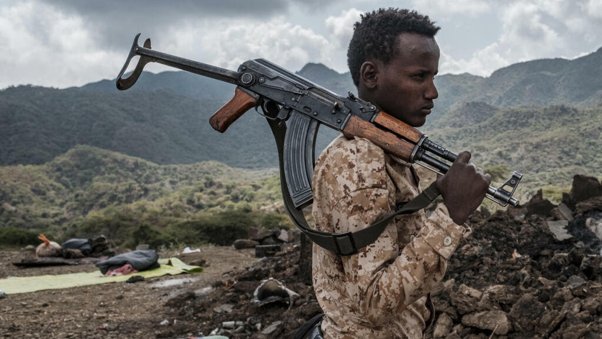
An Afar Special Forces member stands beside a damaged house near the village of Bisober in Ethiopia’s Tigray region. The village was damaged during fighting between Tigrayan and Ethiopian federal forces. (Photo: Eduardo Soteras)
The fighting has begun. Reports of artillery exchanges, drone strikes, and military clashes along the Ethiopia–Eritrea border have brought the Horn of Africa into another dangerous confrontation. The full extent of the fighting remains difficult to establish, but the possibility of a wider war is no longer an abstract concern. For people who have lived through decades of conflict, the developments are frighteningly familiar.
What troubles me most is the apparent calculation behind Prime Minister Abiy Ahmed’s actions. He seems convinced that the international community will do little to stop him. His repeated claims concerning Eritrea’s Red Sea coast, particularly Assab, have gradually transformed what he presents as a historical grievance into a dangerous territorial ambition. He speaks as though Ethiopia’s population, economic needs, and imperial history somehow entitle it to the territory of another sovereign country.
Ethiopia is already suffering from conflicts in Tigray, Amhara, and Oromia. Millions have experienced displacement, hunger, and the destruction of their livelihoods. The Pretoria Agreement of November 2022 stopped the large-scale fighting in Tigray but failed to establish a durable political settlement. Fighting in Amhara continues, while Oromia remains deeply unsettled. These are profound political problems that require negotiation, accountability, and a willingness to confront the country’s internal contradictions.
Instead, Abiy has increasingly turned his attention toward Eritrea.
There is something profoundly disturbing about a government that has failed to establish peace within its own borders contemplating the acquisition of another country’s territory. Assab cannot resolve the grievances of the Amhara, Oromo, or Tigrayan peoples. It cannot restore the lives destroyed during Ethiopia’s recent wars, and it cannot provide the political legitimacy that Abiy’s government has struggled to secure.
But an external enemy can serve another purpose. It can be used to rally a divided population, silence critics, and present territorial expansion as a patriotic obligation. The danger is that a war against Eritrea may be promoted as a national cause when it is, in reality, a diversion from unresolved political crises at home.
The argument that Ethiopia needs Assab because it has a large population is particularly troubling. Population size does not confer sovereignty over another country’s territory. Landlocked countries throughout the world depend on commercial arrangements with coastal neighbors. Ethiopia can negotiate the use of Eritrean ports, as it has done before, without questioning Eritrea’s territorial integrity.
Commercial cooperation and territorial acquisition are entirely different matters.
Ethiopia did not lose Assab when Eritrea became independent. Eritrea recovered its independence after a long struggle against Ethiopian rule. Assab was part of Eritrea before the federation with Ethiopia, remained part of Eritrea during Ethiopian occupation, and belongs to Eritrea today. The internationally recognized boundary between the two countries was addressed through the Eritrea–Ethiopia Boundary Commission. Ethiopia’s past occupation of Eritrea cannot establish a permanent claim to its territory.
The language of recovering Assab is therefore misleading. It transforms the end of an occupation into a grievance and treats Eritrean independence as an injustice to Ethiopia. This is the logic of imperial nostalgia, not a legitimate basis for relations between sovereign states.
Eritrea has been betrayed before
Eritreans have good reason to be suspicious of international assurances. Their experience after the Second World War offers a painful lesson about the distance between the principles proclaimed by powerful governments and the decisions they make when strategic interests are involved.
When Italy lost its colonies, Eritrea’s future became a subject of negotiation among the victorious powers. Britain administered the territory and considered partitioning it. The United States attached considerable importance to its military communications facilities near Asmara, which later became known as Kagnew Station. Haile Selassie wanted Eritrea incorporated into his empire.
The wishes and rights of Eritreans were subordinated to these competing interests.
Rather than allowing Eritreans to determine their future through a referendum, the international powers accepted a settlement that placed Eritrea under the Ethiopian Crown. Under United Nations General Assembly Resolution 390 A(V), Eritrea was federated with Ethiopia in 1952 as an autonomous unit, with its own constitution, assembly, and institutions.
The arrangement was supposed to protect Eritrea’s autonomy. Instead, it provided the setting for its gradual destruction.
Haile Selassie systematically dismantled the federation. Eritrean political institutions were weakened, constitutional protections disregarded, and the territory’s autonomy progressively eliminated. In November 1962, Ethiopia formally annexed Eritrea.
The governments that had helped establish the federation did not intervene effectively to defend it. The United Nations failed to enforce the guarantees contained in its own resolution.
Eritreans were left to fight for their freedom.
The liberation struggle lasted thirty years. It brought enormous suffering, displacement, and destruction. Generations of young people sacrificed their lives. Eritrea finally achieved independence in 1991, followed by an internationally observed referendum in 1993.
That independence was not a concession from Ethiopia or a gift from the international community. It was the outcome of an extraordinary struggle after international diplomacy had failed Eritreans.
This history matters because the assumptions that made the earlier betrayal possible have not entirely disappeared. Once again, Eritrea’s sovereignty risks being subordinated to the ambitions of a more populous neighbor and the strategic calculations of external powers.
History must not be allowed to repeat itself.
There is another historical irony worth remembering. In May 1963, just six months after Ethiopia annexed Eritrea, Haile Selassie hosted the founding summit of the Organization of African Unity in Addis Ababa. The gathering celebrated African liberation, sovereignty, and solidarity at a time when its host had just extinguished Eritrea’s autonomy.
Haile Selassie enjoyed enormous prestige as a Pan-African statesman. Yet the contradiction between his international reputation and his government’s treatment of Eritrea received remarkably little attention.
The OAU subsequently failed to provide meaningful institutional support for Eritrea’s liberation struggle. Its commitment to the sovereignty of established African states was not matched by an equally determined defense of Eritrean self-determination.
The African Union now faces a similar test. It cannot defend the territorial integrity of some African countries while treating Eritrea’s internationally recognized boundaries as negotiable. The principles of sovereign equality and territorial integrity must apply to Eritrea as fully as they apply to Ethiopia.
The language of destruction and the expectation of impunity
Abiy’s present rhetoric cannot be separated from his conduct during the Tigray war. His record gives ample reason to take his threats seriously.
In July 2021, he used language comparing his enemies to cancer and invasive weeds that needed to be uprooted. Although these remarks were presented as attacks on the TPLF, the distinction between a political organization and the Tigrayan population became increasingly blurred.
Amnesty International documented the spread of dehumanizing language against Tigrayans, while the United Nations International Commission of Human Rights Experts on Ethiopia examined the broader patterns of hostility and violations committed during the war.
The comparison with Rwanda is difficult to avoid. During the 1994 genocide, Tutsis were described as vermin and enemies whose elimination was necessary. The circumstances are not identical, but the danger of dehumanizing language is unmistakable. Once people are portrayed as weeds, cancers, or contaminants, their destruction can be presented as a form of cleansing.
Such language is especially dangerous when it comes from the head of a government commanding an army.
Abiy has also been reported as boasting that he reduced Mekelle, the capital of Tigray, to Beshasha, the village where he grew up. The precise wording of that reported remark still requires confirmation from an original recording or transcript. Nevertheless, the account belongs to a wider record of rhetoric that has repeatedly treated military destruction as an acceptable instrument of political power.
His invocation of Gaza is particularly revealing.
Abiy has referred to the failure of the international community to intervene effectively in Gaza. I understand his message as a warning to Eritrea: do not expect the world to come to your rescue. The significance of that message lies in what it reveals about his apparent understanding of international politics.
He does not need the international community to approve of another war. He needs only to believe that it will remain passive.
And why should he expect otherwise?
The international community has often been conspicuously absent when African lives are at stake. Governments issue statements of concern while atrocities continue. Diplomats call for restraint while weapons are delivered. International institutions investigate crimes long after the victims have been killed or displaced.
The phrase international community suggests a shared commitment to protecting human life and upholding international law. Yet when powerful interests are involved, that community frequently disappears. Its principles become negotiable, its condemnations selective, and its response painfully slow.
Eritreans experienced this after the Second World War. They have every reason to fear that they may experience it again.
Abiy’s apparent confidence is especially dangerous because he commands a large military establishment and has demonstrated a willingness to pursue costly campaigns. His previous wars involved mass mobilization, repeated offensives, and enormous casualties. If he believes that numerical superiority, sustained assaults, and foreign military technology can deliver Assab, the consequences could be catastrophic.
But population size is not military destiny.
Eritrea’s liberation struggle demonstrated that a smaller population can resist a much larger state equipped with extensive foreign military assistance. Ethiopia’s previous occupation ended despite the enormous resources committed to maintaining it.
It would be a tragic mistake to imagine that another war could reverse that history.
The UAE is not a bystander
The role of the United Arab Emirates is central to understanding Abiy’s confidence. It should not be treated as a peripheral issue or reduced to speculation about possible future assistance.
The UAE has been an important military partner of Abiy’s government since he came to power in 2018. Its support during the Tigray war included military equipment, training, and drone capabilities that helped change the course of the fighting. A Chatham House study of the regional dimensions of the Tigray conflict describes the UAE’s military assistance, including drones that helped halt the Tigrayan advance toward Addis Ababa in 2021.
This relationship is established. It is not a matter of conjecture.
The UAE’s involvement in Sudan’s war makes the relationship even more troubling. In February 2026, Reuters reported the existence of a training camp for Sudan’s Rapid Support Forces inside Ethiopia’s Benishangul-Gumuz region. The investigation drew on interviews, satellite imagery, documents, and diplomatic correspondence. Eight sources, including a senior Ethiopian official, attributed the financing and logistical support for the camp to the UAE. Reuters could not independently verify every element of the alleged Emirati role, and Abu Dhabi denied involvement.
The allegations are serious, particularly given the RSF’s record of atrocities in Sudan and the extensive reporting on Emirati support for the force. The European Union Agency for Asylum has also examined the UAE’s reported involvement in Sudan’s conflict.
These developments reveal the wider regional implications of the relationship between Addis Ababa and Abu Dhabi. Ethiopia is not simply receiving foreign assistance for its own defense. Its territory and military relationships have become entangled in conflicts beyond its borders.
Now reports of foreign military personnel operating alongside Ethiopian forces raise further questions.
Video footage has circulated showing foreign men in military clothing in Tigray, and reports have identified some foreign personnel as drone operators. Their nationalities and precise roles have not been conclusively established. Separately, an investigation by Mada Masr, citing an Ethiopian Air Force source, reported that Emirati military officers were stationed at the Ethiopian Air Force headquarters in Debre Zeit to oversee drone operations.
These reports deserve urgent and independent investigation.
There is a considerable difference between supplying drones and participating in their operation. If foreign officers are directing strikes, providing targeting intelligence, or otherwise participating in military operations, their involvement would raise questions of responsibility that cannot be answered by describing them merely as advisers or suppliers.
Who is operating these drones? Who selects their targets? Who provides the intelligence? Who authorizes the strikes? And who is accountable when civilians are killed?
These questions cannot be avoided simply because the personnel involved may belong to powerful foreign states.
The UAE’s established military role in Ethiopia, its reported involvement in Sudan, and the allegations concerning foreign drone operators make external military involvement a central issue in the present crisis. The exact extent of Emirati operational participation in the current fighting along the Eritrean border still requires independent verification, but the history of military cooperation is already well documented.
Abiy has benefited from that cooperation. It is reasonable to conclude that the availability of foreign military technology and the expectation of continued external support have strengthened his capacity to pursue military solutions.
The UAE cannot be allowed to present itself as a neutral diplomatic actor while its military relationships escape scrutiny.
Any serious proposal to end the fighting must examine the external networks that supply weapons, finance military operations, provide intelligence, and sustain the capacity to wage war. Where credible evidence establishes complicity in atrocities, accountability must extend beyond the immediate combatants.
Otherwise, international diplomacy will continue addressing the symptoms of conflict while ignoring those who help make it possible.
Assab is not a bargaining chip
The United States also has an important responsibility.
On November 10, 2026, five American senators, Jeanne Shaheen, Cory Booker, Chris Coons, Jeff Merkley, and Chris Van Hollen, wrote to Secretary of State Marco Rubio expressing concern about renewed conflict in Ethiopia and the danger of wider regional escalation.
The letter recognizes the limitations of the Pretoria Agreement and the need for broader diplomatic engagement. It also explicitly opposes any Ethiopian attempt to acquire Assab by military force.
This is an important statement, but it raises a larger issue.
Why should Assab be part of negotiations over Ethiopia’s internal political crisis in the first place?
Eritrea did not create the grievances of the Amhara, Oromo, or Tigrayan peoples. Its territory cannot be used to compensate one faction, satisfy another, or rescue a government struggling with a crisis of legitimacy.
Nor should Eritrea’s sovereignty become entangled in Ethiopia’s disagreements with Egypt and Sudan over the Nile. The management of an international river system and the territorial integrity of Eritrea are separate matters. There is no legitimate reason to connect them.
Assab belongs to Eritrea. Its future cannot be determined by negotiations among Ethiopia, the United States, or other external powers without Eritrea’s sovereign consent.
This should not be controversial.
Ethiopia and Eritrea can negotiate commercial port arrangements when political conditions permit. Such cooperation could benefit both countries and the wider region. But access to port services does not imply ownership, and economic dependence cannot justify territorial expansion.
International diplomacy must not encourage the belief that military threats can produce concessions that would otherwise be unacceptable.
The senators’ letter is welcome insofar as it rejects the use of force to acquire Assab. But a congressional letter is not a substitute for a coherent American policy. Washington must make clear that Eritrea’s sovereignty is not negotiable and that no military attempt to alter its borders will be legitimized.
It must also confront the role of external military assistance. A diplomatic initiative that asks African governments to exercise restraint while ignoring the powerful states that help arm them will remain incomplete.
The same applies to the African Union. Its credibility depends on defending the sovereignty of all its members, not selectively invoking territorial integrity according to political convenience.
The principles are already established. What has too often been missing is the willingness to uphold them.
The present confrontation is particularly tragic because the people of Eritrea and Ethiopia have already paid an extraordinary price for the ambitions of political leaders. The thirty-year Eritrean liberation struggle, the 1998–2000 border war, and the devastating conflict in Tigray have left wounds that remain open.
Many families have lost loved ones in more than one war. Young people have grown up knowing displacement, military mobilization, and uncertainty as ordinary features of life. Communities that should be rebuilding their homes and livelihoods face the prospect of another round of destruction.
I find it painful to contemplate another generation being sacrificed for a territorial ambition that has no legitimate foundation.
The tragedy is not inevitable. Ethiopia’s political problems can be addressed through political means. Its commercial needs can be met through negotiated arrangements with neighboring countries. The disputes among its peoples require serious engagement with their grievances, not a new external war.
But none of these solutions will emerge if Abiy continues to treat military force as a substitute for political legitimacy.
Nor will they emerge if external powers continue enabling warfare while claiming to support peace.
The international community must confront the danger now, rather than waiting until another catastrophe has unfolded. The fighting must be stopped, civilians protected, and Eritrea’s sovereignty respected. The military relationships that encourage escalation, including the UAE’s established support for Abiy’s government, must be subjected to serious scrutiny.
Eritreans remember what happened after the Second World War. Their future was shaped by the strategic interests of powerful governments. The federation was imposed without a referendum, its guarantees were dismantled, and the international community failed to protect the arrangement it had created.
Eritreans were left to fight for thirty years to recover their independence.
They should not be abandoned again.
The fighting has begun. The international community must act before it becomes another prolonged tragedy for the peoples of Eritrea, Ethiopia, and the wider Horn of Africa.
History must not repeat itself.

