Remittances from the African diaspora far exceed development aid. But the windfall is unevenly shared, and sending money to the continent costs more than anywhere else in the world. Here is the breakdown in infographics.
By Alix Lavoué , Julie Desrousseaux – Africa Report
Published on November 10, 2026 at 10:14 am (GMT +1)Share
Some investments are measured in factories, infrastructure and major projects. Others are settled in a few clicks, to pay school fees, fill a fridge, fund medical care or help a relative launch a business. As an essential part of economic life, remittances from the diaspora reached $124.2bn in 2025 on the continent, 86% more than in 2016, according to the International Fund for Agricultural Development (IFAD).
This growth far outstrips that of Africa’s population (+24%) and of the number of emigrants (+32%, to reach around 46 million people). The trend does not come down to a single factor. Diaspora incomes, the needs of families who stayed behind, the rise of digital services and better recording of transfers all play a part.
“Migrants also have greater means on average,” said Pedro de Vasconcelos, a remittances specialist at IFAD. Inflation and the rising cost of living are also increasing household needs.
READ MORETrump’s remittance tax threatens Africa’s financial lifeline
The phenomenon is global: remittances to low- and middle-income countries reached $728.6bn in 2025, nearly double their 2016 level. They represent more than four times the amount of global official development assistance and outstrip foreign direct investment (FDI) in these economies. In total, some 220 million migrants financially support 1.1 billion relatives.
Egypt, Nigeria and Morocco take the lion’s share
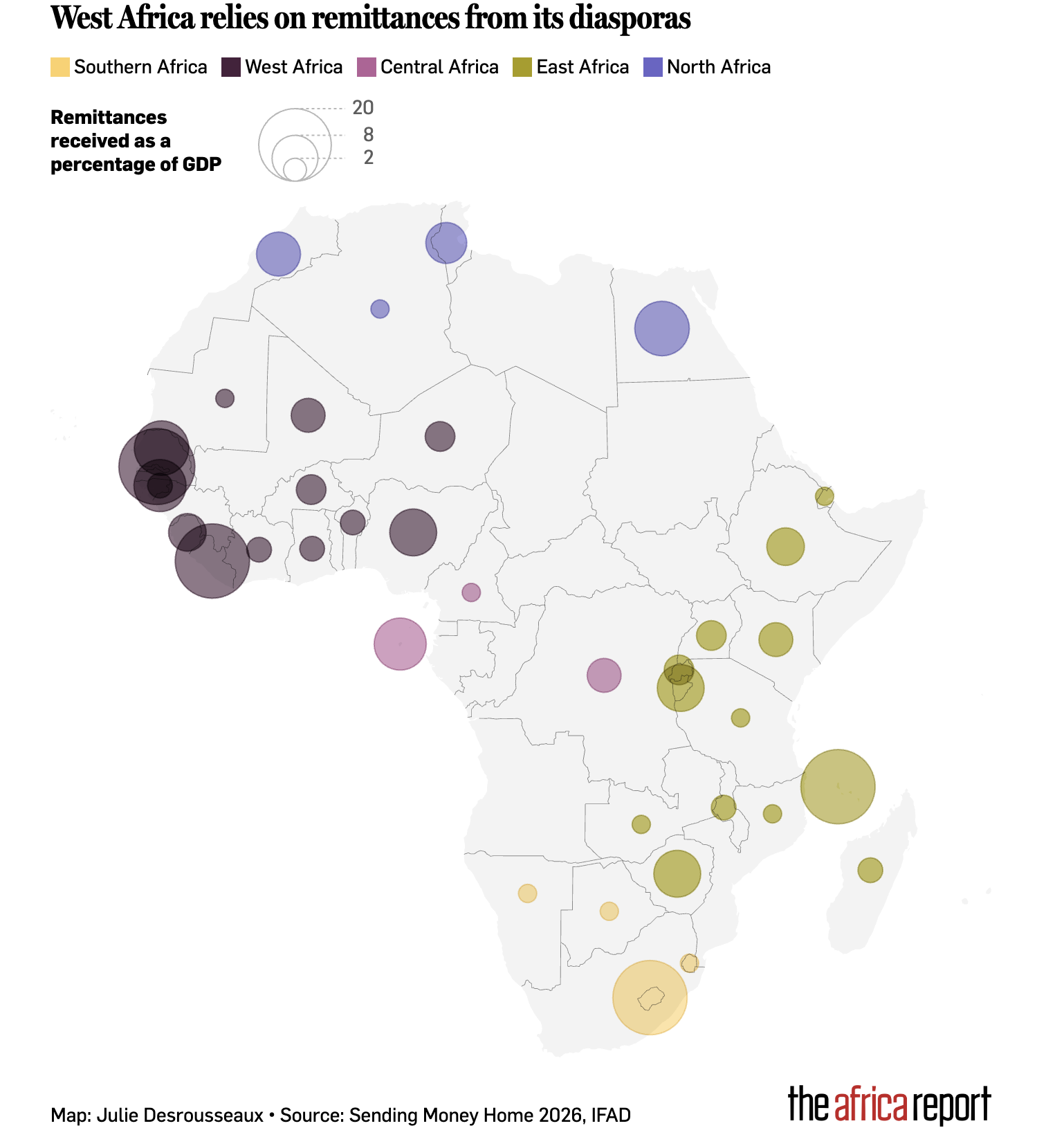
On the continent, the distribution is far from uniform. North Africa accounts for the bulk of flows, with $60.2bn in 2025, ahead of West Africa ($36.1bn), East Africa ($22bn), Central Africa ($4.1bn) and Southern Africa ($1.8bn).
A rise in remittances therefore does not mean that migrants are making an equivalent financial effort
Egypt now tops this ranking: its receipts rose from $18.6bn in 2016 to $41.5bn in 2025. Nigeria shows more moderate growth (from $19.7bn to $22.8bn), while Morocco has more than doubled its inflows, from $6.4bn to $13.7bn. For de Vasconcelos, the economic ties between Moroccan expatriates and their home country matter, as does the structuring of transfer channels. “Digital and formal channels are well developed,” he said.
The expert nonetheless sounds a note of caution: “It would be difficult to attribute the doubling to a single cause.” Caution is, in any case, needed when reading these series. Growth of 10% to 20% is considered normal, notes the IFAD expert. Conversely, when amounts double or even triple, as in the DRC (up 459% since 2016, to nearly $3.3bn), it is worth asking what has changed in the flows, but also in how they are measured.
In a country where the informal sector remains massive, these figures also reflect progress. “Some countries showed extremely low remittances, which we knew were completely unrealistic, and that is changing. That is the good news: there is growing awareness,” said de Vasconcelos.
“A rise in remittances therefore does not mean that migrants are making an equivalent financial effort,” warned the economist Honoré Mondomobe. The increase may reflect both a real rise in the sums sent and better statistical visibility: transfers made in cash or through informal channels now increasingly go through declared operators.
The same goes for Angola (up 1,197% between 2016 and 2025), Guinea (up 1,082%), Ethiopia (up 824%) and Zambia (up 769%), where the increases are spectacular. “When the base is very low, a relatively modest rise in value can produce a spectacular percentage,” Mondomobe said.https://datawrapper.dwcdn.net/1khV1/1/
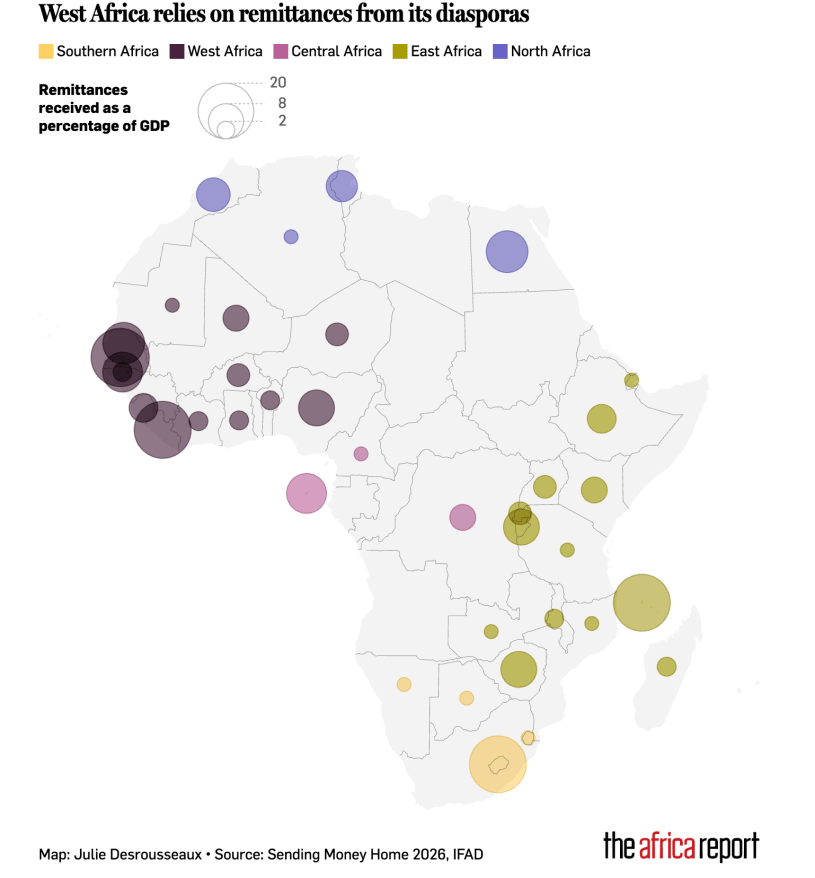
While the big markets – Egypt and Nigeria leading the way – weigh heavily at the continental level, it is often the smaller economies that are most dependent on these inflows, given their weight in GDP. A slowdown in host countries or a disruption to payment channels quickly affects household consumption, available foreign currency and national activity.
Behind these amounts, there are first of all everyday expenses: food, health, education and housing, but these funds can also provide a first form of savings, finance farm equipment or support a small business.
READ MOREImmigrants from South Africa’s neighbours send home billions of rands. Here’s the top 10
According to IFAD, around 34% of remittances to Africa, or nearly $42bn, reach rural areas. In these areas, where access to formal employment, financial services and social protection schemes is often limited, these resources can cushion economic and climate shocks.
Digital: A lever that is still incomplete
Transfer apps, fintechs, neobanks, mobile money: digital tools now make it possible to send funds more quickly and, in some cases, at lower cost. Between 2016 and 2025, the average cost of sending $200 via non-bank providers fell from 9% to 7.2%, a drop of 20%. The continent nevertheless remains the most expensive region in the world in which to receive money, with a rate more than twice the 3% target set by the Sustainable Development Goals.
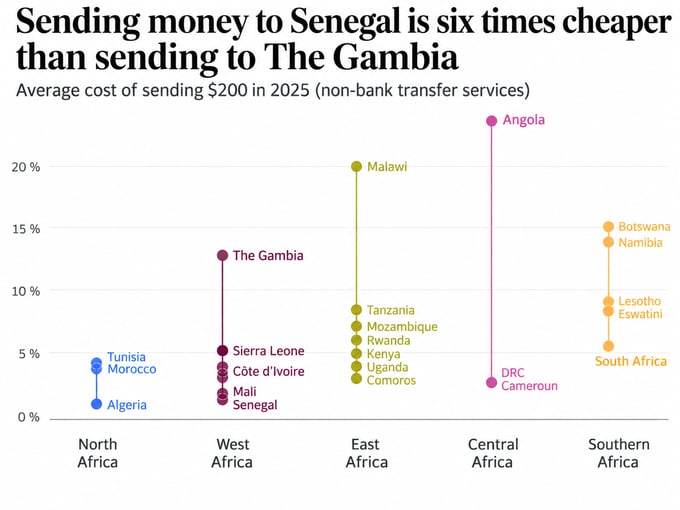
Regional differences are considerable. West Africa has recorded the sharpest fall (7.2% to 4.9%), while fees have risen in Central Africa (from 9.1% to 9.7%) and Southern Africa remains the most expensive sub-region, at 10.4%.
These differences cannot be explained by the level of digitalisation alone. Competition between operators, the use of cash payments, fixed fees and system interconnection also come into play. “Many African corridors have low transaction volumes. With fewer transactions, it is harder to achieve economies of scale and the markets attract fewer operators,” said de Vasconcelos.https://datawrapper.dwcdn.net/I86i4/1/
The advantage of digital is nonetheless tangible: globally, fully digital services cost on average 4.59% of the amount sent, compared with 7.3% for the others. “Digital can facilitate smaller, more regular and more traceable transfers,” said Mondomobe, who also insists on the need to make payment systems interoperable.
More than half of African migrants live on the continent, which makes regional cross-border payments particularly important. Initiatives such as the Pan-African Payment and Settlement System (PAPSS), instant payment platforms in West Africa and interconnection projects in East Africa aim to reduce network fragmentation.
READ MOREWhy moving money across Africa can be harder than sending it to London
As these flows grow, some states are trying to convert this savings pool into public funding by means of diaspora bonds, which are bonds aimed at their nationals abroad. The diaspora then swaps its supporter’s hat for that of an investor.
Senegal (through the Sénégal mo Woté initiative, launched in 2025) and Burkina Faso (the TPBF diaspora bonds, presented in September 2026) have thus raised CFA364bn ($620m) and CFA151.5bn respectively, while Côte d’Ivoire is preparing an issue of CFA900bn. The success of these instruments nevertheless depends on the confidence of subscribers and on transparency over how the funds are used.
While these flows support household incomes and provide a form of stability in times of crisis, heavy dependence exposes economies to shocks hitting host countries. “Family solidarity must not become a pretext for the state to disengage from social protection,” warned Mondomobe.
The challenge for African countries is not limited to attracting more funds: it also lies in reducing the cost of transfers, improving the reliability of data and creating the conditions in which this private resource can contribute lastingly to development.

