It is often assumed that women in Britain first won the vote after the First World War, with the Representation of the People Act of 1918, which allowed women over 30 to vote in national elections. However, this is not the case. The Municipal Franchise Act of 1869 enfranchised them at a local level, but earlier laws had actually removed their right to vote.
An excellent article by Sarah Richardson explains how this took place. As she explains, earlier voting was probably rare, but women did vote at local level. Nor was this just restricted to the rich.
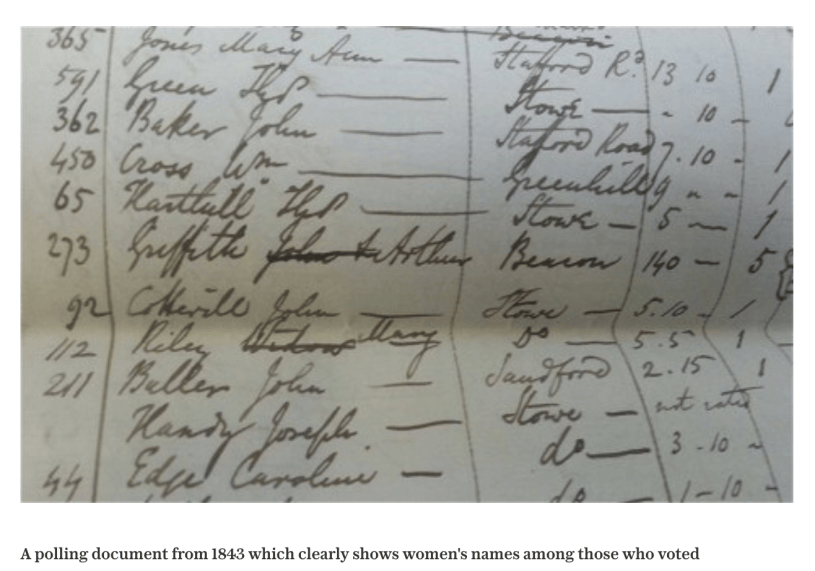
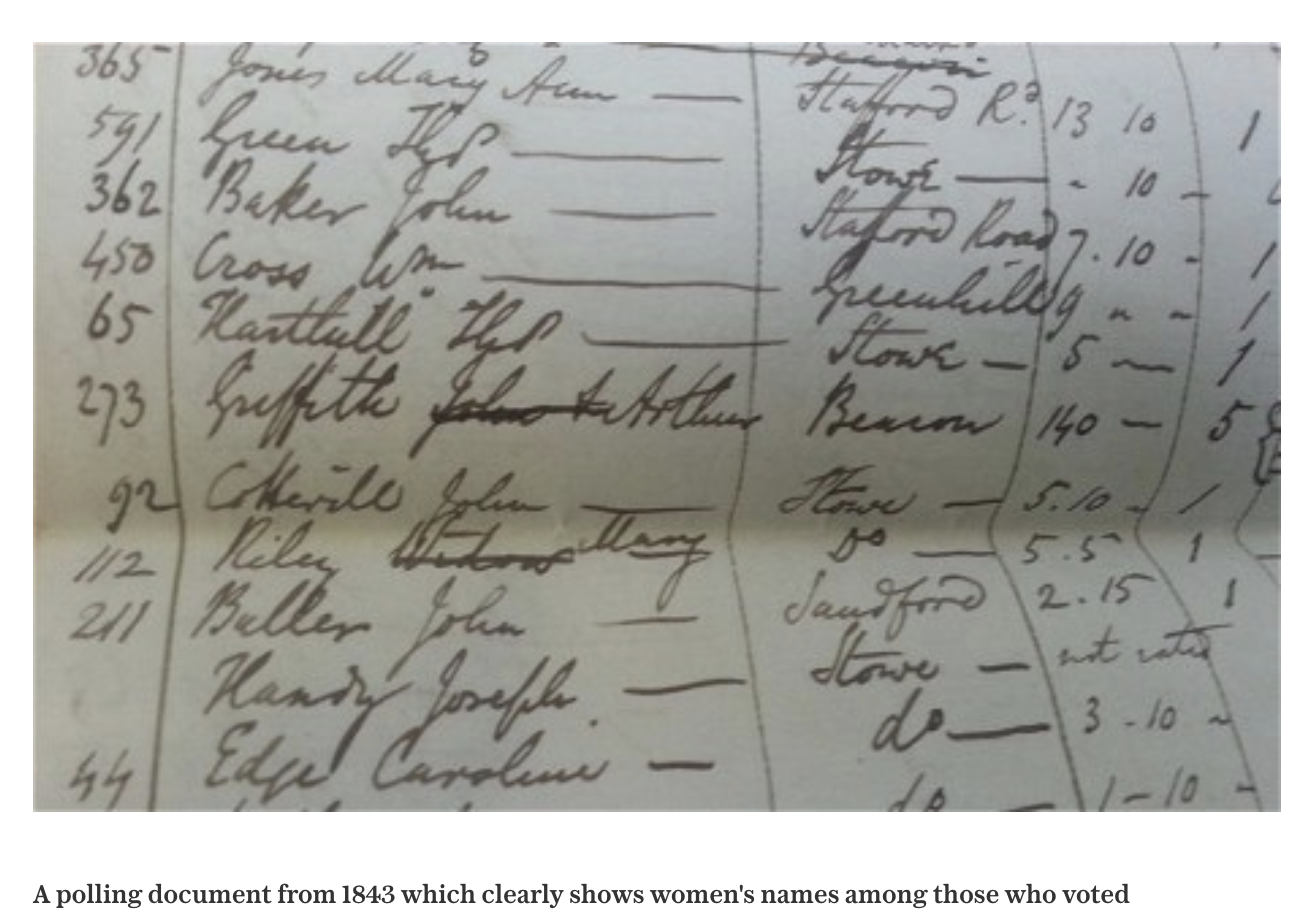
Direct evidence of women voting is scarce, but some examples of poll books from parish elections in the nineteenth century survive, showing single and widowed female ratepayers exercising their franchise. For example, a list of voters for the parish of St Chad in Lichfield in 1843 gives details of around thirty female electors, the rates they paid and how they voted. This poll book is extremely rare. It was compiled by a local solicitor who was the Conservative party agent, probably to keep track of the preferences of parliamentary electors between national elections, as Lichfield was a highly marginal seat. It was unusual for parish offices to be contested, as elections were expensive and organisationally cumbersome. It is even more exceptional to find detailed evidence of voters at such polls recorded, and perhaps unique to see proof of women voting. The women have the right to vote as they are ratepayers. They range widely in wealth and status, from a wealthy widowed butcher to a laundress and even two pauper women.
This right was generally removed by two laws which were otherwise designed to extend the right to vote: the Reform Act of 1832 and the Municipal Corporations Act of 1835. These made explicit what had previously only been assumed: it restricted the right to vote to ‘male’ persons.
The 1832 “Great Reform Act” was – in other ways – a huge stride towards a real democracy.
It abolished the “rotten borough” system, which allowed a handful of voters but had the same right as heavily populated towns to return an MP to Parliament.
It did not allow everyone over a certain age to vote, but it did include small landowners, tenant farmers, and shopkeepers to exercise the right. This was extended to all householders who paid a yearly rental of £10 or more and some lodgers.
However, it explicitly ruled out the right of women to exercise this right in parliament.
But the situation in local elections were far less clear. Sarah Richardson explains that there is evidence of women voting in one town: Lichfield.
My assumption was that the women would be of genteel status. But as I checked their names against the 1841 census return, I was surprised to see the diversity of the group of voters. There were a few women of independent means, owning property and land. There were also women, probably widows, who had inherited their husbands’ businesses. So, for example, the wealthiest female elector on the roll was Grace Brown, a butcher, who managed a large household including several servants.
Due to the high rates that she paid, Grace was entitled to four votes in the election, which she cast in favour of the Conservative candidate. But I was amazed to see many women on the list who were far lower down the social scale including the laundress, Caroline Edge, the servant, Sarah Payne and even paupers, including Sarah Batkin of Stowe Street.
The poll book is all that remains of an unremarkable local parish election in a comfortable Midlands market town in the mid nineteenth century. Yet, it has prompted a need to re-write the history books by providing the first substantial proof that women were able to vote long before they received the parliamentary or municipal franchise.
The BBC produced a programme explaining how this happened.
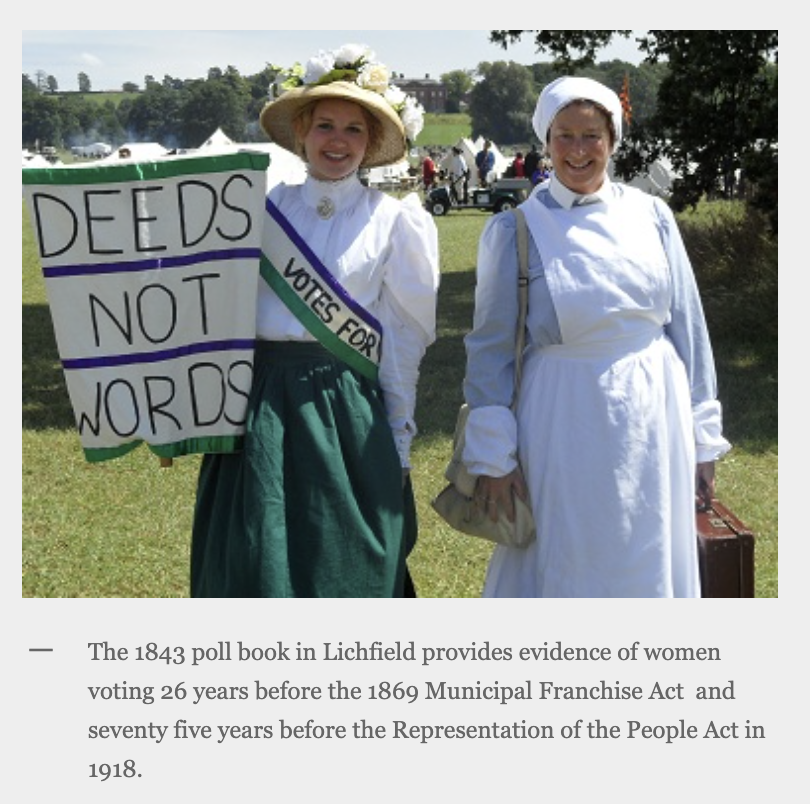
It was to take until 1918 until this remarkable example of democracy was extended to Parliament. The sacrifices of women during the First World War and the campaigns by the suffragettes had made their case.