By Hatu G/Medhin, PhD
The Horn of Africa has a long history of political conflict in which borders, historical grievances and military sacrifice are repeatedly used to justify political decisions. Governments and political movements invoke sovereignty when it serves their interests, change alliances as circumstances shift, and mobilise people around territorial threats. Yet, ordinary people are usually the ones who pay the price.
Eritrea is a clear example. Its independence came after a long national struggle. The sacrifices made during that period remain an important part of the country’s history. More than three decades after independence, Eritrea still needs to move beyond the politics of struggle and address the everyday responsibilities of running a country. So, the question is whether Eritrea’s sovereignty can finally translate into a better future for its people.
Many African borders were inherited from colonial rule. Colonial powers drew boundaries through agreements and administrative decisions, often without consulting the communities affected. African leaders recognised that repeatedly changing these borders could create further conflict. In 1964, the Organisation of African Unity adopted Resolution AHG/Res.16(I), committing member states to respect the borders that existed at independence. The principle of uti possidetis juris helped preserve these boundaries and protect the territorial integrity of newly independent states. However, there is an important conceptual distinction illustrated in Ethio-Eritra border conflict. The no war no peace situation persisted for years, until Abiy Ahmed accepted the decision in 2018, paving the way for peace and his 2019 Nobel Peace Prize.
Eritrea’s borders
Eritrea’s borders were shaped by Italian colonial administration, Eritrean referendum and later by Boundary Commission’s 2002 decision. Its internationally recognised sovereignty rests on this historical and legal foundation. Respect for territorial integrity remains essential to regional stability. However, Eritrea’s ruling authorities have also used territorial claims and external threats to advance political interests, turning borders into instruments of political mobilisation and justification for conflict.
Badme offers important lessons. This small border town became a national symbol during the 1998–2000 war, helping sustain nearly two decades of hostility between Eritrea and Ethiopia. The small town is becoming a rallying point for nationalism and political mobilisation. Yet, following the 2018 rapprochement with Prime Minister Abiy Ahmed, Isaias Afwerki described Badme as a pretext for the war and argued that the border dispute was not its underlying cause. The contradiction became even more apparent during the 2020–2022 Tigray war, when Eritrean forces crossed into Ethiopian territory and fought alongside Ethiopia’s federal government against the TPLF. Now, reported cooperation between the Eritrean regime and the TPLF under the “Tsimdo” initiative signals another shift in regional alignments, supported by coordinated political messaging. This raises questions about the consistency with which the Eritrean government applies its stated principles of territorial integrity when its strategic interests change. They also demonstrate how borders and sovereignty can become instruments of political mobilisation rather than consistent principles guiding regional relations.
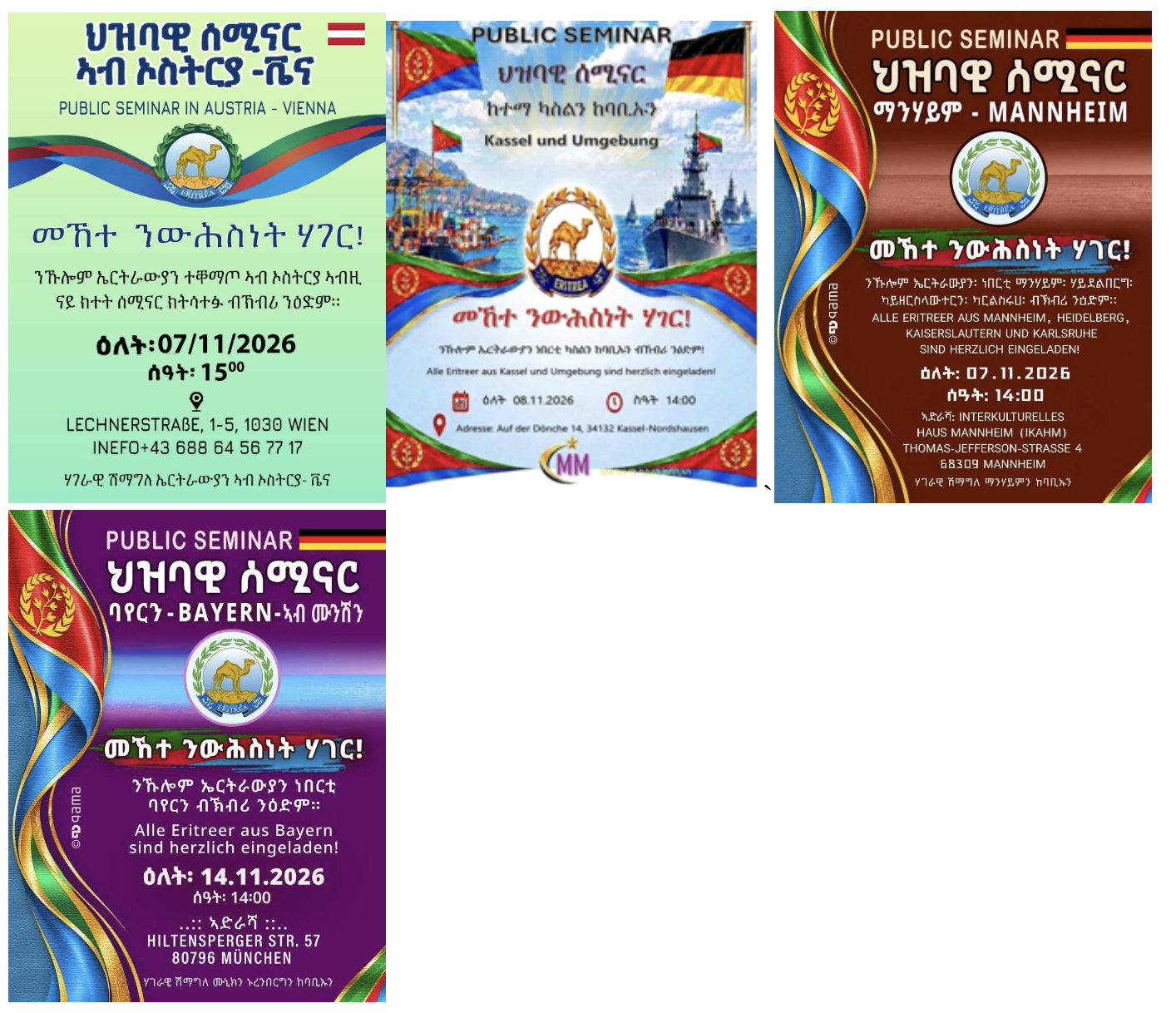
Image: The four public events (Vienna, Umgeburg, Mannheim and Bavaria) organised within a single week demonstrate how the regime uses diaspora mobilisation to reinforce a wartime mentality and raise funds
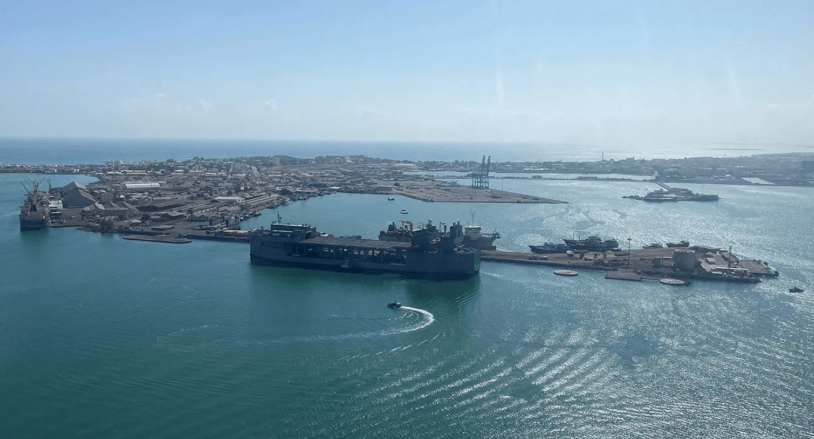
Today Assab risks becoming another symbol in a similar political narrative. Ethiopia’s interest in reliable maritime access is legitimate, but it should not be turned into a territorial claim or another source of hostility. Recent statements by Ethiopian government owned media outlests have already provided the Eritrean regime with an opportunity to present an external threat as a national security concern. Such statements provide the Eritrean regime with an opportunity to frame Ethiopia’s maritime ambitions as a national security threat, potentially strengthening its existing security narrative. This risk could strengthen the regime’s political position by providing an issue around which it can build external alliances, reinforce the romanticisation of war and justify further sacrifices in the name of defending national sovereignty.

The romanticisation of war in Eritrea goes beyond commemorating the liberation struggle and honouring those who sacrificed their lives for independence. It involves turning war and military sacrifice from a historical experience into a continuing political expectation. Through songs, films, national celebrations, and state messaging, the regime has repeatedly portrayed military sacrifice, martyrdom and resistance as sources of national pride and patriotism. This has helped embed a wartime mentality in which the country is portrayed as constantly under threat, and citizens are expected to remain prepared for further sacrifice. Indefinite national service, military training through Sawa, and the continued emphasis on external threats have reinforced this mindset across generations.
The deeper consequence is a society conditioned to view permanent mobilisation as necessary for national survival. By continually invoking past enemies, external threats and the sacrifices of the liberation generation, the regime sustains fear and loyalty while narrowing the space for independent thought, criticism and political change. This can create a form of psychological subordination in which people begin to accept restrictions on their freedom and opportunities as unavoidable duties to the nation As experiences from other countries show, this mindset can persist beyond regime change, adding to the challenges of weakened institutions and a militarised state. Mishandled external involvement could further deepen divisions, obstruct reconciliation and undermine the legitimacy of new leadership.
A new generation ready for change
Young Eritreans have had enough. A whole generation is stepping up because they refuse to stay stuck in the same old fights and bad habits of the past. They know Eritrea needs a completely new direction, one that protects its land without using borders as an excuse for endless war, and puts real diplomacy, regional trade, and the daily lives of its people first.
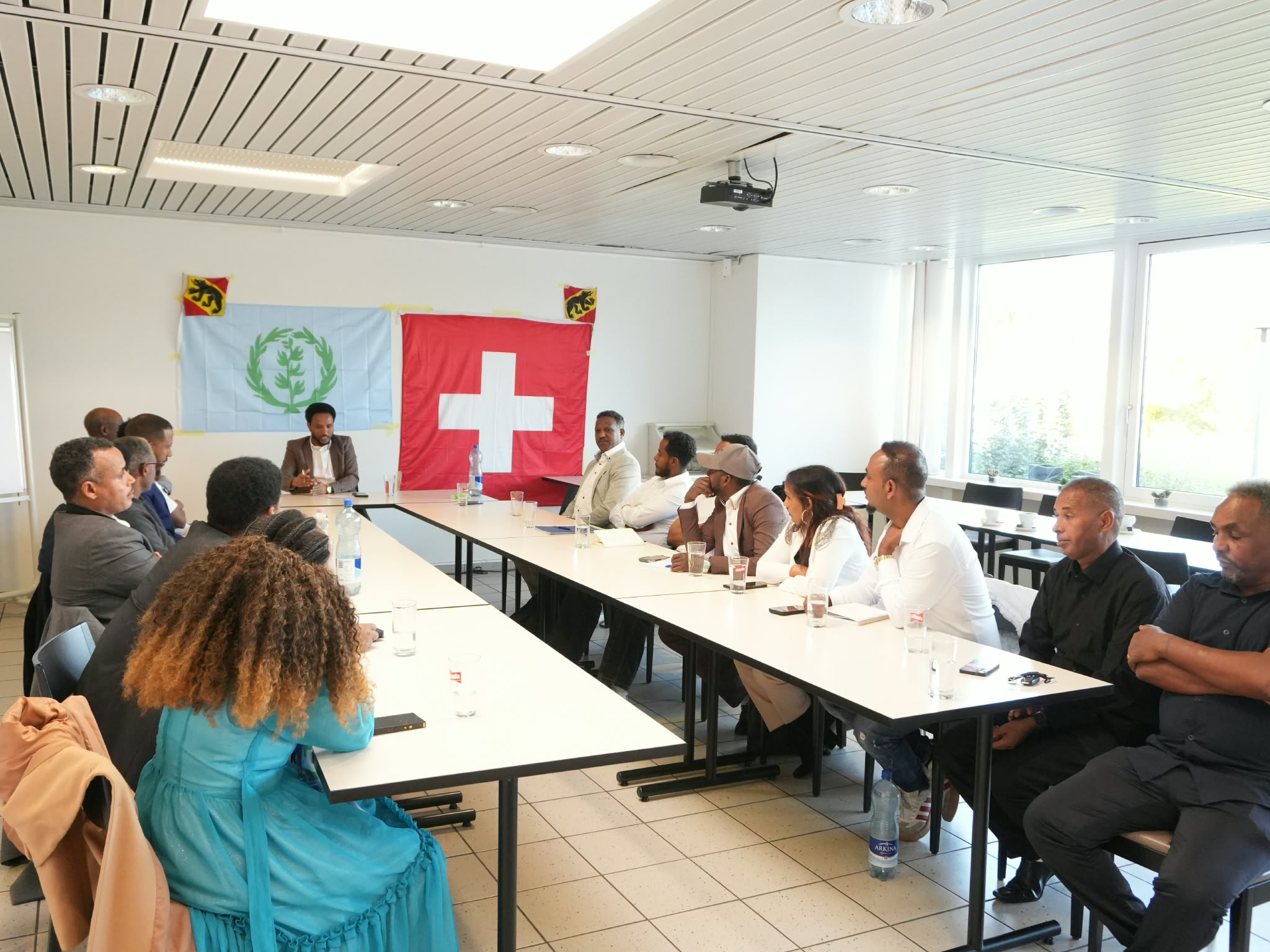
Image: Eritrean Blue Revolution Front (EBRF) diplomatic and political leader Mr Beyen Gerezgiher (Wufuy) attends the EBRF conference in Switzerland and meets with newly elected leaders, demonstrating the readiness and capacity of Eritrean opposition leaders to engage internationally and contribute to a future transitional government.
Look at Ethiopia’s situation. It makes complete sense why a landlocked country of over 120 million people needs a reliable way to reach the sea. The international community has already solved this exact headache. Article 125 of the United Nations Convention on the Law of the Sea recognises landlocked states’ rights of access to the sea and freedom of transit, with practical arrangements negotiated between both sides. But, It does not itself guarantee Ethiopia unrestricted access to Assab.
The government in Addis Ababa should avoid becoming entangled in the Eritrean regime’s regional political manoeuvring or repeating past strategies of exploiting Ethiopia’s internal divisions for political survival. You cannot solve decades-old problems with the same mindset that created them.
Youth and fresh ideas
At the core of Eritrea’s crisis is a generational bottleneck that has weakened the country’s institutional foundations. For over thirty years, the old leadership has retained power while excluding young people from almost every decision that matters. The country has not only lost political freedoms; it has also lost an entire generation of potential leaders who should have been developing the skills and experience needed to govern the state. This has weakened public institutions and created a significant gap between the ageing leadership and the generation that must eventually rebuild the country.
Recognizing this, young Eritreans in diaspora are organising and identifying the institutional gaps that must be addressed. They understand that removing the current regime cannot simply mean replacing old faces at the top. They must not inherit the same militarised and authoritarian system that excluded them; they need institutions that give them the authority and opportunity to lead. This is where Ethiopia can play a constructive role. Rather than relying on pressure and waiting for change from Eritrea’s current political leadership, Ethiopia should help address the coordination gap among legitimate Eritrean political actors. This means facilitating their coordination, formally recognising their political role and establishing direct official channels of engagement, particularly with the EBRF, to support an Eritrean-led process of political and institutional change.
A genuine transition means restoring essential public services and entrusting capable young people with the authority to help govern a modern state. A hybrid transitional model, with executive authority vested in a technocratic transitional government, is one option worth considering. It would allow skilled professionals to step in and lead to the recovery of the economy, rebuild public institutions, restore relations with neighbouring countries, and establish a legitimate constitutional order. Such a transition could create an opportunity to replace military standoffs with practical economic cooperation. One proposal is to establish a Free Economic Zone around the port of Assab, positioning it as a trade and logistics hub for the wider Horn of Africa. However, Assab’s existing port infrastructure and supporting facilities are not currently ready for immediate implementation of this vision. The port would require major infrastructure rehabilitation, substantial international investment, and sustained regional engagement to create the stability needed for long-term development.
For Ethiopia in particular, the proposed zone could provide reliable, long-term commercial access to Assab and associated supply routes through legally binding agreements and clear commercial arrangements. Such an approach would provide greater trade security without turning port access into a territorial or political dispute. Finally, the future of the region should not remain trapped in conflicts inherited from previous generations; it should be shaped by the economic opportunities, cooperation, and stability we create for the next one.

