The Tigray Connection, Egypt’s Regional Strategy and the Logic of Reciprocal Intervention
Source: SARA AL-SAEED NOV 5
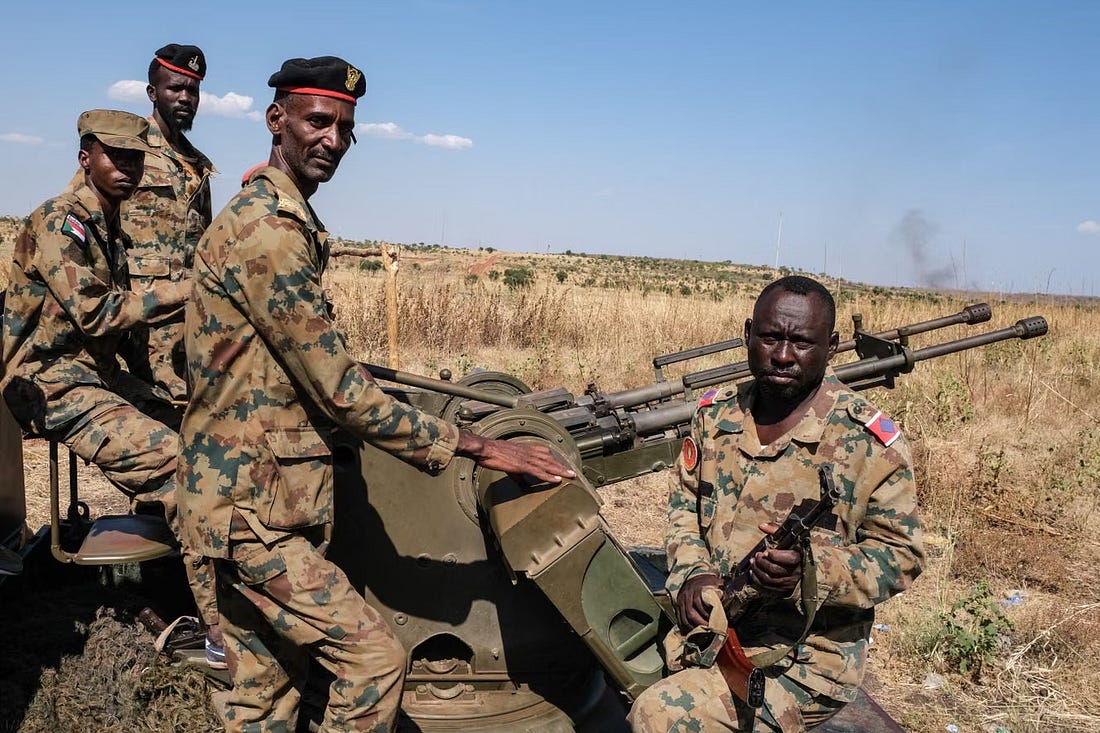
Sudan’s military leadership demands that Ethiopia respect Sudanese sovereignty and stay out of its war. It has yet to explain why its own dealings with Ethiopia’s armed opponents should carry no regional consequences. The dispute did not begin with the allegations that Addis Ababa has supported the Rapid Support Forces (RSF). It begins with an older question: how can a military establishment cultivate relationships with the enemies of a neighbouring government, permit its territory to become part of that government’s internal conflict, and then expect the neighbour to remain neutral when the same military establishment faces an armed adversary at home?
That question is largely absent from the account portraying Ethiopia as the sole source of danger to Sudan. On 4 November 2026, Reuters reported that Addis Ababa had ordered six members of Sudan’s consular staff in Assosa to leave within 48 hours, as relations between the two countries deteriorated further. Sudan accuses Ethiopia of allowing the RSF to use its territory for military activities and drone attacks. Ethiopia denies the allegations and accuses the Sudanese Armed Forces (SAF) of assisting armed groups opposed to its government. To present this confrontation as though it began with Sudan’s civil war in April 2023 is to disregard a documented history of Sudanese military involvement in Ethiopia’s domestic security struggles.
Since war broke out in Tigray in November 2020, the Sudan–Ethiopia border has been much more than a line separating two states. It has become the point at which the al-Fashaga dispute, the Grand Ethiopian Renaissance Dam (GERD), the movement of fighters and the calculations of competing military establishments intersect. In April 2023, Chatham House published a study based on diplomatic, Sudanese and Tigrayan military sources indicating that Sudan had facilitated the passage of supplies and military materiel to Tigrayan forces and rebels from Ethiopia’s Benishangul-Gumuz region, while allowing armed groups to operate from eastern Sudan. The study recorded Khartoum’s denial that it had provided training or equipment to Tigrayan forces. It also described longstanding ties between the Sudanese military and the Tigray People’s Liberation Front (TPLF), strengthened under Abdel Fattah al-Burhan, and reports of Gumuz fighters using Sudan’s Blue Nile state as a staging area for operations inside the Ethiopian region where the GERD is situated.
The significance of this evidence is not that it validates every accusation made by Addis Ababa. It is that it unsettles the chronology on which the Sudanese military’s account depends. The SAF’s relationship with Ethiopian armed opposition predated the war between the army and the RSF. It also predated the investigations that subsequently identified facilities inside Ethiopia used to train RSF fighters. Nor was that relationship confined to offering sanctuary to people displaced by war. Researchers reported movements of supplies, the activity of armed formations and interests shared between the Sudanese military and opponents of the Ethiopian federal government. If Ethiopian conduct across the border merits scrutiny, so does the conduct of Sudan’s military authorities on their own side of it.
Tigray’s Army 70
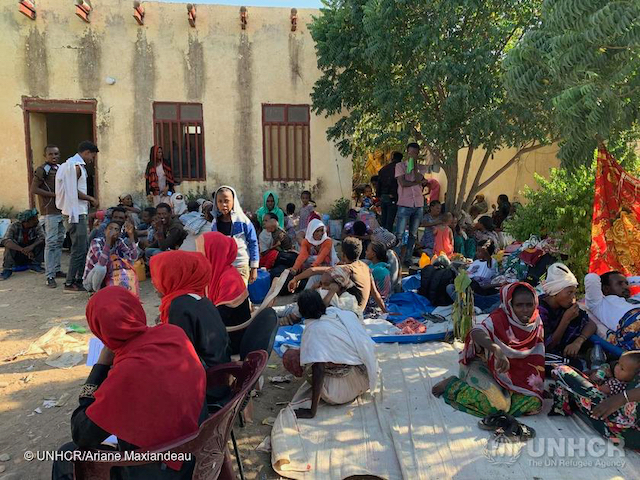
These concerns have become more acute with the emergence of a Tigrayan formation known as Army 70. Its ranks include fighters and officers who crossed into Sudan during the 2020–2022 war, some having previously served in Ethiopia’s federal forces. These combatants must not be conflated with Tigrayan civilian refugees, whose right to protection is entirely separate from the use of Sudanese territory by an armed organisation. Yet the International Crisis Group reported in 2026 that several thousand Army 70 fighters had fought alongside the SAF against the RSF. Germany’s Institute for International and Security Affairs similarly identified Army 70 as a TPLF-linked armed group that had intervened on the Sudanese army’s side, warning that it could become a factor in renewed fighting over Western Tigray.
The implications extend well beyond who fought alongside whom in Sudan. The presence of an experienced armed formation associated with one of Ethiopia’s principal domestic adversaries, based in a neighbouring country whose relations with Addis Ababa are strained, alters the security environment on the frontier. The issue is particularly sensitive in Western Tigray, where the territorial disputes left unresolved by the 2020–2022 war and the Pretoria agreement remain combustible. No government can reasonably be expected to regard a hostile armed force near its border as irrelevant to national security. The practical question for Ethiopia is whether arrangements that enabled those fighters to operate in Sudan might also give them the capacity to exert military pressure inside Ethiopia.
In May 2026, Addis Ababa went further, expressly accusing the SAF of providing weapons and financial support to TPLF-linked fighters and facilitating incursions along Ethiopia’s western frontier. Those were official allegations, not findings independently established in every detail. They nevertheless followed earlier research about Sudanese cooperation with Tigrayan forces. An investigation published by Mada Masr in August also examined Army 70 movements near the Ethiopian border and cited an Ethiopian military source alleging that the Sudanese army supplied the formation with weapons. A general denial from Khartoum cannot, by itself, dispose of a record that stretches beyond one statement or one episode of fighting.
The SAF’s choice of Ethiopian interlocutors was hardly accidental. Chatham House recorded the different relationships cultivated by Burhan and Mohamed Hamdan Dagalo, known as Hemedti, before the outbreak of Sudan’s war. Burhan and the military establishment reinforced their historical links with the TPLF, while Hemedti pursued ties with Prime Minister Abiy Ahmed and figures in the federal government. Sudan’s subsequent fracture therefore did not create these regional rivalries from nothing. It redistributed pre-existing relationships across two rival centres of armed power. To describe the RSF solely as a presumed Ethiopian instrument is to deny it any political and strategic agency of its own, and to reduce a complicated Sudanese struggle to a single story of foreign manipulation.
The Egyptian connection
Egypt supplies the wider regional dimension. Cairo is neither an impartial mediator between Sudan’s armed rivals nor a patron of Burhan for reasons confined to Sudan. Its relationship with the SAF also reflects a particular conception of the balance of power in the Nile basin and its dispute with Ethiopia over the GERD. Egyptian policymakers have reason to worry about Addis Ababa’s expanding economic, diplomatic and military options in the Horn of Africa and the Red Sea. Against that background, Sudan — especially its military establishment and eastern frontier — may acquire value as a means of exerting indirect pressure on Ethiopia. The contradiction is that attempts to constrain Ethiopia by exploiting its internal vulnerabilities may give Addis Ababa stronger incentives to seek instruments of counter-pressure.
This does not establish that Cairo directs TPLF operations or that Egypt, Sudan and Eritrea operate a unified command for the Ethiopian insurgency. The public evidence cannot sustain that conclusion. It does, however, justify close examination of a developing political and security alignment among actors whose interests converge in limiting Ethiopian influence. In September 2026, Ethiopia’s chief of staff, Birhanu Jula, accused Eritrea of supporting the TPLF and suggested possible Sudanese and Egyptian involvement; all three governments denied the allegations. On 4 October, Egyptian President Abdel Fattah el-Sisi hosted Burhan, Eritrean President Isaias Afwerki and Somali President Hassan Sheikh Mohamud at a quadrilateral summit in New Alamein. The official declaration presented the meeting as a commitment to consultation, sovereignty and regional stability. Reuters subsequently reported, citing Egyptian officials, that the participants had discussed military and intelligence coordination should the fighting reach the borders of the countries concerned. Conditional coordination is not proof of a joint operation already under way. It is evidence that military contingencies concerning Ethiopia have entered a structured regional discussion.
The alignment is all the more revealing because Eritrea fought alongside Abiy’s government against the TPLF only a few years ago. Disagreements over the settlement that followed Pretoria, compounded by Ethiopia’s pursuit of maritime access, have led Asmara to reconsider its relationships. The old front lines have not remained fixed: yesterday’s enemy may become today’s partner when a government’s perception of the principal threat changes. What is taking shape around Ethiopia is not necessarily a coherent alliance with an agreed vision of regional order. It is a set of different grievances and calculations meeting at a common desire to restrict Addis Ababa’s room for manoeuvre. Such arrangements can produce a collective escalation even when none of the participants seeks an open regional war.
In this environment, it is difficult to dismiss Ethiopia’s concerns as invented or merely an excuse for expansion. Ethiopia has extensive borders, a complex internal security landscape and a recent history of devastating conflict whose political and territorial causes remain unresolved. If a neighbouring military establishment maintains relationships with fighters associated with that conflict while drawing closer to Addis Ababa’s regional rivals, the Ethiopian government has reason to reassess its security options. One need not approve every decision taken by Abiy’s government to recognise this. It is enough to abandon the fiction that Ethiopia alone possesses foreign armed relationships or that the pressures bearing upon it are irrelevant to its conduct.
This is the setting in which reports of Ethiopian involvement with the RSF should be read. In February 2026, a Reuters visual investigation drew upon satellite imagery, an Ethiopian security document and testimony from multiple sources to identify a camp in Benishangul-Gumuz used to train thousands of fighters for the RSF. The news agency reported allegations of Emirati financing and logistical support. The United Arab Emirates denied supporting the RSF, while Ethiopian authorities did not answer Reuters’ detailed questions at the time. The investigation presented evidence more substantial than a diplomatic accusation, although it did not thereby verify every subsequent Sudanese claim about drone attacks or operations launched from Ethiopian territory.
Ethiopia and the RSF
The more revealing question is not whether the possibility of Ethiopian support should be denied, but how such support would fit into Ethiopia’s security calculations. The International Crisis Group observed that Addis Ababa appeared to have increased its engagement with the RSF partly in response to Sudan’s involvement with the TPLF. This changes the centre of the argument. Rather than asking only whether Ethiopia has intervened in Sudan, we should ask why the RSF might have acquired strategic value for Ethiopia in the first place. If the Sudanese military has used ties with Ethiopian armed groups to pressure Addis Ababa, then a relationship between Ethiopia and the SAF’s principal rival can be understood as an attempt to deny Khartoum a monopoly over instruments of regional pressure. It could be intended to raise the cost of further Sudanese involvement, deter additional escalation or prevent the formation of an overwhelmingly hostile regional alignment. There is no direct evidence that this was the sole motive guiding Ethiopian decisions. There is, however, a serious research basis for treating it as a plausible strategic calculation rather than a convenient defence invented after the fact.
Nor should the RSF be treated as an incidental or wholly passive actor in that calculation. It is one of the two principal armed parties to Sudan’s war, with its own military and economic networks, political alliances and interests in the struggle over power and the future organisation of the state. That struggle cannot be reduced to a confrontation between ‘the state’, personified by Burhan, and a foreign instrument, personified by the RSF. Control of state institutions, or a claim to represent them, does not confer an unlimited popular mandate upon military leaders or place their decisions beyond criticism. Equally, recognising that the RSF has political interests and external relationships of its own does not legitimise its conduct. Political agency and accountability are separate questions.
This distinction matters when Ethiopia is told what position it must adopt towards Sudan’s war. Addis Ababa is entitled to assess its interests and frontier security in light of the different Sudanese actors’ relationships with its opponents. It would be unrealistic to expect it to regard a military institution linked to the TPLF as a reliable security partner merely because that institution speaks in the name of the Sudanese state. But the freedom to take a political or diplomatic position is not an unrestricted entitlement to provide weapons. The International Court of Justice has held, in the Nicaragua and Congo cases, that material support to irregular forces operating against another state may violate the principles of non-intervention and the prohibition on the use of force. Grave abuses documented by the United Nations against the RSF, particularly in El Fasher, also make assistance that could facilitate further atrocities a matter that cannot be set aside in the name of reciprocity. Those findings do not absolve the SAF of scrutiny over its own conduct. The essential distinction is between understanding a state’s strategic reasoning and accepting the legality of every instrument it employs.
Here lies the central defect in Burhan’s position. If Sudan’s military authorities have enabled Ethiopian opposition fighters to benefit from Sudanese territory, resources or institutional relationships, they cannot reasonably profess surprise when Ethiopia reconsiders its neutrality towards Sudan’s war. The SAF cannot expect the consequences of its decisions to cross Ethiopia’s borders while insisting that Sudan’s borders remain insulated from any Ethiopian response. The difficulty is not that Addis Ababa has security interests of its own; every state does. It is that the Sudanese military seeks freedom to operate through neighbouring conflicts while depicting other states’ pursuit of their interests as aggression without antecedent or context.
Egypt faces a predicament to which its own regional policy may have contributed. An attempt to contain Ethiopia by reinforcing relationships with Addis Ababa’s adversaries may encourage, rather than deter, the expansion of Ethiopian countervailing partnerships. The further the Egyptian–Ethiopian rivalry reaches into the domestic conflicts of Sudan, Eritrea and Tigray, the harder it becomes to manage disagreements over the GERD or maritime access within distinct diplomatic processes. Cairo may ultimately strengthen precisely the behaviour it opposes: an Ethiopia more prepared to employ regional leverage, a Sudan more exposed to competition among its neighbours, and a Horn of Africa less able to absorb another confrontation.
The Sudanese public should not be made answerable for these calculations. Sudan cannot be reduced to the decisions of its military leadership, any more than its future can be reduced to the ability of one armed party to defeat another. Sudanese sovereignty is not synonymous with Burhan, and the national interest is not automatically defined by the SAF’s relationships with Cairo, Asmara or any other capital. Ethiopia, too, has a lasting interest in distinguishing a dispute with a particular military leadership from its relationship with Sudan as a state, a society and an indispensable neighbour.
Defending Ethiopia’s security interests does not require absolving Abiy’s government of responsibility for its decisions. Nor does recognising the RSF as an autonomous Sudanese actor require overlooking the serious violations associated with its forces. It does require rejecting a chronology that begins on the day Port Sudan accuses Addis Ababa of interference and overlooks the Sudanese army’s earlier relationships with Tigrayan fighters and its subsequent regional alignment with Egypt and Eritrea. If Sudan’s military leadership wants Ethiopia to remain outside its war, it must first answer a question about its own neutrality towards Ethiopia’s conflicts.
Conclusion
The SAF can no longer plausibly treat Ethiopia’s armed opponents as legitimate instruments of its regional policy while demanding that Addis Ababa abandon its own security calculations when the Sudanese military comes under pressure. Neutrality cannot be a one-sided obligation imposed upon a neighbour by a state whose military reserves the freedom to intervene. This is not an argument for giving any country unlimited licence to fight its neighbours’ wars. It is an argument for recognising the contradiction and the consequences it has produced. Before demanding Ethiopian neutrality, Sudan’s military leadership should stop treating Ethiopia’s internal security as a bargaining arena. To assign Addis Ababa sole responsibility for the present regional entanglement is to disregard the policies that helped create it.
Sources and further reading
1. Chatham House, Coordinating International Responses to Ethiopia–Sudan Tensions, April 2023: https://www.chathamhouse.org/2023/04/coordinating-international-responses-ethiopia-sudan-tensions/03-untangling-ethiopia-and
2. International Crisis Group, Ethiopia, Eritrea and Tigray: A Powder Keg in the Horn of Africa, February 2026: https://www.ecoi.net/en/file/local/2137710/b210-ehtioipia-eritrea-tigray.pdf
3. International Crisis Group, Power Struggle in Ethiopia’s Tigray: Averting a Return to War, May 2026: https://www.ecoi.net/en/document/2140863.html
4. Gerrit Kurtz, Stiftung Wissenschaft und Politik, The Tigray Region in the Grey Zone between War and Peace, July 2026: https://www.swp-berlin.org/10.18449/2026C29/
5. International Crisis Group, Pulling Ethiopia and Eritrea Back from War, October 2026: https://www.ecoi.net/en/document/2145938.html
6. Reuters, Ethiopia Builds Secret Camp to Train Sudan RSF Fighters, Sources Say, 10 February 2026: https://www.reuters.com/investigations/ethiopia-builds-secret-camp-train-sudan-rsf-fighters-sources-say-2026-02-10/
7. Reuters, Airstrikes and Artillery Hit North Ethiopia as Government and Rebels Clash, 5 October 2026: https://www.reuters.com/world/africa/airstrikes-artillery-hit-north-ethiopia-after-tigray-capitals-fall-aid-sources-2026-10-05/
8. Reuters, Ethiopia Expels Sudanese Diplomats after Fresh Allegations of Support for RSF, 4 November 2026: https://www.reuters.com/world/africa/ethiopia-expels-sudanese-diplomats-after-fresh-allegations-support-rsf-2026-11-04/
9. Egyptian Presidency, El Alamein Joint Declaration, 4 October 2026: https://www.presidency.eg/EN/%D9%82%D8%B3%D9%85-%D8%A7%D9%84%D8%A3%D8%AE%D8%A8%D8%A7%D8%B1/%D8%A7%D9%84%D9%81%D8%B9%D8%A7%D9%84%D9%8A%D8%A7%D8%AA-%D9%88%D8%A7%D9%84%D9%85%D8%A4%D8%AA%D9%85%D8%B1%D8%A7%D8%AA/event3-10-2026-1/
10. Mada Masr, Clashes in Ethiopia along borders with Sudan, Eritrea stoke worry of larger regional war, 3 August 2026: https://www.madamasr.com/en/2026/08/03/news/politics/clashes-in-ethiopia-along-borders-with-sudan-eritrea-stoke-worry-of-larger-regional-war/
11. Al Jazeera English, Sudan Blames Ethiopia, UAE for Recent Drone Attacks: What We Know, 6 May 2026: https://www.aljazeera.com/news/2026/5/6/sudan-blames-ethiopia-uae-for-recent-drone-attacks-what-we-know
12. UN Human Rights Office, RSF Violations During Capture of El Fasher, 13 February 2026: https://sudan.un.org/en/310121-rsf-violations-during-capture-el-fasher-amount-war-crimes-and-possible-crimes-against
13. International Law Commission, Articles on Responsibility of States for Internationally Wrongful Acts: https://legal.un.org/avl/ha/rsiwa/rsiwa.html
14. ICJ, Military and Paramilitary Activities in and against Nicaragua (1986): https://api.icj-cij.org/sites/default/files/case-related/70/070-19860627-JUD-01-00-EN.pdf
15. ICJ, Armed Activities on the Territory of the Congo (2005): https://api.icj-cij.org/sites/default/files/case-related/116/116-20051219-JUD-01-00-EN.pdf

