Two unrelated people in cemeteries in England from 1,400 years ago exhibit close African ancestry, suggesting early medieval Britain was more diverse than thought. They had DNA that was close to the Yoruba, Mandenka, Mende and Esan people of West Africa.

By Ariel David Haaretz August 13, 2025
We may think that the presence of black Africans and other ethnic minorities in Europe is linked to recent migrations, or at most to phenomena like enslavement and colonialism that began in the Early Modern period. Conversely, in the popular imagination, medieval Europe is often seen as insular, largely cut off from the world and ethnically homogenous – that is, white.
But a pair of new ancient DNA studies belies this picture, or at least makes it more nuanced. The research suggests that already by the Early Middle Ages, parts of Europe – England at least – may have been more cosmopolitan than we thought, integrating immigrants from as far as sub-Saharan Africa.
Geneticists who sequenced the DNA of 1,400-year-old skeletons at two burial grounds in Southern England were stunned by two very clear outliers. An early adolescent girl and a young male traced a large part of their ancestry, roughly a quarter, to West African populations.
The two were unrelated and while they lived more or less at the same time, their social and cultural circumstances in England were vastly different – yet they shared this surprising genetic link to Africa.
Researchers reported on the discovery Wednesday in the journal Antiquity, in two separate papers, one on the finds in a seventh-century cemetery in Dorset, southwest of London, and the other on a contemporaneous burial ground in Kent, southeast of the capital.
Anglo-Saxon vs. Romano-British
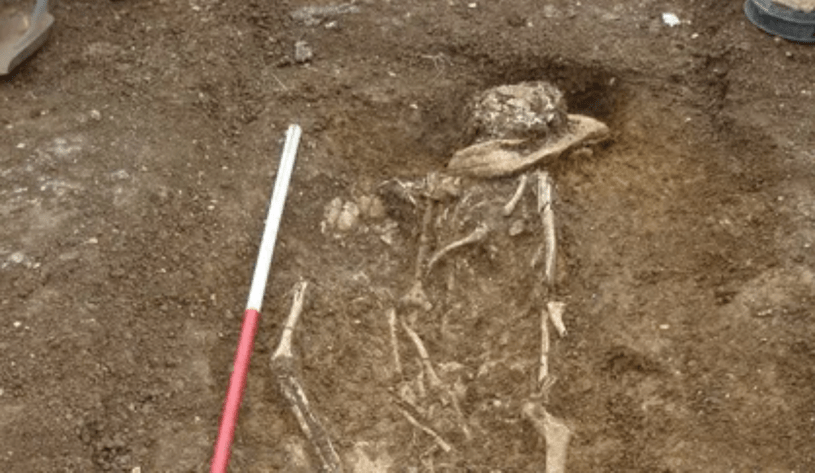
The cemetery at Updown in Kent, was excavated in the 1970s and 1980s, and contained 78 burials, of which six were sequenced for a study by Prof. Duncan Sayer of the University of Lancashire and colleagues. Meanwhile, Dr. Ceiridwen J. Edwards of the University of Huddersfield and colleagues extracted ancient DNA from 18 out of 26 people unearthed in a 2011 dig at Worth Matravers, a village near the coast in Dorset.
The two burial grounds, both on the south English coast but separated by 250 kilometers (150 miles), were in fact worlds apart back in the seventh century.
Kent, the English region closest to France, was a power base of the Anglo-Saxons, the Germanic tribes who had recently migrated to England in the dying days of the Western Roman Empire, Sayer says. It was also heavily influenced by trade with Frankish Gaul. The people buried at Updown seem to have been of higher status, possibly connected to nearby Anglo-Saxon royal centers, and they were entombed with rich grave goods, including imported Frankish and even Byzantine artifacts.
Dorset, in contrast, had not yet come under Anglo-Saxon control and was on the fringes of Britain’s continental ties, notes Edwards, the leader of the team that investigated the Worth Matravers cemetery. The burials there followed late Roman Christian customs: they were much simpler, almost devoid of grave goods, and some of the tombs included two or three bodies.

Archaeologically there was “a marked and notable cultural divide between Dorset and areas to the west, and the Anglo-Saxon influenced areas to the east,” Edwards says.
So far the material culture. Now researchers sampled people buried in these two cemeteries to study the early medieval migrations into England at the genetic level.
While most of the dead displayed either Northern European or Western British and Irish ancestry, two genomes stood out. A girl at Updown, who died aged 11-13, and a male aged 17-25 from Worth Matravers both had partial ancestry that is closest to that of the Yoruba, Mandenka, Mende and Esan groups in sub-Saharan West Africa, the researchers report.

Further analysis showed that the African gene flow most likely came from the unrelated paternal grandfathers of both individuals. (The geneticists know it came from the male side of the family because their mitochondrial DNA, which is inherited only from the mother, only displayed Northern European ancestry).
Based on the dating of the cemeteries, the two mixed-ancestry individuals buried in Southern England descended from people who probably left sub-Saharan Africa between the mid-sixth and the early seventh century, Sayer and colleagues write.
We will likely never know who these migrants were but the historical context allows the researchers to speculate.
The mid-sixth century saw a major revival of the Eastern Roman Empire. Under Emperor Justinian, the Byzantines reestablished control over many lost territories, including parts of North Africa that had been conquered by the Vandals, one of the Germanic peoples that had invaded the empire. This revival brought Byzantine culture to preeminence across Europe and renewed trade around the Mediterranean, including with Africa.
So the most plausible scenario is that those black Africans who intermixed with British women were traders, Sayer and colleagues say.

While it cannot be ruled out that they were enslaved, two elements make this unlikely. Firstly, large-scale trading of black African slaves only started in the ninth and tenth centuries under the Caliphate. Secondly, their descendants were, as far as we can tell from their burials, perfectly integrated and well-respected by their respective communities.
Updown girl, downtown man
The Updown girl had clearly been living in the Anglo-Saxon equivalent of a white-bread world. She was buried close to her family members (the genetic study also identified the remains of an aunt and grandmother) and her grave goods were typical of a relatively high-status female of the time and place, the researchers report. These included a richly decorated pot, probably imported from Frankish Gaul, a bone comb, a knife and a metal spoon, an artifact possibly linked to Christian symbolism.
“This individual grave tells subtly of experience among the better-off, alongside a royal center,” Sayer and colleagues write. “This early-medieval population included immigrants and their descendants, women exogamously married and travelers passing through from near and far, and used Christian symbolism.”
The burial of the male in Worth Matravers in Dorset, was, like that of his peers, simpler. He was placed in a joint tomb alongside an older male with British ancestry and an anchor made of limestone, one of the few grave goods found in the cemetery. The two were unrelated and the double burial might suggest a possible social kin or work relationship, such as apprentice and master, Edwards and colleagues write in their paper on the Dorset cemetery.

The fact that the individuals with African ancestry were buried as typical members of their communities indicates that they were valued locally, the researchers say in a joint media release.
The extent to which non-Caucasian groups inhabited Europe in antiquity and in the Middle Ages is debated among researchers and often causes ideological controversy outside academia. Scholarly conclusions that Europe may have been more diverse than we might imagine already in distant times tend to provoke the ire of nationalist and right-wing ideologues, who prefer to think of the continent (both in the past and possibly in the present as well) as purely white. For example, back in 2017, a BBC cartoon about Roman Britain featuring an African legionnaire stirred up a major online kerfuffle, with accusations that history was being re-written in the name of identity politics.
Similar squalls about the political misuse of the past, particularly by white supremacists, have recently shaken the field of Medieval studies.
It remains to be seen whether the new finds from Dorset and Kent will stir up similar controversy.
The research “adds a new dimension to understanding long-distance movement and demographic interaction in Britain during the Early Middle Ages,” the authors of the two studies assert. “Our joint results emphasize the cosmopolitan nature of England in the early medieval period, pointing to a diverse population with far-flung connections who were, nonetheless, fully integrated into the fabric of daily life.”

