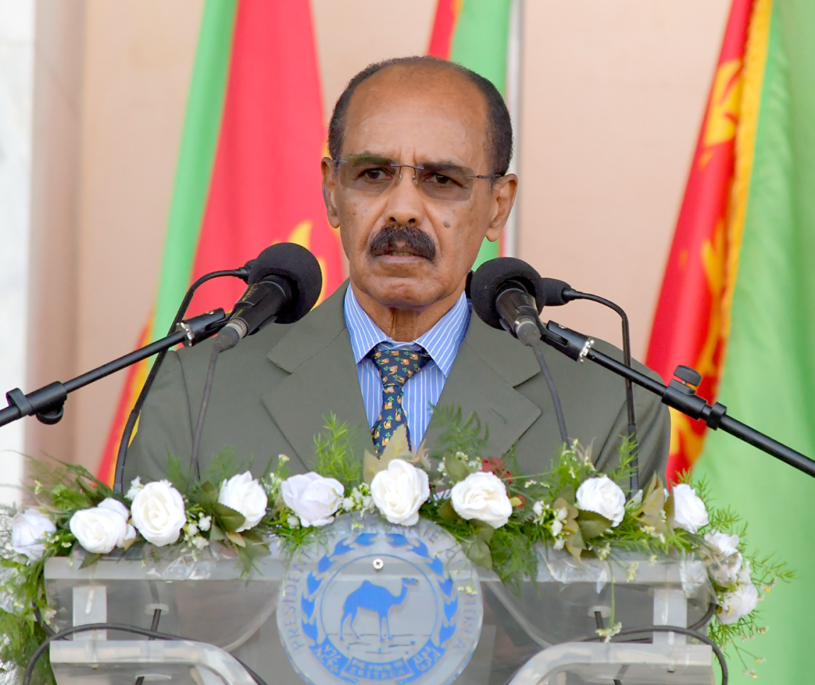
Author: Dr. Tomas Solomon
Isaias Afwerki’s latest Independence Day address to the nation wasn’t really a national speech. As always, it was a tedious lecture about “World Order” and global politics. For three decades, his regime has relied on a reliable strategy: shift attention away from Eritrea’s internal collapse and blame external powers for his failures.
The speech gives extraordinary attention to the United States, President Trump, Venezuela, Iran, the Strait of Hormuz, NATO, U.S. debt, rare minerals, artificial intelligence, and the “old and exhausted global order.” He speaks as if Eritrea were a thriving global player offering wise counsel to the world.
But there is a significant contradiction here. A leader who has never held a national election, never implemented his country’s constitution, banned independent media, and refused to build accountable institutions has zero credibility lecturing anyone about justice, sovereignty, or fairness.
During his address, Isaias claimed it is “paramount” to critique President Trump’s “MAGA” doctrine through the lenses of wealth, military power, and global influence. He questioned U.S. policies toward Iran and Venezuela, arguing for “a new global order founded upon fairness and justice.” The words sound grand. The reality in Eritrea tells a different story.
Since gaining independence in 1993, Eritrea has never held a national election. Its 1997 constitution was ratified but immediately shelved. There is only one political party that is controlled entirely by Isaias, and no functioning legislature. Human Rights Watch explicitly calls Isaias an unelected dictator, while Freedom House describes Eritrea as a “militarized authoritarian state” defined by arbitrary detentions, indefinite military conscription, and a complete lack of independent press since the government shut it down in 2001. The United Nations Commission of Inquiry (COI) on Eritrea also concluded that there are reasonable grounds to believe Eritrean officials have committed systematic and widespread crimes against humanity, including enslavement, imprisonment, enforced disappearances, and torture, to maintain control over the population since 1991.
This is the actual context of his speech. It isn’t about “fairness” or “humanity’s mission.” It’s about a ruler who turned a liberation struggle into a permanent, one-man dictatorship.
Using Global Affairs to Hide Domestic Failure
One of the most irrational aspect of the speech is its lack of perspective. You would expect a president speaking to his people on Independence Day to talk about Eritrean issues such as poverty, jobs, clean water, electricity, schools, healthcare, regional conflicts, the mass exodus of its youth, national service, constitutional governance, prisoners, and the future of the country.
Instead, Isaias spends the majority of the address analyzing America’s national debt, industrial output, Trump’s tariffs, U.S. military power, Venezuela, Iran, nuclear weapons, NATO, and the Strait of Hormuz. This isn’t deep strategic thinking. It’s an escape tactic.
A government that cannot guarantee basic human rights or provide standard public utilities has no business lecturing the world about global systems. World Bank data shows that as recently as 2023, only 54.4% of Eritrea’s population had access to electricity, and just 14% were using the internet. These aren’t just minor speed bumps on the road to development; they are the direct results of a closed, militarized system that crushes individual initiative and treats its people as a workforce to be exploited and mobilized for war rather than citizens to be served.
The Ultimate Double Standard is that Isaias loudly questions whether the U.S. has the legal right to act unilaterally against Iran. This comes from a man whose own government locks up citizens without trial, vanishes critics, suppresses religion, and forces its youth into endless national service. Amnesty International reports that this forced conscription often amounts to modern-day slavery.
Blaming Washington: The Regime’s Favorite Playbook
This anti-American rhetoric isn’t new; it’s the DNA of the Eritrean regime. Every single year, the country’s economic stagnation, diplomatic isolation, youth flight, and institutional decay are explained as consequences of hostile foreign policy, sanctions, conspiracies, hegemonic systems, or “unipolar” domination. But this argument has expired.
Eritrea’s core failures are internal and structural. The government has willfully chosen a brutal brand of authoritarianism for 35 years. According to the Bertelsmann Transformation Index (BTI) 2026, Eritrea has made zero effort to reform its political or economic systems, choosing instead to remain a tightly controlled surveillance state with a command economy. Washington didn’t build that system. Isaias did.
His critique of Trump is equally telling. While he tries to sound analytical, even giving Trump minor credit for recognizing American decline, he ultimately lumps him into the same old narrative of U.S. power, intimidation, monopolization, military threats, and global manipulation. No matter who is sitting in the Oval Office, Democrat or Republican, the United States is always the designated villain. That consistency is not analysis. It is just disciplined propaganda.
The Hypocrisy of the “World Order” Argument
Isaias says the global system must be replaced by one based on fairness, justice, resource ownership, peace, stability, mutual respect, and legal mechanisms. Yet, inside Eritrea, those concepts don’t exist.
- Fairness? There are no independent courts to hold the government accountable.
- Justice? Journalists and political dissidents have been locked away in secret prisons for decades.
- Ownership? Citizens aren’t even allowed to own their own futures, let alone organize, speak freely, or build independent businesses.
- Peace and Stability? Isaias has consistently dragged his country into regional conflicts, wedging wars with Ethiopia, Djibouti, Sudan, and Yemen. Human Rights Watch and the BTI have well-documented Eritrea’s brutal involvement in the Tigray war alongside Ethiopian federal forces.
The speech demands a new global order, but Eritrea itself has no constitutional order. That is the hypocrisy at the center of the address.
What Ukraine Taught Us About Isaias’s True Colors in International Affairs
On March 2, 2022, the UN General Assembly voted on a resolution condemning Russia’s invasion of Ukraine. Out of the entire world, only five countries voted against it: Russia, Belarus, North Korea, Syria, and Eritrea.
This matters because Eritrea’s vote was not a procedural footnote. It exposed the regime’s instinctive alliance with aggressive, authoritarian states. Isaias cannot credibly complain about the principle of territorial sovereignty, the same principle he claims to defend when it suits his narrative. A regime that sides with Russia, Belarus, North Korea, and Syria on a war of aggression is not defending international law. It is joining the world’s anti-democratic bloc while dressing the decision in anti-imperialist language. It is pure political opportunism.
A Growing Strategic Risk in the Red Sea
The most concerning part of Isaias’s rhetoric isn’t the words themselves, but the politics and risk behind them.
Isaias discusses Iran and the Strait of Hormuz at a moment when Hormuz has become a central flashpoint in global energy security. With rising shipping risks, drone threats, and tensions over global energy flows, maritime chokepoints are highly sensitive.
This matters because Eritrea sits right along the vital Red Sea shipping corridor. A belligerent, isolated, militarized regime near a global chokepoint should not be dismissed as merely poor, eccentric, or “deranged.” That is a policy mistake.
The situation with Iran has proven that a country doesn’t need an expensive navy to disrupt global trade; it just needs missiles, drones, sea mines, and a willingness to host hostile actors. Eritrea’s regime has the exact mix of secrecy, militarization, and grievance-based ideology to become a spoiler. Ignoring it until a crisis erupts would be negligence.
While recent media reports highlight a potential “diplomatic reset” and the possible lifting of U.S. sanctions due to Red Sea maritime tensions, this engagement may be a calculated performance by Isaias. By projecting willingness for a renewed alliance with Washington, he can create artificial leverage to demand greater strategic concessions, economic aid, or military backing from his primary patrons in Russia and China.
This behavior fits a historical pattern of authoritarian opportunism. Isaias has spent years entrenching his regime within the circles of Russia and China, even visiting Beijing and Moscow in recent years to advocate for a “new global order” to replace “Western hegemony”. By momentarily entertaining Washington’s maritime overtures, he doesn’t intend to actually pivot West; rather, he may be artificially driving up his stock. He could be showing Beijing and Moscow that his 1,000-kilometer Red Sea coastline is a hot commodity, essentially telling them: “If you don’t give me what I want, I have other suitors knocking on my door.” Look no further than his latest Independence Day speech to see this strategy in action.
U.S. Policy That Actually Works
Washington needs to stop treating Eritrea either as an untouchable pariah or as a harmless, aging dictatorship. With recent leaks showing that U.S. officials are considering lifting sanctions to secure Red Sea shipping lanes, a transactional “blank check” approach would be a major mistake. Instead, a smart, clear-eyed strategy must balance maritime security with firm demands for internal accountability.
A serious, effective U.S. policy should focus on five core pillars:
1. Strategic monitoring of Eritrean ports and military partnerships: Washington must treat Eritrea’s 1,000-kilometer Red Sea coastline as a vital security zone and a maritime-security risk, not merely a human-rights file. The U.S. and its allies must closely watch Eritrean ports and islands for foreign military footprints, drone infrastructure, signals intelligence facilities, or covert logistics networks involving adversarial powers.
2. Shift to Hyper-Targeted Financial Pressure: Broad economic sanctions often hurt regular citizens while allowing the ruling elite to profit off the black market. Effective policy means freezing the illicit financial assets, international bank accounts, and shipping networks tied directly to Isaias’s inner circle, military leaders, and the ruling party’s commercial monopolies.
3. Human-rights accountability tied to policy incentives: Any normalization should require measurable steps: release political prisoners, end indefinite national service, allow family contact for detainees, permit independent humanitarian access, and begin constitutional implementation.
4. Red Sea coalition coordination: The United States should work with regional partners, the EU, Gulf states, and African institutions to prevent Eritrea from becoming a permissive platform for anti-shipping activity, sanctions evasion, arms flows, or hostile intelligence operations.
5. Break the Regime’s Information Monopoly: The dictatorship survives by keeping its population in the dark and sealing off the country from the outside world. U.S. policy should actively support the Eritrean diaspora’s democratic voices, fund independent satellite and digital media networks, and protect transnational human rights groups that document the regime’s abuses.
There should be no blank checks. Isaias should not be rewarded with diplomatic engagement simply because his country occupies a strategic location. Engagement without conditions would validate the regime’s belief that geography can purchase impunity.
Conclusion
Isaias’s speech is not the work of a serious reformer analyzing the world. It is the familiar performance of a dictator who has failed his own people and chooses instead to talk about the failures of the rest of the world.
He preaches about justice while denying it to his citizens. He talks about sovereignty while robbing Eritreans of control over their own lives. He demands global order while refusing constitutional order. He talks about peace while his regime has repeatedly contributed to regional instability. He speaks of progress while Eritreans continue to flee a state that cannot provide political freedom, economic opportunity, or basic dignity.
The West should read his speeches, not for their analytical value, but as a warning signal. A dictatorship near a global chokepoint, aligned instinctively with Russia and North Korea on Ukraine, obsessed with anti-American grievance, and insulated from domestic accountability is not a minor nuisance. It is a latent strategic risk.
The mistake would be to ignore Isaias until Eritrea becomes part of the next Red Sea crisis.


Thank you Dr. Tomas for the excellent analysis of Esayas’s speech. Indeed, the Eritrean dictator’s speech is the same old and outdated speech. Blaming the west especially USA for all the ills in the wold and nothing about the Eritrean people’s aspirations. The same every year with different verbs but no substance at all. Out of 23 minutes of speech, 18 minutes about USA’s sins and “world order” and just 5 minutes about domestic issues and even then, only false hopes of his government will work on “housing, education and infrastructure”. Mind you only false hopes as usual and nothing to show as achievement not even a tangible solid plan.
The sad part is, Eritreans got used to his disrespectful speeches and we don’t even get enraged by that. The west also has underestimated Eritrea’s relevance and has not paid serious attention to the Eritrean dictator’s potential risks.
In any case kudos to your excellent and to the point article.