The TPLF’s reinstatement of the 2020 regional government threatens the fragile peace in Tigray but also risks triggering another full-blown battle in the region.
- It is likely that the Eritrean government and the Sudanese Armed Forces (SAF) will support the TPLF’s move to capture western Tigray as they are structurally positioning themselves to logistically and operationally back a TDF offensive into western Tigray.
- The Horn of Africa faces an acute risk of proxy war. As Eritrea and the SAF expand their funding and hosting of active Ethiopian insurgencies, the federal government in Addis Ababa is escalating its reciprocal support for the armed domestic opponents of both Asmara and Port Sudan.
2 June 2026
Source: ACLED
- The Fano-Tigray alignment is poised to weaken the federal government
- TPLF and cross-border actors encircle western Tigray
Author Jalale Getachew Birru Senior Analyst, East Africa
✓ ACLED is the world’s most trusted source of conflict information >
Escalating tensions between the Ethiopian government and a resurgent Tigray People’s Liberation Front (TPLF) in Tigray threaten not only renewed violence in the region but also ripple effects on already-simmering tensions in the neighboring Amhara region and in other countries in the Horn of Africa. The TPLF reinstated the 2020 regional government in May as part of a high-risk testing-the-waters strategy that also involves a shift toward aligning with some Fano militias and the Eritrean government, which was not the case during the 2020-2022 conflict. The federal government has, at the same time, mobilized its forces to and around the disputed western Tigray, setting the stage for the imminent renewal of active hostilities.
The TPLF is currently consolidating power by systematically pushing aside the interim regional government. After full consolidation, the TPLF’s first action will most likely be to mobilize its forces to seize the disputed territories in western Tigray in the next few months, as it is acting as the only savior of Tigrayans. Since forcibly controlling western Tigray is a red line for the Ethiopian government, if the TPLF mobilizes to forcefully control western Tigray, it will almost certainly trigger a full-blown battle, dragging the region into another round of war. If the TPLF takes action to forcibly control western Tigray, the newly realigned actors will certainly assist the TPLF in various ways. The likelihood of Eritrean and Ethiopian forces confronting each other directly is low because Eritrea wants Tigray as a buffer zone, and neither party can withstand the consequences of such a confrontation, either locally or diplomatically. But both parties and neighboring countries like Sudan will likely continue supporting rival groups, which will result in a proxy war. TPLF-aligned Fano militias, like the Amhara Fano National Movement (AFNM), will be used to weaken the Ethiopian government by either intensifying their fight against the government or fighting alongside the TPLF.
The Fano-Tigray alignment is poised to weaken the federal government
- TPLF-aligned Fano militias are highly likely to provide operational support or launch diversionary offensives to assist a TPLF campaign to recapture western Tigray. This multi-front coordination aims to overstretch and fracture the deployment capabilities of the Ethiopian National Defense Force (ENDF) across northern Ethiopia.
- Escalating Fano militia activity and possible alignment with the TPLF and Eritrea also present a severe risk of reigniting mass ethnically motivated violence in western Oromia, where they have been increasingly active in 2026. This geographical expansion threatens to revitalize the fractured Oromo Liberation Army (OLA) (also known as the Oromo Liberation Front (OLF)-Shane), shifting the Oromia security landscape from localized skirmishes back to coordinated, sustained insurgent warfare.
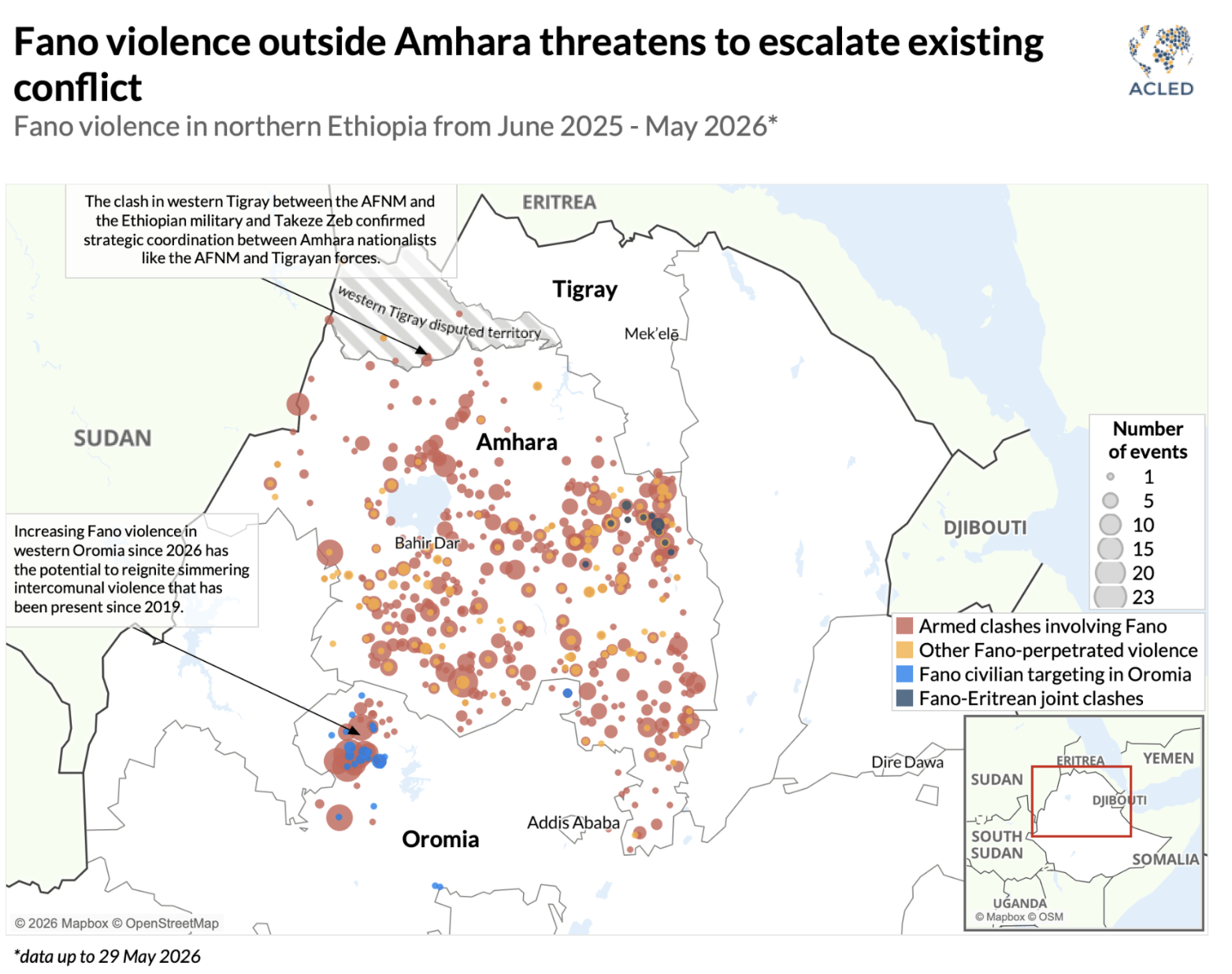
The tactical adoption of the “enemy of my enemy is my friend” paradigm has forged an unprecedented alignment between some Fano militias through the AFNM and the TPLF. The previously collaborative relationship between Fano militias and the Ethiopian government has been sour since the signing of the Pretoria agreement and was worsened by the dismantling of regional special forces across Ethiopia in April 2023, which ignited direct confrontation between the government and Fano militias. The exact state of relations between the TPLF and AFNM remains unclear. However, there are indicators on the ground that point to an operational alignment. On 2 February, the AFNM attacked the Tekeze Zeb — a local militia established by the current local government to protect the disputed western Tigray — in Tsegede, western Tigray. The armed clash happened within a week after the TPLF launched coordinated operations in western Tigray to regain the disputed Tselemt along the Tigray-Amhara border from 26 to 29 January. This operational timing serves as an indication of strategic coordination between Amhara nationalists such as the AFNM and Tigrayan forces. If the TPLF begins to mobilize the Tigray Defense Forces (TDF) to control disputed territories in western Tigray in the next few months, the AFNM will most likely take two actions. It will either directly fight the security forces alongside the TDF or initiate another round of coordinated operations inside the Amhara region to paralyze federal reinforcement pipelines heading toward the western front.
Concurrently, western Oromia — which shares a volatile, porous border with the Amhara region and is directly adjacent to AFNM core operational zones — may present another set of risks. Thus far in 2026, violence involving Fano militias has increased in western Oromia after a relative lull following the surrender of the rebel OLA/OLF-Shane faction to the government in December 2024.1 Even though the incidents in western Oromia are being reported as involving Fano militias in general, local ACLED sources claim that these militias are trained by Eritrea. This is not the first time that Fano militias and Eritrean forces have worked together. ACLED local sources report Eritrean forces fighting alongside Fano militias against Ethiopian security forces in the Amhara region in September 2025. The report indicated that these Eritrean forces were wearing Fano uniforms to obscure their identity, and that the operation was launched by a predecessor group to the AFNM (see map below). An increase in Fano militia activities in western Oromia will likely unite the dispersed and divided OLA/OLF-Shane insurgency in the name of defending the local Oromo community and fighting Fano militias, which decreased over the past year to sporadic clashes with security forces instead of lengthy armed confrontation.
The increasing Fano militia activity in western Oromia has already seen an uptick in Fano militia attacks targeting Oromo civilian populations, as well as armed confrontations between advancing Fano units and security forces. At the same time, Ethiopian state security forces and OLA/OLF-Shane elements are conducting crackdowns on ethnic Amhara civilians accused of acting as Fano or supporting the group. This dynamic effectively reignites deep-seated intercommunal animosities and cyclical atrocities that have plagued the Amhara-Oromia borderlands since 2019 and should be expected to worsen should Fano further escalate their activities in western Oromia to coincide with a re-escalation of fighting between the Ethiopian state and the TPLF.
TPLF and cross-border actors encircle western Tigray
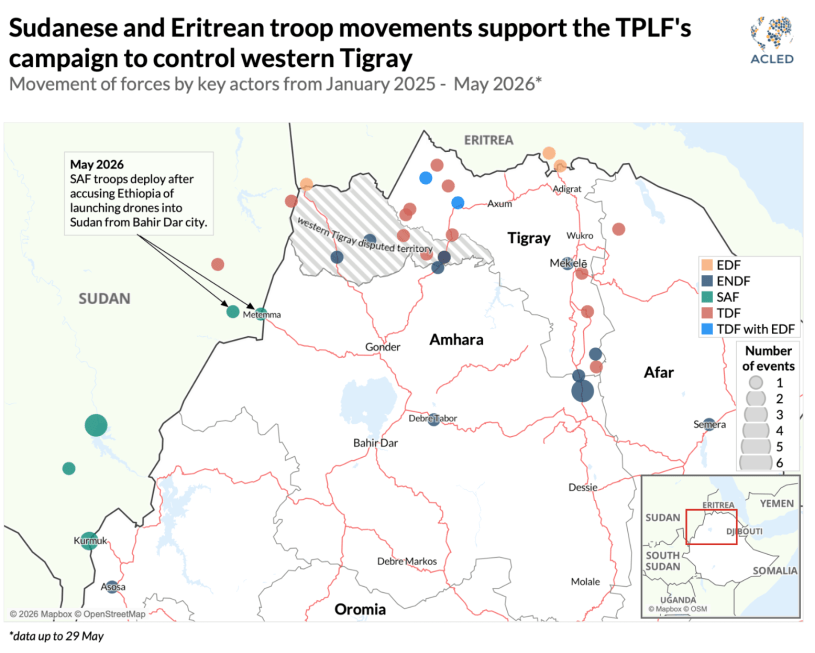
- It is likely that the Eritrean government and the Sudanese Armed Forces (SAF) will support the TPLF’s move to capture western Tigray as they are structurally positioning themselves to logistically and operationally back a TDF offensive into western Tigray.
- The Horn of Africa faces an acute risk of proxy war. As Eritrea and the SAF expand their funding and hosting of active Ethiopian insurgencies, the federal government in Addis Ababa is escalating its reciprocal support for the armed domestic opponents of both Asmara and Port Sudan.
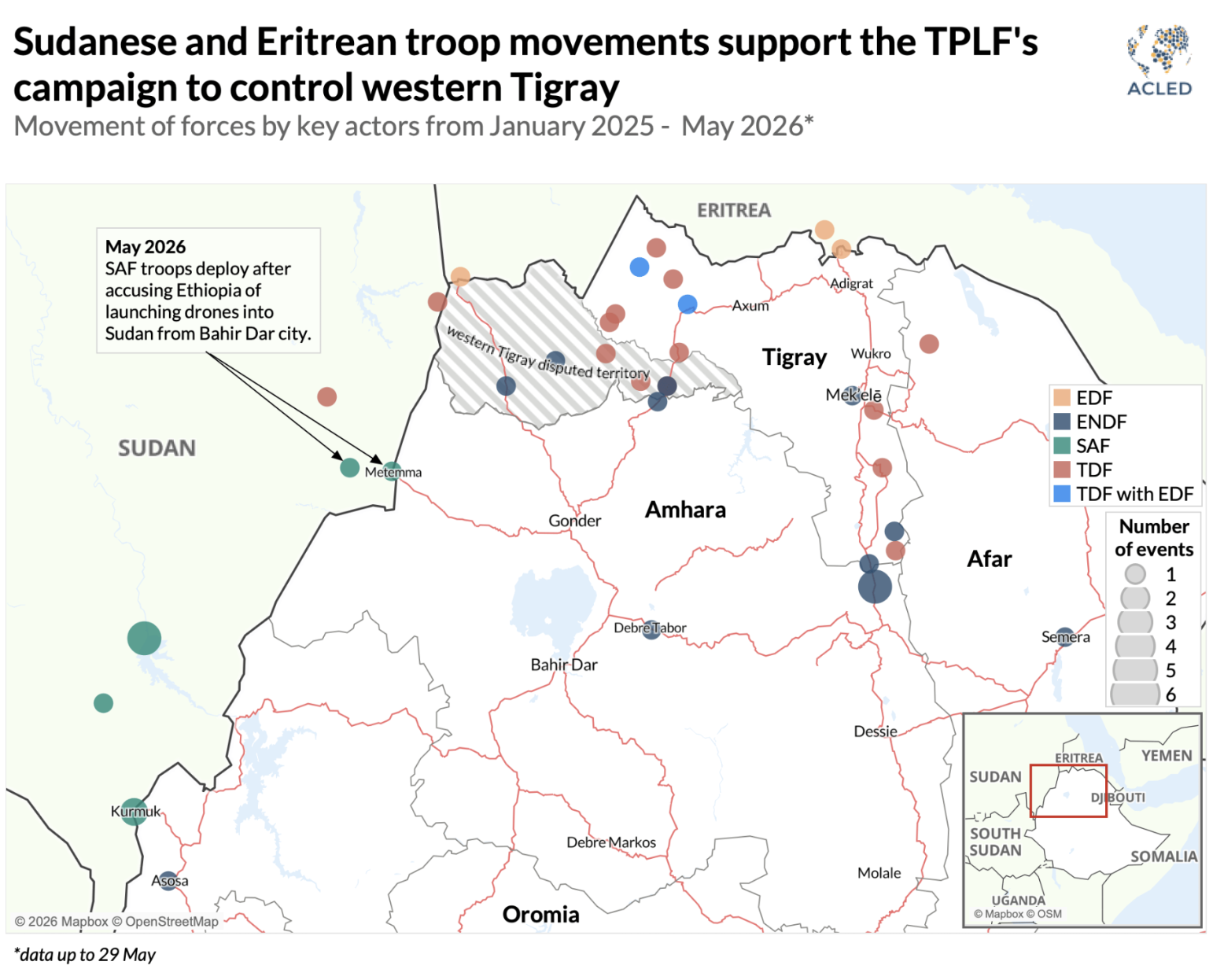
There is a high probability that the Eritrean government and the SAF will support any TPLF mobilization to control western Tigray by providing weapons and hosting the TDF in their territories for coordinated operation against western Tigray. What we are currently observing is simultaneous coordinated moves involving various actors to assert their interests in the region. We can take two such moves as an example. First, in January and February, the Eritrean Defense Forces (EDF) and the TDF moved their troops in the Tigray region closer toward western Tigray. These movements happened as the TPLF launched coordinated operations to regain the disputed Tselemt area at the end of January 2026. In the past year, there has been an indication that the Eritrean government has been supporting the TPLF and other insurgent groups like the AFNM to weaken Arat Kilo under the guise of a movement called Tsimdo.2 In mid-May, the Tsimdo movement was hosted in Port Sudan city in Sudan, marking the first overt, unified front established by regional state and non-state actors explicitly aligned against the administration in Arat Kilo. The conference brought together actors linked to the Eritrean government, the SAF leadership, dissident factions of the Ogaden National Liberation Front, prominent Amhara nationalists, and other armed peripheral opposition groups.3 To counter the Eritrean military and the TDF movement closer to western Tigray, in February, several ENDF trucks carrying heavy weaponry, including tanks and armored vehicles, and ENDF convoys were observed in Welkait, western Tigray.
The operationalization of this multi-axis alliance is already visible on the ground. The Tsimdo meeting was held a week after the SAF accused Ethiopia of launching drones to attack Khartoum in support of the Rapid Support Forces (RSF). This accusation occurred on 5 May, the same day the TPLF officially reinstated the 2020 regional council in Tigray. After the accusation, the SAF mobilized its troops and weapons in Gedaref state, which borders western Tigray and the Amhara region (see map below). This is the second coordinated move on the chessboard that suggests that, when the TDF mobilizes to control western Tigray from the east, the AFNM will mobilize in the Amarha region to support them from the south, and the remnants of the TDF in Sudan — with the support of the SAF and Eritrea — will mobilize from the west, effectively encircling western Tigray and security forces from all directions.
However, Ethiopia is not merely a passive recipient of these asymmetric threats; Addis Ababa is aggressively leveraging its own proxy architecture to alter the internal stability of its neighbors and the Tigray region. Ethiopia is hosting and financing Eritrean opposition actors like the Brigade Nhamedu, also known as Blue Revolution Movement; the Eritrean Afar National Congress; and the Red Sea Afar Democratic Organization, which aim to forcibly overthrow Eritrean President Isaias Afwerki’s government.4 Some reports also indicate that Ethiopia is supporting the RSF, directly undermining the SAF’s core strongholds in eastern and central Sudan.5 The Tigray Peace Forces (TPF), which aim to remove the TPLF from Tigray, are also present at the border between the Tigray and Afar regions. The Ethiopian security forces do not confront these forces, indicating their alignment with the TPF’s objective, though the TPF denied receiving any support from the federal government.6
Consequently, the localized dispute over western Tigray has transformed into the primary trigger for a much wider, systemic conflict capable of reshaping the geopolitical architecture of the entire Horn of Africa by shifting alliances.
Visuals produced by Christian Jaffe.
Footnotes
- 1For more on the peace agreement between the OLA/OLF-Shane faction and the government, see Ethiopia Weekly Update (10 December 2024) and Ethiopia Weekly Update (17 December 2024).
- 2Daniel Tesfa and Mirjam van Reisen, “The Ximdo Gamble: TPLF–Eritrea Alliance and the Fragile Peace in Tigray and the Horn of Africa,” GAIC-Papers #01, 21 July 2025
- 3YouTube @HidmonaTelevision, “Engagement38/ Engagement for the Peace of Africa/SOLIDARITY:FOR THE PEACE OF AFRICA,” 16 May 2026
- 4BBC Amharic, “Eritrean opposition group Birgade Nhamedu announces plans to use its Addis Ababa office as a military central office,” 17 May 2026 (Amharic); Seyum Getu, “Agreement between Eritrean opposition parties,” Deutsche Welle Amharic, 8 January 2026 (Amharic)
- 5Giulia Paravicini and Reade Levinson, “Ethiopia builds secret camp to train Sudan RSF fighters, sources say,” Reuters, 10 February 2026
- 6Wazema Radio, “Hara land,” 6 February 2026

