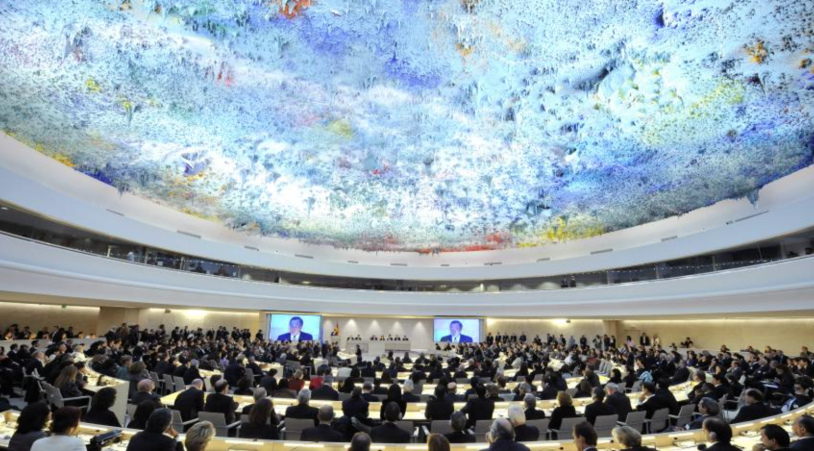
This week, Council members will decide not only who will become the next Special Rapporteur, but also whether one of the United Nations’ longest-standing human rights mandates will continue to serve as an independent witness for those with few others to speak on their behalf.
Source: InDepthNews
By Jaya Ramachandran
GENEVA | 6 July 2026 (IDN) — For thousands of Eritreans worldwide, the UN Special Rapporteur’s office is more than an international appointment. It remains one of the few channels for victims, political prisoners, and families separated by exile to reach the international community.
For this reason, the Worldwide Eritrean Community has urged the 47 member states of the United Nations Human Rights Council (UNHRC) to renew the Special Rapporteur’s mandate on human rights in Eritrea. Their appeal coincides with a significant contest in Geneva over who will succeed Mohamed Abdelsalam Babiker, whose six-year term is ending.
This timing is deliberate. As the Human Rights Council prepares to appoint a new independent expert, Eritrea has renewed its efforts to end the mandate. This week, governments, diplomats, and human rights advocates will decide not only who will take on one of the UN’s most challenging human rights roles, but also whether the Council will maintain independent scrutiny of one of the world’s most closed countries.
Diplomatic sources in Geneva report that eight candidates are now competing for the position after the application deadline was extended due to fewer initial applicants than expected. While the selection process is usually discreet, this year’s appointment carries significant political weight as the mandate’s future is under intense diplomatic lobbying.
“Do Not Turn Away”
In their open letter to Council members, Eritrean civil society organisations and diaspora groups make a direct and urgent appeal: do not let international attention fade.
For these groups, the Special Rapporteur serves as an indispensable witness.
For over a decade, successive Rapporteurs have documented allegations of arbitrary detention, enforced disappearances, torture, restrictions on freedom of expression and religion, and Eritrea’s system of indefinite national service, which many observers cite as a main reason Eritreans continue to flee.
“The mandate has, over many years, provided an independent, impartial and internationally recognised mechanism for monitoring and reporting on the human rights situation in Eritrea,” the organisations write.
They argue that the conditions which prompted the Human Rights Council to establish the mandate in 2012 have not fundamentally changed. Independent media remain absent. Civil society continues to operate under severe restrictions. International human rights investigators are still denied meaningful access. Thousands of Eritreans continue to leave the country every year, often undertaking dangerous journeys in search of safety and opportunity.
The organisations reject the Eritrean government’s assertion that the mandate is politically motivated. Instead, they describe it as a necessary expression of the Human Rights Council’s responsibility to protect universal human rights wherever serious concerns persist.
Their message to Council members is simple: renew the mandate regardless of political alliances or regional considerations and keep it in place until genuine and lasting progress can be demonstrated.
More Than Reports
Since its creation in 2012, the mandate has become far more than a reporting exercise.
Unable to enter Eritrea because successive governments have refused access, Special Rapporteurs have relied on painstaking interviews with refugees, former officials, victims, relatives and civil society organisations. Piece by piece, these testimonies have helped build one of the most comprehensive independent records of human rights conditions inside the country.
For many Eritreans living abroad, these reports have also provided something less tangible but equally important: recognition.
Families searching for relatives who disappeared years ago, former detainees rebuilding their lives, and communities forced into exile have seen their experiences documented by an impartial international mechanism when few others were willing or able to listen.
That explains why diaspora organisations regard the continuation of the mandate as far more than a procedural decision at the United Nations.
Asmara Pushes Back
The Eritrean government has never recognised the Special Rapporteur’s legitimacy.
Officials in Asmara have consistently argued that country-specific mandates unfairly single out developing countries, infringe on national sovereignty, and ignore Eritrea’s security concerns and development achievements.
Last year the government went a step further, introducing an unprecedented draft resolution seeking to terminate the mandate altogether.
The effort failed. Instead, the Human Rights Council voted to extend the mandate, reaffirming the need for continued independent monitoring.
Diplomats in Geneva say Eritrean representatives have continued lobbying member states during the current session, urging them to replace country-specific monitoring with technical cooperation and dialogue.
Human rights organisations counter that dialogue cannot substitute for independent oversight where meaningful access remains restricted, and accountability mechanisms are largely absent.
A Wider Coalition
The Worldwide Eritrean Community is not alone in making its case.
More than thirty international human rights organisations—including Human Rights Watch and Amnesty International—have likewise urged the Human Rights Council to renew the mandate.
They argue that accountability remains unfinished.
A decade has passed since the UN Commission of Inquiry concluded that crimes against humanity may have been committed in Eritrea. While welcoming reports that some long-term detainees have recently been released, the organisations stress that isolated gestures cannot replace structural reform.
Arbitrary detention, restrictions on fundamental freedoms, the absence of judicial independence and the lack of political pluralism, they argue, continue to justify independent international monitoring.
Choosing a Successor
Against this backdrop, selecting the next Special Rapporteur is no ordinary personnel decision.
Whoever is appointed will inherit one of the Human Rights Council’s most demanding mandates, requiring not only legal expertise but diplomatic resilience, political independence and the confidence of victims whose stories often cannot be told openly.
The next Rapporteur must also navigate a divided Human Rights Council, where support for country-specific mandates is challenged by governments favoring less confrontational, technical cooperation approaches.
The appointment therefore has implications extending well beyond Eritrea. It is also a measure of how firmly the United Nations intends to defend the independence of its Special Procedures system at a time when international human rights mechanisms face growing political pressure.
A Test for the Human Rights Council
The debate over Eritrea ultimately reaches beyond a single country.
It raises a broader question for the Human Rights Council: should independent international scrutiny continue where governments reject external oversight, or should it be replaced by quieter engagement focused on dialogue?
For supporters of the mandate, the answer is clear.
They argue that without independent monitoring, the experiences of countless Eritreans would be excluded from the international agenda. While the reports alone may not transform conditions, they preserve an objective record, give victims a voice, and remind governments that the world is watching.
This conviction underpins the Worldwide Eritrean Community’s appeal.
Its concluding message is neither confrontational nor rhetorical. It is a plea for persistence: the Human Rights Council should maintain the mandate until real, measurable, and lasting improvements in Eritrea’s human rights situation are evident.
This week, Council members will decide not only who will become the next Special Rapporteur, but also whether one of the United Nations’ longest-standing human rights mandates will continue to serve as an independent witness for those with few others to speak on their behalf. [IDN-InDepthNews]

