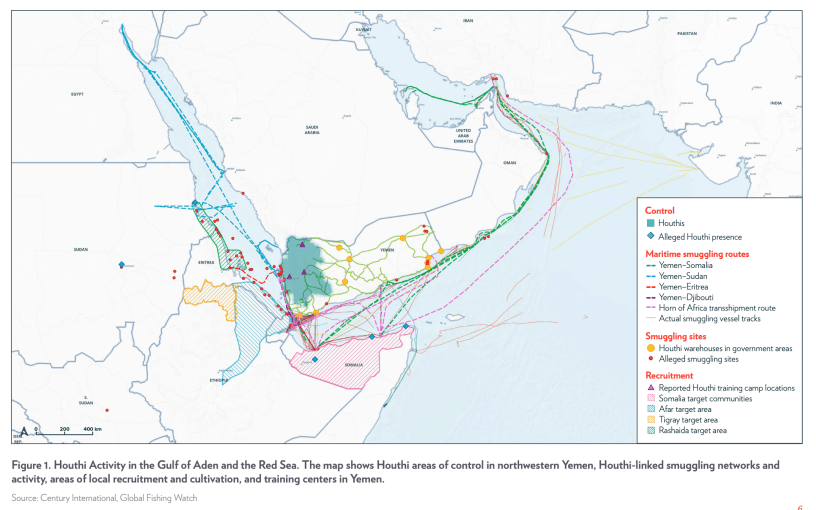
Eritrea now also allegedly serves as yet another smuggling hub for Iranian arms en route to Yemen. Arms routed through Eritrea are transferred between ships around the Dahlak archipelago, a cluster of small islands in the Red Sea, and sent on to Yemen…
Yemeni and regional sources also claim that the Houthis are reestablishing a footprint in Eritrea, again with Iranian support.116 If these claims are correct, it would mean that the Houthis have built a logistical footprint that runs, intermittently, along the African shores of the Gulf of Aden and the Red Sea from northeastern Somalia to northern Sudan.
August 24, 2026 — Peter Salisbury, Nadwa Al-Dawsari and Jay Bahadur
Source: The Century Foundation
 Peter SalisburyFellow
 Nadwa Al-DawsariContributor
 Jay BahadurContributor
- 11. Overview: From Spoke to Hub
- 22. Houthi Consolidation, Centralization, and Expansion in the Gulf of Aden
- 33. Leveraging the Network: Expanding Ties Across the Red Sea
- 44. Red Sea Reach: The Houthis and IRGC in Sudan and Eritrea
- 55. Circumstance or Strategy? Joining Up the Dots
- 66. Bridging the Gulf: Conclusion and Recommendations
- 7Acknowledgements
What You Should Know [Full Report Below]
- Drawing on innovative research, this report describes the Houthis’ push into the Horn of Africa and its neighborhood and makes the case that the group is trying to establish itself as a new node of the “Axis of Resistance” ecosystem in the region.
- The Houthis are making outreach efforts to a variety of African groups, including Somalia’s al-Shabaab, factions of the Sudanese Armed Forces, and various marginalized peoples and tribes across the Horn of Africa.
- In many cases, the Houthis do not share ideology, language, religion, or grievances with these groups. But they have been placing bets on new relationships that will deepen their power, reach, and resilience in the region.
- The Houthis’ expansion strategy closely mirrors efforts by Iran and Lebanon’s Hezbollah to mold the nonstate armed groups they sponsored into a Middle East-wide network that became today’s Axis of Resistance.
- This report is the last of three in Beyond the Axis, a Century International project supported by the Cross-Border Conflict Evidence, Policy and Trends (XCEPT) research program, funded by UK International Development.
Download the From Spoke to Hub PDF
1. Overview: From Spoke to Hub
In the fall of 2024, security forces in Mukalla, a small port city in southern Yemen, detained a Somali man named Ahmed Elmi Samatar. Under interrogation, Samatar confessed that he was a go-between for al-Shabaab, the militant Somali affiliate of al-Qaeda, and Yemen’s Houthis, an Iran-backed armed group that controls much of northwestern Yemen. Over the course of 2024, Samatar had facilitated travel for as many as four hundred Somali nationals for military and ideological instruction at Houthi training camps. He had also helped Houthi engineers to travel to Jilib, the de facto capital of al-Shabaab-controlled territory in Somalia.
The Houthis’ surprising foray into Somalia is just one prong in the group’s multifaceted effort to expand their presence and influence along the African coast of the Gulf of Aden and the Red Sea. Since the early 2020s, alone and in concert with Iran, the Yemeni group has established itself as a key player in illicit trade in Yemen and its neighborhood; recruited migrants from African countries to serve as smugglers, spies, and soldiers; and built ties not just with al-Shabaab but also with Islamist factions within the Sudanese Armed Forces (SAF).
This report describes the Houthis’ push into the Horn of Africa and its neighborhood and makes the case that the group is trying to establish itself as a new node of “Axis of Resistance” activity in the region. The Houthis’ first contact with African groups began more than a decade ago, in the form of ad hoc initiatives driven by expediency—opportunistic workarounds to circumvent arms embargoes and counter-smuggling operations. But over time, these various measures have accumulated into a larger project, albeit one that is still in its early stages. A growing body of evidence suggests that Houthi outreach is part of a strategy, planned and executed by a core of operatives based in Sana’a.
The Houthis’ expansion strategy matters because it closely mirrors efforts by Iran and Lebanon’s Hezbollah, in the early to mid-2000s, to mold the nonstate armed groups they sponsored into a Middle East-wide network that became today’s Axis of Resistance.1 From 2003 onward, the Quds Force—the expeditionary arm of Iran’s Islamic Revolutionary Guard Corps (IRGC)—and Hezbollah built and expanded upon existing ties to grow their political, military, and economic alliances.2 Over time, the IRGC and Hezbollah developed a playbook for building up armed-group capabilities. First, they would teach groups—including Hamas, the Houthis, and Iraqi armed factions—to fight using conventional guerrilla tactics. Then, the IRGC and Hezbollah would teach those groups to use advanced Iranian arms to strike targets hundreds and even thousands of kilometers away. Later, they taught Axis groups to build their own weapons from commercially sourced parts. In a very few cases, like that of the Houthis, Axis groups have advanced through all of these stages and then gone on to cultivate new allies and build out their own networks.
This is the last of three reports outlining the findings of the Beyond the Axis project, a two-year research initiative at Century International, supported by the Cross-Border Conflict Evidence, Policy, and Trends program (XCEPT). The first, “From Smugglers to Supply Chains,” published in February 2026, traces how the Houthis transformed from passive recipients of Iranian weapons into arms manufacturers in their own right.3 The second, “Beyond the Axis,” introduces a new framework for tracking group progress up the Axis “capability ladder”—the IRGC and Hezbollah playbook for cultivation and capacity building described above.4 That report shows how groups that absorb Axis training and align with IRGC strategy become more powerful and more bound to both Tehran and one another. “Beyond the Axis” also argues that, as groups have simultaneously developed autonomous capabilities and become more densely connected to one another and to the global economy, the Axis of Resistance has morphed into a new kind of power: a complex, adaptive ecosystem.
This report expands on this earlier work, applying the “Beyond the Axis” framework to show the ecosystem in action. Ecosystems do not stop at neatly delineated borders imposed by institutions or analytical frameworks. They constantly grow and reshape themselves. The Houthis, once seen as a spoke in the Axis, are now becoming a hub for ecosystem expansion. The effort is in its early stages and is by no means guaranteed to succeed. But even a few relatively limited wins have the potential to make the Houthis and the Axis more resilient to arms embargoes and counter-smuggling efforts, give the Houthis more options to threaten global trade and neighboring states, and build up the capabilities of brutal nonstate armed groups while deepening connectivity and fault lines across the many complex conflicts of the Gulf of Aden and the Red Sea.
The report starts by discussing how the Houthis’ consolidation of control over the illicit economy in Yemen opened new doors into the Gulf of Aden, before examining how the IRGC’s return to Sudan and Eritrea has expanded regional linkages in the Red Sea and increased the chances of capability breakout among cultivated African groups. It makes the case that, even if Houthi outreach among Yemen’s African neighbors started as a scattered collection of opportunistic bets, it has evolved into something strategic and intentional that borrows heavily from the earlier IRGC and Hezbollah playbook. It closes with recommendations on how the capability ladder framework can be applied to track Houthi relationships and capability-building efforts in the region, in order to help policymakers better target and plan interventions that do not simply exacerbate conflict dynamics in an already volatile region.
The report marshals a unique body of evidence gathered by a team of researchers using a novel, multidisciplinary research method to triangulate evidence for different claims. It builds on the mass of data gathered for the earlier reports in the series and is based on around one hundred in-depth interviews with experts and confidential sources, including senior military, security, and intelligence officials; reviews of open-source and private documents, and public and private land and sea interdiction data; port statistics; analysis of alleged smuggling sites using satellite imagery and nighttime light emission; telephone call data; and a systematic, rigorous analysis of remotely sensed data, including satellite imagery and ship automatic identification systems (AIS).
Evidence is stronger for some of the activities and relationships the report documents than for others. The sources most likely to provide information on Houthi activity are motivated by their opposition to the group, and disinformation is a persistent problem. The report signposts the authors’ level of confidence in different claims, either in the text or in footnotes. In some cases, where evidence was too thin, the authors did not engage directly with claims so as not to further amplify them.5
There is still little evidence that the drones, missiles, antiaircraft systems or manufacturing knowledge that made the Houthis so dangerous have passed to any of the nonstate groups they are cultivating. But capability transfers often become visible only after they have taken place, and the Houthis’ intent and forward momentum are nevertheless clear. The Houthis want to become a consequential player in the Gulf of Aden and the Red Sea, as part of a broader effort to achieve the status of regional power. Along with Iran and the numerous regional and international players who have turned the Horn of Africa and its neighborhood into a perpetual conflict zone, the Houthis are adding new layers of complexity to an already volatile part of the world and, at a minimum, risk increasing the suffering of Yemenis and their African neighbors alike.
Perhaps most importantly, as the “Beyond the Axis” report shows, the best time to disrupt emerging ties between the Houthis and other armed actors is now, while their relationships are at their thinnest and most transactional. Once these other groups internalize Houthi lessons and Iranian technology, their bonds with the Houthis will become stronger and the costs of defection will outweigh the benefits of cooperation. As these bonds strengthen, policy options for regional and international stakeholders will narrow and become more expensive.
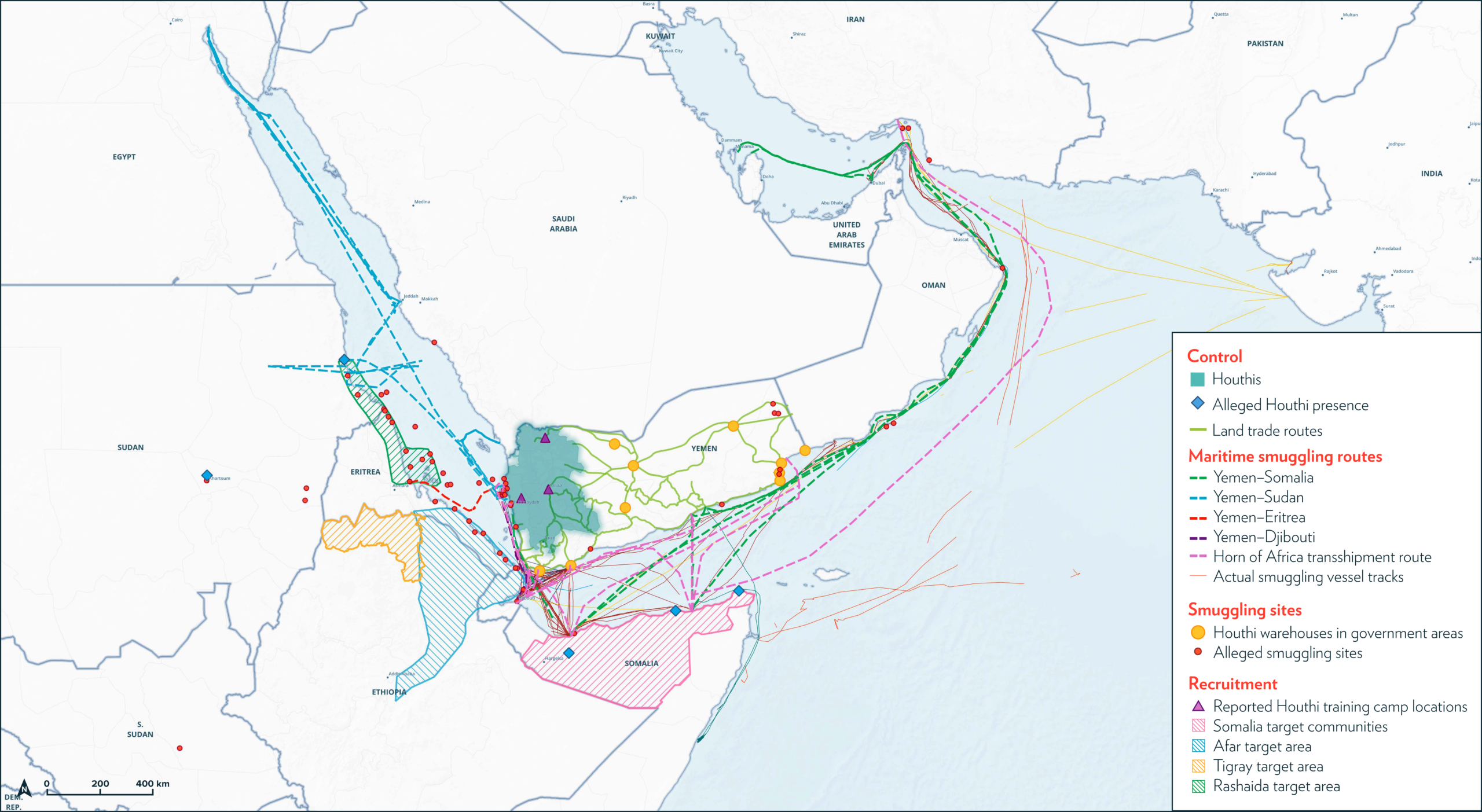
Figure 1
Eritrean Return
Yemeni and regional sources also claim that the Houthis are reestablishing a footprint in Eritrea, again with Iranian support.116 If these claims are correct, it would mean that the Houthis have built a logistical footprint that runs, intermittently, along the African shores of the Gulf of Aden and the Red Sea from northeastern Somalia to northern Sudan. Efforts to substantiate the claims also show the challenge of tracking these purported relationships in such closed environments.
As with Sudan, the Houthis purportedly have long-standing ties to Eritrea that were paused in the mid-2010s and renewed amid changing regional geopolitics in the 2020s. Eritrean opposition leaders and media reports claim that the IRGC provided the Houthis with training in Eritrea beginning in 2009 at the latest, following the signing that year of a cooperation agreement between Eritrea and Iran.117 After a 2016 fallout between Riyadh and Tehran, Eritrea, like Sudan, aligned with Saudi Arabia and the Emirates, allowing Abu Dhabi to set up a military base in the southern port of Assab to support its Yemen operations. But relations between Abu Dhabi and Asmara cooled as the Emirates aligned itself more closely with Ethiopia—Eritrea’s neighbor and long-time adversary, which has long sought to gain access to or even annex portions of Eritrea’s coast, including at Assab. As tensions have increased between Eritrea and Ethiopia, Asmara has restored ties with Tehran and joined it in backing the SAF in the Sudan war. (The Emirates reportedly backs the RSF although Emirati officials deny supporting the group.)
Eritrea now also allegedly serves as yet another smuggling hub for Iranian arms en route to Yemen. Arms routed through Eritrea are transferred between ships around the Dahlak archipelago, a cluster of small islands in the Red Sea, and sent on to Yemen.118 However, an intensive open-source investigation of alleged smuggling sites using satellite imagery and AIS detection software showed little to no activity at named smuggling sites in the Dahlak area. Complicating matters further, Eritrean and Ethiopian sources claim that the Houthis also maintain ties to Eritrean opposition groups.

