By Mintesinot Melaku
ADDIS ABABA — The Ethiopian government’s announcement of a mass prisoner release has triggered intense legal and political controversy, with remaining detainees, their families, and legal experts accusing authorities of imposing discriminatory conditions and bypassing constitutional and legal procedures.
The release of more than 600 federal detainees, announced as a major peace milestone following recommendations from the National Dialogue Commission, included prominent opposition figures such as federal parliamentarian Christian Tadelle and former EZEMA leader Chane Kebede.
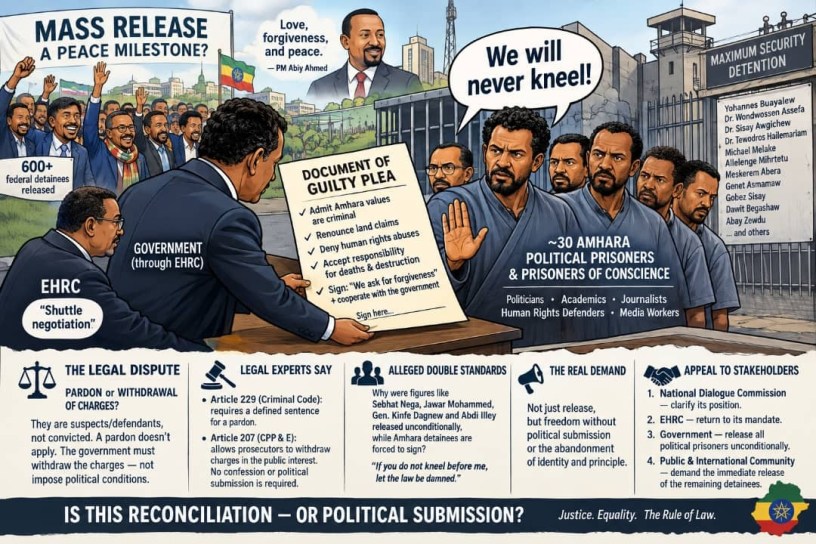
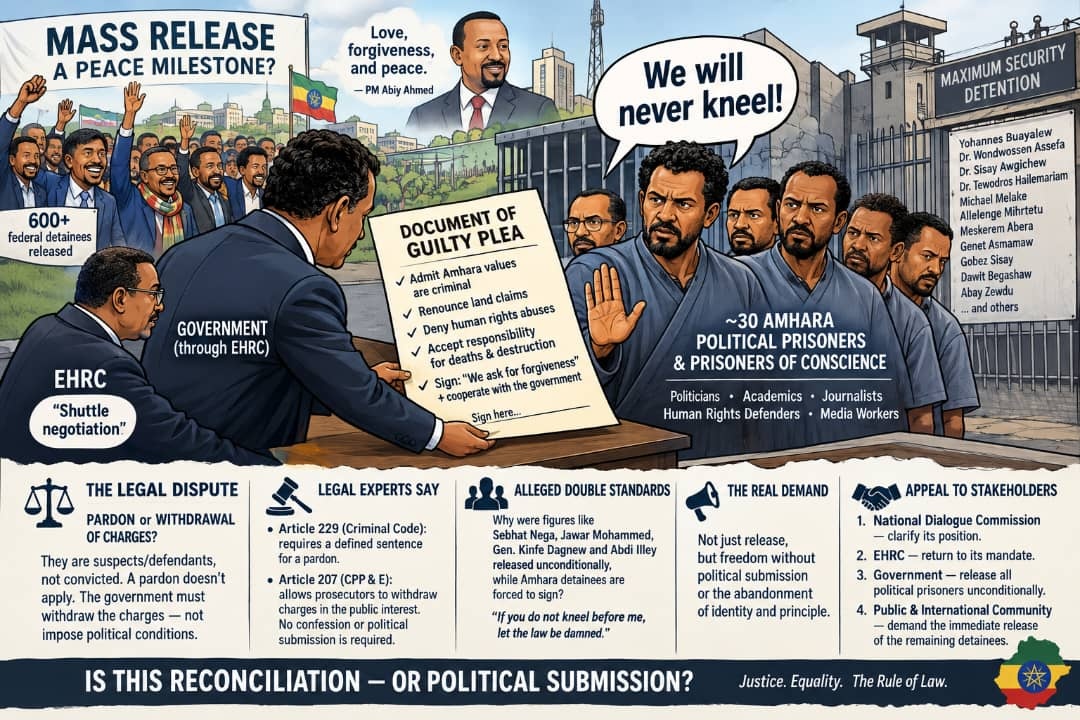
Yet the release has exposed a deep divide between those who accepted the government’s terms and approximately 30 high-profile Amhara political prisoners and prisoners of conscience who reportedly refused to sign what they describe as a “Guilty Plea.” The detainees have chosen to remain in maximum-security detention rather than accept conditions they say compromise their political convictions, identity, and legal rights.
The EHRC’s Role and the ‘Shuttle Negotiations’
According to federal authorities, the mass releases followed a five-month mediation process facilitated by the Ethiopian Human Rights Commission (EHRC). Chief Commissioner Berhanu Adelo described the commission’s role as “shuttle
negotiation,” carrying requests between the government and detainees while communicating the conditions imposed by state authorities.
However, the remaining Amhara detainees—including prominent politicians, academics, journalists, and human rights defenders—have sharply criticized the EHRC’s involvement.
In a collective statement, they accused Commissioner Berhanu of abandoning the commission’s independent human rights mandate and acting instead as an “executive agent for the ruling party.”
The detainees allege that the EHRC presented them with conditional documents requiring them to surrender their political positions, personal integrity,
and ethnic identity in exchange for their freedom.
Purported prerequisite for release
According to the detainees and sources familiar with the matter, the government’s conditional document reportedly required them to:
• Acknowledge that core Amhara cultural values, including patriotism and heroism, are criminal.
• Renounce political demands concerning the return of ancestral Amhara lands allegedly taken by force.
• Deny ongoing human rights crises in the Amhara region, including alleged systemic institutional violence, genocide, and mass displacement.
• Accept legal and moral responsibility
for deaths and property destruction in the Amhara region since the conflict began in March 2023.
• Sign an official apology stating, “We ask for forgiveness,” while pledging full cooperation with the current administration.
“We will never kneel,” the prisoners declared, emphasizing that although they support peaceful political dialogue as a means of resolving Ethiopia’s national crises, they reject conditions they believe criminalize their identity and political convictions.
Among those reportedly remaining in state custody are politicians Yohannes Buayalew, Dr. Wondwossen Assefa, Dr. Sisay Awgichew, and Dr. Tewodros Hailemariam, as well as human rights
defenders and media workers Michael Melake, Allelenge Mihrtetu, Meskerem Abera, Genet Asmamaw, Gobez Sisay, Dawit Begashaw, and Abay Zewdu.
The Core Legal Dispute: Pardons or Withdrawal of Charges?
Beyond the political controversy, the central legal dispute concerns the distinction between a pardon and the withdrawal or termination of criminal charges.
The remaining defendants—many of whom, according to their supporters, have spent more than three and a half years moving between courtrooms and maximum-security detention facilities—argue that their cases remain active and that no final verdict has been issued.
On that basis, they contend that a pardon is legally inapplicable because they have not been convicted. If the government intends to release them, they argue, it must lawfully terminate the charges against them without imposing political or ideological conditions.
Legal practitioners have criticized the Ministry of Justice’s approach, arguing that the administration is conflating two separate legal mechanisms: withdrawing criminal charges and granting a pardon.
Pardons and Prior Convictions
Legal expert Ermias Tilahun has argued that Article 229 of the Ethiopian Criminal Code requires a clearly defined penal sentence for a pardon to apply.
Because the detainees are legally classified as suspects or defendants rather than convicted persons, he maintains that requiring them to sign pardon documents circumvents established statutory procedures.
Withdrawal of Charges and Prosecutorial Authority
Legal expert Solomon Gezahegn has cited Article 207 of Ethiopia’s Criminal Procedure and Evidence Law, together with Federal Attorney General Establishment Proclamation No. 943/2016, in arguing that the authority to withdraw or terminate criminal charges rests with the prosecutor on grounds of public interest.
According to this interpretation, the law
does not establish a procedural requirement for defendants whose trials are ongoing to confess wrongdoing, apologize, or accept political preconditions in exchange for the withdrawal of charges.
The legal experts’ arguments raise a broader question: whether the government can condition the release of defendants with active cases on political declarations or whether their cases must be resolved through established judicial and prosecutorial procedures.
Allegations of Double Standards and Discrimination
The remaining Amhara detainees have also accused the government of applying discriminatory standards in its handling of political prosecutions.
In their joint declaration, they cited the cases of prominent political and military figures from other regions—including Sebhat Nega, Jawar Mohammed, General Kinfe Dagnew, and Abdi Illey—as examples of individuals whose collective charges were previously dropped unconditionally in the name of the public good.
The detainees argue that the government’s treatment of their cases demonstrates a double standard in the application of justice.
“In legal practice, dropping a collective mass charge selectively for specific individuals has no legal basis,” the statement read. “It is an illegal approach that implies, ‘If you do not kneel before me, let the law be damned.’”
The allegations of discrimination remain a central part of the detainees’ appeal for equal treatment under the law.
Political Milestone or Incomplete Gesture?
In a New Year message, Prime Minister Abiy Ahmed praised the mass prisoner release as a major achievement of the National Dialogue process, emphasizing the values of “love, forgiveness, and peace.”
The Prime Minister said the government was responding to requests from dialogue participants who wanted citizens detained over past mistakes to be reintegrated into society.
However, families of the remaining
detainees argue that the government introduced severe, extra-legal conditions—including forced confessions—that were never requested by National Dialogue participants.
While the release of hundreds of detainees has been welcomed by families and civil society, critics contend that the insistence on conditional signing has undermined the reconciliation process and left the government’s peace initiative incomplete.
The Ministry of Justice has reportedly maintained that detainees who refuse to sign the documents will remain in custody while their cases proceed through the judicial system.
Calls for Local and International Intervention
The collective declaration issued by the remaining 30 detainees concludes with a four-point appeal to national and international stakeholders.
1. National Dialogue Commission
The commission is urged to publicly clarify its position regarding what the prisoners describe as a “staged drama” being conducted in its name.
2. Ethiopian Human Rights Commission
The EHRC is called upon to cease acting on behalf of the ruling political party and return to its statutory mandate of protecting and promoting human rights.
3. The Government
The detainees call on the government to release all political prisoners unconditionally if it genuinely seeks peace, reconciliation, and national healing.
4. The Public and International Community
The appeal urges the Amhara diaspora, civil society organizations, international human rights institutions, and foreign governments to demand the immediate release of the remaining detainees.
A Test for Ethiopia’s Reconciliation Process
The controversy surrounding the prisoner releases has transformed what the government presented as a major reconciliation milestone into a wider debate over justice, political freedom, and
equal treatment under the law.
For the remaining detainees and their families, the central issue is not simply release from prison, but whether freedom can be granted without requiring political submission or the abandonment of identity and principle.
As Ethiopia continues to navigate its political and security crises, the handling of these detainees is likely to remain a significant test of the government’s commitment to reconciliation, constitutional rights, and the rule of law.

