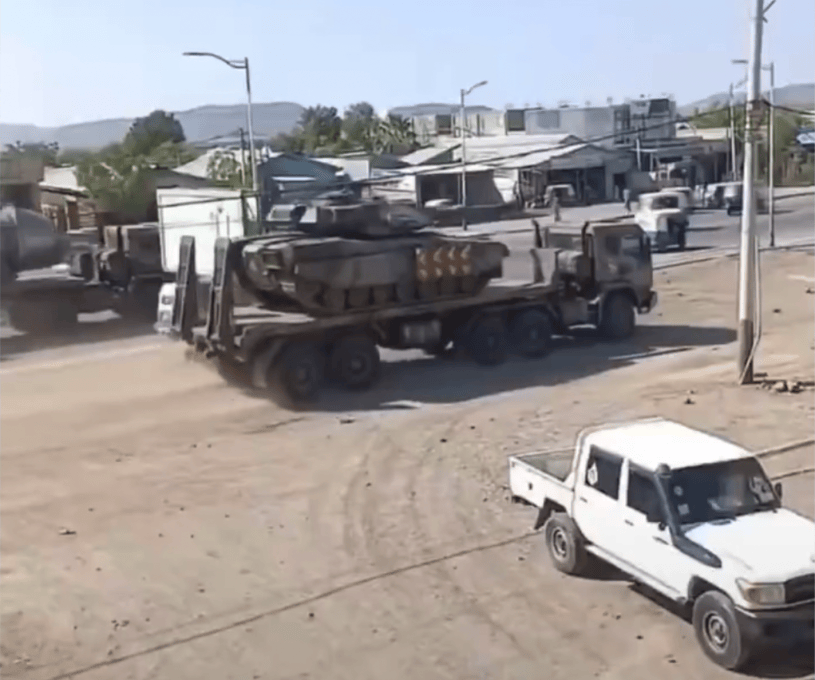
Context: Ethiopia said an “all-out invasion” by Eritrean forces had left it with no option but to defend itself, in a letter to the UN shared with Reuters on Friday, as blasts continued near the border between the two countries. In response, Eritrea’s information minister said his country had shown restraint since Ethiopia had declared a war of aggression against Eritrea by stating in 2023 it would acquire sovereign access to the sea.
Source: Jawar Mohammed member of Oromo Federalist Congress.
In my recent analyses, I argued that the northern war was moving steadily toward the Eritrean frontier and that Isaias’s intervention would eventually force Abiy to make a much bigger decision. That moment is now approaching, and the question is no longer only whether the ENDF can reach the border, but whether Abiy should stop there when the security threat he identifies lies beyond it.
The ENDF and the Tigray Peace Force have reversed the TPLF offensive, recovered major towns and regained Adigrat, giving the federal side both the initiative and a level of military confidence it did not have when the fighting began. Ethiopia therefore approaches the Eritrean frontier from a position of momentum rather than retreat.
That military advantage is reinforced by a stronger diplomatic position. Ethiopia has formally invoked its right to self-defence and accused Eritrean forces of entering Ethiopian territory and supporting armed groups fighting the federal government. Eritrea rejects those accusations, but reports of Eritrean forces operating inside northern Tigray have strengthened Ethiopia’s argument that the confrontation can no longer be treated simply as an internal conflict.
The harder question is what Ethiopia should do if it concludes that the threat does not end at the border. Restoring the frontier without addressing what the government sees as the source of that threat could simply postpone another confrontation. Eritrean forces could regroup, armed Ethiopian opponents could continue to find support across the frontier, and Ethiopia could again face the same security architecture after paying heavily to regain control of Tigray. From that perspective, a deeper move into Eritrea could be framed not as territorial expansion, but as an attempt to remove a threat that the Abiy government believes has already crossed into Ethiopia.
Regional consequences
This concern is no longer limited to Eritrea or the TPLF. Ethiopia increasingly sees a wider regional proxy architecture involving Egypt, Eritrea, Sudan and Ethiopian armed groups. Egypt has developed closer military and strategic relations with Eritrea while its disputes with Ethiopia over the Nile and Red Sea remain unresolved. Eritrea, in turn, has developed ties with the TPLF and other Ethiopian armed groups, while Sudan has also been accused of providing rear space and support to forces fighting the federal government. Egypt, Eritrea and Sudan reject or dispute these accusations, but from Ethiopia’s security perspective the larger concern is the possibility of Eritrea becoming a forward platform through which competing regional powers can sustain pressure on Ethiopia.
Abiy also has a domestic political reason to avoid allowing this confrontation to become another long war. Prolonged fighting would consume resources, deepen economic pressure, create public fatigue and give his political opponents more space to organise around the costs of another northern conflict. The current military momentum gives him an opportunity, but that advantage may not remain indefinitely. A war that drags on could gradually turn battlefield success into a political liability for Abiy himself.
His close relationship with the UAE may strengthen his confidence in considering a harder course. Abu Dhabi has maintained close strategic relations with his government and has publicly supported Ethiopia’s sovereignty during the current confrontation. Saudi Arabia remains more cautious, given its major Red Sea interests and its previous investment in the Ethiopia-Eritrea rapprochement, but the Gulf picture itself is changing.
Saudi Arabia and the UAE have begun repairing the rift that had widened between them as renewed Houthi attacks place greater pressure on Saudi security and the wider Red Sea environment. The growing need for coordination around Bab el-Mandeb is bringing Riyadh and Abu Dhabi closer again. That re-alignment could matter for Abiy, whose close relationship with the UAE may give him greater confidence that Ethiopian security concerns will receive a serious hearing in Saudi Arabia as well.
This does not mean Saudi Arabia would support an Ethiopian war inside Eritrea. Abiy would still have to judge whether the UAE remains politically supportive, whether Saudi Arabia can be kept from openly opposing Ethiopia, and whether any cross-border campaign can continue to be presented as addressing an existing national-security threat rather than seeking Eritrean territory.
For that reason, I think automatically stopping at the border deserves serious reconsideration. If the threat ends there, Ethiopia has every reason to stop. If Eritrea remains the military rear of a wider proxy system directed against Ethiopia, however, restoring the old frontier may leave the underlying security problem untouched. Under those conditions, the strategic case for carrying the campaign inside Eritrea becomes considerably stronger.
Abiy therefore enters the next phase with military momentum, a stronger self-defence argument, unusually favourable relations with the UAE and a changing Gulf environment. At the same time, he knows that another prolonged war could gradually weaken his own political position at home.
The calculation may consequently be moving in one direction. If Ethiopia concludes that Isaias and the regional architecture around him remain an immediate national-security threat, the government may have strong reasons to push beyond the border rather than restore the old line and wait for the same threat to reorganise. The decisive question is whether Abiy believes he can do this without surrendering the diplomatic advantage Ethiopia currently holds.

