Unbroken Chains:A 5,000-Year History of African Enslavement, by Martin Plaut
Review by Professor Keith Gottschalk – Source: NEW AGENDA – Issue 102 September 2026
“Unbroken Chains” is the welcome, overdue history of slavery and the slave trade in Africa, through Africa, and from Africa. The known history of this stretches as far back as written and carved records. The endnotes and bibliography cover 65 pages, indicating that this was a history waiting to be written up. The book proceeds chronologically with the Trans-Saharan slave trade, the Indian Ocean, then bifurcates into indigenous slavery, Trans-Atlantic slavery, and finally Ottoman empire slavery, Barbary slavery, and African slavery today.
The provocative dimension of this book is its debunking of several popular myths, such as that the Trans -Atlantic slave trade was first and exceeded all others, and that Britain was the largest slave-trader. It is widely argued by more than one theoretical school that western wealth derives from slavery and the slave trade. Yet Portugal, which had the biggest slave-trading numbers in its history, remained the poorest country in western Europe by the 1920s, with many Portuguese leaving as migrant workers for France. The number of victims of African slavery dwarf the holocaust. They are comparable to the entire number of people who were killed in World War Two, exceeding 40 million people.
In 1833 Britain emancipated 800,000 slaves, almost all in the Caribbean and Cape Colony. In 1903 they started freeing over two million slaves in the Sultanate of Sokoto, in today’s northern Nigeria. Martin Plaut also summarises the history of Omani slaves in east Africa and their eventual freeing in the 20th century.
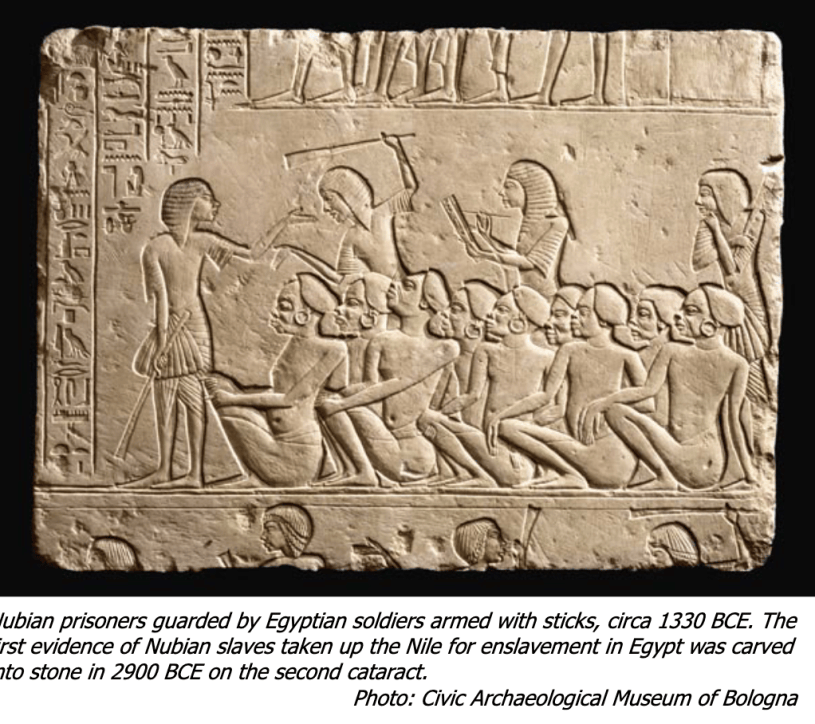
Unbroken Chains tables three issues for debate: Why are publications on slavery so overwhelmingly limited to the “Black Atlantic”? Who should pay reparations, and to whom should reparations be paid? Why has the United Nations (UN) and the United Nations Educational, Scientific and Cultural Organization (UNESCO) said so little, and the African Union (AU) and Arab League said zero, on slavery in Africa and on the African diaspora of slave descendants in Arab and other Muslim states? There are also silences on this diaspora in histories of Iran, Pakistan, and India. Nubian prisoners guarded by Egyptian soldiers armed with sticks, circa 1330 BCE. The first evidence of Nubian slaves taken up the Nile for enslavement in Egypt was carved into stone in 2900 BCE on the second cataract.
Some answers are already evident. An organised, w ell -resourced African diaspora, with a student and academic contingent, is a major driver of African-American and other diasporic studies − reading lists, lectures, seminars, popularisation. A Pan-African theoretical framework also makes it difficult to campaign on issues of indigenous slavery in Africa, if Haile Selassie’s Ethiopia is canonised as the greatest black kingdom. But a left, radical thought framework has no difficulties analysing the slave trading of a comprador bourgeoisie on the west African coast, nor slavery as part of feudal-style chiefly rule in the interior.
UN, AU, and Arab League members selectively take up case studies that reinforce their current anti-western imperialist campaigns on other issues.
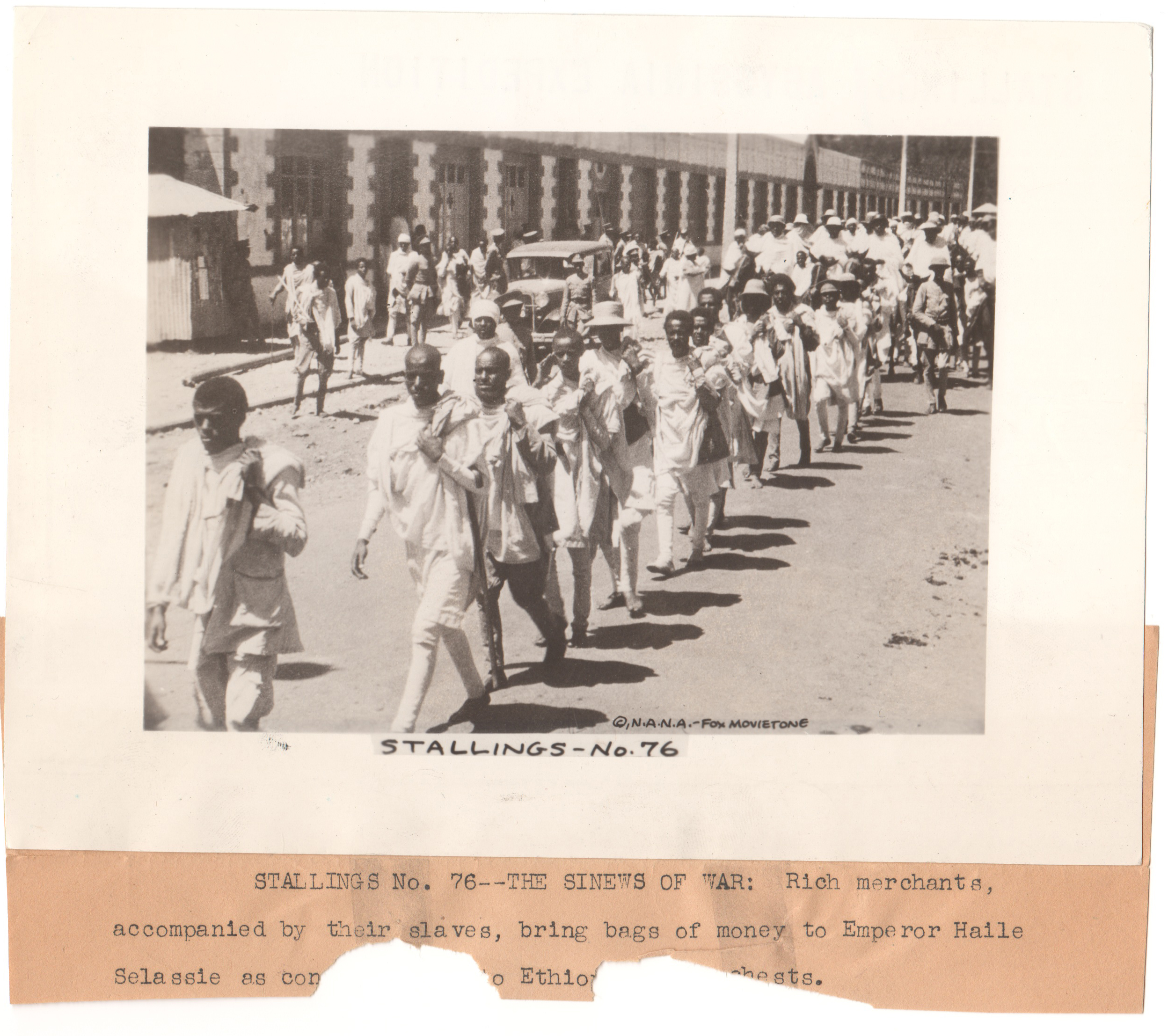
They have no enthusiasm to raise the issue of, for example, one million European former slaves in the Barbary states and former Ottoman Empire requiring compensation. The first breakthroughs are occurring. The Indian High Court in the State of Karnataka issued a landmark judgement that Sidis (those descendants of African slaves) are entitled to be registered as statutory “Other Backward Classes” under the constitution. This entitles them to affirmative action in applying for jobs in the civil service, and admission as students to universities. This potentially benefits up to 100,000 Sidis. The 150,000 Sidis in Pakistan may be also encouraged to take up the battle on the same issue across the border. There are also practical issues about how compensation for inter-generational trauma, such as ancestral enslavement, might be paid.
One likely case will be Haiti, who for two centuries had to pay “compensation” to France for the freeing of every man, woman, and child of the entire Haitian nation. Compensation here could take the form of a sovereign wealth fund. The black diaspora in Arab and other Muslim states will require creative thinking about the format of compensation. Mauretania, Mali, Niger, Libya, and the Sudan will need to open political debate on this issue, which also includes the issue of racism from paler citizens to darker citizens. Here the AU’s Pan-African Parliament, and its Economic, Cultural, and Social Council are the appropriate organs who are overdue to start raising these issues.Unbroken Chains is warmly recommended for every library, especially scholarly ones.
Keith Gottschalk is an adjunct professor in Political Studies at the University of the Western Cape.

