Source: Joël Kotek, professor at the Free University of Brussels – Le Point
INTERVIEW. While the population of Gaza has not collapsed, the discourse on genocide has flourished. How can such a gap be explained? Joël Kotek, professor at the Free University of Brussels, explores this question in his latest book.

Interview byErwan Seznec
Published onOctober 7, 2026 at 8:00 AM
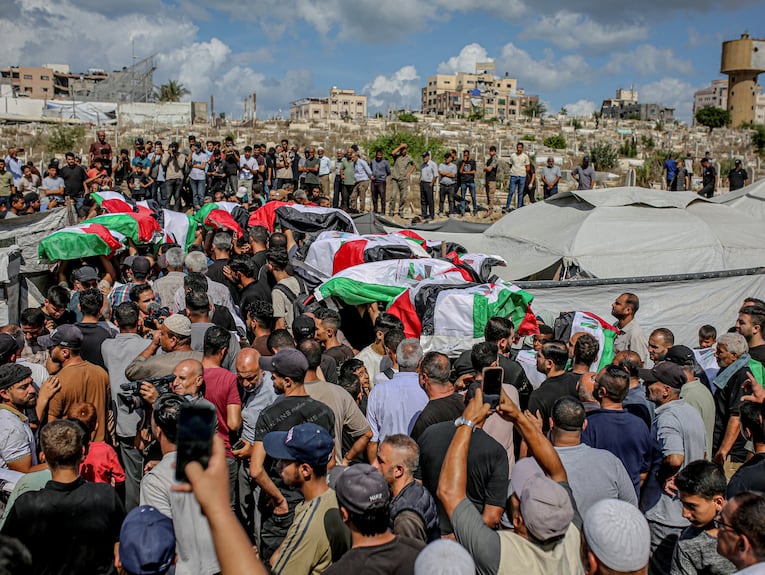
A large crowd gathers at a funeral in Gaza on October 1, 2026, after the clearing of a building destroyed three years earlier. The fighting was fierce, but the Gaza Strip, now as before October 7, 2023, remains densely populated. MIDDLE EAST IMAGES VIA AFP/FAIZ QREQA
On October 7th, Hermann Publishers will release *Genocide Tested by Gaza: An Essay on a Misused Word* . A historian specializing in the Holocaust, Joël Kotek begins with facts and figures. Even according to Hamas’s data, which should be treated with caution, the horrific fighting in the Gaza Strip has not emptied it of its population.
The death toll is very high, but it remains incomparable to that of the 20th-century genocides , from Armenia to Rwanda, including the massacre of Jews during the Second World War. Did the Israeli army fail in its objective? No, argues the historian. It simply never had genocidal intent . Interview.
Le Point: Why do you refuse to talk about genocide in Gaza?
Joël Kotek : Because today, we use “genocide” as a synonym for “massacre.” But they are not the same thing. There is a veritable global fascination with this word, and François Zimeray has rightly pointed this out. As Bernard Bruneteau, professor of contemporary history at the University of Rennes, writes, genocide has become a concept with an “almost theological charge” : it serves to designate absolute evil. The problem is that a concept that tries to say everything ends up saying nothing. And the conflict between Israel and Hamas does not meet the criteria that define this crime.
The law recognizes five criteria. First, the nature of the act: genocide is mass homicide. It refers to the physical, biological elimination of a group, not material destruction. Second, the victim: an unarmed human group, defined as such by its persecutor, often according to arbitrary racial criteria. Third, the scale. The 1948 Convention speaks of destroying a group “in whole or in part. “
As Raphael Lemkin already stated, it must involve a “substantial part” of the group, large enough to threaten its survival. The fourth criterion is that the victims are targeted “as such,” that is, because they belong to the group, regardless of their age or sex. Finally, there is intent. This is the most difficult to prove: it is necessary to establish the specific will to destroy the group, what lawyers call dolus specialis .
The word genocide has become a fetish, a totem brandished to designate realities that have nothing to do with each other.
And Gaza does not meet these conditions?
No. The war waged by Israel is not targeting the Palestinian population as such. It is targeting an armed terrorist group, Hamas, responsible for the genocidal events of October 7th.
You add a sixth criterion, that of the historian.
Yes, and for me it’s crucial: the decision. When a genocide is decided upon, it shows in the numbers. The unarmed civilian population disappears almost immediately. Genocides are cold-blooded, systematic massacres of unprecedented intensity. Once the decision is made, the number of victims explodes. And they are always defenseless civilians, from Namibia to Rwanda.
Let’s do some simple math. The Armenian genocide involved 3,000 civilians murdered every day for fifteen months. The Jewish genocide involved 4,400 civilians murdered every day from 1941 to 1945. The Tutsi genocide involved 8,000 civilians murdered every day for one hundred days. Gaza resulted in 74,000 deaths in three years, 70 per day, including at least 17,000 combatants. These are not the same orders of magnitude.
So where does this success of the word come from?
Thirty years ago, the Belgian historian Maxime Steinberg said that “genocide” is a sick word. This is even truer today, given its inappropriate use. The word has become a fetish, a totem brandished to designate realities that have nothing to do with each other.
October 7th, on the other hand, constitutes genocide in your opinion.
Yes. October 7th is a day, a sequence of events, of genocide. Its defining characteristic is the will to systematically exterminate. It was a massacre, both hot and cold: deliberate, premeditated, and systematic. Apart from the hundred or so hostages, everyone within range of a bullet, including Muslims and Asians, was murdered. In criminal law, this is the equivalent of assassination, as opposed to murder.
Doesn’t this minimize the suffering of the Palestinians?
Not at all. This is obviously not to deny the gravity of the war in Gaza, nor the very real suffering of the Palestinians. But we must question the obsessive use of the word “genocide” whenever Israel is involved. Because this accusation is never neutral when it targets the Jewish state.
What do you mean ?
This obsession, in my opinion, is part of the long history of anti-Jewish representations. It reactivates old motifs in a secular, legal, and humanitarian guise. The war between Israel and Hamas offers old anti-Semitic imaginaries, reactionary as well as progressive, Christian as well as Muslim, the opportunity to reformulate themselves in the language of human rights. Under the cover of defending Palestine, passions long suppressed by the memory of the Holocaust are being unleashed.
What is striking is that this hatred almost never presents itself as hatred of Jews. It masquerades as moral virtue, as legitimate indignation, as solidarity with victims. Antisemitism had not disappeared; it lay dormant, kept in check by the memory of Auschwitz. It awaited a new moral framework to become acceptable again. This framework now exists.


Thank you. Thank you for posting that.
It’s a pleasure