23 September 2026
Authors: Jalale Getachew Birru Regional Expert, East Africa and Clionadh Raleigh President & CEO
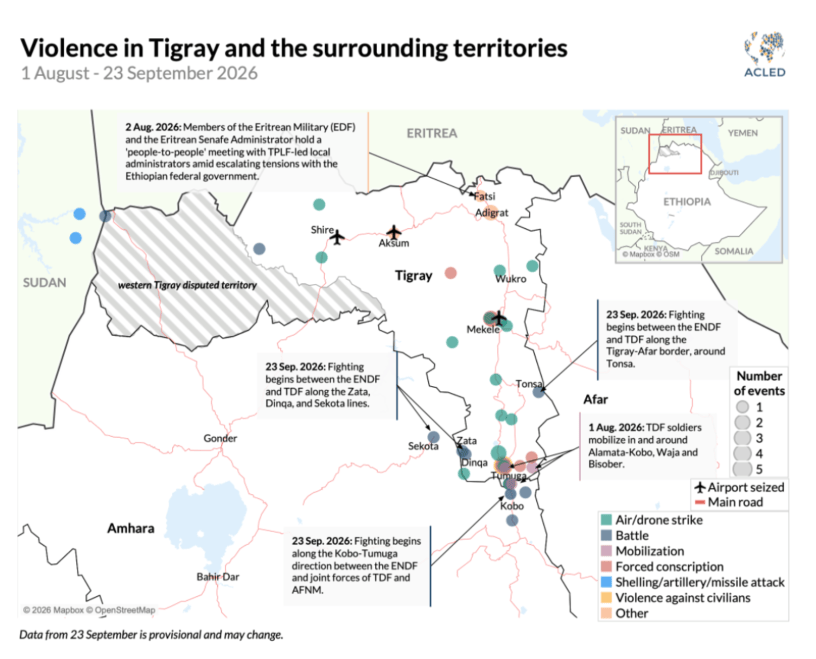
On 23 September, the Tigray Defense Forces (TDF), led by the Tigray People’s Liberation Front (TPLF), seized control of airports in Mekelle, Aksum, and Shire in Tigray (see map). Armed clashes have begun along the Kobo-Tumuga direction between the Ethiopian National Defense Force (ENDF) troops and joint forces of TDF and the Amhara Fano National Movement (AFNM), according to ACLED local sources.
Similar clashes are reported along the Zata, Dinqa, and Sekota lines of the Tigray-Amhara border, and along the Tonsa line of the Tigray-Afar border. These actions follow a low-scale conflict between the TPLF and the government that began on 1 August in Shererina at the border of Ethiopia and Sudan.
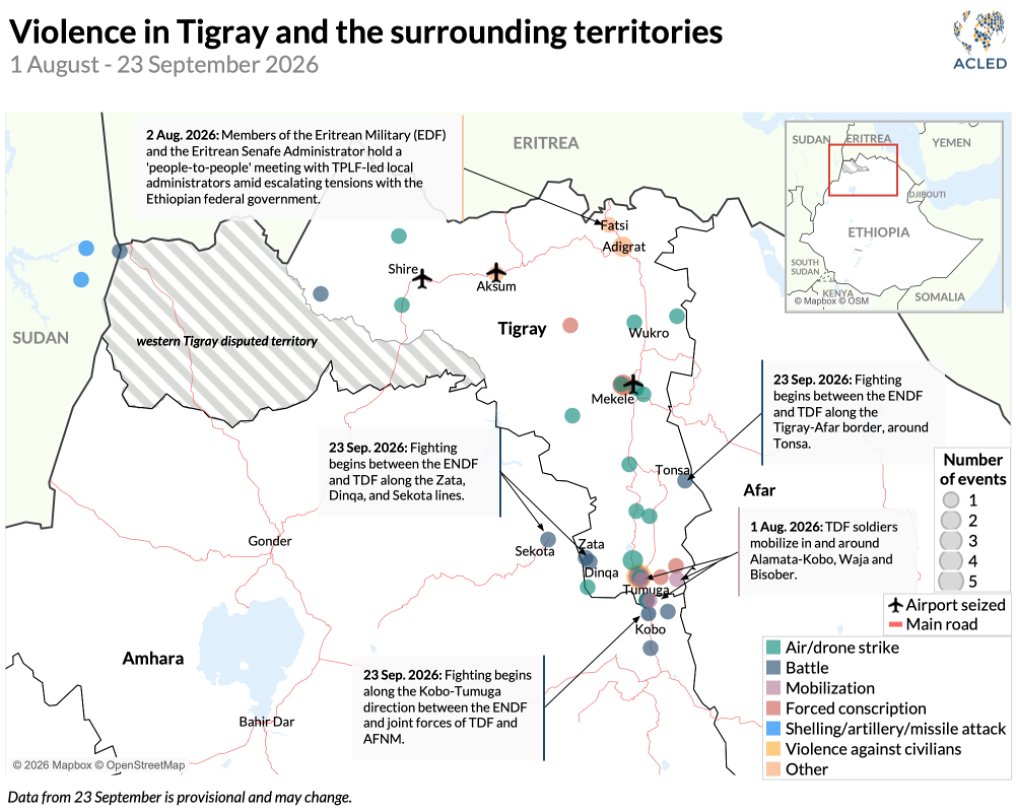
During this phase and until 22 September, the violence was low intensity, with ENDF conducting defensive drone strikes targeting TDF and TPLF officials and multiple drone strikes concentrated in Mekelle and Southern Tigray zone. Since the beginning of September, a new round of TDF deployments with heavy weapons (tanks and artillery, etc.) has been observed in Southern Tigray zone. The TPLF has been on a forced recruitment drive and general saber-rattling for several months.
These developments today followed the formal announcement of the Ethiopian Peoples’ Forces Alliance for Survival on Sunday, whose main purpose is to remove the current government. The alliance brings together seven armed and political factions:
- AFNM,
- Oromo Liberation Army (OLA) — also known as the Oromo Liberation Front (OLF)-Shane,
- TPLF,
- Ogaden National Liberation Front (ONLF),
- Afar Revolutionary Democratic Unity Front (Ugugumo),
- Benishangul Peoples’ Liberation Front (BPLF), and
- Gumuz Peoples’ Democratic Movement (GPDM).
These first post-alliance actions by the TPLF suggest that they are leading the charge to destabilize the government on multiple fronts. Seizing airports and clashes in and around Tigray is not — in and of itself — an important military development as the TPLF already controls the Tigray state as the regional government since 5 May.
What is important is that on two other occasions in recent Ethiopian history (the attempted coup in Amhara on 22 June 2019 and the start of the Tigray War in 2020), actions by one group prompted others across the country to act. The groups involved in those previous events are involved in the announced alliance. In the Amhara example, joint actions (in Bahir Dar, Amhara; in Addis Ababa; and in Benishangul-Gumuz) were defeated quickly. The Tigray War on 3 November 2020 began when TPLF troops and allied local militia launched a coordinated assault on the ENDF Northern Command headquarters in Mekelle, and other critical federal military facilities across the region. On 4 November, Prime Minister Abiy Ahmed declared a state of emergency in the region.
Today’s episode will cause worry that the other agents in the alliance are about to act in their areas across the Ethiopian state. It will also worry the government if the TPLF and the AFNM can continue to work together in coordinated attacks like that in Kobo-Tumuga today.
The ENDF is already stretched, and is preparing for likely international actions stemming from contests with Eritrea, developments in Somaliland, and alliances with the United Arab Emirates and Israel. A series of active insurgencies across the state could debilitate the military and prevent any participation in the growing security situation in the Red Sea.
However, it is unlikely that several of the groups in this alliance have the ability, organization, recruits, or agenda to ‘rise up’: many have been beaten back by federal and state forces in the recent past, and others remain highly localized threats, if active at all. The TPLF does, however, remain a thorn in the side of the Ethiopian government, as do the Amhara factions. Declaring a state of emergency is unlikely to be the next step, although it may be soon approaching.

