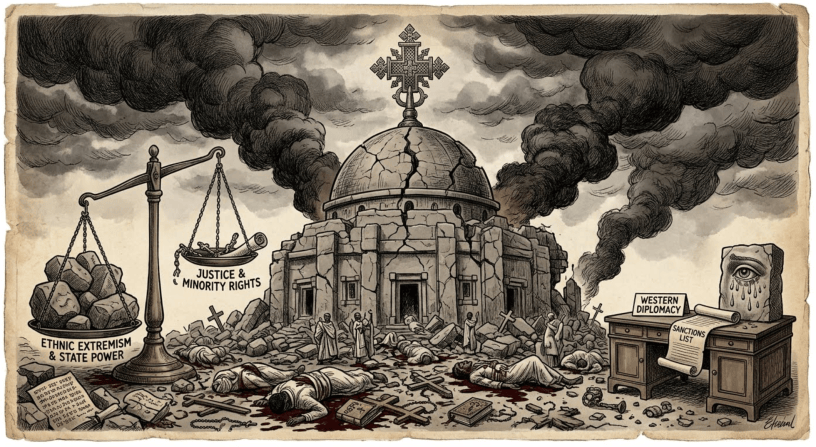
By Mintesinot Melaku, One of the few journalists still reporting from Ethiopia under severe and hazardous conditions
Ethiopia, a nation of 120 million people, has long stood as Africa’s spiritual anchor and a global symbol of sovereign freedom. It is celebrated across the Black diaspora as the only African nation to decisively defeat a European colonial empire, at the Battle of Adwa in 1896. To archaeologists, it is the cradle of humankind. To millions of believers, it is the cradle of African Christianity, having adopted the faith as a state religion in the fourth century—long before most of Europe.
The Abiy Ahmed Presidency
Yet today, this ancient civilization is facing an existential crisis. Under the regime of Prime Minister Abiy Ahmed, Ethiopia’s foundational religious and social harmony is being systematically dismantled in a campaign of ethnonationalist violence that threatens to erase one of the world’s oldest Christian communities.
When Abiy took power in 2018, he was greeted by the West as a visionary reformer, even winning a Nobel Peace Prize. Instead, his tenure has devolved into an era of severe state repression and bitter polarization. The structural vulnerabilities of Ethiopia trace back to 1991, when the country’s internal borders were redrawn along strict ethnic lines. This system of “ethnic federalism” fractured the nation’s diverse social fabric.
But rather than healing these divides, Abiy has weaponized them. His devastating military campaigns in Tigray and Amhara, combined with a total failure to protect Orthodox Christian communities, have turned Ethiopia into a nation at war with itself.
Christian communities attacked
Nowhere is this devastation more acute than in Oromia, the country’s largest region. There, Christian communities are targeted and historic churches burned with near-total impunity. In 2024 alone, more than 270 Christians were reported slaughtered in the Shirka district. The terror is ongoing: just days ago, on October 23, 2026, another brutal assault in the region claimed the lives of more than 60 civilians.
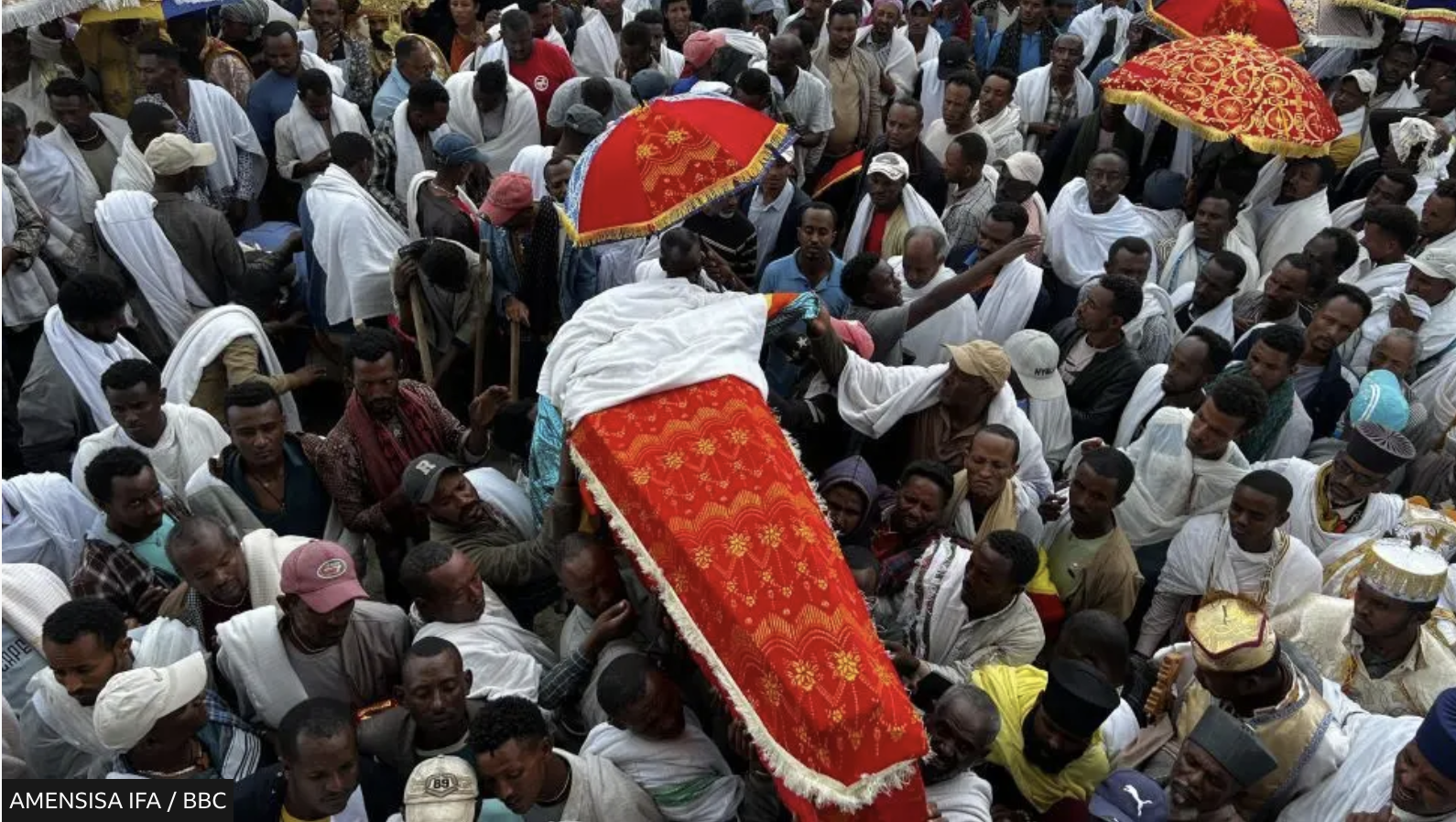
While perpetrators operate openly from nearby forests, federal and regional authorities consistently look the other way. This persistent state inaction amounts to state complicity. These are not isolated local clashes; they form a systemic pattern targeting the ancient Ethiopian Orthodox Tewahedo Church and the millions who sustain it.
At the heart of this persecution lies Oromummaa, a radicalized ethnonationalist ideology championed by prominent regional officials. This framework increasingly portrays Amharas and Tigrayans—Ethiopia’s historic Semitic-speaking Christian populations—as historic oppressors to be marginalized or purged.
The parallels to twentieth-century totalitarian movements are chilling. Where past authoritarian regimes sought to “purify” a dominant demographic, this ethnonationalist drive envisions an altered state cleansed of rival ethnicities and traditional faith practices. In Oromia, cultural erasure has become a prerequisite for total political control.
The result is an assault on Ethiopia’s soul. Monasteries dating back over a millennium have been looted, shelled, or defiled. Priests and monks have been summarily executed. Even the world-renowned rock-hewn churches of Lalibela—older than most European cathedrals—have stood precariously close to the frontlines of state-sponsored conflict. To witness the systematic erasure of this heritage is to watch a foundational chapter of human history be permanently extinguished.
What happens within Ethiopia will inevitably reverberate far beyond its borders. The country anchors the Horn of Africa, sitting adjacent to the Red Sea and the Bab el-Mandeb Strait—a vital chokepoint through which 12 percent of global maritime trade passes. A total state collapse would catastrophically destabilize East Africa, trigger unprecedented refugee flows, and further empower a formidable coalition of non-Western autocracies.
Foreign backing
The United Arab Emirates, Iran, China, and Russia have deeply aligned with Abiy’s regime, supplying advanced drones and heavy weaponry that have been repeatedly deployed against civilian infrastructure. Ethiopia’s rapid drift into this autocratic, anti-Western orbit poses a direct threat to global security.
The moral and strategic imperatives for Washington and its democratic allies are urgent. The West cannot afford to repeat the catastrophic diplomatic paralysis seen during the tragedies of Rwanda and Bosnia.
First, international bodies must explicitly recognize and condemn the systematic targeting of Orthodox Christian and specific ethnic communities across Ethiopia. Second, the U.S. must leverage Global Magnitsky Act sanctions and asset freezes against the specific civilian and military officials responsible for directing mass killings and religious persecution.
Finally, international financial aid and security assistance must be strictly conditioned on human rights compliance.
The Ethiopian people do not request foreign boots on the ground; they are a fiercely proud, resilient population. However, they urgently require the international community to break its silence and declare that religious freedom and bodily dignity are non-negotiable.
The international community once collectively promised “Never Again.” If those words are to retain any meaning, the world must speak out now—before one of the oldest Christian civilizations on earth is dismantled before our eyes.

