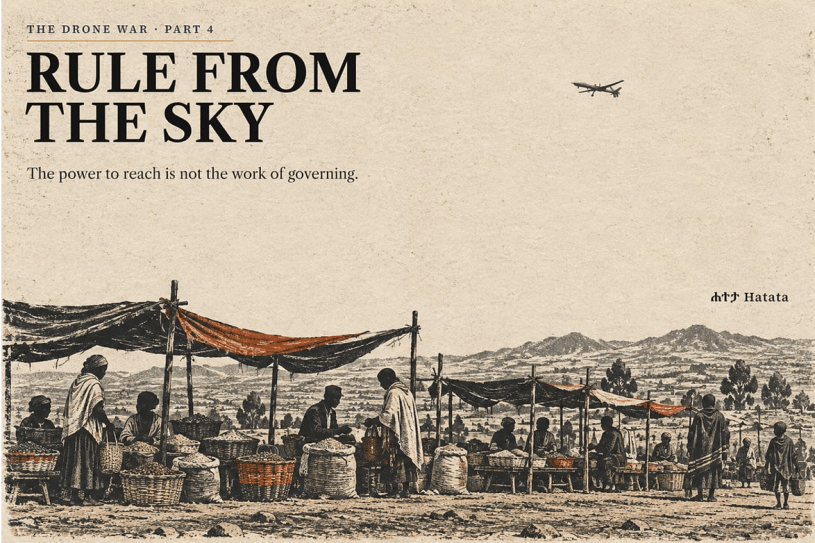
From Tigray to Amhara and Oromia, the federal government strikes where it cannot secure consent. The weapon is new. The form of rule it serves is not.
| Source: ሐተታ HATATA |
The sky cannot be plowed; the king cannot be brought to court.
Amharic proverb
The Anniversary
On 22 June 2021, a federal airstrike hit the market at Togoga in central Tigray, and local health officials counted 64 dead and 180 injured. Two days later the army spokesman, Colonel Getnet Adane, called it “a precision strike that was successful,” and explained that the fighters it hit had gathered to celebrate Martyrs’ Day. He did not say what Martyrs’ Day commemorates. On 22 June 1988, on market day, the Derg’s MiGs and helicopter gunships bombed the market at Hawzen. The historian Gebru Tareke puts the dead at between 1,800 and 2,500, most of them civilians who had come to buy and sell. Tigray has marked the date ever since.
Thirty-three years apart, two very different Ethiopian governments struck a Tigrayan market on the same day of the year, and each said it had struck fighters.
The drone war that grew out of the Tigray war, which began in late 2020, and spread to Amhara and Oromia before returning to Tigray this autumn, is usually narrated as a sequence of incidents, each a possible violation awaiting an investigation that never comes. That framing is accurate and insufficient. Five years of the record show not an accumulation of excesses at the edges of a policy but a policy: governing contested regions through lethal force from the air, at a distance that technology has made cheap and impunity has made cheaper still. The record does not establish an order to strike civilians. It establishes the method.
Not every strike discussed here was a drone’s; the type of aircraft that hit Togoga has never been established, and the Derg flew MiGs. The drone did not invent rule from the air. It changed its terms: cheaper than the jet, more patient than the helicopter, and harder than either to see or to answer.
Violence in Place of Power
Max Weber defined the modern state as the human community that successfully claims “the monopoly of the legitimate use of physical force within a given territory.” The definition is usually remembered for its monopoly and forgotten for its adjective. Hannah Arendt pulled the two apart half a century later. Power, the capacity of people to act in concert, is what governments rest on; violence is what they turn to when that power is slipping. “Violence can destroy power; it is utterly incapable of creating it,” she wrote in On Violence. Violence can produce, she conceded, “the most instant and perfect obedience.” “What never can grow out of it is power.”
The modern Ethiopian state was assembled through precisely this substitution at its edges. The old distinction between mahel-äger, the center, and dar-äger, the margins, described a geography of rule in which the center governed the margins less by incorporation than by expedition: tribute collected under arms, revolt answered by punitive campaign. The Derg industrialized the expedition. Its air force bombed markets, villages and roads across Tigray and Eritrea through the 1980s, and Hawzen was the worst of it, not its exception. The federation that followed was meant to end the expedition by giving the margins a constitutional claim on the center. Its premise was that the regions would be governed through their own institutions rather than over them. Its practice was another matter: the governments that ruled under it kept the expedition alive at the margins, most brutally in the Ogaden, where Human Rights Watch documented the collective punishment of civilians in 2007 and 2008.
Abiy Ahmed came to power in 2018 promising medemer, the coming together of Ethiopia’s peoples in a renewed national project. In the years that followed, his government brought drone warfare to three of the federation’s most populous regions. The Pretoria agreement of November 2022 ended the war in Tigray; it did not end the method. Within months the method moved to Amhara, where the dissolution of the regional special forces in April 2023 drove many of their members into Fano and a six-month state of emergencyfollowed in August. In Oromia, where the war with the Oromo Liberation Army had been running since 2018, it deepened.
The Economist has called the result “Ethiopia’s undeclared drone war.” The adjective matters as much as Weber’s. Humanitarian law binds an undeclared war as fully as a declared one, but politics treats them differently: a war that is never declared is easier never to justify, conclude or account for before the public in whose name it is fought. It can continue as an administrative condition of the regions in which it is fought.
This is the sense in which the drone is a form of politics. Part 3 of this series argued that taking a town is not the same as governing it, and that the federal march up Tigray’s highways redistributed the army’s problem rather than solving it. The drone carries the same logic into the air. It allows the federal government to act in places it cannot govern, and to keep acting there without first securing anyone’s agreement. What it offers the regions it strikes is not a bargain but a demonstration: that the center can reach them at any hour and will not explain itself afterward. Late in 2024 a senior army colonel said as much on state media, speaking of the armed movements: “The only language they understand is force. From now on we will talk to them in that language.”
The strikes need not be militarily useless to be politically insufficient. In 2021 they helped turn back an army marching on the capital; without them, Zecharias Zelalem concludes in his study for the European Council on Foreign Relations, Addis Ababa “would almost certainly have fallen.” That success, he argues, likely persuaded officials that military victory was still within reach, and worth fighting on for rather than settling. Pretoria ended that war a year later, but neither the reversal nor the agreement settled the relationship between the federal government and Tigray. In Arendt’s terms, the drone is violence deployed where power has failed, and its very efficiency allows the failure to be deferred.
The Revolution in Killing
Every revolution in military technology changes not only how wars are fought but who pays for them, and the armed drone changed the price of killing in a precise and one-sided way. A Turkish Bayraktar TB2 costs about $5 million and a Chinese Wing Loong between $1 million and $2 million, against $10 million to $40 million for the fighter jets in Ethiopia’s inventory. The operator of a TB2 does not have to enter the airspace over the target. None of the suppliers, Turkey, China, Iran or the United Arab Emirates, attaches conditions on human rights to its sales, and in December 2023 the chief executive of Turkey’s Baykar came to Bishoftu, home of the Ethiopian air force, to accept a national honor for his “contributions to the development of Ethiopia’s air force.”
Since March 2025 the supply has come home. Abiy inaugurated SkyWin Aeronautics Industries in Addis Ababa that month, and Aeroabay, opened late that year, now produces thousands of small first-person-view attack drones at $5,000 to $10,000 apiece, largely from imported components. These are not the long-endurance aircraft behind most of the strikes in this essay. But a weapon bought in an emergency has become one the state manufactures, and analysts place the fleet in the thousands. The cost of a strike to the state that orders it has fallen, in money, in soldiers and in pilots, far below anything the older instruments demanded. The price paid where it lands has not fallen.
Grégoire Chamayou, in A Theory of the Drone, argued that the weapon transforms war from combat into something closer to a hunt. Combat is a relation between parties who can wound each other; the hunt is organized around finding, following and striking prey that can only hide or run. Progress is measured in targets removed, and the question of how the war ends can be postponed indefinitely, because there is always another target. Derek Gregory called the geography that follows “the everywhere war,” in which the battlefield dissolves into a field of potential targets distributed across ordinary space. Both wrote about wars waged across borders, against populations the striking state never claimed to rule.
The United States gave this form of war its bureaucracy. The Intercept‘s investigation, drawing on a Pentagon study of the 2011–12 campaigns in Yemen and Somalia, described the president approving named targets, the military given a sixty-day window to strike them, and strikes in Yemen against unknown people whose conduct was judged suspicious. The White House would later promise “near certainty” that no civilians would be harmed; the study, whose relation to that guidance remained unclear, applied near certainty to the target’s presence, not to the absence of civilians, and accurate identification remained, in its word, a “critical” problem. The machinery could authorize a death more confidently than it could establish who stood beneath the aircraft.
Ethiopia inverts the case in a way that sharpens it. The people beneath its drones are citizens of the state that sends them, and the field of targets is the villages, towns and countryside of its own federation. What the drone spares Addis Ababa is not the domestic cost of sending soldiers abroad but the political cost of settling with the regions it is fighting: the compromise, the negotiation and the reckoning with grievances that a political solution would demand. For a Prosperity Party government that has met each political crisis by reaching for force before it reaches for terms, the drone makes that habit cheap.
The drone’s power rests on an asymmetry of vision. According to the diocese, a drone circled the Abbay Giyorgis St Arsema Unity Monastery in Borena, South Wollo, for hours before the 22 July strike that killed two nuns. Those beneath it could not know what its operators saw or what they had decided. The state watches without disclosing what it sees, judges without hearing those below, and strikes without being answerable. The people beneath learn to live under a sky that may open at any moment, for reasons no one will give them. In Bila, in Oromia, survivors of a 2022 strike told Zelalem that the sight of an aircraft, or any sound like the drone’s low buzzing roar, can bring on panic.
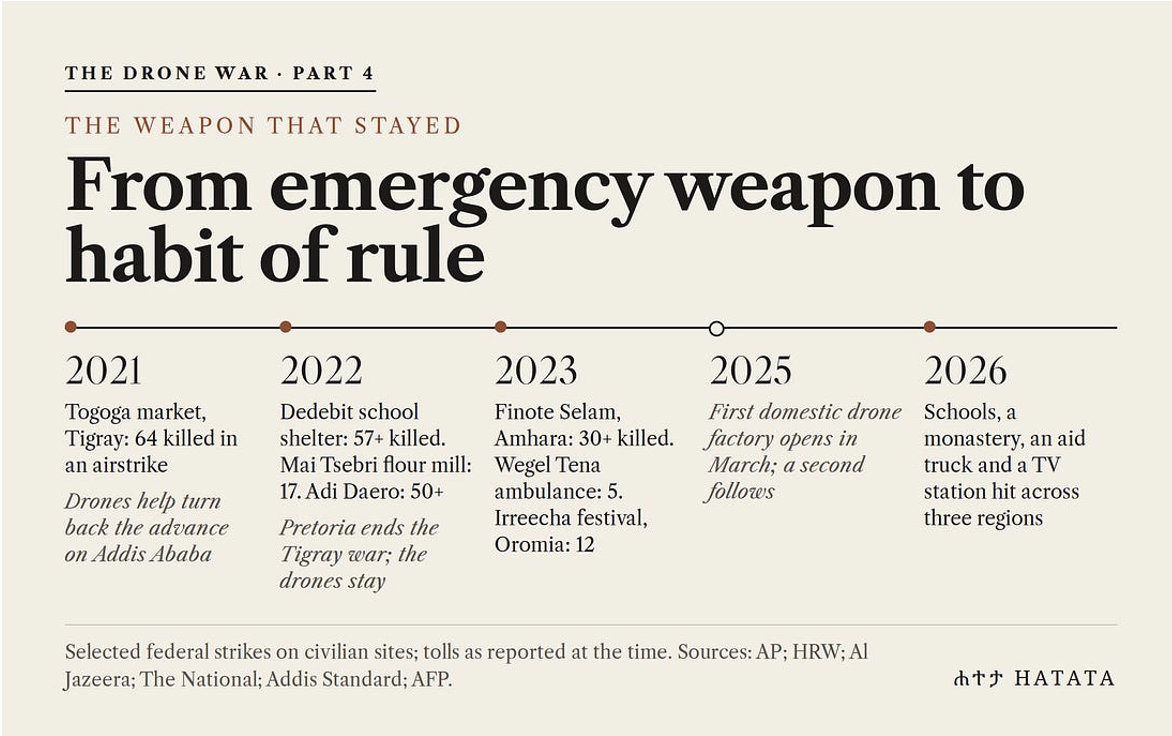
Selected federal strikes on civilian sites and the turning points that kept the drones flying, 2021–2026. Tolls as reported at the time.
How Killing Becomes Routine
The social psychologist Herbert Kelman, studying how ordinary people come to take part in massacres, identified three processes that erode the moral restraints against killing: authorization, routinization and dehumanization. Authorization relieves the individual of the obligation to make moral choices, because the act has been sanctioned by legitimate authority. Routinization turns the act into a series of procedures, each too small and too technical to invite reflection. Dehumanization strips the victims of their standing as persons whose deaths would require justification. Read at the scale of the state, those three processes show how Ethiopia’s drone war has become sustainable, and the technology lends each of them a new efficiency.
Authorization arrived first in law. In May 2021, parliament designated the TPLF and the OLA, which the government calls “Shene,” as terrorist organizations. The TPLF’s designation was lifted after Pretoria, but the logic it established, that an armed movement rooted in a region’s grievances is a security object rather than a political interlocutor, has governed each war since. The state of emergency in Amhara did for Fano what the designations had done for the TPLF and the OLA: it placed a region’s armed opposition, and the territory in which it moved, under a legal regime of exception. Once a region is defined as terrain in which enemies hide, the people who live there become, in the logic of targeting, the medium in which the enemy is concealed.
Routinization followed in practice. ACLED has counted 102 federal drone strikes in Amhara since the Fano insurgency began in April 2023, and the European Council on Foreign Relations, drawing on ACLED’s data from August 2023 to early 2025, counts at least 449 civilians killed by drone strikes there. On a broader measure that includes other air strikes, the Amhara Association of America, a diaspora advocacy group, counted 74 government drone and air strikes in the region in July 2026 alone, with 45 people killed; in Tigray, since fighting resumed on 1 August, the Global Centre for the Responsibility to Protect has cited reports of “near-daily drone strikes.”
Numbers of this kind measure harm. Repetition alone does not reveal how targets are chosen. Repetition without explanation, investigation or consequence reveals something else: how little the institution has been asked to change. A strike that draws no inquiry becomes the precedent for the next.
From Movement to People
Dehumanization begins with names. In the Tigray war the government called the TPLF “the junta,” and the word did not stay with the TPLF. The UN’s International Commission of Human Rights Experts on Ethiopia found that officials’ anti-TPLF narratives “expanded to include the Tigrayan population more widely,” that Tigrayans were attacked to cries of “junta,” “woyane” and “agame” and called a “cancer,” and that on 30 June 2021 the prime minister himself spoke of the “junta” as a cancer and as invasive weeds to be removed. The state acted on the name. From November 2020 its forces ethnically profiled, arrested and detained Tigrayans, and in Addis Ababa the mass arrests of Tigrayans came in waves into 2022.
Fano has been given a name of its own. Senior government advisers coined “jawisa,” bandit, hunter, scavenger, for its fighters, the Commission found, and once Fano turned its guns on the Prosperity Party in 2023, the same passage from armed opponent to suspect population appeared in the treatment of Amhara civilians. Under the 2023 state of emergency the UN human rights chief counted more than 1,000 Amhara arrested in August alone, the US State Department reported thousands detained on the basis of their ethnicity, and federal and Oromia police restricted the movement of Amhara into Addis Ababa to keep Fano out of the capital.
Amhara living in Oromia were exposed twice over: suspected by the state as Fano, and cast in an older settler narrative as neftegna and mete, gunmen of the imperial conquest and newcomers with no claim to the land, to be sent back to “their own” region. That is a different charge from the state’s: not that they support an enemy, but that they do not belong where they live. On 18 June 2022 in Tole, survivors said, the OLA killed more than 400 Amhara residents; the OLA denied it.
In Oromia the name came first. The government calls the Oromo Liberation Army “Shene,” and when parliament designated it a terrorist organization in May 2021, the attorney general explained why the state would not use the movement’s own name: “We don’t have any reason to endorse the name it uses to glorify itself.” The imposed name then did the work the other names did. Oromo rights advocates, citing Addis Standard, reported detainees told that unless they paid a bribe they would be accused of being “Shanee”.
In a 2024 investigation, sources told Reuters that a secret committee of senior federal and regional officials, Koree Nageenyaa, had ordered hundreds of arrests and dozens of killings of people suspected of ties to the OLA, among them a 2021 massacre of 14 shepherds that the government had blamed on the OLA itself. A regional investigation and the Ethiopian Human Rights Commission found that the shepherds were not OLA members. A population named as the enemy can be struck without anyone having to say why.
After the Strike: Silence
After the strike, dehumanization takes its second form: disappearance from the account. The government’s own statements about its strikes have run from claims of precision to denial to silence. Togoga was “a precision strike that was successful.” In October 2021, when Tigrayan media reported air raids on Mekelle, the head of the Government Communication Service, Legesse Tulu, called the reports “a total and absolute lie,” while the state press agency said on the same day that the air force had hit “media and communications equipment used by the TPLF.”
Since then the usual answer has been no answer: the government, Zelalem found, “rarely, if ever, publicly acknowledges the strikes, no matter how many casualties.” When Addis Standard, in an editorial, called on the army to show “maximum restraint,” Field Marshal Birhanu Jula replied: “We ensure restraint to avoid civilian casualties.” He also told state television, in late 2023: “If we find groups of extremists, we will strike them!” The civilians killed by the strikes do not appear in the official account even as casualties to be regretted. They are not so much denied as never counted, and a death that is never counted requires no justification.
The Pattern of Life
The hunt Chamayou describes depends on pattern-of-life analysis. A drone that can loiter for hours does not only watch; it accumulates. From who comes and goes and where people gather, it builds a profile of normal life against which an anomaly can be detected. Out of pattern-of-life analysis came the signature strike, which Gregory examines in “From a View to a Kill”: the target is not a named person whose identity has been established but a pattern of conduct judged to indicate hostility, such as men of fighting age assembled in a certain place or vehicles moving at a certain hour. The person is not identified and then struck. The person is struck because his conduct has been read as a signature.
More information does not necessarily correct the first mistake. In Drone Inc., a CorpWatch report, Pratap Chatterjee and Christian Stork describe “cross-cueing,” in which a drone’s camera is pointed automatically at the place a phone’s signal is detected, though the location can be off by dozens of feet, and the analyst watching may not know how the person came into the frame. “Each error compounds the next,” Chatterjee warns.
The image can be sharp while the identification is wrong.
Colonel Getnet’s explanation of Togoga does not disclose how the target was selected. It discloses how the government justified it. The fighters, he said, had gathered to celebrate Martyrs’ Day. The justification named no commander and no unit. It named a gathering, on a date, in a place, and declared its meaning military: a theory of the target, offered after the fact. A market on market day and a commemoration on the anniversary of a massacre are the moments when the most people stand in one place.
The people beneath the drones have drawn the lesson: in Amhara, Fano has warned residents not to gather in large numbers, or even to travel by vehicle in some areas, so as not to draw the drones overhead. When the justification for a strike is a pattern of ordinary life, ordinary life becomes the evidence.
Unmaking the Conditions of Life
What the strikes land on is as revealing as how often they land. Across three regions and five years the record returns to the same kinds of places. Some are where food is made and sold: the market at Togoga, a flour mill at Mai Tsebri, a church compound in Oromia where villagers were gathering corn. Some are where people shelter and learn: a school sheltering the displaced at Dedebit, teachers’ housing in Mekelle. In August Tigray’s education bureau listed more: Gejet secondary school in Seharti, where a drone destroyed classrooms and 35 computers bought under a World Bank education program, and Abraha Weatsbaha primary in Kilte-Awlaelo, hit soon after new classrooms built with European Union support had opened. On 22 September alone, the UN human rights office confirmed, federal airstrikes hit five schools in Tigray.
Some are where the wounded are carried and treated: an ambulance at Wegel Tena and, across Amhara this year, health facilities and ambulances that the Organization for Justice and Accountability in the Horn of Africa found destroyed by federal drone attacks. Lindsey Green of Physicians for Human Rights, which has documented attacks on health care by every armed party, calls such attacks part of “a playbook that has been used across Ethiopia for more than five years without consequence.” Some are the supply lines of people who have already fled. At Sheraro a strike hit a truck carrying 41 metric tons of maize and oil for more than 56,000 displaced people. At Borena two nuns died in their monastery. In Mekelle a drone struck the studios of Tigray TV.
The pattern has not paused. On the night of 29 October in Rama, in central Tigray, a drone hit a private vehicle carrying sorghum; the next morning, as people gathered the scattered grain, a second strike hit them. A hospital confirmed 11 dead, and ACLED recorded 12 civilians killed in a strike it believed was carried out by the federal army, which did not respond to questions. The sequence does not establish what the operators saw or intended. It establishes that people gathering spilled food were among the dead.
The same day, drone strikes hit the Jari 2 displacement camp near Hayk, in Amhara. Reuters reported at least 15 dead, five of them children, and Addis Standard 16; Reuters could not establish who carried out the attack. The survivors, people already displaced once, are now sheltering in a school.
The list has a logic. A market is where a village buys food, sells its harvest and gathers; a television station is how a cut-off region hears warnings. To strike them is to reach past the fighter into the conditions under which everyone around him lives.
The reach into those conditions is not the work of a single hand. In Tigray this autumn the state-owned Commercial Bank of Ethiopia restricted services on accounts opened in the region, and Tigray’s education bureau says teachers’ salaries have gone unpaid since October 2025. On 25 September four sources told Reuters that the TPLF had ordered the phone and internet shutdown. A source close to the group denied it. One source suggested the restrictions might be meant to deny federal forces the network and blunt their drone advantage. If so, the hunted went dark to survive the hunt, and the dark fell on everyone.
The drone is the federal share of this unmaking: a war that cannot locate its enemies within the population ends up striking the places the population cannot do without. The drone does not remove risk from war; it moves it, from the operator who is out of reach to the market that is not. The protection at one end of the weapon and the exposure at the other are the same transaction.
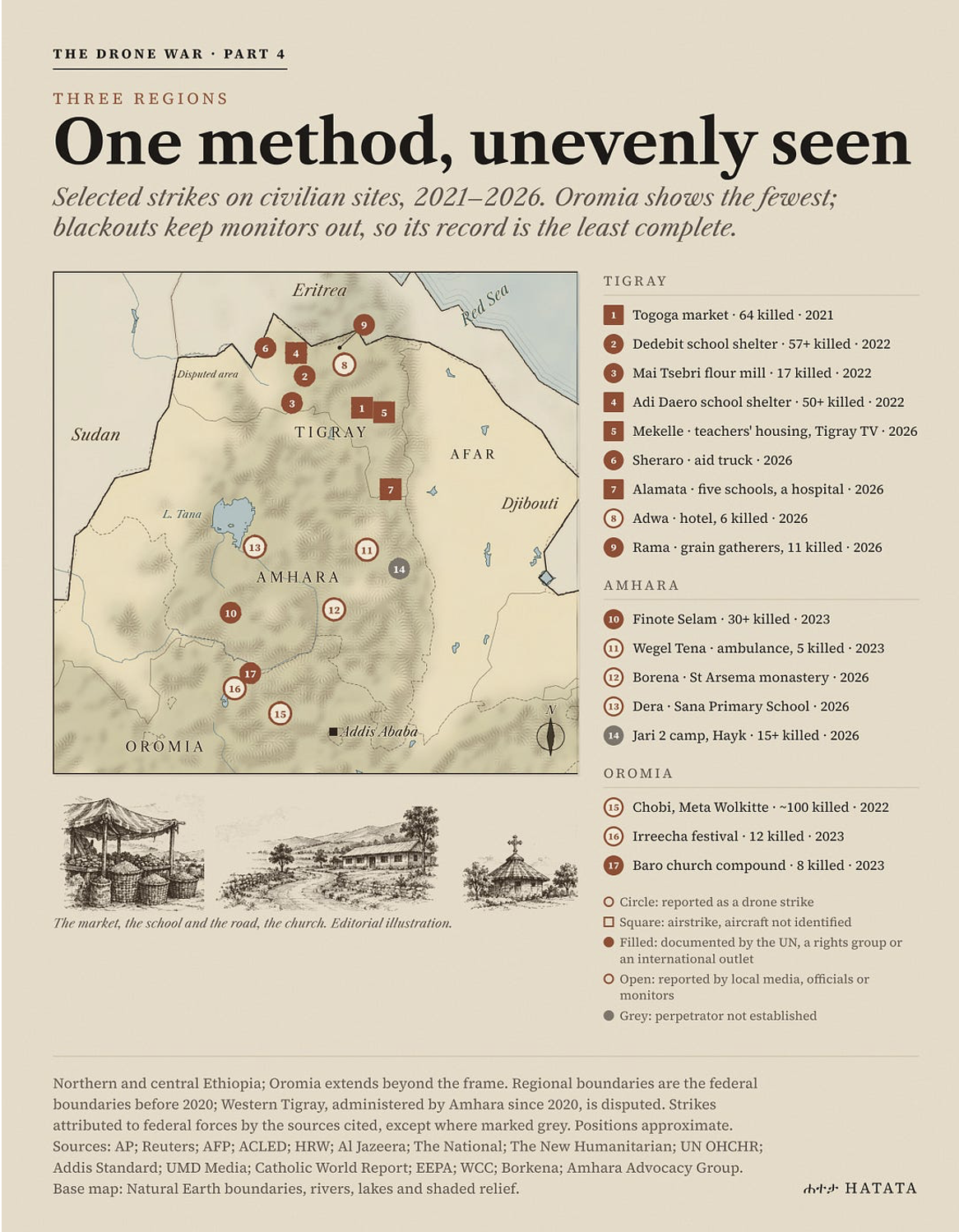
Selected strikes on civilian sites in northern and central Ethiopia, 2021–2026; the key, attribution and boundary notes appear on the map.
Accountability at a Distance
International humanitarian law does not prohibit drones. It prohibits attacks that fail to distinguish civilians from fighters, attacks whose expected civilian toll is excessive in relation to the military advantage anticipated, and attacks made without feasible precautions, and it gives hospitals and medical workers special protection. Each of those rules presupposes an answerable authority: someone who can be asked who was at the coordinates, what was expected and what was done to spare them. Where investigators have been able to put those questions, the answers have been damning; at Dedebit in 2022 and at the teachers’ housing in Mekelle this August, where residents saw a likely fighter jet drop the bomb, Human Rights Watch found “no evident military target.” In most cases the questions have never been put by anyone with access. Where they have been, as when Human Rights Watch wrote to the army’s spokesperson after Mekelle, the army has not replied.
The machinery that might have demanded answers has been dismantled. The UN Human Rights Council let its only investigative mechanism on Ethiopia, the International Commission of Human Rights Experts, lapse in 2023, and the UN human rights office has released no report on Ethiopia since 2024, Physicians for Human Rights notes.
Oromia shows what follows when even the record disappears. It is the longest-running front and the least visible. What did surface was already grave: the European Council on Foreign Relations counted at least 150 civilians reported killed by drone strikes in Oromia in September and October 2022 alone. Since then blackouts mean that “detailed information remains scarce,” a January 2025 report for the Norwegian Organization for Asylum Seekers found, and since August not one named civilian site struck in Oromia has appeared in the international and rights-group reporting this series has tracked. The state has the means to look, and the public has no means of checking what it saw.
Distance, in this war, operates in three registers at once.
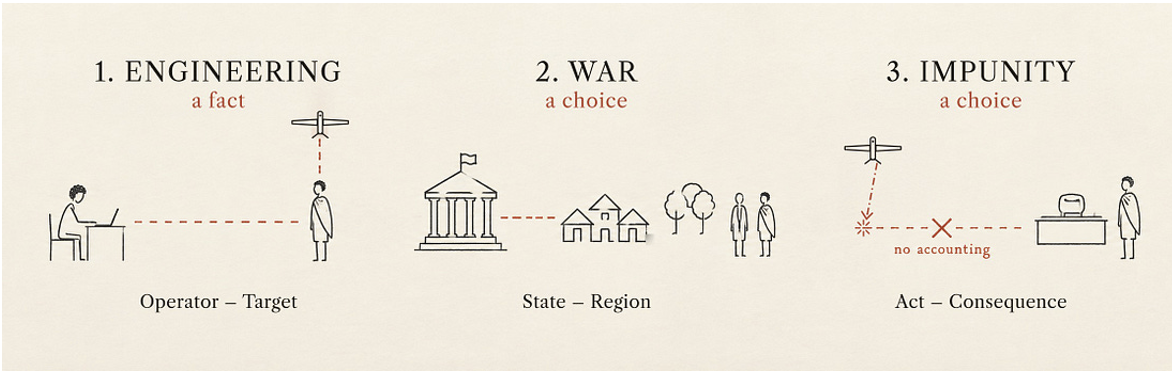
Editorial illustration.
The operator is distant from the target, which the technology guarantees. The state is distant from the region, which the war presupposes. And the act is distant from any consequence for those who order it, which the absence of effective accountability ensures. The first distance is a fact of engineering; the second and third are political choices, and it is the third that turns the first two into a system. A weapon whose use is never examined becomes a routine, and a routine that kills civilians without consequence becomes a feature of government. Normalization, in this sense, is not a single atrocity. It is a practice repeated from Tigray to Amhara to Oromia, for which no one has been held to account.
Rule Without Consent
The record establishes a pattern: a federal fleet whose strikes keep landing on civilians and the systems they live by, a government that has given no public accounting for them, and five years in which the wars the strikes were meant to end have not ended. Tigray’s has resumed, and Amhara’s and Oromia’s continue. Violence can clear a road, kill a commander, turn back an army marching on the capital and empty a market. It cannot produce the consent of the people who use the market.
Every 22 June, Tigray mourns a market bombed by one government. It now has a second to mourn, bombed on the same day by another, and in Amhara and Oromia the calendar of such days is still being written. A government that can reach every market in three regions and answer for nothing it does there has not solved the problem of ruling them. It has made the power to reach them a substitute for the work of governing them.
This is Part 4, the last in a ሐተታ Hatata series on Ethiopia’s drone war. Part 1, “Ethiopia’s Drone War Has Lost Its Sanctuary,” on the Alliance’s strikes on the government’s air bases. Part 2, “Sudan’s War Runs Through Ethiopian Airfields.” Part 3, “The Ghost Army: How the Fall of Mekelle Was Mistaken for Victory.”
Sources and method
The record of remote killing does not assemble itself.
Witnesses speak. Local reporters reach a site. Medical workers count the dead. Investigators compare accounts that governments neither confirm nor answer. Their work makes violence available for public scrutiny and keeps the possibility of accountability open.
The record and its limits
The record brings together event data, investigations and local reporting. These sources do different work; none captures the violence in full.
ACLED
Conflict-event data, used to track reported strikes and their patterns over time.
Zecharias Zelalem, European Council on Foreign Relations
Reporting and analysis of Ethiopia’s drone campaigns, including quantitative findings drawn from ACLED.
Amhara Association of America
Regional monitoring of reported aerial attacks, civilian casualties and damage to civilian sites.
These sources differ in geographic coverage, reporting periods and categories. Their figures are presented separately, not combined into a single total.
Individual incidents are documented through investigations by the Ethiopian Human Rights Commission, UN bodies and rights organizations, alongside Ethiopian and international journalism. Responsibility is given as each source gives it. Where tolls or accounts differ, the difference is reported, not resolved.
The map shows documented incidents, not the full extent of the violence. An unmarked place is not necessarily an unharmed place.
Methodological precedents
Airwars is credited for its approach to documenting civilian harm, which preserves local accounts, assesses allegations and scrutinizes official claims. It is not a source of Ethiopian strike data.
The DRONE WARS data project brings together Bureau of Investigative Journalism records covering 1,696 strikes between 2002 and 2018. It is a precedent for assembling a public record, and it exposes the gaps, uncertainties and classifications that shape any such record.
Illustrations
The cover, the map’s vignettes and the three-distances drawing are editorial illustrations, not documentary reconstructions.
Further reading and viewing
“The Kill Chain”, Cora Currier, The Intercept. The Pentagon study behind the U.S. targeting bureaucracy.
Drone Inc., Pratap Chatterjee and Christian Stork, CorpWatch. The contractors and systems behind remote targeting.
CorpWatch animation. This short animation shows how errors in surveillance, identification and interpretation can travel through the targeting network and lead to the killing of the wrong person.
Sources
1. AP. “64 Dead in Ethiopian Airstrike on Tigray Marketplace.” PBS NewsHour, June 2021.
2. AP. “Ethiopia Confirms Tigray Airstrike, Says Fighters Targeted.” WJLA, 24 June 2021.
3. Gebru Tareke. The Ethiopian Revolution: War in the Horn of Africa. New Haven: Yale University Press, 2009.
4. Max Weber. “Politics as a Vocation” (1919). In From Max Weber: Essays in Sociology, edited by H. H. Gerth and C. Wright Mills. New York: Oxford University Press, 1946, 77–128; quotation at 78.
5. Hannah Arendt. On Violence. New York: Harcourt, Brace & World, 1970; quotations at 53 and 56.
6. Human Rights Watch. “Collective Punishment: War Crimes and Crimes against Humanity in the Ogaden Area of Ethiopia’s Somali Regional State.” June 2008.
7. Al Jazeera. “Ethiopia Declares State of Emergency Following Clashes in Amhara.” 4 August 2023.
8. The Economist. “Ethiopia’s Undeclared Drone War.” 3 September 2026.
9. Zecharias Zelalem. “Deadly Skies: Drone Warfare in Ethiopia and the Future of Conflict in Africa.” European Council on Foreign Relations, 28 February 2025.
10. AFP. “Ethiopia Expands Domestic Drone Production as Conflicts Persist Across Regions.” Addis Standard, republished by allAfrica, 9 September 2026.
11. Turkish Minute. “Ethiopia Builds Domestic Drone Fleet Following Decisive Use of Turkish UAVs in Civil War.” 8 September 2026.
12. Grégoire Chamayou. A Theory of the Drone. Translated by Janet Lloyd. New York: The New Press, 2015.
13. Derek Gregory. “The Everywhere War.” The Geographical Journal 177, no. 3 (2011): 238–50.
14. Borkena. “Ethiopia: World Council of Churches Condemns Drone Strike on the Abbay Giyorgis St Arsema Unity Monastery.” 28 July 2026.
15. Herbert C. Kelman. “Violence without Moral Restraint: Reflections on the Dehumanization of Victims and Victimizers.” Journal of Social Issues 29, no. 4 (1973): 25–61.
16. Fana Broadcasting Corporate. “House Designates Shene and TPLF as Terrorist Organizations.” May 2021.
17. France 24. “Ethiopia Boosts Drone Production to Fight Rebels.” Republished by ACLED, 8 September 2026.
18. Amhara Association of America. “Renewed Patterns of Genocidal Violence, State Repression and False Dialogue in Ethiopia.” Statement, 1 September 2026.
19. Global Centre for the Responsibility to Protect. “Ethiopia: Renewed Escalation Demands Urgent International Action to Prevent Further Atrocities.” 10 September 2026.
20. UN Human Rights Council. “Report of the International Commission of Human Rights Experts on Ethiopia.” A/HRC/54/55, advance unedited version, 14 September 2023.
21. Amnesty International. “Ethiopia: Tigrayans Targeted in Fresh Wave of Ethnically Motivated Detentions in Addis Ababa.” November 2021.
22. Dejen Yemane Messele and Yohannes Eneyew Ayalew. “Colonial Narratives and Systemic Hatred Against the Amhara in Ethiopia: Making Sense of Genealogical Dynamics.” African Identities. Published online 25 August 2025.
23. Amnesty International. “Ethiopia: Authorities Must Investigate Massacre of Ethnic Amhara in Tole.” July 2022.
24. UK Home Office. “Country Policy and Information Note: Amhara and Amhara Opposition Groups, Ethiopia.” June 2025.
25. The Reporter. “Going Two Up From Blank: The Government’s Terrorist List.” 8 May 2021.
26. Oromo Legacy Leadership and Advocacy Association. “OLLAA Condemns Recent Attacks Against Civilians Throughout Ethiopia.” 15 February 2022.
27. Reuters. “In Ethiopia, a Secret Committee Orders Killings and Arrests to Crush Rebels.” Republished by Citizen Digital, 25 February 2024.
28. Al Jazeera. “Air Raids Target Capital of Ethiopia’s Tigray; 3 Civilians Dead.” 18 October 2021.
29. Addis Standard. “Editorial: Drone Strikes Inflicting Immeasurable Civilian Casualties in Oromia, Amhara Regions; Army Must Employ Maximum Restraint.”
30. Derek Gregory. “From a View to a Kill: Drones and Late Modern War.” Theory, Culture & Society 28, no. 7–8 (2011): 188–215.
31. Al Jazeera. “17 Killed by Ethiopian Drone Attack in Tigray: Aid Workers.” 11 January 2022.
32. Fred Harter. “‘Horrific’ Civilian Toll as Ethiopia Turns to Combat Drones to Quell Local Insurgencies.” The New Humanitarian, 5 March 2024.
33. Human Rights Watch. “Ethiopia: Airstrike on Camp for Displaced Likely War Crime.” 24 March 2022.
34. Human Rights Watch. “Ethiopia: Indiscriminate Airstrike in Tigray.” 25 September 2026.
35. Addis Standard. “Ethiopia: Tigray Education Bureau Decries ‘Pattern of Drone Destruction’.” Republished by allAfrica, 28 August 2026.
36. JURIST. “UN High Commissioner for Human Rights Urges De-escalation as Fighting Intensifies in Ethiopia.” 26 September 2026.
37. Physicians for Human Rights. “Multiple Armed Groups Continue to Target Health Workers and Health Facilities in Ethiopia.” Press release, August 2026.
38. Catholic World Report. “Catholic Relief Services Aid Convoy Comes Under Attack in Ethiopia.” 25 September 2026.
39. UMD Media. “Fear Keeps Students Home After Drone Strike on Tigrai TV Damages Nearby Mekelle School.” 28 September 2026.
40. AFP. “Drone Strikes in Ethiopia Kill at Least 25: Witnesses.” Africanews, 31 October 2026.
41. Reuters. “Drone Strikes on Ethiopia Displacement Camp Kill at Least 15, Sources Say.” WMBD, 30 October 2026.
42. Addis Standard. “Drone Strike Kills 16, Injures 22 at Hayiq Jari 2 IDP Camp in Amhara Region.” 29 October 2026.
43. Kulu Media. “CBE Accounts Opened in Tigray Can Access Services in Addis Ababa.” 28 September 2026.
44. Reuters. “Internet Disruption Seen in War-Hit Northern Ethiopia, Web Monitor Says.” 25 September 2026.
45. Norwegian Organization for Asylum Seekers (NOAS). “The Security and Human Rights Situation in Oromia, Ethiopia.” January 2025.
46. Cora Currier. “The Kill Chain.” The Intercept, 15 October 2015.
47. Pratap Chatterjee and Christian Stork. Drone Inc.: Marketing the Illusion of Precision Killing. CorpWatch.
48. DRONE WARS. “Data.” Snapshot of Bureau of Investigative Journalism data as of 30 November 2018.
Airwars. “Methodology.”
ሐተታ Hatata is free today. But if you enjoyed this post, you can tell ሐተታ Hatata that their writing is valuable by pledging a future subscription. You won’t be charged unless they enable payments.


Thank you for this detailed account of the killings of civilians by a genocidal regime.