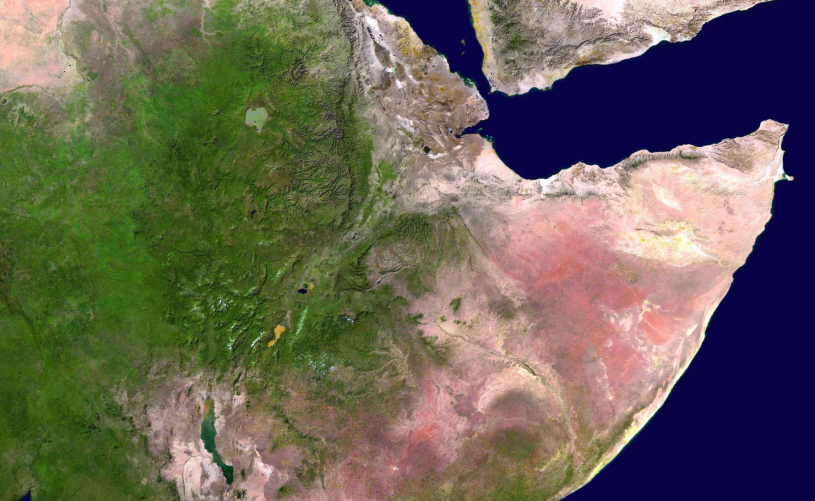
Today, what is underway is a brawl for supremacy over the Horn’s resources and strategic geography, waged simultaneously at the level of ethnic communities fighting for land, armed movements and their state backers competing for territory and resource access, and external powers positioning for control of the region’s logistics nodes.
Source: Sahan Issue 127
‘Give Peace a Chance’ was the title of a 1969 single written by John Lennon, recorded during his famous honeymoon ‘bed-in’ with Yoko Ono. Capturing the counterculture sentiments of the time, it was adopted as an anthem of the anti-Vietnam War movement in the following decade. Thirty years later, a provocative inversion of the title– ‘Give War a Chance’– was adopted in a well-known Foreign Affairs article by Edward Luttwak in 1999, in which he argued that humanitarian interventions or premature negotiations can freeze conflict, resulting in endless, recurring war. Luttwak contended that war has an internal logic, and if allowed to ‘run its course’, can bring about a more durable peace.
There have been plenty of legitimate criticisms of Luttwak’s argument; it glosses over the prospects of mass atrocities without intervention, the fact that wars often fragment and persist, and arguably makes a number of false assumptions about rational war dynamics. But Luttwak was nevertheless correct in criticising the perverse effects of inadequate intervention, which remain relevant when examining the limited Pretoria agreement, which has arguably paused rather than ended the Tigray war. Still, it was written in the age of post-Cold War geopolitics, the so-called ‘liberal order’ underwritten by American power. Today, that era has waned– and the nature of conflict has itself substantially changed, with no region perhaps better placed, beyond the Middle East, to examine such changes than the Horn of Africa.
Though there are many drivers to highlight, including the throes of wilting US hegemony, three interlocking shifts can be identified to explain the transformation of war in the region. The first is the changed character of violence, in which conflicts are increasingly targeting the social and productive fabric of communities rather than pursuing political outcomes, including through deliberate depopulation strategies, the destruction of agrarian systems, and the weaponisation of aid denial and starvation. The second is the lowering of the cost of conflict, particularly through drone proliferation. And the third is the regionalisation of politics, with the Horn of Africa drawn into the tumult of the Arabian Peninsula and beyond, the region transformed into a violent, zero-sum arena of rivalrous external powers.
The emergence of a single, interconnected conflict system — with Sudan as its fulcrum — is reverberating across the broader region, tying the Horn of Africa both to the tumult of the Sahel to the west and to the ‘Middle Power rivalry’ of the Arabian Peninsula to the east. The institutional framework provided by the African Union and IGAD has withered on the vine, unable — or unwilling — to contend with their normative responsibilities in the wars under their watch. And so, the multilateral architecture of peace and security forged in the early 2000s, representing genuinely emancipatory ideas that left behind the stagnation of the Organisation of African Unity (OAU), has fallen by the wayside. There needs to be a reinvigoration of the region’s peace and security architecture, but even reaching for the lowest-hanging fruit — a humanitarian ceasefire in Sudan — seems beyond a paralysed international system.
Conflicts in the post-Cold War Horn operated within a broadly recognisable logic; armed movements had definable political goals in Eritrea, Ethiopia and Sudan, and violence was broadly oriented towards achieving them, though Somalia’s internecine clan conflict of the 1990s was a marked exception. In turn, ceasefires were achievable, and mediation had a framework within which to operate. The wars of today — epitomised by Gaza, Tigray, and Sudan — are different in kind and degree, with the systematic targeting of a society’s social fabric having become a primary instrument of war rather than being considered collateral damage. These are not entirely new phenomena, of course, but the impunity with which these actors are pursuing such strategies is remarkable, with a distinct intensification and normalisation of brutality.
Though the shaky Pretoria agreement ended active fighting in Tigray– for now– the scarring of its population, economy, and civic institutions represented a template. Sudan’s civil war, now entering its fourth year, follows the same logic on a greater scale, with the Rapid Support Forces (RSF) campaign across Darfur characterised by mass killings of Masalit, Fur, and Zaghawa, and the systematic destruction of agricultural and civic infrastructure. Moreover, Tigray, Sudan, and Gaza have also returned to the use of starvation as a method of war, with the erosion of International Humanitarian Law normalised and writ large.
One enabler of this shift is the transformation of the technology of war, and in particular, the proliferation of drone warfare across the Horn. Technological transformation and proliferating drone warfare have dramatically lowered the cost of conflict, allowing states to externalise violence into their peripheries at diminishing fiscal and political cost,
while reducing the need for sustained ground deployments or political bargaining with restive peripheries. The first confirmed drone strike in Africa occurred in Somalia in 2011 and, since then, at least 900 have taken place across 15 states, with Sudan, Ethiopia, and Somalia accounting for the majority. Unlike the grinding kill zones of Ukraine’s frontlines, where Russian and Ukrainian servicemen operate thousands of UAVs in attritional warfare, the dominant pattern in the Horn is one of asymmetric application; deployed by governments against insurgent populations with limited capacity to respond.
The Tigray war served as a laboratory for foreign-supplied combat drones, with the infusion of Turkish- and Emirati-supplied systems — including Bayraktar TB2s, Chinese Wing Loong 1s, and Iranian Mohajer-6 UAVs — turning the tide against the advancing Tigrayan rebels in 2021. It came at severe civilian cost, one which has since been replicated against the raging insurgencies in Amhara and Oromia. Today in Sudan, the Sudanese Armed Forces and the RSF are operating drones extensively as the country enters its fourth year of war, with numerous instances of large-scale massacres and thousands of deaths inflicted from the air. Non-state armed groups, too, are latching onto the relative cost-effectiveness of drone warfare. The Yemen-based Houthis, whose barrage of drones and missiles into the Red Sea has wrought immense disruption to global shipping since late 2023, represent the most visible example. Through their burgeoning relationship with Al-Shabaab, they are now seeking to develop that jihadist group’s drone arsenal and capacity, establishing a potential threat on either side of the strategic Gulf of Aden.
But the changed character of violence and the proliferation of drone technology must be understood within the external patronage networks from the Gulf and beyond that have enveloped the Horn of Africa. Sudan’s proxy war is the clearest example, and a key node in the brutal Emirati-Saudi tussle for supremacy along the littoral administrations of the Gulf of Aden and Red Sea. Hopes that Abu Dhabi, Riyadh, and Cairo might be brought together under the Quad framework to deconflict their interests — even enough to open a window to a ceasefire — had already dimmed before the Middle Eastern conflagration. Now they look improbable, and the geopolitical brawl for oil, resources, and the strategic chokepoints of the Bab al-Mandab looks set to intensify further.
Though conflict in the Horn of Africa has always been transnational in nature — and limited datasets have long failed to grasp the interconnected nature of violence across the region — Sudan’s war has taken regionalisation to another dimension. Each of Sudan’s neighbours has been pulled into the violence, with their ruling elites tempted by the promise of patronage and the fear of being left on the wrong side of a reconfigured regional order. The RSF’s gold, for instance, flows through South Sudan, Uganda, and Chad to Gulf refineries, financing the war machine whilst entrenching the economic dependence of transit states on the conflict’s continuation.
On the other side sits a rough Türkiye-Saudi-Egypt-Qatar bloc, which has thrown its weight behind the military government in Khartoum and its allies in Eritrea and Somalia. The Gordian knot of vying foreign interests is intersecting with and accentuating already-present tensions within the Horn and beyond — be it the Cairo-Addis conflict over Nile waters or Somalia’s perennial centripetal-centrifugal dynamics. Fears of a renewed conflict in Tigray earlier this year partially stemmed from the understanding that it would be impossible to contain any such war, given the stakes and investments of a broad array of states in Eritrea’s and Ethiopia’s respective strategic positions.
The US-Israeli strikes on Iran, launched in February 2026, represent an escalation of the erosion of international norms at the systemic level. Though US hard power has thus far failed to topple the Tehran regime, and has inflicted considerable costs on its Gulf allies, it was further evidence of a new prevailing logic — that might is right, and that the architecture of the multilateral order built after 1945 has faded beyond recognition. The Iran war’s most significant consequence for the Horn may not be any direct military spillover — though the risk of Houthi escalation against Somaliland targets is real. Rather, it is the further acceleration of the competition for littoral positioning already underway, and the further erosion of any normative constraints on the conduct of armed actors.
The accumulated effect of these dynamics– the changed character of war, the lowered costs of conflict, the transnational patronage networks, the collapse of mediation frameworks and IHL norms, and the intensification of competition for the Red Sea littoral– is a regional conflict system of a qualitatively different order than that of previous decades. It is sustained by external patronage, as well as the entrenched domestic war economies and elite survival strategies that render these conflicts self-perpetuating. And the struggle of more coherent ‘Middle Powers’ will continue to intersect with the murky networks of the Red Sea economy.
Today, what is underway is a brawl for supremacy over the Horn’s resources and strategic geography, waged simultaneously at the level of ethnic communities fighting for land, armed movements and their state backers competing for territory and resource access, and external powers positioning for control of the region’s logistics nodes. Luttwak was not entirely wrong, with his insight that ill-thought-out intervention can freeze conflicts into recurring cycles of violence readily apparent in the Horn. Jeddah over Sudan is another clear example of conferring legitimacy on belligerents without constraining them, relieving pressure whilst the underlying dynamics– and conflict– grind on. But his deeper argument that wars, left to burn, can exhaust themselves feels awfully irrelevant in the total, externalised wars of the Horn today. These wars do not burn out, but smoulder and spread– and consume what remains of the regional order.
The Horn Edition Team
 Martin Plaut