Background
1. This Guidance Note supersedes UNHCR’s Eligibility Guidelines for Assessing the International Protection Needs of Asylum-Seekers from Eritrea of April 2011.1
2. Since its independence in 1993, Eritrea has been governed by the People’s Front for Democracy and Justice (PFDJ), headed by President Isaias Afwerki, who serves as both Head of State and Head of Government.2 No elections have been held since 1993.3
3. In 2002, the arbitral award by the Eritrea-Ethiopia Boundary Commission regarding the delimitation and demarcation of the border between the two countries was not implemented in full,4 which led to an impasse, referred to by Eritrea as a situation of “no war, no peace”.5 The Government of Eritrea therefore adopted a strategy focusing on national security and self-reliance, in pursuit of which it consolidated power in the Executive branch, suspended the nation’s Constitution, curtailed civil liberties, suspended the National Assembly, extended national service, postponed electoral processes, and incarcerated individuals without legal recourse on grounds of treason.6 While relations with Ethiopia thawed in 2018,7 more recently concerns have arisen about renewed tensions between the two countries.8
4. Eritrea reportedly continues to place restrictions on the enjoyment of basic human rights, including the rights to freedom of opinion, religion, and expression,9 with particular concerns having been expressed about human rights violations in the context of Eritrea’s national service.10 The Special Rapporteur for the situation of human rights in Eritrea stated in May 2025: “Eritrea has yet to establish credible and effective mechanisms capable of addressing the prevailing impunity and providing redress to victims. This persistent failure to ensure accountability not only undermines the rule of law, but also signals tolerance for human rights violations, emboldening perpetrators and perpetuating cycles of abuse.”11
Recent reports have highlighted instances of arbitrary detention and enforced disappearance,12 problems with the rule of law and administration of justice;13 surveillance of the population in violation of the right to privacy;14 allegations of deployment of child soldiers;15 restrictions on citizens’ right to a free civic and democratic space and restrictions on political participation;16 restrictions on the right to leave and enter one’s own country;17 restrictions on domestic and international human rights organizations;18 the criminalization of consensual same-sex sexual activity between adults;19 and child labour.20
Refugees
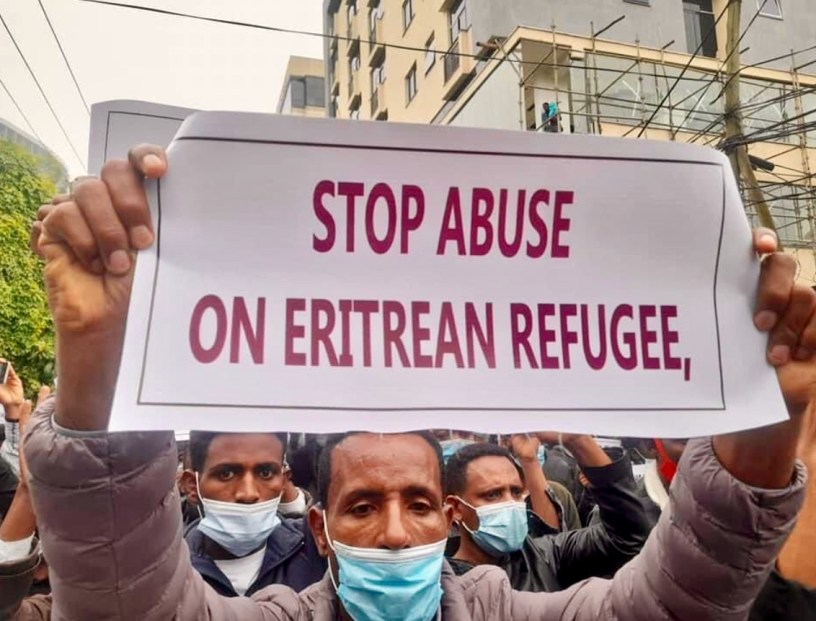
6. By December 2025, UNHCR was aware of over 679,000 Eritrean refugees and asylum-seekers around the world, with Ethiopia, Sudan, Germany, Uganda, Egypt and Switzerland among the top host countries.21
Humanitarian Situation and Challenges to Human Development
7. ACAPS notes that, “The Eritrean Government significantly restricts humanitarian access, resulting in limited information on humanitarian needs in the country.”22 Eritrea faces significant economic challenges. Ranked 178 out of 193 countries in UN Development Programme’s Human Development Index, Eritrea has a Gross Domestic Product (GDP) per capita estimated at USD 656 in 2023,23 and a life expectancy of 69 years.24 Real GDP growth was estimated at 2.9% in 2023, the latest publicly available data.25 Eritrea is extremely climate vulnerable and exhibits “limited adaptive capacity resulting from weak governance structures and inadequate infrastructures.”26 Around 70 per cent of Eritreans live in rural areas and are dependent on subsistence agriculture for their livelihoods.27 Food insecurity as well as limited access to safe water, sanitation and health services present major concerns.28 In 2022, Eritrea signed a five-year Sustainable Development Cooperation Framework with the United Nations.29
International Protection Needs
8. UNHCR continues to call on all countries to allow civilians fleeing Eritrea access to their territories, to guarantee the right to seek asylum, and to ensure respect for the principle of non-refoulement at all times. UNHCR calls on States to register all arrivals who seek international protection and to issue documentary proof of registration to all individuals concerned.
9. All claims of Eritrean nationals seeking international protection should be processed through fair and efficient procedures in accordance with international and regional refugee law and other relevant legal standards. In countries where Eritrean asylum-seekers arrive in large numbers, represent a discernible and similar pattern in the nature of their claims, and where refugee status determination exceeds the local capabilities, UNHCR encourages the adoption of a prima facie approach in the processing of claims.
Full Report

