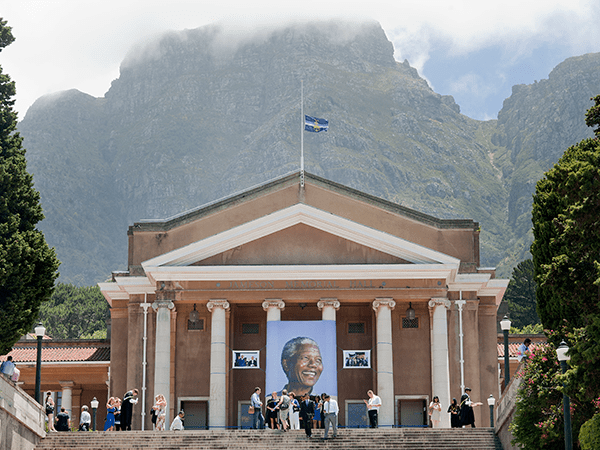
Professor Adam Mendelsohn on the resurgence of anti-Semitism, and its impact on UCT

30 April 2026

Where to for the Jews?
INAUGURAL LECTURE, UNIVERSITY OF CAPE TOWN
29 April 2026
I remember the lecture well. I was a new PhD student in Boston, part of a cohort of junior scholars being inducted into the field of Jewish history. Our speaker was one of the leading international scholars of modern Jewish history. The study of antisemitism, we were confidently told, was stale and irrelevant, a backwater to be avoided. After all, contemporary Jew hatred was a marginal phenomenon, the preserve of extremists on the fringes, a vestige of the past.
We were instructed to transcend the “lachrymose conception of Jewish history” – a focus on discrimination, marginalization, and suffering – and instead write about the synthesis – the creative interplay – between Jews and the societies in which they live. The subtext of the lecture was clear: Jews were living in a golden age of acceptance and inclusion, an era unimaginable to those who came before. And antisemitism was yesterday’s news, fading into insignificance, unworthy of serious scholarly attention.
This was the advice of one of the leading scholars of modern Jewish history but twenty years ago. In retrospect, his predictions have the ring of Francis Fukuyama’s now much mocked claim in 1992 that we were witnessing the end of history as liberal democracy triumphed. For much like Fukuyama, we were blithely ignoring evidence to the contrary. The notorious World Conference against Racism in Durban in 2001, which descended into an antisemitic hate fest, for example, was explained away an aberration. No need for alarmism. So too were other squalls that momentarily darkened the skies. We had the wind at our back and basked in our confidence.
Until the climate changed. The historian Simon Schama has evocatively compared the last two years to “lifting a floor covering to expose what we’d idly imagined to have long gone, the endlessly festering slough of dehumanization.” Scholars, myself included, now routinely marvel at the appearance in mainstream public discourse of antisemitic tropes and stereotypes of a classical variety.
The sensation is like that of a palaeontologist transported to Jurassic Park, seeing alive in the wild what we assumed only lived on in textbooks. Phenomena which carry unfortunate echoes of the past – widely shared advice not to wear identifiable Jewish symbols when walking in parts of Paris and London, threats and violence against Jewish institutions, ideological purity tests applied only to Jews – have become part of a new normal. And today the study of antisemitism is all the rage. New university research centres, new journals, and new academic programmes jostle for attention, trying to make sense of what has happened and what it all means.
Within the field of modern Jewish history, there is a sense of rupture, that something profoundly changed after October 2023. What is less clear is whether what we are seeing and studying all around us is new or old.
We have seen, for example, the unanticipated reappearance of the “Jewish question,” a subject that agitated many European societies from the 19th century until World War II. Then the public debate about the “Jewish question” focused on what was to become of the largest non-Christian minority in Europe. The debate became ugly and urgent – including in South Africa – in the 1920s and 1930s.
Historically Jews had been marginalised, persecuted, and excluded. In the 19th century, an age of emancipation and new nation states, what was to become of the Jew? Should Jews be integrated as citizens in the countries in which they lived, and if so, under what terms? Or should be excluded from society? Jews offered a variety of their own answers to the “Jewish question.” Some sought full inclusion and acculturation. Others embraced new forms of solidarity rooted in socialism or advocated for cultural autonomy. An initially small but growing minority pushed for a homeland of their own. Debate about the “Jewish question” was seemingly resolved by the Holocaust – which decimated the Jewish population of Europe, rendering the issue of Jewish integration all but moot — and by the creation of the state of Israel in 1948.
Yet over the last two years, the “Jewish question” has resurfaced in the public realm in a variety of guises but often asking modern iterations of the older, 19th century questions. Are Jews to retain full acceptance and inclusion within the societies in which they live? If so, is their inclusion conditional on accepting or rejecting particular political positions? Can attachment to Israel, in other words, remain central to Jewish identity? And are Jews required to conform to the dictates and expectations of others?
Many Jews too have been asking modern versions of the older “Jewish question.” What, they are asking, is happening in societies and institutions where they once felt most at home? Has a “golden age” of Jewish life ended? And what does the future hold? These questions reveal much about the anxiety and uncertainty felt by many Jews, but also hold up a mirror to the societies in which Jews live, and the institutions with which Jews have been associated. In essence, they are asking themselves the question that I will pose this evening: where to for the Jews?
In answering this question, I will do three things. Firstly, I’ll explore some of the ideas that have accreted around the Jew over time, and offer some brief thoughts on why the Jew as a phantasm exercises such a hold on the popular imagination. Secondly, I will move from the realm of fantasy and projection to the actual experience of Jews. I will do so by tracing the historical trajectory of Jews in South Africa and by exploring their relationship with UCT. And thirdly, I will examine a handful of contemporary trends that provide hints at what the future may hold for Jews in South African society.
I begin with a paradox. The number of Jews in the world today is smaller than the total population of Gauteng, still well short of the historic peak of 16.6 million Jews in 1939, before the Holocaust. Today Jews make up 0.2 percent of the world’s population, and an even smaller share – 0.08 percent – of South Africa’s. The entire South African Jewish population would not even fill the Cape Town stadium. And yet in South Africa and globally, “the Jew” occupies a prominence in the public and popular imagination that belies their numerical inconsequence.
Why is the idea of “the Jew” so potent? And why do so many societies have Jews on the mind? Some of the reasons are of recent historical origin, others of much longer duration. I’ll run through some of these quickly.
The first relates not to living Jews but to dead ones. The Holocaust occupies a prominent position in public consciousness and as a cultural reference point. Research undertaken by the Kaplan Centre has shown that on social media South Africans resort more readily to Holocaust and Nazi analogies than to motifs drawn from the apartheid era.
The hold that the Holocaust has on the popular imagination here and abroad was not inevitable. Scholars who write about the penetration of the Holocaust into mass culture typically trace this to the 1980s and 1990s. In other words, this is a recent phenomenon, and its durability is uncertain. But whether durable or not, it has meant that many are at least superficially familiar with an event inextricably connected with Jews, even if only dead ones.
Secondly, the prominence of Jews in America, and particularly in American cultural life, has provided an outsized visibility to Jews and Judaism worldwide. As American cultural influence and soft power has expanded, so too has the figure of the Jew been carried abroad.
Again, this of relatively recent origin. Scholars trace the emergence of the concept of Judeo-Christian civilisation – which offered a degree of inclusion to Jews in American civic life – to the post-war period. This was cemented by the rise of multiculturalism as a concept and ideal in the 1960s and 1970s. These concepts offered new opportunity for Jews to openly embrace a public identity as Jews. For example, though Jews have long been associated with the entertainment industry, the dominant pattern was for Jews to downplay their particularity. It is no accident that the very Jewish Irving Berlin is known for composing the iconic song White Christmas – the best-selling single of all time – and not for Hannukah songs.
This was not only a decision about marketability, but also about the risks of publicly inhabiting an ethnic identity outside the mainstream. Only over the last few decades we have seen an increasing confidence of Jewish artists, authors, comedians, and filmmakers to put overtly Jewish themes and characters on to the page and screen. This has made the Jew a visible figure in public life to a degree unimaginable even in the 1960s and 1970s.
And thirdly, Israel is (unfortunately) much in the news. Close to half of the world’s Jews now live in Israel. Whatever their own political views and allegiances – and even if they reject it — Jews in the diaspora are bound up with Israel. Sociologist Zygmunt Bauman recognised this intertwining of fates. “Whether praised or censured, revered or berated, the State of Israel and all its works provide the reference point for present-day Jewish identity.”
Indeed, over the last two years, Jewish institutions in the diaspora have been attacked – often rhetorically, sometimes physically – because Jews are associated in the public mind with Israel. The ugly spat between Roedean and King David High School in Johannesburg was a local example. And intellectuals and public figures have demanded that Jews – as a collective, and as individuals – take a public position on Israel lest they be classed as bad Jews, or, even worse, as Zionists. Such demands are not made of other individuals or groups – the insistence is that the Jew publicly take sides. This is coerced speech. Again, this has ensured that the Jew occupies an unusual degree of prominence in public life.
But the idea of the Jew also carries much older cultural baggage. As the parent religion of Christianity, Judaism was cursed by history to be the foil for its progeny. In Christian thought, the Jew became the obverse of the Christian, and was invested with symbolic (and sometimes diabolical) power. In Europe, Jews had the misfortune to be the largest and most conspicuous non-Christian minority.
As David Nirenberg has demonstrated, ideas about the Jew were endlessly mutable, reimagined and repurposed in every age to meet contemporary needs. “The Jew” was a screen on which to project social anxieties and fantasies that revealed much more about the projectionist than about actual Jews. In the medieval period, some of the most pernicious persecution of Jews was abetted by converts from Judaism to Christianity whose voices were amplified by the church. These converts were presented as witnesses to Judaism’s immorality and perversion, truth tellers who had seen the light, able to speak with authority about all that was wrong with Jews.
The tortuous millennia-long relationship between Christianity and Judaism has many legacies. There are certainly echoes in the present of a past eagerness to pronounce authoritatively on what Jews ought to think and believe, how to define and understand prejudice against them, and who amongst them is good and bad. Islam has its own complicated relationship with Judaism, far less rosy than imagined by those who idealise the treatment of religious minorities in pre-modern Islamic societies. Here too the Jew has been invested with outsized meaning and significance.
Beyond the religious realm, the idea of the Jew was reimagined in the 19th century as the midwife of modernity. In much of medieval Christian society, the Jew had been a marginal figure, expelled from England, France, and Spain, and elsewhere obliged to cling to scorned occupations including peddling, pawnbroking and trading in second-hand goods. With the exception of a small elite, the dominant Jewish experience in much of Europe was of poverty and marginalisation. The coming of industrialisation and urbanisation – alongside the immense impact of the emancipation of Jews in the 19th century – propelled them from marginal occupations and marginal status to the centre of the new economic and social systems brought by modernity.
In general, Jews entered industries related to their original trades: tailors into textiles, hardware dealers into metal manufactures, weavers into the textile trade, peddlers into storekeepers. Later in the century they joined the free liberal professions en masse, becoming doctors, lawyers and journalists. Within two generations in central and western Europe, families that had experienced grinding poverty saw their fortunes transformed. And in the United States, Jews became the single most economically successful immigrant group in the American history. This pattern of dramatic social and economic mobility among Jews was at odds with the experience of many others in these societies whose economic and social status was disrupted by industrialisation and urbanisation.
The conspicuous success of Jews – much remarked upon and puzzled over at the time – bred resentment. And it made the Jew a symbolic embodiment of modernity for those who disapproved of the profound social changes wrought by industrialisation and urbanisation.
For those disgruntled with social and economic change, the Jew was easily imagined as the unjust (and mysterious) beneficiary of processes that had wrought massive dislocation and disruption to the wider society. As Shulamit Volkov has described, the Jew came to stand “for modernity, for success under its auspices, for the manipulation of its advantages, and the destruction of all remnants of the old world.”
For those on the left, the Jew was easily imagined as the arch capitalist exploiter. For those on the right, the Jew was easily imagined as the socialist revolutionary undermining the foundations of society. This line of thinking about Jews from left and right now associated Jews with money and power, and gave birth to a potent set of fantasies about how Jews use money and power to subvert, control, and manipulate.
Paradoxically, such fantasies allow for an obsession with Jews despite and because their numbers are so small. These fantasies assume Jewish conspiracy, that they are working together for malign purposes. When enmeshed with racial thought in the 19th century, these ideas positioned Jews as perpetual and unassimilable outsiders and as an active danger to the nation. In South Africa we are schooled to think of race in terms of black and white. In Europe and elsewhere, antisemites fixated on the Jew as the racial outsider.
We still see echoes of these ideas today in the trope of the Jew as manipulator of financial markets, of the Jew as power-hungry and self-interested, of the Jew as social upstart and as perverter of social morals, and in the idea of Jewish conspiracy.
Paradoxically this is fed by the outsized prominence of the Jew in the public imagination for all the other reasons I’ve described – it’s a perpetual motion machine for prejudice. But it is also fed by the conspicuous success of Jews today. Jews delight in the success of other Jews, basking, for example, in the reflected glory of “their” Nobel Prize winners and eagerly boasting that 22 percent of all Nobel Prize winners have been Jews. But so do those who despise them: they also delight in enumerating Jewish success, albeit assuming that this success is unjustly gained and sinister in purpose, a cancer on the body politic rather than as a positive contributor to the collective good. Similarly, older medieval tropes about Jews have been endlessly adapted to fit modern circumstances.
For all of these reasons and others – some dating back millennia, some of more recent origin – the idea of the Jew carries cultural baggage that far outweighs their small numbers. But the carapace built up around the Jew tells us very little about the actual experience of Jews. These are not just the put-upon and passive objects of history. For as much as it is important to understand perceptions of Jews, we also need to also understand their agency – what they want, what they think, and what they have done despite and because of how they have been imagined.
Now from the global to the local. What has any of this to do with the experience of Jews in South Africa? And why is it relevant to the present and future?
In the longue durée of Jewish history, the Jewish community in South Africa is of recent origin. Jews were legally barred from settling at the Cape until 1803, and their numbers remained small for the next fifty years. This pattern was similar elsewhere in the English-speaking world. There were scarcely fifteen-thousand Jews living in the United States in 1840; fewer than five hundred in British Canada, and sixty lonely pioneers in hardscrabble New Zealand.
At the time – and indeed for the whole of the 19th century – by far the largest share of Jews worldwide lived in the borderlands of the Russian Empire in the Pale of Settlement that today stretches from Latvia and Lithuania on the Baltic across Poland, Belarus, and Ukraine on the Black Sea. For the most part, Jews in Russia were restricted to living within the Pale of Settlement, and unable to legally move elsewhere within the Russian Empire. Significant numbers of Jews also lived in North Africa and the urban centres of the Ottoman Empire including Baghdad, Cairo, and Jerusalem.
This pattern began to shift dramatically in the last quarter of the 19th century because of an exodus of Jews from the Russian empire. This exodus was initiated by young people leaving the poorest regions within the Pale of Settlement where population growth and economic stagnation had produced dire poverty and downward economic mobility. The Jewish population in the Pale of Settlement increased fivefold between 1800 and 1900 at the same moment that their traditional occupations were undercut.
By the last quarter of the century, many Jews saw little future for themselves in the Russian Empire, a sentiment reinforced by outbreaks of acute violence – pogroms – against Jews – and a government that was often antagonistic toward Jews and other religious minorities. The vast majority of Jewish emigrants – 1.5 million – moved westward into Central and Western Europe, and then on to the Americas, with offshoots to Ottoman Palestine, South Africa, and Australia. This was an age of mass migration.
At the same moment that Jews were leaving en masse – and for some of the same reasons – more than a million Muslims were escaping the Russian Caucuses for the Ottoman Empire, settling in large numbers in the Levant. As Vladimir Hamed-Troyansky, the historian of this migration has argued, there is much overlap in the “specific directionality and religious mandate of [Jewish and Muslim] emigration [from the Russian empire into the Levant] as well as in their origins in persecution and mass flight.”
The number of Jews who made their way to South Africa was much smaller than those who went to the United States, but South Africa became a compelling destination following the discovery of gold on the Witwatersrand in 1886. The Jewish population grew almost tenfold, from 4,000 in 1880 to more than 38,000 in 1906.
A few arrived with means including the Beit brothers who came from Hamburg and were later to gift £500,000 that kickstarted the building of UCT. But the vast majority came with very little from what today is Lithuania and Latvia, a region whose economic prospects were particularly poor. Chain migration gave the Jewish community some of its enduring features including an intense Zionism carried by the immigrants to these shores.
These newcomers settled in small towns across South Africa, in many ways recreating the economic roles they had played in eastern Europe as intermediaries between farmers and larger markets. They became peddlers – smouse – storekeepers, hoteliers, and traders.
A yearbook published in 1929 gives us a window into their dispersion across rural South Africa and the world they created for themselves. Note the proliferation of Zionist societies in the towns and villages where they settled. This, alongside religion, became the organising principle of Jewish life. There were already over sixty of these Zionist societies in South Africa by 1905, and many more by 1929.
Although there were always dissenters – particularly those drawn to radical leftwing politics – in South Africa their numbers were small. Coming from the Russian Empire, where Jews were experiencing acute crisis, and where Jews were subjects rather than agents of history, Zionism held revolutionary appeal. It promised Jews the opportunity to determine their own fate.
The Zionism that immigrants carried with them to South Africa was driven by an urgent contemporary imperative – to provide haven for Jews in a homeland of their own — but also drew upon deep cultural and religious roots. Anyone with even passing acquaintance with Jewish liturgy is familiar with daily invocations of Jerusalem and Zion, and with the intonation of “next year in Jerusalem.” Jews in the diaspora had travelled to and settled in what they regarded as the Holy Land ever since the formation of the Jewish diaspora in the 8th century BCE, and had an unbroken, continuous presence there since antiquity.
In the second half of the 19th century, these older religious and cultural traditions, practices and aspirations fused with the search for safety and for self-determination to create modern Zionism. This was a moment when many other ethnic and national groups were similarly engaged in national projects. As with these other movements, Zionism was broad, diverse, and internally fractious. From the start, Zionism has meant different things to different people. There are left wing versions and right wing. Religious and secular. Cultural and fiercely practical. Capitalist, socialist and Marxist.
Binationalists and exclusivists. This variety and dynamism is erased in present-day discourse. Instead, the term Zionism is much misunderstood and is the subject of endless projection. These projections typically tell us more about the agenda, motives, and biases of those who seek to describe and define Zionism than about Zionism itself. Sound familiar? But at its core, Zionism is a simple idea: Jews are a people and deserve self-determination, as do other peoples. If we believe in the right of people to form nations, then this is an unremarkable idea.
Despite moving to South Africa and not Ottoman Palestine, Zionism gave Jewish immigrants to South Africa a sense of common purpose, pride, and solidarity. Despite moving far from the centres of Jewish life, through Zionism Jews in South Africa could still participate in a grand collective project of helping to build a state where Jews could determine their own fate. Even as they and their children acculturated into South African society – most honoured strict religious observance in the breach – Zionism provided an alternative civil religion to many Jews.
These immigrants typically sent their children to public schools so that the second generation was thoroughly South Africanized. For Jewish immigrants and their children, public school and then university education promised a degree of social and economic mobility unimaginable in the Russian Empire. In the Russian empire, Jews encountered severe restrictions that limited their ability to move out of the Russian borderlands and into more prosperous cities like St Petersburg, as well as limits on access to universities. The first state mandated quota – the “numerus clausus” – was introduced by the Russian state in 1887 and set limits on the admission of Jewish students to 10 percent in the Pale of Settlement, 5 percent outside the Pale of Settlement, and 3 percent in Moscow and St. Petersburg.
Here this story intersects with that of the University of Cape Town. There were no such limits at the South African College, the forerunner of UCT. As Howard Phillips has described, the College, then in central Cape Town on what is now the Hiddingh campus, took its cue from Scotland.
In addition to being staffed by Scottish professors — in 1900, over 40 percent of its academic staff were graduates of Scotland’s four universities – it adopted the openness to Jews and other religious dissenters typical of Scottish universities. As a result, the South Africa College, and then UCT became a magnet for Jewish immigrants and their children. Because of this phenomenon – Scottish professors teaching Jewish immigrants, the College and then UCT were jokingly referred to as the “Scottish mission to the Jews”
If you’ll indulge some personal history, my own family reflects the transformative encounter between immigrants and the university. All four of my grandparents were the children of immigrants. My maternal grandfather, Louis Resnick, one of six siblings, grew up in Salt River with a cow in the backyard. His parents came from Lithuania, his father working at a meat wholesaler. His older brothers did not go to university – one ran a small clothing store, another sold wholesale textiles, another worked for Foschini’s – but he and his younger brother both went to UCT medical school.
After specialising as an OBGYN in Manchester, he returned to practise in Cape Town, and to train UCT medical students at Somerset hospital. Here was the transformative power of the university. Within a single generation, the children of immigrants achieved prosperity and status unimaginable to their immigrant parents, and entirely inaccessible in the Pale of Settlement.
The same was true of my paternal grandparents. Leonard Mendelsohn was one of four children who grew up above the modest family store on main road in Wynberg. He went to Wynberg Boys where he developed a lifelong passion for cricket and rugby – part of the process of acculturation typical of the children of immigrants – and then on scholarship to UCT’s medical school in the mid-1930s. There was no money to send his three sisters to university, the subject of resentment on their part.
At university he met Enid Daitsh. Unusually, her well-to-do immigrant father insisted that his daughters receive a university education. Enid wanted to be a nursery school teacher, but her father insisted on medical school. Her sister went to UCT architectural school, and her brother to MIT. Enid was among the early cohort of women to graduate from UCT medical school; a letter of reference describes her as a promising doctor “notwithstanding her disability” – that is, being a woman.
As this demonstrates, we should not idealise UCT. At the same time that Jewish students were welcome, the university admitted very few black students. Most black South Africans were denied the transformative upward mobility that university education enabled. Yet even in taking this step of admitting a few black students, UCT was, according to Howard Phillips, “far in advance of both prevailing white public opinion and all other white South African residential universities and university colleges.”
When it came to admitting Jews, the broader context is also significant. In the 1930s, when my grandparents were students at UCT, Jews had been hounded from universities in Germany, and increasingly made unwelcome at universities in many other countries. In Poland, home to more than 3 million Jews – the largest Jewish population in Europe at the time – universities had become sites of conflict as right-wing student groups used violence to intimidate Jewish students and to pressure universities to introduce quotas.
Although official restrictions were never formally implemented, some departments restricted the admission of Jews. They were more successful in introducing segregation into the classroom with separate seats for Jewish students. This was officially introduced at Warsaw University, the biggest university in Poland, in 1937, but had been imposed earlier by “nationalist students who beat those Jews who did not comply and intimidated reluctant professors.”
And in the United States, home to the largest Jewish community in the world at the time – more than 4 million Jews in the late 1930s – Jews were actively restricted from attending most American universities. Notoriously, Harvard University led the charge in the early 1920s when it very publicly imposed quotas severely limiting the admission of Jews. It did so because of what it openly termed a “Jewish problem”: that is, too many Jewish students. Many American universities followed suit.
Strikingly, UCT did not introduce quotas, despite pressure to do so. Vice Chancellor John Carruthers Beattie insisted in 1928 that, in his words, “as long as I and others are here there will be no discrimination against Jews.” Such sentiment was not a given at the time. As Milton Shain has written, this was an era where the “Jewish question” entered South African political life. It is no accident that UCT’s nickname – the Ikeys – comes from this same period.
It originated in 1919, at the intervarsity rugby match against Stellenbosch University, when students from the latter institution sang songs taunting UCT. One of their grounds for doing so was the large number of Jewish students at the University of Cape Town. At the time, the registrar estimated that nearly a quarter of all students at UCT were Jewish. Ikey was a shortening of the name Isaac, and was used as a slur to refer to Jews. It is not unrelated to the word Kike.
The UCT SRC formally complained to Stellenbosch about the lyrics of the song with no effect. Stellenbosch’s students knew they had struck a cord, and the name stuck in the 1920s and 1930s precisely because it carried a sting. Today it is shorn of its original meaning, and now worn as a badge of pride, but is a vestige of this era when it meant something that UCT attracted and accepted Jewish students. This original meaning of Ikey – as an ethnic slur – has all but been forgotten. This forgetting is itself telling, reflecting the public forgetting that Jews as a community were discriminated against, as well as the erasure of Jewish history from public narratives in South Africa.
From my description of my grandparents’ experience – and of the contrast that it formed with the world at the time – you can begin to understand the deep sense of attachment and loyalty felt by many Jews toward UCT, as well as the particular role of the university as a social and economic escalator. Thanks to this history, Jews have long felt entirely at home at UCT.
This was a place that transformed their families’ trajectories. This was a place where the application of liberal values – as exemplified by the broad-minded John Carruthers Beattie – offered inclusion and acceptance when this was not a given. Hence the Jewish faith in liberalism as a protector of minority rights. This was a place where ability and talent counted more than social origins. This was a place where an antisemitic slur – Ikey – was ultimately transvalued into a badge of pride.
Given this sense of attachment, Jews constituted a significant minority amongst students for more than a century, and particularly so in the medical faculty. Between 1922 and 1929, for example, 29 percent of all medical graduates at UCT were Jewish. In 1939, when my grandparents were at medical school, a little under a third were Jewish.
A final example of what Howard Phillips describes as a “congenial environment” for Jews is telling. In 1967, during the Six Day War, UCT gave a leave of absence to 77 Jewish students who wished to volunteer in Israel. One member of senate thought this infringed on South Africa’s declared policy of neutrality in Arab-Israeli matters, but refrained from raising this “in the light of the strong Jewish representation in the senate.” How times have changed.
For the reasons I’ve described, UCT has a particular and emblematic relationship with Jews. The same is true of Wits. But for good or ill, the University of Cape Town also tells us a lot about the present of Jews in South Africa. And it may also tell us a lot about their future too.
I’ll move now to the third and final section of my lecture, turning from the historical to the present day.
Over the last two and a half years, the South African Jewish community has become acutely aware of its vulnerabilities. Crisis can be clarifying, revealing the impact and influence of longer-term processes whose implications have hitherto not been fully understood. For example, though we have long been aware of demographic decline, the broader implications of this were not fully appreciated. The Kaplan Centre has tracked these numbers for the last four decades. At its zenith in 1970, the Jewish community numbered 118,200. In 2001, we estimate that there were at least 69,000 Jews in South Africa. Today it is close to 50,000.
This is largely the product of emigration. I was reminded of this on a visit last month to Toronto where I was hosted for supper by friends who recently left South Africa. Their other guests emigrated as teenagers in the early 1990s; by happenstance one had been in my year at a Jewish primary school in Cape Town. She produced a photograph of our standard four class from 1991; more than half of our 24 classmates no longer live in South Africa. This is confirmed in data collected by the Kaplan Centre.
The effects of emigration are now accentuated by aging. The median age of Cape Town’s Jewish population is 45 as compared with the national average for the broader South African population of approximately 28. These twin processes of aging and demographic decline are a global phenomenon – outside of Israel and America, almost everywhere the Jewish population is shrinking. Despite its own decline, South Africa still has the 11th largest Jewish population in the world, but only because those below it on the list are shrinking too.
The latter also reflects a profound process of geographical consolidation over the last century. A once global people has become concentrated in a handful of countries. Some of this is a consequence of the all but disappearance of substantial and ancient centres in North Africa and the Middle East largely because these countries expelled their Jewish populations after 1948.
In some places, that process began before the creation of the state of Israel. In Iraq, for example, many Jews saw the writing on the wall after the infamous Farhud in Baghdad in June 1941, two days of rioting and murderous violence targeting Jews. 40 percent of Bagdad’s population was Jewish at the beginning of the 20th century. Today a handful of Jews remain in Iraq.
In 1948 there were 65,000 Jews living in Cairo. Today there is reportedly only one with Jewish parentage and Egyptian citizenship: the last Egyptian Jew in Cairo. It is for this reason – the mass, forced exodus of Jews from North Africa and the middle east — that today more than half of Israel’s Jewish population traces its origin to places in the Muslim world where there are barely any Jews left.
Outside the Middle East and north Africa we have seen a hollowing out of Jewish communities in Ethiopia, Yemen, and India. The exodus of Jews from Russia and Ukraine over the last three decades has been equally dramatic. Since the collapse of the Soviet Union, Jews have voted with their feet. In 1970, there were more than 1.8 million Jews in the Soviet Union. Today there are just over 160,000 in the former Soviet states. Most moved to Israel, followed by the United States. The result is that only 9 countries globally have more than 100,000 Jews, and only two – Israel and America – have more than half a million. The distribution of the Jewish world today looks entirely different than it did 100 years ago.
Within South Africa, America, Australia, and other countries we have seen a parallel process of consolidation. Whereas in 1929, as demonstrated in the yearbook, Jews lived across South Africa, today the population is concentrated in Johannesburg and Cape Town. As a result, fewer South Africans will interact with Jews on the street, in schools, in the workplace, and in social settings, rendering them less visible and less familiar. The result is that most people in South Africa have never knowingly met a Jew.
That absence matters. As historian Jessica Roitman has argued, in places where Jews are more visible, people can disapprove of Israel’s policies while still knowing Jews as neighbours, colleagues, or friends. In places where Jews are not present, that distinction is much harder to make and demonization of Israel or antisemitic biases face less friction.
Although the Jewish community has long been aware of these slow and ongoing demographic processes – which have a very real impact on its ability to fund its own institutions and support an ageing population – it took the recent crisis to make it fully aware of the political and psychic implications of its reduced numbers. Unfortunately, this post-October 7 crisis relates to the place that Jews occupy in South African society.
Not for decades has the place of Jews in society been so uncertain. Even though they are full citizens and their rights protected by the Constitution, the figure of “the Jew” has surfaced in South African public life. This manifests as crass prejudice, in an obsession with Jews in the media, in the differentiation between “good” Jews and “bad” Jews among public intellectuals and academics, in the targeting of Jewish owned businesses and performers for boycotts as if they are an extension of the Israeli state, and in the dismissal of the concerns expressed by Jews.
The latter is very telling. All of the frankly ludicrous “debate” in South Africa about definitions of antisemitism – much of it deeply ignorant, conducted in bad faith, and often itself a symptom of prejudice – has distracted from the actual problem of antisemitism. This would be laughable if it wasn’t so tragic. Here at UCT – and in fact in this very building – we have been told that Jews instrumentalise claims of antisemitism for malign purposes, a view endorsed by some members of UCT’s Council.
Tell that to the victims of the massacre on Bondi Beach. Can you imagine the same being said for other forms of prejudice – that Black South Africans, or Muslims, or any other group invent, inflate, and instrumentalise the prejudice against them? Again, this draws upon a long history of assuming that Jews are engaged in conspiracy, that they are acting to advance their own interests at the expense of others. The real problem, however, is not one of definitions, but of hate.
Just last month, synagogues, a school, a kosher restaurant and a Jewish ambulance service were attacked in Detroit, Liège, Rotterdam, Amsterdam, Antwerp and London respectively. In the United States, where Jews account for only 2% of the American population, in 2024, 69% of all religiously motivated hate crimes and more than 16% of all reported hate crimes targeted Jews. This was part of a long-established pattern, signs of an unhealthy obsession with “the Jew.”
South Africa has thus far been spared the violence we have seen elsewhere. There is no single or simple explanation for this. Some of this reflects luck, for example, that a pipe bomb failed to go off outside Jewish communal offices in Cape Town in December 2024. There is no shortage of anxiety and vigilance. Jewish institutions are heavily guarded, all the more so over the last two and half years. Herzlia has had men with shotguns outside since November 2023 when the school was accused by two speakers at a large Palestinian solidarity march in Cape Town of training “murderers.” No one challenged them. None of this is normal.
Unfortunately, I have heard plenty of examples from students here at UCT about their own experiences of being excluded and targeted, and of concealing what school they went to, what their religious identity is, as well as clothing or jewelry that would visibly mark them as Jewish. This evidence is anecdotal – and the problem appears to be sporadic rather than endemic – but echoes broader reporting on the experience of Jews in South Africa over the last two years.
The Kaplan Centre’s own systematic research tells a dark story. Since 2021 we have systematically tracked racism, xenophobia and antisemitism on social media in South Africa. In 2022 we drew cautiously hopeful conclusions relating to online antisemitism. The successes of platforms in countering antisemitic content – relative to xenophobic and racist content – seemed to offer a glimmer of hope. How wrong we were.
Since 2024 we have seen surge of antisemitic content on Facebook, X, and TikTok. These are public posts on public Facebook groups, form part of public discussion on X, and circulate as public short videos on TikTok. Much of this material is crude content of a classical antisemitic variety. Nonetheless, it has been normalised – it escapes comment, criticism, and moderation – and too often breaches the barriers between the virtual realm and the real world.
Typically, this content takes three forms. Firstly, motifs traceable to medieval European antisemitism: blood libel accusations, i.e. that Jews are bloodthirsty, and use the blood of Christian children for ritualistic purposes, depictions of Jews as satanic or demonic forces, and portrayals of Jews as inherently malevolent beings. Such tropes do not appear as historical references but as contemporary accusations. A second and more pervasive cluster involves conspiratorial narratives.
Here, Jews are depicted as orchestrators of hidden power structures — controlling and manipulating from the shadows. A third category involves what may be termed Zionist substitution rhetoric. Although many posts reference “Zionists” rather than “Jews,” contextual analysis reveals that the distinction is largely semantic.
The term “Zionist” frequently functions as a collective proxy, especially when paired with classic conspiratorial tropes or claims of global control. This substitution performs two functions. First, it offers rhetorical insulation against accusations of antisemitism. Second, it reframes antisemitic narratives as ostensibly political critique. However, when collective guilt, biological metaphors, or dehumanising imagery are indiscriminately attached to “Zionists,” the boundary between political speech and ethnic demonisation collapses.
In South Africa, this dynamic is amplified by the moral authority of anti-colonial vocabulary. When “Zionists” are framed as demographic infiltrators or colonial occupiers, antisemitic narratives fuse with locally resonant grievances concerning land, race, and historical injustice. The effect is dehumanisation, casting anyone who can be accused of Zionism as beyond the pale.
In retrospect, what had appeared as positive signs in our research about online hate in 2022 reflected displacement rather than decline. Antisemitism had merely receded from visibility. The post–October 7 moment gave new purpose and life to an existing repertoire.
This underscores that antisemitism in digital or other environments – including university campuses – cannot be treated merely as content to be banned or removed, but as a resilient, flexible, and adaptive ideology that is organised around a conspiratorial architecture. This elasticity enables antisemitic narratives to absorb new grievances — from anti-globalisation rhetoric to claims of complicity in genocide — and remain relevant and resonant over time.
To illustrate this, I’ll offer an unfortunate local example from a speech given in South Africa in October 2024. “Every time we protested, the Zionists were too clever. They were arrogant, acting with impunity, putting fear into you. They put fear into corporations, into universities, into communities, into governments, into political parties, into associations. They run the world with fear. They control the world with money. And every time you say something, they terrify you and they say it’s antisemitic. But I’ve got a message for them. Find a new narrative, this one is dull, boring, and stupid.”
Here we see the hallmarks of conspiratorial thinking, as well as mechanisms – substitution, euphemism, accusations of collective disloyalty – of a malign strand of anti-Zionism rhetoric.
Telling here is that the speaker chose to use a very particular set of tropes that have a long antisemitic history – about money, power, subversion, fearmongering, manipulation, conspiracy. Why draw on these particular tropes? Harsh criticism of Israel – its government, policies, wartime actions – can be framed in many ways, but why imagine Zionists in a way that reflects classical antisemitic ideas about Jews, money, power, and conspiracy? Substitute ‘Zionist’ with ‘Jew’ in this diatribe, and we have Der Sturmer, the Nazi rag infamous for dehumanising Jews.
Statements of this kind – not the only example from this same speaker– point toward another troubling tendency. Over the last two and a half years we have seen an effort to marginalize most Jews by rendering Zionism beyond the Pale, transfiguring an unremarkable idea, deeply rooted in Jewish historical experience and religion – that Jews should have a homeland of their own – into a Frankenstein’s monster that is imbued with all that is evil.
A core element of Jewish identity thereby becomes morally suspect, and Zionists are rendered un-people. These processes are not unlike those from the start of my lecture when I described how the idea of “the Jew” became the subject of endless projection, a vessel for projected prejudices.
As in times past, some of the flag bearers for these malevolent messages have been Jews. A small minority of Jews have presented themselves as truth-tellers, “good Jews” who are at odds with the morally blind “bad” Jewish majority. They appear to have built an identity around this role, revelling in the attention and validation that they receive publicly for having seen the light.
This phenomenon is particularly pronounced in academia, perhaps because it inverts a standard status hierarchy. Suddenly they transcend their whiteness. They have a rapt audience who celebrate and amplify all they have to say, particularly when it is directed at other Jews or the Jewish community, or about matters about which they have no expertise like the history and nature of antisemitism. Somehow, as Jews, they know the truth. The standards of evidence and analysis that we would otherwise expect and demand in academia evaporate in the face of their truth. And because they are Jews – and therefore paraded as preachers of the true gospel — others are able to safely echo their opinions. They provide license and cover to others.
Society typically frowns on lecturing religious groups about their beliefs, or generalising about ethnic groups, or accusing the victims of prejudice of inflating and inventing the prejudice they experience, but this dynamic neatly bypasses that problem.
What has troubled many Jews is how these broader dynamics – and how such views — have been normalised. Antisemites rarely view themselves as acting out of hatred. Instead, they believe they are acting for the good of society. But in South Africa, we seem to have become confused when crass prejudice masquerades as principled politics. Too many people nod along, join the bandwagon, or stay silent.
As a consequence, many Jews in South Africa feel intensely vulnerable. They are aghast as outsiders attempt to dictate to them what they must think and what is an acceptable component of their identity. A community much reduced size has seemingly been abandoned by institutions that once stood by principle. Many Jews in turn have responded to this betrayal by cutting ties with those same institutions, no matter how long and deep their historical association has been.
Unfortunately, UCT has not been immune. To provide but one example, the speaker who I cited a moment ago – he who inveighed against clever, arrogant Zionists “acting with impunity, putting fear into you,” putting “fear into corporations, into universities, into communities, into governments, into political parties, into associations,” he who claimed that “They run the world with fear. They control the world with money” – was awarded an honorary doctorate by UCT last month.
Instead of peeling away the carapace of malign ideas that have built up around “the Jew,” UCT has added a lacquer of respectability to the newest layer of hateful thinking about Jews. The message is that holding and propagating such crude and hateful ideas is no disqualification from earning one of UCT’s highest honours.
Alarming too is UCT’s willingness to ignore the entreaties of those who pointed out that doing so was deeply problematic. So too was the gleeful public shaming – bullying — of those who publicly and privately questioned UCT’s decision.
We see here further – and extraordinary – illiberalism, intolerance and ugliness. So much of the bile directed their way has presented them and their concerns as the extension of a foreign state – as representatives of Israel, somehow responsible for its actions. All this for voicing dissent, for exercising the right to disagree. My worry here is not only for UCT, but for what this ugly and stupid outpouring says about South African public life. Is there to be no room for disagreement, or even expressing a contrary opinion?
As I described earlier, the historical relationship between Jews and UCT has long been emblematic of the place of Jews in South African society. This relationship has frayed over the last two years. Many Jewish staff despair at the campus climate: the accumulation of slights, insults, and ugliness; the ease at which tropes about Jewish money and power – as well as other stereotypes – have been mouthed by colleagues as well as in Council; and an administration that is seemingly indifferent, befuddled, or incapable of meaningful intervention. This despair is not limited to staff.
Many long-loyal alumni have cut all ties. And tellingly, many Jewish students are voting with their feet by preferring Stellenbosch to UCT. What a historical irony. They have understood UCT to be telling them that they do not belong here, and that no length of history will protect them at UCT.
Unfortunately, the award of an honorary doctorate by UCT to a person who openly and unabashedly traffics in antisemitic tropes in the present may also be a sign of the future for Jews in South Africa. This is a future where Jews are marginalised, maligned, and made unwelcome. I hope that I am wrong.
Adam Mendelsohn
Isidore and Theresa Cohen Chair in Jewish Civilisation
Professor of Historical Studies
Director of the Isaac and Jessie Kaplan Centre for Jewish Studies & Research


https://www.medialternatives.com/golders-green-response