Six years ago I published an article on this subject. I have now had a comment which raises interesting questions about it. It questions whether there was a drought in British ruled India in 1943 which Churchill allegedly ignored.
The comment – which appears below – is relevant. So is the quote from an article by Vimal Mishra et. al. I have copied the relevant sections below, as a contribution to the debate.
Martin
Drought and famine in India, 1870-2016
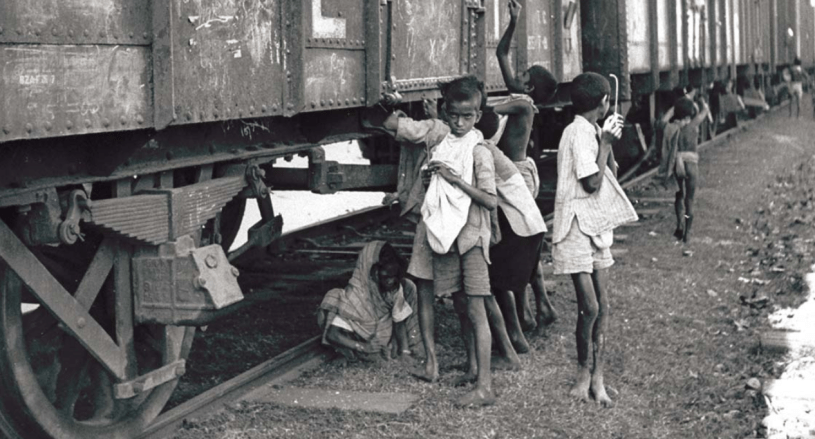
The last major famine in the British era occurred in 1943, which is also known as the Bengal Famine. The famine resulted in 2-3 million deaths (Devereux, 2000). Our SAD analysis identified 1937-1945 as a period under drought based on severity, area, and duration. However, we find the drought was most widespread during August and December 1941 (Table S2 and S3) – prior to the famine. This was the only famine that does not appear to be linked directly to soil moisture drought and crop failures (Fig. S13, S14).
The famine-affected region received 15, 3, 9, and 4% above normal precipitation during June, July, August, and September of 1943 (Fig. S13). We find that the Bengal famine was likely caused by other factors related at least in part to the ongoing Asian Theater of World War II including malaria, starvation and, malnutrition (Sen, 1976). In early 1943, military and political events adversely affected Bengal’s economy (Tauger, 2009), which was exacerbated by refugees from Burma (Maharatna, 1996). Additionally, wartime grain import restrictions imposed by the British government played a major role in the famine (FIC, 1945).
We note that aside from the 1943 Bengal Famine, all the other famines in the 1870-2016 appear to be related at least in part to widespread soil moisture drought.
Source: Drought and famine in India, 1870-2016, Vimal Mishra, Amar Deep Tiwari, Saran Aadhar, Reepal Shah, Mu Xiao2, D.S. Pai3, Dennis Lettenmaier, Research Gate
Comment by Michael Clark
The claims re Churchill and the Bengal famine are said to be based upon science. A study in the early 21st century has proven there was no drought in Bengal between 1942 and 1944 (Drought and Famine in India, 1870–2016. Vimal Mishra Jan 2019) . This goes on to thus claim that Churchill was to blame for the famine. Except common knowledge, historical records and data already prove a drought didn’t cause the famine. In 1942 a typhoon hit Bengal, it destroyed much of the rice crop. It also destroyed much of the road and rail networks. No it was not dry in 1942, we know that, it was very wet in fact. So wet that what little rice remained was infected by brown spot. Rice yields dropped dramatically. This had happened before, the British simply imported rice from Malaysia, Thailand and Burma.
Of course there was a slight problem in 1942 and 1943, it was called World War Two. Thus Malaysia, Thailand and Burma were invaded by the Japanese. So there was no rice to be had there. Did the British government ‘divert’ rice from Bengal, there is no evidence of this, was rice from Bengal used to feed Indian soldiers, many fighting a war on the Burmese border, yes, how else would they be feed, was rice exported from other parts of India , yes, it couldn’t be sent by land to Bengal and limited if any shipping, as discussed below was available. Was any significant amount transported to the UK, no, for all the same reasons listed below. The British Army bought grain, at higher prices than the local population, thus Indian authorities and merchants were prone not to inform any British officials of rice shortages.
Once informed, Churchill demonstrably sort all avenues to solve the problem. Australia had lots of rice. So could Churchill divert ships and food from Australia. Now remember WW2, the Bay of Bengal and the Indian Ocean was full of Japanese submarines, in fact their surface ships bombed Bengal itself. So could Churchill divert ships from Europe. Small problem, yes ww2 again. In 1942 /43 those pesky Germans were sinking over 500,000 tons of allied ships, each month, on occasions 800,000 tons. So Britain had no ships, certainly no free warships, so get the US to help. It is well documented Churchill asked several times for the US to provide warships to protect convoys from Australia. Every time Roosevelt refused, explaining he was actually using them to fight those equally pesky Japanese, remember them, remember ww2, it was in all the papers at the time.
Did Churchill ask the local administrators to do more, yes many times and that is very, very well documented. So did drought cause the Bengal famine, definitely no, did Churchill. So not the typhoon, no brown spot, not WW2, not the Japanese, not the Germans.

